Beer Machining Technology relies on Ingersoll tools, among others. The new addition is the Win Cut cutting system, a parting tool from the 3D printer. The result: higher cutting values and more economical production.
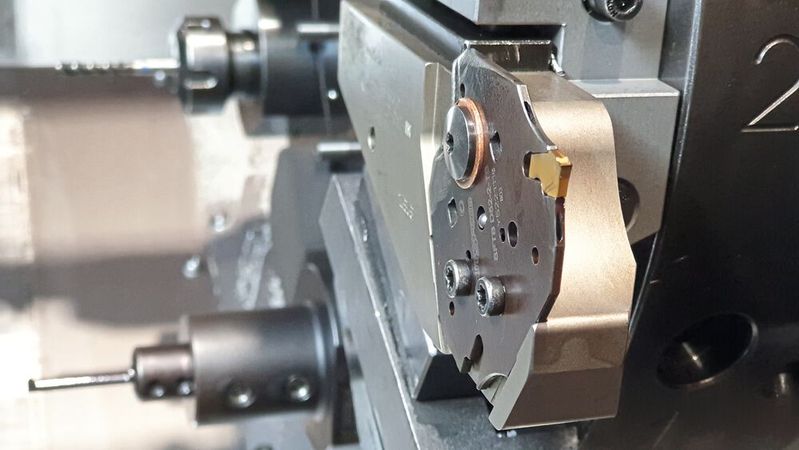
With its robust planar design of the blade holder and stable clamped blades, Win Cut impresses in Beer's manufacturing process.
(Image: Ingersoll)
Dipl.-Phys. Manfred Flohr is a freelance specialist journalist
Georg Beer's company was founded in 1995 as a secondary business, initially producing bolts and simple small turned parts for surrounding farmers. Gradually, craftsmen and small to medium-sized enterprises expanded the customer base. After starting in a garage, which was actually a former pigsty, the company picked up speed three years later with the first three-axis milling machine. The secondary business became the main business in 2003, and in 2013 a factory in Schmidgaden with two halls was finally put into operation.
Ten years later, it became too crowded there and Beer relocated to Schwarzenfeld, also located in the Upper Palatinate. On a large plot, the production area could be expanded from 2,000 square meters to 6,400 square meters. In the process, Beer also expanded his machinery, which now includes eight lathes and eleven milling machines, seven of which are 5-axis centers. Currently, 47 employees work in three shifts. The existing lathes are equipped with bar loaders or robots. Beer's goal is further automation of the company.
Today, Beer Machining manufactures machine parts. These are components for conveyor systems and agricultural machinery, turned and milled parts for gearboxes or work on housing and frame parts. Typical batch sizes are between 50 and 300 components, but orders of 20,000 pieces have also been executed. The processing of steel accounts for two thirds, the rest is predominantly stainless steel and some aluminium.
The requirements for the components have increased enormously in recent years.
In the past, when precise fits were required, they were looking at 3/100 mm. Today, we are in the micrometer range.
Georg Beer, Geschäftsführer Beer Zerspanungstechnik GmbH
In particular, form and positional tolerances are increasingly tight. What used to be able to be processed in two or three setups has to be done in a single one today to achieve this. The higher demands are also evident in the machine park, where the 5-axis centers are fully utilized.
The time for experiments is over
Udo Stangl, technical advisor at Ingersoll, has a special relationship with the company. When he started as a field representative for the tool manufacturer ten years ago, Beer was his first customer he was able to win over for Ingersoll. During those early days, a lot was still being experimented with, as Georg Beer reports. Today, the company strives to reduce its tool suppliers to just a few. The proportion of tools from Ingersoll has increased, which are now used in all areas for turning, drilling and milling. "This also makes it easier for our employees, who ultimately have to be familiar with the possible cutting values," Beer explains. Ingersoll supports this with on-site training.
For indexable insert drills, Beer has now completely switched to tools from the manufacturer from Haiger, with which good experiences have been made. "When an existing tool from another manufacturer fails, it is replaced with a new one from Ingersoll," says Georg Beer. For high-feed milling, the Gold S Feed from Ingersoll has proven to be the best after various tests in the company and is now used in the diameters 50 and 63 millimeters. Here, the demand of the contract manufacturer varies greatly and depends on series in which they are needed. "We have just machined 300 valve blocks, but don't know when the next order of this kind will come," says Beer. Last year less stainless steel was processed, but more steel instead. But this is just a snapshot.
High stability with soft cutting behavior
A consistently required machining step, on the other hand, is the parting off of turned parts, as Beer always turns from the bar. For this, Ingersoll has introduced its new Win Cut system, which Georg Beer was immediately impressed with: "This is a very good tool. I like the cutting behavior and the type of mounting of the Win-Cut grooving system. It's better than anything we've used before. With the triangular blade shape, the tool gets a high stability and thus a smoother, soft cutting behavior. This tool is more cutting-friendly."
Georg Beer's judgment is based on decades of experience and he looks back on the time when the behavior of a tool was judged by ear on open machines. "With today's encapsulated machines, I can't hear anything anymore, but when I observe how evenly the chips flow off, I can very well imagine what I would hear with an open machine." When parting off with the Ingersoll tool, there would hardly be anything to hear, at best a sharp quiet whistling. Harsh scraping noises only occur with incorrect parameters. "If the values are right and the correct settings have been chosen, however, it's like cutting through butter," Beer assures. The best experience in machining, in Beer's opinion, can be gathered on a conventional machine where turning is done by hand. Here the forces to be applied are directly noticeable and the chip flight is best observed. This is how knowledge is built up.
Stable construction and 3D printing
Thomas Kölbl, application technician at Ingersoll, gives details about the new tool: "In order to optimally support the plate and achieve the large parting depth of up to 120 millimeters at 2 or 3 millimeters parting width, without affecting another cutting edge, Win Cut works with a one-sided plate." For Georg Beer, this concept is very understandable. With previously used tools, he has found that the second cutting edge on a double-sided plate already shows some wear when it is changed. With the one-sided plate, more cost-effective production is possible.
Date: 08.12.2025
Naturally, we always handle your personal data responsibly. Any personal data we receive from you is processed in accordance with applicable data protection legislation. For detailed information please see our privacy policy.
Consent to the use of data for promotional purposes
I hereby consent to Vogel Communications Group GmbH & Co. KG, Max-Planck-Str. 7-9, 97082 Würzburg including any affiliated companies according to §§ 15 et seq. AktG (hereafter: Vogel Communications Group) using my e-mail address to send editorial newsletters. A list of all affiliated companies can be found here
Newsletter content may include all products and services of any companies mentioned above, including for example specialist journals and books, events and fairs as well as event-related products and services, print and digital media offers and services such as additional (editorial) newsletters, raffles, lead campaigns, market research both online and offline, specialist webportals and e-learning offers. In case my personal telephone number has also been collected, it may be used for offers of aforementioned products, for services of the companies mentioned above, and market research purposes.
Additionally, my consent also includes the processing of my email address and telephone number for data matching for marketing purposes with select advertising partners such as LinkedIn, Google, and Meta. For this, Vogel Communications Group may transmit said data in hashed form to the advertising partners who then use said data to determine whether I am also a member of the mentioned advertising partner portals. Vogel Communications Group uses this feature for the purposes of re-targeting (up-selling, cross-selling, and customer loyalty), generating so-called look-alike audiences for acquisition of new customers, and as basis for exclusion for on-going advertising campaigns. Further information can be found in section “data matching for marketing purposes”.
In case I access protected data on Internet portals of Vogel Communications Group including any affiliated companies according to §§ 15 et seq. AktG, I need to provide further data in order to register for the access to such content. In return for this free access to editorial content, my data may be used in accordance with this consent for the purposes stated here. This does not apply to data matching for marketing purposes.
Right of revocation
I understand that I can revoke my consent at will. My revocation does not change the lawfulness of data processing that was conducted based on my consent leading up to my revocation. One option to declare my revocation is to use the contact form found at https://contact.vogel.de. In case I no longer wish to receive certain newsletters, I have subscribed to, I can also click on the unsubscribe link included at the end of a newsletter. Further information regarding my right of revocation and the implementation of it as well as the consequences of my revocation can be found in the data protection declaration, section editorial newsletter.
The triangular blade is firmly screwed to the holder, giving it a very high stability. The plan contact ensures that lever actions, which can especially occur with swords with a larger projection length, are completely absorbed in the tool holder. The cutting inserts have a special clamping system over three contact surfaces at the lower step, which is more robust than a conventional self-clamping system, increasing the stability of the system. The efficient cooling of the Win-Cut grooving system was made possible by 3D printing. The cooling jet reaches the cutting edge from above and below via winding cooling channels inside, ensuring optimal chip control.
Beer is currently using the system with triangular swords in the diameters 52 and 82 millimeters with the SFC and SFJ cutting plates for different chip development. The soft cut is not only something for the ear, but also benefits productivity because it allows for higher cutting values. "With the same tool life, we were able to increase the standing quantity and thus save money compared to the previous tool," reports Georg Beer. "In the end, it's always about the economic aspect."



:quality(80)/p7i.vogel.de/wcms/53/f7/53f7dadbe4d656a3fd4f4077445f29f6/0129828707v1.jpeg "Thanks to its compact design and drilling/unscrewing function, the Fire Birdie is suitable for applications with limited installation space and frequent tool changes. (Image:Marcel Kraibühler)")
:quality(80)/p7i.vogel.de/wcms/da/4d/da4da8d34671dc6bce80e496212de877/0129850788v1.jpeg "Mate-XT Go supports the arms and shoulders during overhead work and repetitive tasks and is designed to significantly reduce muscle strain in everyday working life. (Image:Comau)")
:quality(80)/p7i.vogel.de/wcms/95/97/95976dbaac68b249eb65e74c5aad5300/0129651893v1.jpeg "The C2.0 centric clamps, the S2 fixed jaw clamps and the \"gredoc\" zero-point clamping systems are used for machining the raw parts. Fastening is carried out with width across flats 27. (Image:Gressel)")
:quality(80)/p7i.vogel.de/wcms/57/1b/571b8895efb299d70846bbdbd7af2338/0130043886v1.jpeg "Servo hydraulics independent of the control system: The servo hydraulics software module is integrated directly into the b Maxx 5500 servo drive (pictured: Mehmet Sari, Export Sales Manager at Hürsan Pres (left), Özgür Deniz Demirbaş, Country Manager at Baumüller Turkey) (Image:Baumüller)")
:quality(80)/p7i.vogel.de/wcms/3b/27/3b27f6c5848be73acecb04054bf0a146/0130115209v1.jpeg "Spectroscopic glucose measurement with infrared spectroscopy enables more regular measurements without physical strain. (Image:Endrich)")
:quality(80)/p7i.vogel.de/wcms/3f/cc/3fccb748b0fe16f1f61249d94c72f126/0130149439v1.jpeg "Requirements for integrated power supply systems: Precise AC and DC power supply systems that not only provide energy, but also reliably combine measurement, analysis and system integration. (Image:Schulz Electronic)")
:quality(80)/p7i.vogel.de/wcms/fd/93/fd93e01c16f5a4709278499d981a459c/0130061090v1.jpeg "Revealed: These servo drives are assembled at Aerotech in Fürth. (Image:Aerotech)")
:quality(80)/p7i.vogel.de/wcms/cb/8a/cb8ae7f5205365efce3e7285154fc3cf/0130132198v1.jpeg "Markus Huber (left) and Nicolai Friis from TU Wien know how to make quantum computers multidimensional in order to perform computing operations even better. (Image:TU Vienna / A. Rommel)")
:quality(80)/p7i.vogel.de/wcms/63/21/6321beb732bf7d92640df46d7aa77573/0130125122v1.jpeg "As part of the Carbon Lab Factory Lausitz, a pilot plant for the production of sustainable, cost-effective and competitive carbon fibers will be built at the Guben site. (Image:Fraunhofer IAP / Kristin Stein)")
:quality(80)/p7i.vogel.de/wcms/53/4f/534fe0f168f6ee070ded4a48faca4cef/business-wire-main-image-1103x620v1.jpeg "The new UR AI Trainer, developed by Universal Robots and Scale AI, is the first direct lab-to-factory solution for AI model training.
(Source: Universal Robots)")
:quality(80)/p7i.vogel.de/wcms/08/70/087062e2e1a9b9add5777410dd746ee9/adobestock-1923991605-5607x3156v1v1.jpeg "A new type of tactile sensor, inspired by human skin, even recognizes grains of sand. (Image:Curioso.Photography - stock.adobe.com)")
:quality(80)/p7i.vogel.de/wcms/7f/08/7f087d7013424d123ab7275cd2e3fe55/adobestock-809456218--c2-a9-20degimages-20-e2-80-93-20stock-adobe-com-ki-generiert-4179x2351v1v1.jpeg "The digital upgrading of existing machines conserves resources, saves energy and reduces the need for new production. (Image:Degimages - stock.adobe.com/AI-generated)")
:quality(80)/p7i.vogel.de/wcms/90/db/90db3087d3af0560fcdb4dbc42443ce1/0130157448v1.jpeg "The switch to SDV is the most complex transformation the industry has ever had to master. The end consumer gets a vehicle that gains rather than loses value over its lifetime. (Image:Sonatus)")
:quality(80)/p7i.vogel.de/wcms/73/f0/73f00bb99a23197db05bb584fe78f20f/0130080581v1.jpeg "The \"China Speed\" analysis by Roland Berger shows that the speed of development has only a limited connection with labor costs. (Image:freely licensed at Pexels)")
:quality(80)/p7i.vogel.de/wcms/2f/5b/2f5ba6a150b52c2b8efada560c5cdafe/0130143442v1.jpeg "Automotive suppliers are facing a severe crisis, which is primarily due to a combination of structural change and economic problems. (Image:freely licensed at Pexels)")
:quality(80)/p7i.vogel.de/wcms/22/d0/22d03cd48e992435338b59464c428d41/0129739814v1.jpeg "More electric vehicles on the roads mean a higher demand for electricity - which should ideally be covered by renewable energies. (Image:BMW)")
:quality(80)/p7i.vogel.de/wcms/94/7a/947ac066b98cbcd3470e83ff9da3e25f/0130096114v1.jpeg "The use of amorphous steels in the stator enables a significant reduction in losses and increases the efficiency of modern electric motors in vehicle drives. (Image:Horse Powertrain)")
:quality(80)/p7i.vogel.de/wcms/e5/f1/e5f171d3d7ae021332cc0aeae4d6e299/0130127049v1.jpeg "In collaboration with Shanghai Jiao Tong University, Lenovo has presented a silicon anode battery under the name \"ED1000\" as a proof of concept for mobile workstations. (Image:Lenovo)")
:quality(80)/p7i.vogel.de/wcms/fa/69/fa696e59706b96fff02283dd74cc2398/0130129635v1.jpeg "Samsung Co-CEO Jun Young-hyun wants to respond to the AI-driven boom in demand in the memory market with contracts for up to five years. This should provide more planning security in the traditionally volatile storage business. At the same time, however, this is likely to increase the pressure on customers to secure precise long-term requirements, prices and supply chains. (Image:Samsung)")
:quality(80)/p7i.vogel.de/wcms/31/a8/31a883a47b86634c382923e78fd9a4c9/0130133225v1.jpeg "Figure 1: GMSL-capable point-to-point connection. (Image:ADI)")
:fill(fff,0)/p7i.vogel.de/companies/69/88/69882c428938e/tmts2026-ticec-banner-en-2000px.png "tmts2026-ticec-banner-en-2000px (https://www.tmts.tw/en)")
:fill(fff,0)/p7i.vogel.de/companies/67/eb/67eba621ef6ea/logo2.png "logo2 (Wuxi InfiMotion)")
:quality(80)/p7i.vogel.de/wcms/61/af/61afe7663150b993ae90614a9ead8b4e/0118063002.jpeg "View into the production of Beer Machining Technology. A total hall area of 6,400 square meters is available.(Image: Ingersoll)")
:quality(80)/p7i.vogel.de/wcms/d5/9d/d59d8970aeee26d01cad414b62877d9f/0118063062.jpeg "During on-site visits by Ingersoll technicians, component optimization is usually the focus (from left): Morina Albion (Machine operator Beer Machining Technology), Thomas Kölbl (Application technician Ingersoll) Georg Beer (Managing Director Beer Machining Technology) and Udo Stangl (Technical consultant Ingersoll).(Image: Ingersoll)")
:quality(80)/p7i.vogel.de/wcms/f3/cb/f3cb7e80ce5488810085dbf6a5902679/0118062970.jpeg "At Beer Machining Technology, turned parts are always produced from the bar. Accordingly, a parting off tool is frequently in demand.(Image: Ingersoll)")
:quality(80)/p7i.vogel.de/wcms/40/3a/403aa869fd9b8076aa5eaba7f39a236a/0118063073.jpeg "At Beer, the tolerances of the required components are increasingly in the µ range.(Image: Ingersoll)")
:quality(80)/p7i.vogel.de/wcms/81/1a/811a8115760f095ec9f4e06844f92e51/0123844452v1.jpeg "Long drill chips not only filled the chip bins quickly but also affected process reliability. (Image:Ingersoll Werkzeuge GmbH)")
:quality(80)/p7i.vogel.de/wcms/0c/58/0c587c8221ae96052b5dcc0f40eb3dcd/0128880879v1.jpeg "A chip surfer with a solid carbide head is used for finishing in the third operation. (Image:Ingersoll)")