In Finnentrop, Germany, Wilhelm Drexelius GmbH & Co. KG manufactures around 2.8 million precision turned parts per year. Turning, drilling, and parting off are machining processes that run continuously here, and with Ingersoll tools, even more is being achieved.
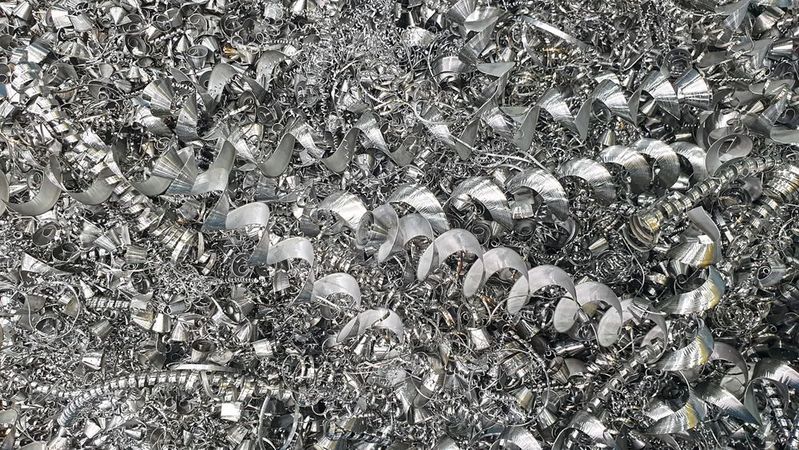
Long drill chips not only filled the chip bins quickly but also affected process reliability.
(Image: Ingersoll Werkzeuge GmbH)
The company was founded in 1965 by Wilhelm Drexelius in a barn and was later continued by his two sons. Due to a lack of succession, the current managing directors Björn Hering and Thomas Gutstein were able to take over the company in 2008. Both are trained turners without a commercial background, which Björn Hering does not see as a disadvantage:
In the end, it is most important to know what is happening in production. Being able to operate a machine is more important than the numbers. That’s what you have your people for, and you also get a feel for it over the years.
Björn Hering, Managing Director, Wilhelm Drexelius GmbH & Co. KG
Hering was the first apprentice in the company and is now the boss of his former trainer.
Drexelius currently has a total of 35 employees. For many years, the two managing directors themselves worked in production. Meanwhile, Hering now works almost exclusively in the office, due to the company's growth. Gutstein divides his time between production and office work. The turning shop has 21 machines available on a production area of 2,100 square meters (approx. 2511 sq yd), mostly from the manufacturer Nakamura. All are equipped with a main spindle, counter spindle, and Y-axis and have two or three turrets. This equipment enables Drexelius to complete the machining of all components on one machine. Bar parts with diameters ranging from 8 to 100 millimeters (approx. 0,3 to 3,9 inches) are manufactured, and the machines are consistently equipped with bar feeders.
Typical batch sizes range between 100 and 10,000 pieces, with the manufacturer ensuring that a certain portion of large series is always running.
If we were to produce only 100 parts on each of the 21 machines, we would not keep up with programming and setup.
Björn Hering, Managing Director, Wilhelm Drexelius GmbH & Co. KG
In the past, the company was also strongly represented in the production of prototypes and sample parts. Drexelius gradually moved away from this as it became increasingly difficult to manage the growing organizational effort for quality assurance, test reports, and documentation. Economically, this was no longer feasible, according to the company.
A focus on the processed materials is on stainless steels, but parts from other steels, such as free-cutting, case-hardening, and construction steels, as well as aluminum alloys, are also manufactured in Finnentrop.
"For a hair salon, we once even turned wooden curlers," reports Thomas Gutstein with a smile. Drexelius has a wide customer base. A large share includes sanitary and fittings manufacturers, but the fields of agriculture, measurement and control technology, mechanical engineering, and medical technology are also supplied.
The automotive industry was consciously avoided. However, there was an exception in 2021 when Drexelius took over an order from another turning shop that had problems manufacturing a stainless steel turned part for an engine in the required quality and quantities. However, even at Drexelius, things did not run smoothly with the existing tools initially. The service life of the plates initially used left something to be desired, the surface quality was not satisfactory, and burr formation appeared on the turned part.
Seeking help, they turned to Ingersoll and promptly received a solution. With the DCMT 11T308 MT TT8020 indexable insert from the tool manufacturer's portfolio in Haiger, the user immediately achieved the desired quality and productivity. "These plates work," was the feedback from production. Because they were very satisfied with the cutting inserts, they were subsequently used repeatedly as problem solvers, and gradually more tools from Ingersoll were adopted into production, including threading inserts, drills, and parting tools.
"The use of new tools stands and falls with acceptance by employees," says Björn Hering. However, the suggestion to try out more products from Ingersoll came from the staff, who were very impressed with the smooth operation of the Ingersoll tools. The employees' desire to have the best tools available on the market aligns well with the management's focus on the economic aspect. If tools do not work well, there is often high wear on plates or the required surface quality cannot be achieved reliably. Disruption in operations also occurs when employees constantly have to try out new parameters to achieve moderately satisfactory results.
Long chips during drilling
During a plant visit, Kevin Richstein, a technical consultant at Ingersoll, took a close look at the containers near the machines and discovered very long spiral drill chips. They occur when drilling long-chipping materials such as S355 or C15 and had long been a thorn in the side of Drexelius. The fact that employees have to empty the chip buckets every half hour is the smaller problem. Long tangled chips also affect process security, can cause problems during transfer, or scratch components. Richstein's analysis: "Ingersoll can handle this better!"
Date: 08.12.2025
Naturally, we always handle your personal data responsibly. Any personal data we receive from you is processed in accordance with applicable data protection legislation. For detailed information please see our privacy policy.
Consent to the use of data for promotional purposes
I hereby consent to Vogel Communications Group GmbH & Co. KG, Max-Planck-Str. 7-9, 97082 Würzburg including any affiliated companies according to §§ 15 et seq. AktG (hereafter: Vogel Communications Group) using my e-mail address to send editorial newsletters. A list of all affiliated companies can be found here
Newsletter content may include all products and services of any companies mentioned above, including for example specialist journals and books, events and fairs as well as event-related products and services, print and digital media offers and services such as additional (editorial) newsletters, raffles, lead campaigns, market research both online and offline, specialist webportals and e-learning offers. In case my personal telephone number has also been collected, it may be used for offers of aforementioned products, for services of the companies mentioned above, and market research purposes.
Additionally, my consent also includes the processing of my email address and telephone number for data matching for marketing purposes with select advertising partners such as LinkedIn, Google, and Meta. For this, Vogel Communications Group may transmit said data in hashed form to the advertising partners who then use said data to determine whether I am also a member of the mentioned advertising partner portals. Vogel Communications Group uses this feature for the purposes of re-targeting (up-selling, cross-selling, and customer loyalty), generating so-called look-alike audiences for acquisition of new customers, and as basis for exclusion for on-going advertising campaigns. Further information can be found in section “data matching for marketing purposes”.
In case I access protected data on Internet portals of Vogel Communications Group including any affiliated companies according to §§ 15 et seq. AktG, I need to provide further data in order to register for the access to such content. In return for this free access to editorial content, my data may be used in accordance with this consent for the purposes stated here. This does not apply to data matching for marketing purposes.
Right of revocation
I understand that I can revoke my consent at will. My revocation does not change the lawfulness of data processing that was conducted based on my consent leading up to my revocation. One option to declare my revocation is to use the contact form found at https://contact.vogel.de. In case I no longer wish to receive certain newsletters, I have subscribed to, I can also click on the unsubscribe link included at the end of a newsletter. Further information regarding my right of revocation and the implementation of it as well as the consequences of my revocation can be found in the data protection declaration, section editorial newsletter.
With the Quad Twist, he introduced an indexable insert drill for the large diameters required at Drexelius. The drill is a cassette tool that not only realizes the currently needed diameter of 63 millimeters (approx. 2,4 inches), but can also be adjusted in the range of 61 to 65 millimeters (approx. 2,4 to 2,6 inches). This gives the user flexibility and the ability to perform other drillings if needed without having to purchase a new tool. An initial test with standard indexable inserts did not yield the desired result, as the machines at Drexelius proved not strong enough and therefore could not be operated in the optimal performance range. However, Ingersoll was able to make improvements and introduced the PS variant of their cutting insert, which is equipped with a special chip former. This indeed made the Quad Twist a problem solver and impressed the setters with excellent chip breaking and long service life.
Stable and fast parting-off
Once the chip problem with drilling was solved, Kevin Richstein became aware of another challenge: parting off components. Especially with large diameters, there were recurrent issues with consistency. The closer the parting tool got to the center, the more difficult it was to work cleanly. Richstein provided Drexelius with the Win Cut parting system from Ingersoll. It was immediately tested in production with a problematic part, a cap made from S355 structural steel, which needed to be parted off from a diameter of 90 millimeters (approx. 3,5 inches) to zero. Positive feedback was promptly given to the tool manufacturer, as Thomas Gutstein reports:
The Win-Cut system has convinced us with its high stability and reliability. The components are now parted off perfectly straight. On top of that, we can run higher cutting values with it.
Thomas Gutstein, Managing Director, Wilhelm Drexelius GmbH & Co. KG
The gain in speed is considerable. For example, with the cap, the machining time was halved from 40 to 20 seconds. The Win-Cut system is completely different in design from a conventional parting blade, as previously used at Drexelius. While a standard blade is generally only clamped, here the triangular cutting insert is firmly screwed to the holder and cannot be pushed away. The efficient cooling of the parting system was made possible by 3D printing. Through winding cooling channels inside, the cooling jet reaches the cutting edge from above and below, ensuring optimal chip control and longer service life.
Drexelius has acquired the system in two sizes for diameters up to 80 and 120 millimeters (approx. 3,1 and 4,7 inches). With the exception of very small components, it is now used for all parting operations. Depending on the application, workers use cutting inserts in the SFJ3 or SFC3 versions, which are equipped with different chip formers. In Finnentrop, they are very satisfied with the service from Ingersoll, particularly highlighting the quick response times.
*Manfred Flohr is a freelance author
Future-Proof Authentication with Universal RFID Readers



:quality(80)/p7i.vogel.de/wcms/93/33/93337b12f88eb2c776c80d4f9e49d323/0129247650v1.jpeg "Isolated IoT data becomes connected real-time personalization. (Image: ©PB Studio Photo - stock.adobe.com)")
:quality(80)/p7i.vogel.de/wcms/8e/fa/8efad6aa006fcf624d07c645b774d8ce/screenshot-202026-01-21-20113324-764x430v1v1.png "The system processes heavy sheets weighing up to 200 kg fully automatically, without programming or teaching. (Image:Teqram)")
:quality(80)/p7i.vogel.de/wcms/0c/58/0c587c8221ae96052b5dcc0f40eb3dcd/0128880879v1.jpeg "A chip surfer with a solid carbide head is used for finishing in the third operation. (Image:Ingersoll)")
:quality(80)/p7i.vogel.de/wcms/a2/9b/a29bb02b3f1e34962e28579dccfbbc49/0129266114v1.jpeg "Bevel gears on workpiece carriers in the rotary indexing conveyor of the VSC 400 DDS - the pick-up spindle removes the workpiece precisely and reproducibly for hard machining at EWS. (Image:Emag)")
:quality(80)/p7i.vogel.de/wcms/4d/74/4d745446555110ca9797db1eabb7c9d3/0129551585v1.jpeg "Jochen Gemeinhardt is responsible for NTT Data's AI business in the DACH region as Head of Production & Supply Chain and Head of Industry Line Global Business. (Image:NTT Data)")
:quality(80)/p7i.vogel.de/wcms/7a/c8/7ac81c41bab1cc98fbe7b20c95644c6c/0129575667v1.jpeg "For the live gala show celebrating the New Year festival, Unitree rehearsed an impressive performance with its robots. (Image:Unitree/YouTube)")
:quality(80)/p7i.vogel.de/wcms/a3/0c/a30c4c3a36910e92d6082fde37261730/0129555015v1.jpeg "From command recipient to decision-maker: thanks to Agentic AI, robots no longer just stubbornly execute pre-programmed scripts. Instead, they analyze visual data in real time and decide autonomously on the next process step (Image:Nano Banana / AI-generated)")
:quality(80)/p7i.vogel.de/wcms/60/00/6000deb595c3e6b2dd0bfe508aa71653/newsimage418166-5084x2861v1v1.jpeg "The robot-guided friction stir welding gun \"Steppwelder\" in use on a conventional 6-axis industrial robot. (Image:Image: Dominik Walz, MPA, University of Stuttgart)")
:quality(80)/p7i.vogel.de/wcms/48/38/4838074eab3f29ec319797fb63881b18/adobestock-693942839--c2-a9-20wirot-20-e2-80-93-20stock-adobe-com-3389x1907v1v1.jpeg "Leaves or bird droppings can cause hotspots on solar modules and reduce performance. (Image:Wirot stock.adobe.com.)")
:quality(80)/p7i.vogel.de/wcms/3f/7f/3f7f9f45ebccd4751d41106866314aea/newsimage418028-2772x1559v1v1.jpeg "Live in the ice channel—detailed recordings in real time make the smallest mistakes and thus time losses in the luge run visible. (Image:Mittweida University of Applied Sciences)")
:quality(80)/p7i.vogel.de/wcms/05/b7/05b7c58dcf5a7fc900348d1c30f7c116/0129540459v1.jpeg "Researchers from Stuttgart have investigated whether the \"technology\" behind hairy elephant trunks, which function as a sensitive gripping system, can also be used in robotics. (Image:Zoo Magic)")
:quality(80)/p7i.vogel.de/wcms/6b/6f/6b6fff754fedf05375e5255460743297/0129197850v1.jpeg "A new core-shell design for anodes aims to reduce storage losses during the first charge cycle of sodium-ion batteries. (Image:BAM)")
:quality(80)/p7i.vogel.de/wcms/37/23/372374e00db2f1803ae5cde2f00aff31/0129599814v1.jpeg "The new Euro 7 standard sets requirements for the wear of service brakes. These can be met with some technical methods. (Image:Aumovio)")
:quality(80)/p7i.vogel.de/wcms/0c/1d/0c1da1d70af62238b11e22b102bd256d/0129108406v1.jpeg "At the first ADAC glare symposium, experts illustrated and analyzed the topic of glare under real conditions. (Image:Dominsky – VCG)")
:quality(80)/p7i.vogel.de/wcms/95/00/95009ae2972690e3fdab0dc701e202c3/0129621847v1.jpeg "Last year, Airbus's revenue increased by six percent to 81 billion US dollars. (Image:Airbus SAS 2024)")
:quality(80)/p7i.vogel.de/wcms/ae/cf/aecf874a057676aa69b3b5e4c7b52411/0129609464v1.jpeg "Glass storage in action: Microsoft has stored map data from the Flight Simulator on this piece of glass. (Image:Microsoft Research)")
:quality(80)/p7i.vogel.de/wcms/2c/8d/2c8da4b72e35ded278178929afb94d55/0129561713v1.jpeg "Change in direction: The shift away from PFAS in semiconductor manufacturing and the move toward sustainable chip production is demonstrated by the trilateral collaboration between Fraunhofer ENAS, the Paul Scherrer Institute PSI, and Memsstar Limited, which rely on the environmentally friendly Gas-MacEtch technology. (Image:andreyarmyagov/Canva)")
:quality(80)/p7i.vogel.de/wcms/a3/df/a3df18dc04ecd4cffbf933b32018facb/0129644484v1.jpeg "Acquisition complete: Finnish Incap has finalized the takeover of EMS manufacturer Lacon. (Image:Gerd Altmann from Pixabay)")
:quality(80)/p7i.vogel.de/wcms/41/85/41855b7e5c57936c33039a7e785462c9/0129633555v1.jpeg "A chip processing method developed by MIT could help cryptographic processes keep data secure by allowing two chips within the same system to authenticate each other using a common fingerprint. (Image:freely licensed)")
:fill(fff,0)/images.vogel.de/vogelonline/companyimg/76800/76895/65.jpg "FAULHABER_120mm.jpg ()")
:fill(fff,0)/p7i.vogel.de/companies/67/eb/67eba621ef6ea/logo2.png "logo2 (Wuxi InfiMotion)")
:quality(80)/p7i.vogel.de/wcms/8a/9c/8a9c3815a932d9e8e0cf208b1c1aafc9/0123844760v1.jpeg "On a production area of 2,100 square meters (approx. 2511 sq yd), Drexelius in Sauerland operates 21 lathes.(Image: Ingersoll Werkzeuge GmbH)")
:quality(80)/p7i.vogel.de/wcms/6a/77/6a77331c49125420513faa74ca249a21/0123846518v1.jpeg "Ingersoll's Win Cut parting system has convinced the setup operators at Drexelius with its solid stability, allowing for higher cutting values.(Image: Ingersoll Werkzeuge GmbH)")
:quality(80)/p7i.vogel.de/wcms/92/69/9269b7f00ef1c13acbf504dc56987f7c/0123846535v1.jpeg "A small selection of the turned parts manufactured at Drexelius in Finnentrop.(Image: Drexelius)")
:quality(80)/p7i.vogel.de/wcms/35/a7/35a7984739dd173ad8d3cf7cd8e2b313/0123846532v1.jpeg "Were able to optimize various processes together (from left): Tim Schiller (Drexelius setup operator), Alexander Wolf (Drexelius production manager), Björn Hering (Drexelius managing director), and Kevin Richstein (Ingersoll technical consultant).(Image: Ingersoll Werkzeuge GmbH)")
:quality(80):fill(efefef,0)/p7i.vogel.de/wcms/67/ae/67ae0b9ac31f8/elatec-wp-universal-reader.png "Elatec WP Universal Reader")
:quality(80)/p7i.vogel.de/wcms/7c/a8/7ca82c84c2e4dd3a2fe833bb8ba49f44/0125664600v1.jpeg "On a DMG CMX 1100 V, multiple components are processed sequentially. High process reliability is essential. (Image:Ingersoll)")
:quality(80)/p7i.vogel.de/wcms/55/c5/55c56781dc11e7113fcaa2e0b53e5d04/0125002081v1.jpeg "The tests showed that standard tools from Iscar, such as the \"LOGIQ6TURN,\" work excellently in lead-free material. (Image:Iscar)")