With the emergence of new vehicle architectures, such as satellite architecture, the sensor and processing technology of these systems must also be further developed to support the new capabilities. The following article shows what challenges this entails and how they can be overcome.
New vehicle architectures are essential for the mobility of the future.
(Image: paul_craft - stock.adobe.com)
Manshul Arora is a Product Marketing Engineer at Texas Instruments.
The globally applied New Car Assessment Program (NCAP) is increasingly working towards the introduction of active safety features with its increasingly stringent safety ratings and regulations. This makes safety a non-negotiable feature of modern motor vehicles. Automobile manufacturers around the world meet these safety requirements and aim for higher levels of autonomy by continuously improving the features of Advanced Driver Assistance Systems (ADAS) in their vehicles. Examples include the emergency brake assistant, speed and distance control, and advanced lane keeping assistants. To support these features and fulfill current safety regulations, an increasing number of radar sensors are being installed in modern cars.
Further development of vehicle architectures
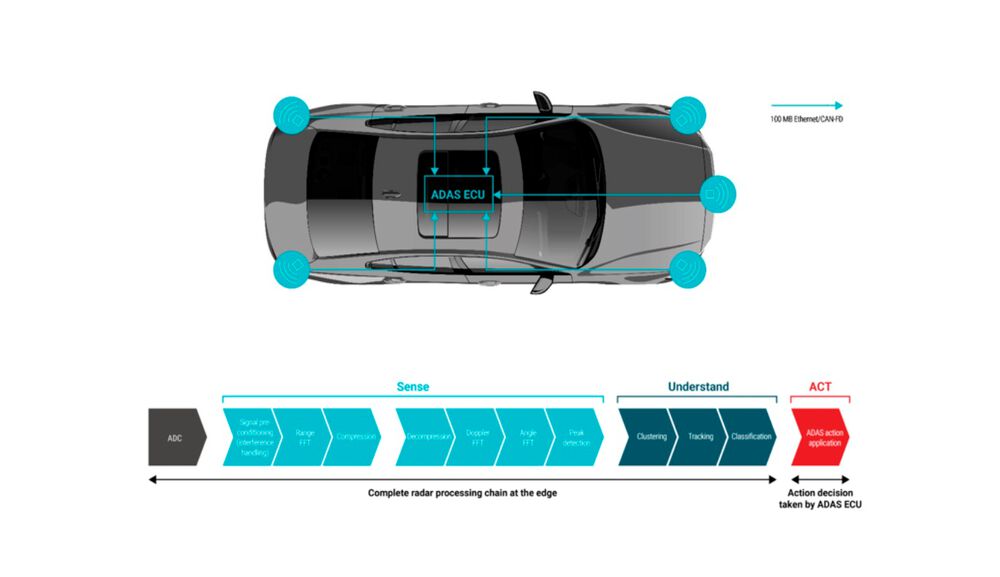
To account for the implementation of ADAS functions in the design of automotive systems, the structure and integration of electrical and electronic system architectures are approached, among other things. The edge architecture is common today. This consists of highly intelligent radar sensors that stream preprocessed data over a CAN network or via Ethernet at 100 Mbit/s to an ADAS ECU. The high-performance sensors contain a processor and are often even equipped with a special accelerator for distance measurement, as well as Doppler and FFT processing (Fast Fourier Transform). Additionally, they include the corresponding algorithms for detection, classification, and tracking of objects. The final object data from each edge radar sensor is then transmitted to the ADAS control unit. Image 1 illustrates this architecture.
Gallery
Image 1. In an edge architecture, the radar sensors are connected to a central ADAS control unit.
(Image:Texas Instruments)
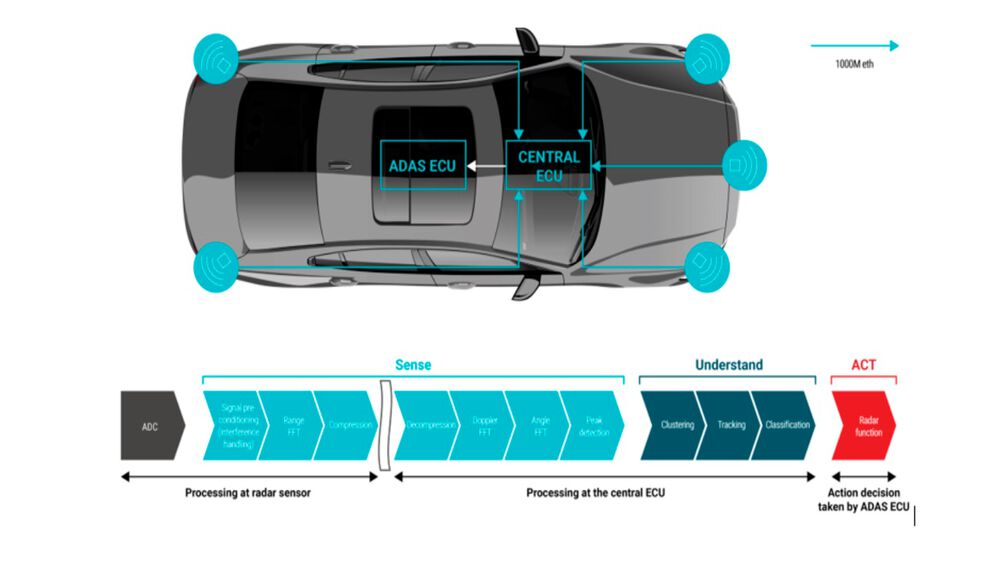
The edge architecture is being further developed and is increasingly giving way to new satellite architectures where the sensor heads distributed throughout the vehicle transmit preprocessed distance FFT data to a powerful central control unit via a fast Ethernet line supporting 1 Gbit/s. A significant portion of the data processing is outsourced to the central control unit (Image 2). In contrast to edge architectures, where individual radar sensors handle the entire data processing on their own, satellite architectures allow the processing of data that has previously only been minimally prepared by the central processor.
Image 2. Connection of the radar sensors to the central ECU in a satellite architecture
(Image:Texas Instruments)
Advantages of satellite architectures
Centralized data processing allows for the implementation of more effective sensor fusion algorithms, enabling more accurate decisions. This can be compared to the processes in the human brain, which makes decisions with information from, for example, the eyes, rather than allowing the eyes to make these decisions independently. Automakers have the option to implement algorithms to improve angular resolution (Distributed Aperture Radar) or to increase maximum speed, or even machine learning algorithms for object classification. The merging of sensor information, together with these algorithms, results in more powerful sensing and comparatively precise perception, which pays off for OEMs through increased autonomy, while vehicle occupants benefit from increased safety.
The use of satellite radar sensors also benefits the scalability and modularity of the systems. If there is the possibility to place the sensors throughout the vehicle at more appropriate locations, the way is open for a multitude of ADAS applications. To adjust the coverage, for example, one can simply vary the number or configuration of sensors. This allows the same platform to be scaled from low-cost, low-end vehicles to high-quality, premium models and designed for different levels of autonomy.
Sensor fusion algorithms and the higher computing power of the central control unit give satellite architectures added value. The simpler satellite sensors and customization via software can also help to reduce system complexity and increase safety levels. The higher performance, increased scalability, and reduced complexity are collectively instrumental in the automotive industry increasingly relying on satellite architectures.
Radar sensor specifically for satellite architectures
Texas Instruments has developed the radar-on-chip sensor AWR2544 specifically for satellite architectures. The component contains an integrated 77 GHz transceiver with four transmitters and four receivers, which benefits distance measurement and increases performance. Also integrated are a radar processing accelerator and a 1 Gbit/s Ethernet interface for generating and streaming compressed distance FFT data. The sensor is suitable for ASIL B and sets up a secure processing environment with its built-in hardware security module.
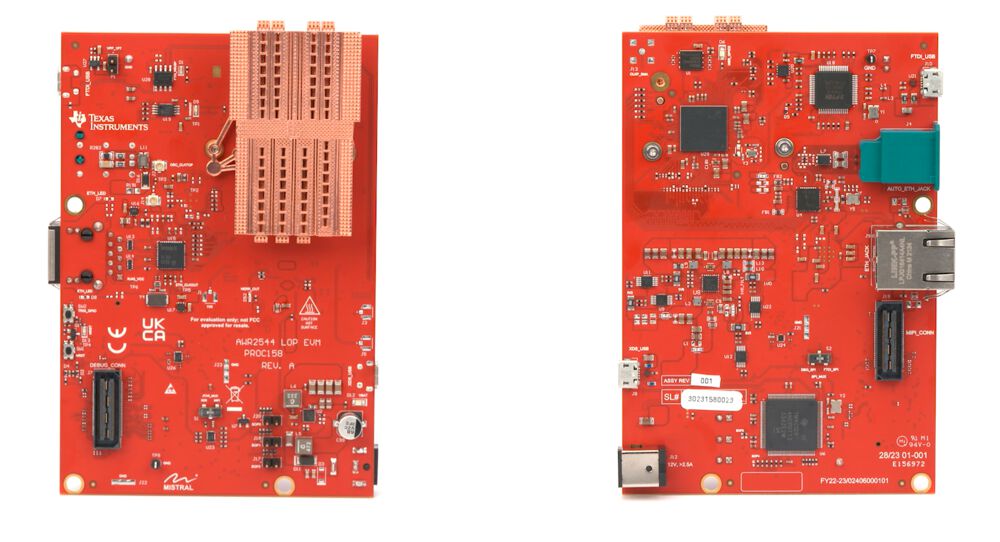
Furthermore, the TI Launch-On-Package technology (LOP) is used in this device. This allows for direct signal transmission from the device's radiating element to the 3D antenna via a waveguide integrated into the circuit board. In Image 3, you can see the evaluation module of the AWR2544LOP with the 3D waveguide antenna.
Image 3. View of the AWR2544LOP EVM
(Image:Texas Instruments)
At the system level, the LOP technology results in increased performance due to the improved signal-to-noise ratio, simpler thermal management, and lower costs because expensive circuit board material can be avoided. In addition, there is a gain in flexibility because the same circuit board can be used for multiple sensor designs.
Date: 08.12.2025
Naturally, we always handle your personal data responsibly. Any personal data we receive from you is processed in accordance with applicable data protection legislation. For detailed information please see our privacy policy.
Consent to the use of data for promotional purposes
I hereby consent to Vogel Communications Group GmbH & Co. KG, Max-Planck-Str. 7-9, 97082 Würzburg including any affiliated companies according to §§ 15 et seq. AktG (hereafter: Vogel Communications Group) using my e-mail address to send editorial newsletters. A list of all affiliated companies can be found here
Newsletter content may include all products and services of any companies mentioned above, including for example specialist journals and books, events and fairs as well as event-related products and services, print and digital media offers and services such as additional (editorial) newsletters, raffles, lead campaigns, market research both online and offline, specialist webportals and e-learning offers. In case my personal telephone number has also been collected, it may be used for offers of aforementioned products, for services of the companies mentioned above, and market research purposes.
Additionally, my consent also includes the processing of my email address and telephone number for data matching for marketing purposes with select advertising partners such as LinkedIn, Google, and Meta. For this, Vogel Communications Group may transmit said data in hashed form to the advertising partners who then use said data to determine whether I am also a member of the mentioned advertising partner portals. Vogel Communications Group uses this feature for the purposes of re-targeting (up-selling, cross-selling, and customer loyalty), generating so-called look-alike audiences for acquisition of new customers, and as basis for exclusion for on-going advertising campaigns. Further information can be found in section “data matching for marketing purposes”.
In case I access protected data on Internet portals of Vogel Communications Group including any affiliated companies according to §§ 15 et seq. AktG, I need to provide further data in order to register for the access to such content. In return for this free access to editorial content, my data may be used in accordance with this consent for the purposes stated here. This does not apply to data matching for marketing purposes.
Right of revocation
I understand that I can revoke my consent at will. My revocation does not change the lawfulness of data processing that was conducted based on my consent leading up to my revocation. One option to declare my revocation is to use the contact form found at https://contact.vogel.de. In case I no longer wish to receive certain newsletters, I have subscribed to, I can also click on the unsubscribe link included at the end of a newsletter. Further information regarding my right of revocation and the implementation of it as well as the consequences of my revocation can be found in the data protection declaration, section editorial newsletter.
To simplify system implementation, there is also a compatible power management circuit with improved functional safety and optimization. The LP87725-Q1 type component includes two low-noise buck converters, a low-dropout regulator, a load switch for supplying a AWR2544-based satellite architecture, and an Ethernet PHY.
Conclusion
ADAS applications are continuously being developed in order to keep up with the constantly increasing levels of autonomy and safety requirements. With the advent of new architectures, including satellite architecture, the sensor and processing technology of these systems must also be further developed to support the new capabilities. Components like the AWR2544 radar sensor provide the necessary flexibility when implementing the mentioned trends in system design, and thus help in the realization of safer and smarter vehicles. (se)



:quality(80)/p7i.vogel.de/wcms/f9/7d/f97deef8fde21c8630d76411b18a20a7/0129803665v1.jpeg "Skoda has invested well over 220 million US dollars in the high-tech battery plant that has now opened in Mlada Boleslav. It has now started its work, which is highly automated ... (Image:Skoda)")
:quality(80)/p7i.vogel.de/wcms/f5/61/f561ad7c72ed41fd7a67ad9c481cb15d/0129799343v1.jpeg "Engine-generator units (MGU) from Steyr Motors are at work in the Leopard 2 main battle tank and the Leguan bridge vehicle (pictured). An extended contract is now to secure at least 500 more systems of this type for the Bundeswehr ... (Image:German Armed Forces)")
:quality(80)/p7i.vogel.de/wcms/6c/b5/6cb5ce2155433f6e73b16399adc4c561/0113143253v1.jpeg "In our China Market Insider we regularly provide you with relevant information directly from China. (Image:© Eisenhans - stock.adobe.com)")
:quality(80)/p7i.vogel.de/wcms/7f/fd/7ffd32863352c40f562f4245e4766e61/0129745849v1.jpeg "After US President Donald Trump once again resorted to his favorite weapon, tariffs, concerns rose in the EU that the so-called tariff deal could become invalid. But it looks as if the sea remains relatively calm ... (Image:F. Schneidler)")
:quality(80)/p7i.vogel.de/wcms/9c/ac/9cac6246660e746c5a3989399ac4d250/0128561645v1.jpeg "Artificial intelligence can drive efficiency in smart factories through centralized data management and predictive maintenance. (Picture: ©Fardived - stock.adobe.com)")
:quality(80)/p7i.vogel.de/wcms/6b/e2/6be235b5ad8a442ccd9d164b0b300d8b/0129763992v1.jpeg "As early as 2020, the Zimmer Group announced that it would convert its production to be sustainably CO2-neutral. (Image:Zimmer Group)")
:quality(80)/p7i.vogel.de/wcms/d4/ba/d4bab9481e66f8570f40eb8ef2a90198/0129795613v1.jpeg "A camera inspection during removal ensures that the components are placed correctly in the KLTs. (Image:Yaskawa Europe)")
:quality(80)/p7i.vogel.de/wcms/cb/56/cb56e42b01638b618e8d1b9b38f32faa/0129810132v1.jpeg "From summer 2026, \"AEON\" will support people at the BMW plant in Leipzig. (Image:diephotodesigner.de/BMW)")
:quality(80)/p7i.vogel.de/wcms/b5/5e/b55ed9355e0395ec0caf111d6af6b494/adobestock-495980372--c2-a9-20natali-mis-20-e2-80-93-20stock-adobe-com-6720x3778v1v1.jpeg "Which engineering skills will be in vogue in 2026? (Image:natali_mis - stock.adobe.com)")
:quality(80)/p7i.vogel.de/wcms/bf/a5/bfa5d882e93f159ce93e933742272b00/nord-vibn-cmyk-2196x1235v1v1.jpeg "With digital twins for virtual commissioning, Nord supports customers in ensuring that systems are available more quickly, even with complex drive systems. (Image:Nord Drivesystems)")
:quality(80)/p7i.vogel.de/wcms/f5/7e/f57ef535ee35e7b3b7ff15a8a63cef10/eds-keyvisual-8000x4496v1.jpeg "(Source: European Defence Supply)")
:quality(80)/p7i.vogel.de/wcms/af/a3/afa312176d956068af20491957eef642/newsimage418262-3100x1745v1v1.jpeg "The autonomous shuttle of the Aula AI project during a demonstration of sensor data with artificial fog. (Image:University of Magdeburg)")
:quality(80)/p7i.vogel.de/wcms/cb/23/cb23acd8e9de969d52522692b62b1892/0129680605v1.jpeg "The Z22198 is an extremely compact, three-axis IEPE acceleration sensor for measuring oscillations (vibrations) and shocks in demanding applications. With an edge length of just 0.24 inches and a weight of 0.03 ounces, it is ideal for lightweight structures and confined spaces. (Image:Copyright 2020 ScROGERS,All Rights Reserved)")
:quality(80)/p7i.vogel.de/wcms/c4/40/c44043c61f9dd99b80ccca398c284018/0129795093v1.jpeg "Subaru manufactures the E-Outback at its Yajima plant, marking the first time it has produced an electric vehicle in-house. (Image:Subaru)")
:quality(80)/p7i.vogel.de/wcms/fe/18/fe1824e572677900655c854f6c92c391/0129811281v1.jpeg "BMW and CATL deepen their partnership and work together on the battery pass. (Image:BMW)")
:quality(80)/p7i.vogel.de/wcms/15/54/15546b27b3a679871325ef6d92509a95/0129750872v1.jpeg "Webasto plans to open its third plant for sunroofs in India. (Image:Webasto)")
:quality(80)/p7i.vogel.de/wcms/70/14/70142aa050f8d3f7784c5ddbb2aba5f1/0129778339v1.jpeg "The software investments in production have saved time in Lacon production. (Image:Lacon)")
:quality(80)/p7i.vogel.de/wcms/5c/0f/5c0fee074c4b6c8e8c0993f3217c2f5a/0129773718v1.jpeg "The General Fusion demonstration reactor. (Image:General Fusion)")
:quality(80)/p7i.vogel.de/wcms/7f/c1/7fc1c83b8509df676d27518b82aaef02/0129764984v1.jpeg "China Resources Microelectronics (CR Micro) has announced its intention to increase the prices of its own products. (Image:China Resources Microelectronics)")
:quality(80)/p7i.vogel.de/wcms/eb/4e/eb4e449562174ec95a5b3d30fb0137a2/0129648135v1.jpeg "The III-V germanium PV module with an efficiency of 34.2% is currently the most efficient solar module in the world. (Image:Jacob Forster)")
:fill(fff,0)/images.vogel.de/vogelonline/companyimg/76800/76895/65.jpg "FAULHABER_120mm.jpg ()")
:fill(fff,0)/p7i.vogel.de/companies/67/eb/67eba621ef6ea/logo2.png "logo2 (Wuxi InfiMotion)")

:quality(80)/p7i.vogel.de/wcms/6e/60/6e60c2f212efa5fe2e7e4d20754b76e7/0118066762.jpeg "Image 1. In an edge architecture, the radar sensors are connected to a central ADAS control unit.(Image: Texas Instruments)")
:quality(80)/p7i.vogel.de/wcms/28/a1/28a16538e27062b1e8f05de012e3b582/0118066765.jpeg "Image 2. Connection of the radar sensors to the central ECU in a satellite architecture(Image: Texas Instruments)")
:quality(80)/p7i.vogel.de/wcms/1d/91/1d9157b4b0d5792369526ca0bdb0a938/0118063213.jpeg "Image 3. View of the AWR2544LOP EVM(Image: Texas Instruments)")
:quality(80)/p7i.vogel.de/wcms/eb/94/eb94a9e1462da95af76b560f1dd32c19/0126804626v1.jpeg "The requirements for automotive chips are clear. However, opinions differ on the right chip technology. (Image:NXP)")
:quality(80)/p7i.vogel.de/wcms/e6/f6/e6f63cd0fc19352f77d99ca431746bad/0125460682v1.jpeg "With BASE-AU, an optical Ethernet solution is available that meets the strict mechanical, thermal, and electromagnetic requirements of the automotive industry. (Image:MD)")