Video signals in the vehicleIn comparison: Gigabit Multimedia Serial Link or GigE Vision?
From
Kainan Wang * | Translated by AI
11 min Reading Time
Gigabit Multimedia Serial Link and Gigabit Ethernet are two popular techniques for connecting cameras, which are frequently found in various end markets. The following article compares both techniques in terms of their system architectures, their key characteristics, and their limitations.
Gigabit Multimedia Serial Link and Gigabit Ethernet are two popular techniques for connecting cameras, which are frequently found in various end markets, such as automotive.
(Image: BMW)
Kainan Wang works as a Systems Applications Engineer in the Automotive Cabin Experience department at Analog Devices in Wilmington, Massachusetts/USA.
Gigabit Ethernet (GigE) Vision is a network-based camera interface standard based on Ethernet infrastructures and protocols, which has become widely used in the industry. Gigabit Multimedia Serial Link (GMSL) from Analog Devices, on the other hand, is a solution developed for cameras and displays in the automotive sector and specifically intended for the transmission of video signals, which is based on serial point-to-point connections.
Although both techniques are used to transmit the video data provided by the image sensors over longer distances, each solution has its very specific characteristic profile. Over the years, GMSL cameras have increasingly been used outside the automotive sector and have been brought into play as an alternative to GigE Vision cameras.
What does a typical system architecture look like? Here, the article deals with the following points:
Connection of the image sensor
Connection to the host processor
Connection of the image sensor
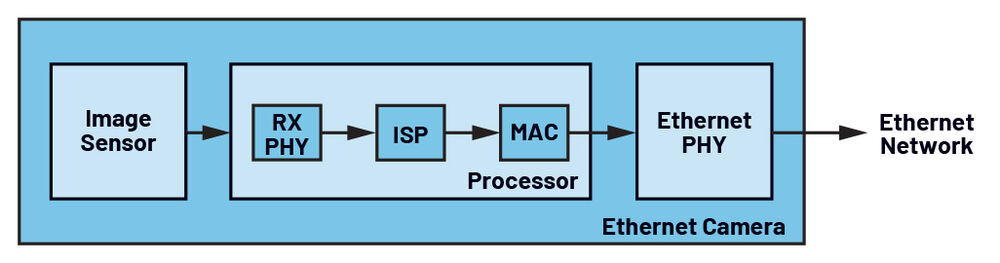
The signal chain of GigE Vision cameras (Image 1) usually consists of three main components, namely the image sensor itself, a processor, and an Ethernet PHY. The processor transforms the raw image data coming from the image sensor into Ethernet frames. This process usually also includes image processing and compression or frame buffering to adjust the data rate to the bandwidth supported by Ethernet.
Figure 1. The most important sensor-side signal chain components of GigE Vision cameras
(Image:Analog Devices)
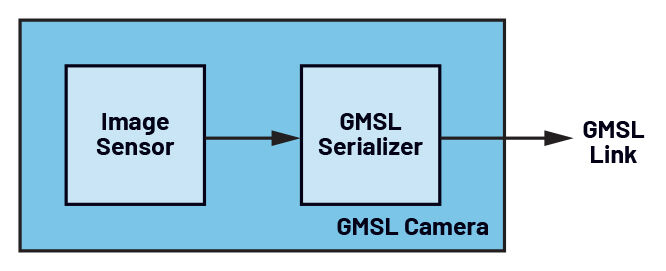
The signal chain of GMSL cameras shown in Image 2 is significantly simpler, as it consists only of an image sensor and a serializer. In typical applications, the serializer converts the raw data from the image sensor and transmits it in its original format. With the elimination of the processor, these cameras are easier to develop and better suited for applications that require space-saving cameras with low power consumption.
Figure 2. The most important sensor-side signal chain components of GMSL cameras
(Image:Analog Devices)
Connection to the host processor
Thanks to their compatibility with different host systems, GigE Vision cameras have found wide acceptance in industry, as a gigabit Ethernet port is practically standard equipment on PCs or embedded platforms today. Some GigE Vision cameras can also work with a universal driver, resulting in a true plug-and-play experience.
In contrast, GMSL cameras require one or more deserializers on the host side. In most use cases, the host is a special embedded platform equipped with one or more deserializers. The deserializers transmit the image data via their MIPI transmitters in their original format, as it is present at the MIPI output of the image sensor. These cameras, like any other MIPI camera, require a separate camera driver for each individual camera design. However, if a driver for the respective image sensor already exists, only a few profile registers or a few write accesses to registers for the SerDes pair are required to transmit a video stream from the cameras to the SoC.
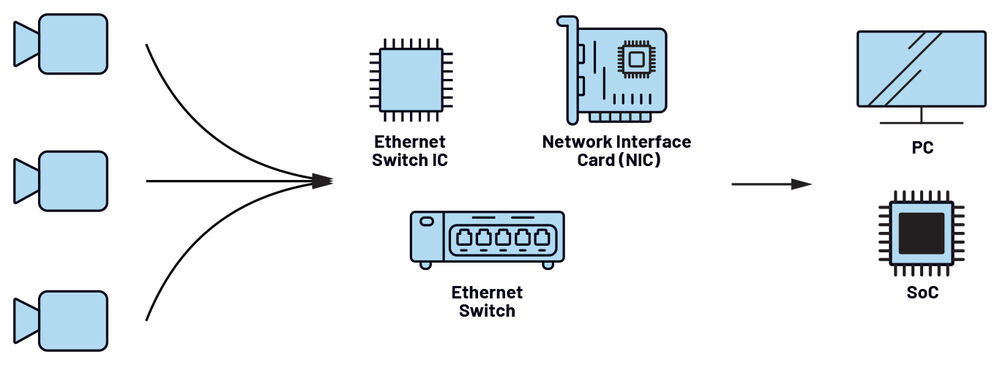
In systems with only one camera, GigE Vision can score some advantages over GMSL in terms of system complexity. The camera can be directly connected to a PC or an embedded platform with an Ethernet port. However, as soon as multiple GigE cameras are used, an Ethernet switch is inevitable. This can be a special Ethernet switch, a Network Interface Card (NIC) equipped with several Ethernet ports, or an Ethernet switch IC between the various Ethernet ports and the SoC. In most cases, however, this leads to a reduction in the maximum total data rate, and what is even more serious, to unpredictable latency, which depends on the interface between the cameras and the terminal device (Image 3).
Figure 3. Example of a typical GigE Vision network
(Image:Analog Devices)
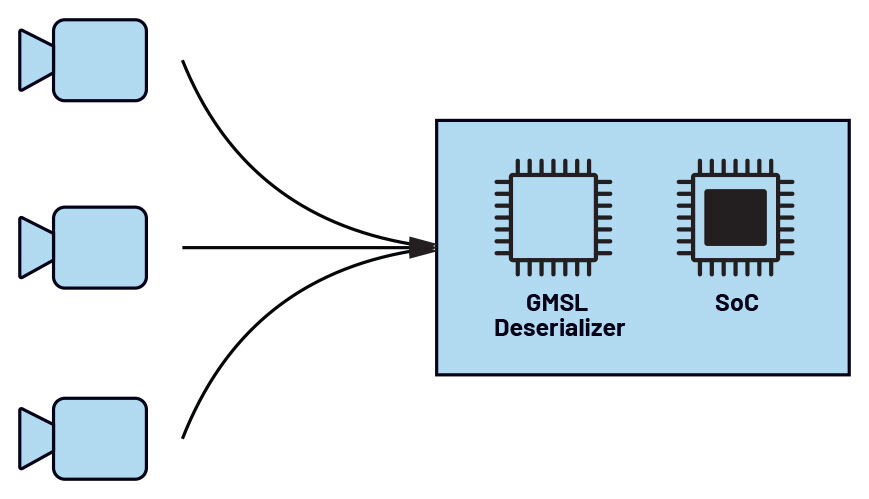
In a GMSL camera system, on the other hand, a deserializer can be connected to up to four links - via MIPI C-PHY or D-PHY transmitters - to support the full bandwidth of all four cameras (Figure 4). As long as the SoC can handle the total data rate, using one or more GMSL units does not reduce bandwidth or increase system complexity.
Date: 08.12.2025
Naturally, we always handle your personal data responsibly. Any personal data we receive from you is processed in accordance with applicable data protection legislation. For detailed information please see our privacy policy.
Consent to the use of data for promotional purposes
I hereby consent to Vogel Communications Group GmbH & Co. KG, Max-Planck-Str. 7-9, 97082 Würzburg including any affiliated companies according to §§ 15 et seq. AktG (hereafter: Vogel Communications Group) using my e-mail address to send editorial newsletters. A list of all affiliated companies can be found here
Newsletter content may include all products and services of any companies mentioned above, including for example specialist journals and books, events and fairs as well as event-related products and services, print and digital media offers and services such as additional (editorial) newsletters, raffles, lead campaigns, market research both online and offline, specialist webportals and e-learning offers. In case my personal telephone number has also been collected, it may be used for offers of aforementioned products, for services of the companies mentioned above, and market research purposes.
Additionally, my consent also includes the processing of my email address and telephone number for data matching for marketing purposes with select advertising partners such as LinkedIn, Google, and Meta. For this, Vogel Communications Group may transmit said data in hashed form to the advertising partners who then use said data to determine whether I am also a member of the mentioned advertising partner portals. Vogel Communications Group uses this feature for the purposes of re-targeting (up-selling, cross-selling, and customer loyalty), generating so-called look-alike audiences for acquisition of new customers, and as basis for exclusion for on-going advertising campaigns. Further information can be found in section “data matching for marketing purposes”.
In case I access protected data on Internet portals of Vogel Communications Group including any affiliated companies according to §§ 15 et seq. AktG, I need to provide further data in order to register for the access to such content. In return for this free access to editorial content, my data may be used in accordance with this consent for the purposes stated here. This does not apply to data matching for marketing purposes.
Right of revocation
I understand that I can revoke my consent at will. My revocation does not change the lawfulness of data processing that was conducted based on my consent leading up to my revocation. One option to declare my revocation is to use the contact form found at https://contact.vogel.de. In case I no longer wish to receive certain newsletters, I have subscribed to, I can also click on the unsubscribe link included at the end of a newsletter. Further information regarding my right of revocation and the implementation of it as well as the consequences of my revocation can be found in the data protection declaration, section editorial newsletter.
Figure 4. Typical connection between GMSL cameras and host
(Image:Analog Devices)
The characteristics in comparison
The following examines the characteristics of GMSL and GigE Vision.
Sensor interface
GMSL serializers only support parallel LVDS (GMSL1) and MIPI sensor interfaces (GMSL2/GMSL3). Because MIPI is the most popular image sensor interface for automotive and consumer cameras, a wide range of image sensors can be used in GMSL cameras. However, due to their internal camera processor, GigE Vision cameras are more flexible in terms of the sensor interface.
Video specifications
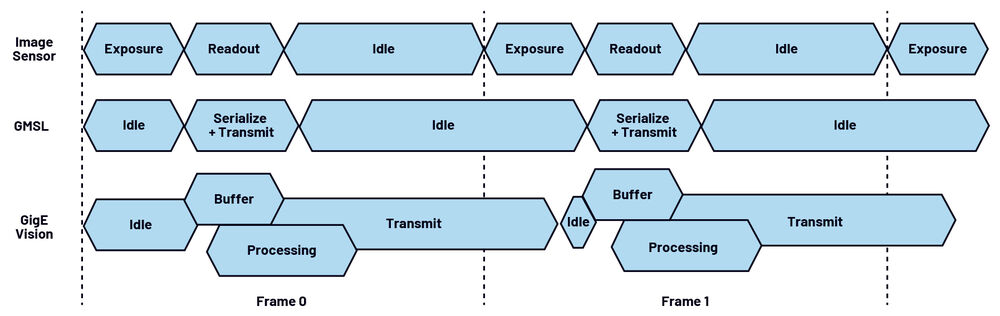
The timing diagram in Image 5 exemplifies the data transmission from an image sensor to a GMSL connection or to a GigE network (in the case of a continuous video stream). In each frame of a video stream, the image sensor sends the image data immediately after the exposure and then switches to an idle state until the start of the next frame. The example diagram rather reflects the conditions with a global shutter sensor, as with a rolling shutter sensor the exposure and readout periods overlap at the frame level, as the exposure and readout for each row are controlled individually.
Figure 5. Timing diagram of video transmission with GMSL and GigE
(Image:Analog Devices)
GMSL serializers on the sensor side serialize the data from the image sensor or sensors and immediately pass them onto the connection line using their proprietary protocol. The processor of a GigE Vision camera buffers the data from the sensors and often also processes it before the video data is prepared into Ethernet frames and transmitted over the network.
Link rate
The link rate is the theoretical maximum data rate of a connection and is often considered the most important specification when comparing different data transmission techniques. GMSL2, GMSL3, and GigE Vision are characterized by very specific, fixed link rates.
GMSL2 supports data rates of 3 Gbit/s and 6 Gbit/s, while GMSL3 supports 12 Gbit/s. All GMSL3 devices are backward compatible with GMSL2 devices when using GMSL2 protocols.
GigE Vision is based on Ethernet standards. In common applications, one often encounters cameras with GigE, 2.5 GigE, 5 GigE, and 10 GigE Vision. As can be read from the designations, these techniques support link rates between 1 and 10 Gbit/s. A GigE Vision camera in line with the current state of the art offers support for 100 GigE with a link rate of 100 Gbit/s [1]. For GigE Vision, all faster protocols are backward compatible with protocols with lower transmission rates.
Although the link rate is closely related to the video resolution, frame rate, and latency, it is difficult to make direct comparisons between two techniques based solely on the link rate.
Effective video data rate
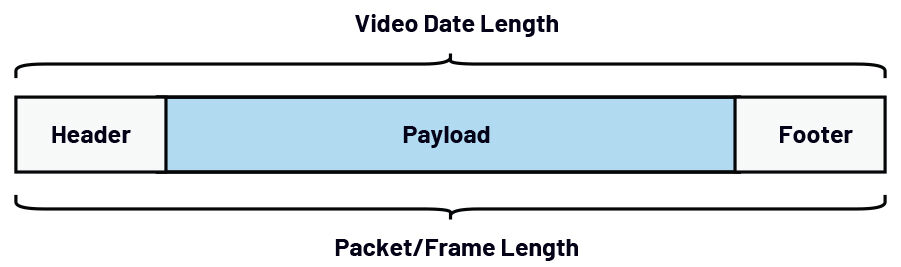
In data communication, the effective data rate is understood as the net data rate without the protocol-related data traffic (overhead). This concept also applies to the transmission of video data. The amount of video data effectively transmitted is normally calculated from the product of the bit depth per pixel and the number of pixels transmitted per packet or frame. From Image 6, the relationship between effective video data rate and overhead can be read.
Figure 6. User data and overhead in a data frame or packet
(Image:Analog Devices)
The GMSL technology transmits video data in packets. Since GMSL2 and GMSL3 work with fixed packet sizes, very accurate statements about the effective video data rate are possible here. For example, if a GMSL2 connection is set up for 6 Gbit/s, a video data rate of a maximum of 5.2 Gbit/s is recommended. However, since a certain overhead and the blanking time due to the MIPI interface of the image sensor are also included in the transmission, the value of 5.2 Gbit/s encompasses the combined data rate of all input side MIPI data lanes and does not represent the amount of actually transmittable video data.
In Ethernet, data transmission takes place in frames, with no uniform frame size specified for GigE Vision. Usually, the aim at the software level is to achieve an optimal compromise between high efficiency - here, long frames have the advantage - and short delays, an advantage of short frames. With these cameras, the overhead usually makes up no more than 5 percent. Faster Ethernet connections reduce the risks associated with long frames, allowing a higher effective video data rate to be achieved.
With both techniques, data transmission does not occur continuously, but in bursts. The average data rate over a longer period of time, i.e., over a video frame or more, can therefore still be lower than the effective video data rate during the ongoing transmission. With GMSL cameras, the burst timing depends purely on the readout time of the image sensor. The burst ratio in real applications could possibly be up to 100 percent to support the full effective video data rate. GigE Vision cameras can be used in more complex and less predictable network environments, where a lower burst ratio is often chosen to avoid data collisions (Image 7).
Figure 7. Data traffic through a GMSL or GigE Vision network
(Image:Analog Devices)
Resolution and frame rate
Resolution and frame rate, as the two most important specifications of video cameras, are driving the demand for higher link rates. For these requirements, compromises must be made with both technologies.
GMSL devices do not offer frame buffering and processing functions. Therefore, resolution and frame rate are determined by what the image sensor or the sensor-side ISP supports within the link bandwidth. Usually a simple trade-off must be made between resolution, frame rate and pixel bit depth.
On the other hand, the concept of GigE Vision is more complex. Although the usable link rate is often lower here than with GMSL, this technology may support a higher resolution or frame rate - often even both - thanks to additional buffers and compression. However, all this has to be bought at the cost of more latency, higher power consumption, and expensive components on both sides of the camera system. In rare cases, these cameras can also transmit unprocessed image data at a reduced frame rate.
Additional features
In addition, other features were considered.
Latency
Especially in applications that have to process the data and make real-time decisions, latency is another crucial specification of video cameras. GMSL camera systems are characterized by low and moreover deterministic latency between the image sensor-side input of the serializer and the output of the deserializer, i.e., the input of the receiving SoC. In comparison, GigE Vision cameras usually have a longer, non-deterministic latency due to the camera-internal processing functions and the more complex network traffic. However, this does not always have to lead to greater latency at the system level, especially if the camera-side processing is more dedicated and is considered for the image pipeline of the system.
Transmission distance
GMSL serializers and deserializers are designed to transmit data in passenger vehicles over coaxial cables for distances up to 15 m. However, the transmission distance is by no means limited to 15 m if the hardware system of the camera meets the GMSL channel specification. The Ethernet protocol used by GigE Vision enables data transmission over distances up to 100 m on copper cables, and even greater distances are possible with optical fibers, even if certain features such as Power over Ethernet (PoE) are no longer supported.
PoC and PoE/PoDL
Both techniques allow data and power to be transmitted over the same cable. While GMSL uses Power over Coax (PoC), with GigE Vision it's PoE (on Ethernet cables with four wire pairs) or Power over Data Line (PoDL) for Single-Pair Ethernet (SPE). However, the majority of GigE Vision cameras use PoE with the traditional four wire pairs.
The uncomplicated PoC technique is the usual solution in camera systems with coax configuration. The same line is used for power supply and data transmission, and only a few passive components are needed for the PoC circuits.
Instead, PoE circuits with support for data rates of 1 GBit/s or more require special circuits with active components, both on the camera side and on the host or switch side. Therefore, PoE equipment is more expensive and not so easily available. With GigE Vision cameras with PoE support, there is usually the option to use a local, external power supply.
Peripheral control and system connection
GMSL is specifically designed for connecting cameras or displays and therefore does not support a wide range of peripheral devices. In typical GMSL camera applications, the link transmits control signals (UART, I²C, and SPI) for communication exclusively with camera peripherals such as temperature and ambient light sensors, IMUs, LED controllers, etc. Larger systems in which GMSL is used as a camera interface usually integrate other interfaces with a lower transmission rate, such as CAN or Ethernet, for communication with other units.
GigE Vision cameras typically use their built-in processor to control peripheral devices. Since this is a popular networking solution for industrial applications, there are multiple protocols for Industrial Ethernet to support various machines and equipment. GigE Vision cameras are connected directly to the network through their hardware and software interfaces.
Trigger and timestamping functions
GMSL connections support the tunneling of GPIO and I²C lines with low latency in the range of microseconds on the forward and return channel to support different trigger and synchronization functions for the camera. The SoC on the deserializer side or one of the image sensors on the serializer side could be the source of the trigger signal in a GMSL camera system.
GigE Vision cameras offer both hardware and software trigger options through a special pin or port or an Ethernet trigger/synchronization packet. In typical applications, a hardware trigger is chosen as the default solution to ensure responsive and accurate synchronization with other cameras or units. The main problem with the software triggering of these cameras is the signal runtime on the network. While there are protocols intended to provide increased synchronization accuracy, these may not be accurate enough or cost-effective. The Network Time Protocol (NTP), for example, only synchronizes to the millisecond [2], while the Precision Time Protocol (PTP) achieves accuracy in the microsecond range, but relies on compatible hardware.
If a synchronization protocol is used in an Ethernet network, all devices connected to this network, including the GigE Vision cameras, can create timestamps in the same clock domain.
Timestamping features are not available with GMSL. Some image sensors can offer a timestamp function via the MIPI header, but this is usually not available for other units on higher system levels. In some system architectures, the deserializer is connected to a SoC that is connected to a PTP network so that a central clock can be used.
Conclusion
As shown in the overview in Table 1, GMSL is a powerful alternative to existing GigE Vision solutions. Compared to GigE Vision cameras, GMSL cameras often achieve equivalent or even better link rates and feature configurations - at lower costs, less power consumption, and a simpler system architecture that requires less space at the system level. Moreover, because GMSL was originally designed for automotive applications, this technology has proven itself under harsh operating conditions with automotive developers for decades.
Accordingly, GMSL can be used without hesitation for the development of systems where reliability and functional safety are paramount. (se)



:quality(80)/p7i.vogel.de/wcms/21/b6/21b61c2ac1df28254fb0dad1574fb2d7/0132853015v1.jpeg "The rose-gold, TiAlSiN-based coating material InoxaCon contributes significantly to the stability and service life of HPTec's new RQR-350 milling tool. It enables safe and efficient automated processes in the manufacturing of surgical instruments. (Image:Cemecon)")
:quality(80)/p7i.vogel.de/wcms/d2/73/d273374d6347651e4e6200cf6061ea4e/0132860560v1.jpeg "Even in July, the flag of the Chinese economy did not flutter particularly briskly in the air. Read here what’s happening and why production in China is apparently declining ... (Image:AI-generated)")
:quality(80)/p7i.vogel.de/wcms/18/47/1847f131e3afda201d1dbb98ad0ecb04/0132826776v1.jpeg "Image 1: Difender armored steels from Dillinger stand out with top scores in ballistic testing and cold bending. Defense companies therefore readily choose them. They can be found, for example, in the armored vehicles Fuchs and GTK Boxer of the German Armed Forces. (Image: Dillinger)")
:quality(80)/p7i.vogel.de/wcms/1e/7d/1e7d651782e0e97b3efc25abf2b52350/img-3485v1.jpeg "The Siemens Energy employees attach balancing weights at the precisely calculated and adjusted angular position to achieve the best possible result. (Source: Schenck Rotec)")
:quality(80)/p7i.vogel.de/wcms/1c/a5/1ca5e3ef5d834c3a42de8909c872e3c6/0132876444v1.jpeg "The autonomous transport system Active Shuttle marketed by Bosch Rexroth has been sold to Neura Robotics. (Image:Bosch Rexroth)")
:quality(80)/p7i.vogel.de/wcms/30/1a/301a1aa59e093d848b69e9ff7006b83e/image1v1.jpeg "Wireless switching devices offer advantages in numerous industrial applications – wherever wired communication reaches its limits (Image: Steute) (Image:)")
:quality(80)/p7i.vogel.de/wcms/a2/85/a285b12508af812e28b17be3482a736c/0132488872v1.jpeg "NIS2 is no longer an abstract requirement in the distant future for many industrial companies. (Image:AI-generated)")
:quality(80)/p7i.vogel.de/wcms/e5/59/e5590f11cef563bf9ae1872bdc4e0fea/0132468153v1.jpeg "Matthias Wolfer is Product Manager Controller at Pilz. (Image: Pilz)")
:quality(80)/p7i.vogel.de/wcms/41/fc/41fc456ff1ff8f30807924663e8df127/img-0942v1.jpeg "In industrial additive manufacturing, the production strategy must influence the design from the very beginning. (Source: Materialise)")
:quality(80)/p7i.vogel.de/wcms/44/fe/44fe86a16c26c09bb363b3671bf0b930/0132847771v1.jpeg "CoreTechnologie (CT) points out that the 3D printing software 4D_Additive has been equipped with additional application possibilities. Here you can learn more about what the new version 1.8 can do – such as generating complex lattice structures or optimizing faulty data ... (Image:CT)")
:quality(80)/p7i.vogel.de/wcms/b4/f2/b4f2c272247f79c5e87334a6839f20cb/0132549860v1.jpeg "Morefire analysis: Many mechanical engineering websites focus on technical specs instead of customer benefits. Translating features into clear benefits increases visibility, inquiries, and competitiveness. (Image: ©peopleimages.com - stock.adobe.com)")
:quality(80)/p7i.vogel.de/wcms/b4/9a/b49aaad0500e06e253f7d75ecb77338a/adobestock-4840668--dani-kreienb-hl-stock-adobe-comv1.jpeg "Metal processing in 2026 will be more digital, automated, and data-driven – but not automatically easier. (Image:© Dani Kreienbühl - stock.adobe.com)")
:quality(80)/p7i.vogel.de/wcms/5b/88/5b88d94e6a43f2b857462cd1921f7386/0132281427v1.jpeg "The eTurbo solves a well-known turbocharger problem: by combining an exhaust gas turbocharger and a permanently excited synchronous motor into a highly integrated core assembly, the compressor achieves sufficient speed even when the exhaust energy is actually not yet sufficient. (Image: BorgWarner)")
:quality(80)/p7i.vogel.de/wcms/75/fe/75feffb63bc6275786606d78a8d797c4/0132901853v1.jpeg "Steyr Motors reports similar business results as last year. Here you can learn more about the details of the Austrian company's situation ... (Image:E-Steyr)")
:quality(80)/p7i.vogel.de/wcms/57/d2/57d2b75d884c18866b46e776126fb46b/org-blobs-user-response-file-output-dac07b02-0e97-4452-9a3a-26528da583b3-file-1787126178766-jpgv1.jpeg "The memory manufacturer CXMT has had an extremely successful IPO. Among the investors are several car manufacturers. (Image:KI-generiert)")
:quality(80)/p7i.vogel.de/wcms/d0/68/d0681c9d26012538a22ff5c103429612/0132875205v1.jpeg "Electric vehicles: Structure of the zone architecture in a modern vehicle. (Image:TI)")
:quality(80)/p7i.vogel.de/wcms/c4/9f/c49f5b8173f678f7ef071355b1fbbd7c/yamu-jay-ai-generated-9088888v1.jpeg "As part of a strategic partnership, Siemens and Reinhausen are advancing the future of energy supply solutions for AI data centers. (Symbol image) (Source: pixabay / AI-generated)")
:quality(80)/p7i.vogel.de/wcms/28/20/28204a4592a69a8682bfbf9a8f7e1dc2/0132846993v1.jpeg "The health status of a lithium-ion battery changes with increasing aging. AI models can utilize characteristic changes in the charge and voltage curves to estimate the state of health. (Image:freely licensed)")
:quality(80)/p7i.vogel.de/wcms/90/dc/90dc332e30a3e4bd3ff77646ed0633b7/0132833369v1.jpeg "Through a compromised repository of the widely used open-source tool LiteLLM, attackers were able to capture several terabytes of data and login credentials. Security company CloudSEK concludes, after analyzing the data, that the attack conducted in March of this year affected more than 2,000 companies, including major players like Microsoft, Nvidia, AWS, and Deutsche Bahn. (Image:freely licensed)")
:quality(80)/p7i.vogel.de/wcms/93/40/9340a3a1088dd79fce6bda5c73b7dd2f/0132818390v1.jpeg "Already in 1980, Intel exited the production of DRAM chips, and in 2022, the Optane series, manufactured using the 3D XPoint process, marked the company's last commercial venture in the field of memory technologies. However, in light of the memory crisis and the growing demand for fast memory chips, Intel CEO Lip-Bu Tan now appears to be considering a possible return to the memory business. (Image: Intel)")
:quality(80)/p7i.vogel.de/wcms/e1/50/e1501d6b603a68ac8164ab9505c04b2d/0117612688.jpeg "Figure 1. The most important sensor-side signal chain components of GigE Vision cameras(Image: Analog Devices)")
:quality(80)/p7i.vogel.de/wcms/f2/12/f212beb0b7b9b2a3a586fc723dfb7538/0117615156.jpeg "Figure 2. The most important sensor-side signal chain components of GMSL cameras(Image: Analog Devices)")
:quality(80)/p7i.vogel.de/wcms/a6/20/a6203785575fafd31d9821c2cbe832f0/0117615164.jpeg "Figure 3. Example of a typical GigE Vision network(Image: Analog Devices)")
:quality(80)/p7i.vogel.de/wcms/aa/74/aa743b2b3ffab9492bf2e7eec096b4d8/0117615167.jpeg "Figure 4. Typical connection between GMSL cameras and host(Image: Analog Devices)")

:quality(80)/p7i.vogel.de/wcms/31/a8/31a883a47b86634c382923e78fd9a4c9/0130133225v1.jpeg "Figure 1: GMSL-capable point-to-point connection. (Image:ADI)")
:quality(80)/p7i.vogel.de/wcms/4e/15/4e15d1c92ff2bc5169291db403dd86e2/0131594892v1.jpeg "Thanks in part to advances in the field of automotive Ethernet, car manufacturers can equip their vehicles with a wider range of functions. (Image:Texas Instruments)")