GaN and SiC transistors reduce the classic switching losses through previously unattainable switching frequencies. In real designs, however, the problem shifts from the semiconductor to the inductance, which becomes the new source of loss under the fast edges.
The losses and penetration depth depend on the frequency.
Power supply units, on-board chargers and server supplies are achieving ever higher levels of efficiency. The reason for this is wide-bandgap semiconductors such as GaN and SiC. The promise: higher switching frequencies, smaller inductances, better efficiencies. This is true in the data sheets. However, real measurements often show a different picture. Although the switching losses of semiconductors are falling dramatically, at the same time effects that were long considered secondary are coming to the fore. It is no longer the transistor that determines the efficiency, but the inductance.
The reason is not a new phenomenon, but a shift in dominance. Fast edges and rising frequencies shift the loss mechanisms from the semiconductor to the inductor. What used to be negligible can become a limiting factor.
What GaN and SiC Change Physically
Power switches made of GaN and SiC allow very high voltage and current change rates. The edge slopes dv/dt and di/dt reach values that were almost impossible to achieve with silicon. Typical switching frequencies increase from the kilohertz to the megahertz range.
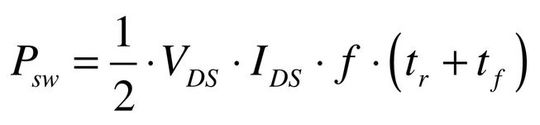
The classic switching losses of a transistor can be described in simplified form using the following formula:
(Source: VCG)
with Psw (switching losses), VDS (drain-source voltage), ID (drain current), f (switching frequency), tr (rise time), tf (fall time).
As the rise and fall times tr and tf are very small for GaN and SiC, this proportion decreases significantly. The developer appears to gain leeway. However, this leeway is immediately eaten up by increased losses in the inductance.
The Inductance Under High-Frequency Current Ripple
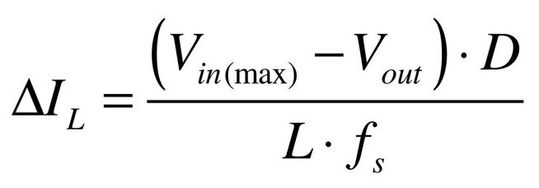
In a buck converter, the current ripple of the inductance results from:
(Source: VCG)
with Vin(max) (maximum input voltage), Vout (output voltage), D (maximum duty cycle), fs (minimum switching frequency), L (selected inductance).
With increasing switching frequency fs, the inductance L could be selected smaller. In practice, this advantage is relativized by the steeper current curves. The current contains significantly stronger high-frequency components. The inductance is no longer subjected to an almost triangular-shaped current, but to a signal whose spectral composition extends far into the high-frequency range. As a result, the frequency-dependent losses in the conductor and core increase disproportionately.
Skin Effect as the Dominant Loss Mechanism
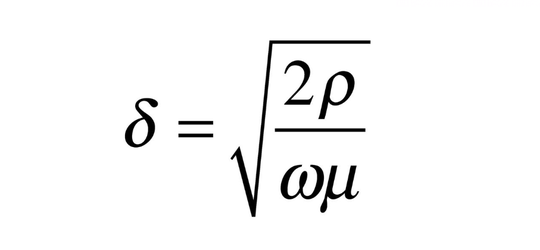
The skin effect means that alternating current no longer uses the entire conductor cross-section. The current density is concentrated on an edge layer with the thickness
(Source: VCG)
where ρ is the specific resistance, ω = 2 π f is the angular frequency and µ is the permeability. As the frequency increases, this penetration depth becomes smaller and smaller. The effective conductor cross-section shrinks and the effective resistance rises sharply.
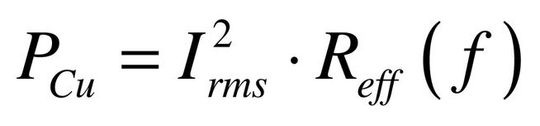
The Ohmic Winding Loss
(Source: VCG)
thus becomes a frequency-dependent variable. At high switching frequencies, Reff is many times greater than the DC resistance. A thick round wire worsens the situation, as its inner cross-section is practically no longer used.
Proximity Effect and the Geometry of the Winding
In addition to the skin effect, the proximity effect also occurs. Magnetic fields from neighboring windings also displace the current into certain areas of the conductor. This current displacement further increases the losses, even if the skin effect alone could still be controlled. The geometry of the winding thus becomes decisive. Flat wire, stranded wire, copper foils or planar structures can become the optimum design.
Core Losses Increase with Frequency
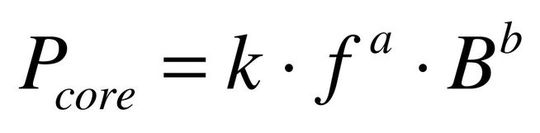
The signs also change in the core material. The core losses can be described approximately using the Steinmetz equation. The Steinmetz equation was originally only developed for sinusoidal excitation and only applies to PWM applications in a modified form:
(Source: VCG)
The exponents a and b are typically greater than one, depending on the material. Doubling the frequency therefore leads to a disproportionate increase in core losses. Classic ferrite materials quickly reach their thermal limits here.
At the same time, the larger current ripple increases the flux density change B, which further increases the losses. Powder cores, nanocrystalline materials and distributed air gaps are necessary to control saturation and heating.
Date: 08.12.2025
Naturally, we always handle your personal data responsibly. Any personal data we receive from you is processed in accordance with applicable data protection legislation. For detailed information please see our privacy policy.
Consent to the use of data for promotional purposes
I hereby consent to Vogel Communications Group GmbH & Co. KG, Max-Planck-Str. 7-9, 97082 Würzburg including any affiliated companies according to §§ 15 et seq. AktG (hereafter: Vogel Communications Group) using my e-mail address to send editorial newsletters. A list of all affiliated companies can be found here
Newsletter content may include all products and services of any companies mentioned above, including for example specialist journals and books, events and fairs as well as event-related products and services, print and digital media offers and services such as additional (editorial) newsletters, raffles, lead campaigns, market research both online and offline, specialist webportals and e-learning offers. In case my personal telephone number has also been collected, it may be used for offers of aforementioned products, for services of the companies mentioned above, and market research purposes.
Additionally, my consent also includes the processing of my email address and telephone number for data matching for marketing purposes with select advertising partners such as LinkedIn, Google, and Meta. For this, Vogel Communications Group may transmit said data in hashed form to the advertising partners who then use said data to determine whether I am also a member of the mentioned advertising partner portals. Vogel Communications Group uses this feature for the purposes of re-targeting (up-selling, cross-selling, and customer loyalty), generating so-called look-alike audiences for acquisition of new customers, and as basis for exclusion for on-going advertising campaigns. Further information can be found in section “data matching for marketing purposes”.
In case I access protected data on Internet portals of Vogel Communications Group including any affiliated companies according to §§ 15 et seq. AktG, I need to provide further data in order to register for the access to such content. In return for this free access to editorial content, my data may be used in accordance with this consent for the purposes stated here. This does not apply to data matching for marketing purposes.
Right of revocation
I understand that I can revoke my consent at will. My revocation does not change the lawfulness of data processing that was conducted based on my consent leading up to my revocation. One option to declare my revocation is to use the contact form found at https://contact.vogel.de. In case I no longer wish to receive certain newsletters, I have subscribed to, I can also click on the unsubscribe link included at the end of a newsletter. Further information regarding my right of revocation and the implementation of it as well as the consequences of my revocation can be found in the data protection declaration, section editorial newsletter.
EMC as a Direct Consequence
The steep edges of GaN and SiC switches generate strong high-frequency fields. The inductance becomes the source of stray fields that excite both differential and common mode interference. Many EMC problems of modern converters are not primarily due to the layout or the switch, but to the magnetic component.
The parasitic capacitances between windings and to the core couple these disturbances into the system. This makes inductance not only a thermal problem, but also an electromagnetic problem.
Inductances Become a Development Discipline
Under these conditions, inductors can no longer be selected solely on the basis of rated inductance and current carrying capacity. Frequency-dependent resistances, core material properties, winding geometry, thermal connection and parasitic elements must be taken into account. Simulation, measurement and characterization become necessary tools. The selection of inductance is therefore rarely a catalog decision, but an integral part of the circuit design.
The New Bottleneck in Efficiency
GaN and SiC reduce losses where developers have suspected them for decades: in the switch. At the same time, they are forcing us to focus our attention on a component that has long been considered uncritical. Today, inductance plays a key role in determining the efficiency, temperature behavior and EMC robustness of modern power converters. Anyone who works with these semiconductors and does not devote the same care to magnetics as to the active component is already wasting the potential of the technology in the initial design. (mr)



:quality(80)/p7i.vogel.de/wcms/dd/08/dd086510d9ae7b50181f6070e4463b44/0129363730v1.jpeg "Typical application for ionizing devices: Wrapping films. (Picture: ©Adobe Stock/SMC)")
:quality(80)/p7i.vogel.de/wcms/35/57/3557c819943c53acec41a0ccba87da4f/0130049064v1.jpeg "Researchers at the Fraunhofer IWU in Chemnitz have long known that many typical sheet metal parts can be manufactured more cost-effectively using hollow embossing rollers. Now there is news to report ... (Image:Fraunhofer IWU)")
:quality(80)/p7i.vogel.de/wcms/59/02/590246e3b3f415c65edbee377c14ca77/26-06-pi-fraunhofer-iws-41450-direktplattieren-pic-01-7771x4369v1v1.jpeg "The Fraunhofer IWS has developed the new \"direct laser cladding\" process, which creates a functional layer directly on the base body by applying a strip-shaped metal to rotationally symmetrical components in a spiral and bonding it locally by laser. (Image:Christoph Wilsnack/Fraunhofer IWS)")
:quality(80)/p7i.vogel.de/wcms/73/60/73608418789b1d9c393f5e2fa974eda2/0130209906v1.jpeg "The robots of the X6 generation from b+m enable very high painting quality and are also particularly compact and easy to maintain. (Image:Beckhoff)")
:quality(80)/p7i.vogel.de/wcms/78/e9/78e9188c25a8a94e67c34c9bf8ffe495/visual-agile-20robots-20and-20google-20deepmind-20partner-20to-20bring-20intelligence-20to-20robotics-2500x1406v1v1.jpeg "Together, the partners are developing adaptable, intelligent robots for a wide range of applications (Image:Agile Robots SE)")
:quality(80)/p7i.vogel.de/wcms/e7/66/e7669ecf0260ae8fc54c214e34e4902a/0130316817v1.jpeg "Siemens and Palo Alto Networks offer tested cybersecurity solution for industrial 5G. (Image:Siemens)")
:quality(80)/p7i.vogel.de/wcms/9f/55/9f55324832c4f426958031375124d9de/siemens-20ubtech-20hmnd-1920x1079v1v1.png "Ready for the factory floor: While Ubtech is planning mass production, Siemens is already testing humanoids in real factory applications in Erlangen. (Image:Siemens)")
:quality(80)/p7i.vogel.de/wcms/11/36/113695ed260e29c8c2d9d39dc5f9d869/0130213768v1.jpeg "AI can work cheaply in China and deliver the results rapidly all over the world. (Image:Dall-E / AI-generated)")
:quality(80)/p7i.vogel.de/wcms/62/5f/625f41e87ebfef156a98c8e6393e32fd/0130211654v1.jpeg "Axial flux motors have some advantages over radial flux motor—but their production is currently still expensive. (Image:RWTH Aachen University)")
:quality(80)/p7i.vogel.de/wcms/77/9b/779b0685d010dfe45c9c2cb1cfecd467/0128886425v1.jpeg "The BlueEye is the first \"real\" hyperspectral camera for the UV range and covers the wavelength range from 220 to 380nm. (Image:Inno-spec GmbH)")
:quality(80)/p7i.vogel.de/wcms/e4/51/e451d52ce0182fb0aaa46a5774f832ef/26-04-pi-fraunhofer-iws-21160-bioslide-pic-01-4128x2321v1v1.jpeg "With the BioSlide research project, the Fraunhofer IWS is investigating how sliding systems can be designed to be more sustainable and energy-efficient. New materials can be tested in a particularly application-oriented manner on this plain bearing test stand. (Image:Fraunhofer IWS)")
![Thanks to advanced 3D printing technology, a more efficient use of resources should contribute to lower-emission aviation—this is the goal of ['skai]-lab. (Image:Oleksandr Pashchenko - stock.adobe.com / AI-generated)](https://cdn1.vogel.de/nghHNSbySccfOjG3n1qCA-FVOjQ=/288x162/smart/filters:format(jpg):quality(80)/p7i.vogel.de/wcms/62/64/626424c97a16e69f871bf216c9629c2a/adobestock-1927043193--c2-a9-20oleksandr-20pashchenko-20-e2-80-93-20stock-adobe-com-ki-generiertv1v1.jpeg "Thanks to advanced 3D printing technology, a more efficient use of resources should contribute to lower-emission aviation—this is the goal of ['skai]-lab. (Image:Oleksandr Pashchenko - stock.adobe.com / AI-generated)")
:quality(80)/p7i.vogel.de/wcms/c3/c4/c3c4ce270b083eeac55654148611f064/0130237945v1.jpeg "China is not giving up on hydrogen, but is intensifying its efforts. (Image:freely licensed from Pixabay)")
:quality(80)/p7i.vogel.de/wcms/4e/c0/4ec0bd19390b169edfa23677373dcdf1/0130260089v1.jpeg "Renewable fuels can supply European road traffic, according to a study. (Image:Aral)")
:quality(80)/p7i.vogel.de/wcms/6f/c9/6fc9050301d745cad25585c6780f8f51/0130197341v1.jpeg "Production facilities are a worthwhile target and are therefore at risk. (Image:ABB Robotics)")
:quality(80)/p7i.vogel.de/wcms/b6/62/b662adc2cec8227d8172509bbfb6ee42/25c0207-107-4961x2789v1v1.jpeg "The GLB is the second model based on Mercedes' new MMA platform. Apparently, Geely's platform is better and cheaper, which is why the two companies are negotiating a partnership. (Image:Mercedes-Benz)")
:quality(80)/p7i.vogel.de/wcms/4d/dd/4dddf438e91f394c04a095dbfd109d1c/0130236430v1.jpeg "Measurement modules: The 720301 module in combination with the SL2000 enables RMS and power calculations, among other things. (Image:Yokogawa)")
:quality(80)/p7i.vogel.de/wcms/61/fc/61fcf95f5cca15494ad18343901ae585/0130317237v1.jpeg "With the AGI CPU, Arm says it is taking a \"historic step\": With the processor aimed at AI in data centers, the company is presenting itself for the first time as a provider of its own chips, not just as a pure IP licensor. (Image:Arm)")
:quality(80)/p7i.vogel.de/wcms/82/90/8290dfe3595b6c6b33726ae8b76172c7/0130319587v1.jpeg "The concept image illustrates how the pattern of tiny protrusions and depressions created on the substrate (MgO, bottom) controls the arrangement of atoms in the superconducting material (YBCO, top). At the interface between the two layers, an electronic structure enables superconductivity to occur at higher temperatures than previously possible. (Image:Chalmers University of Technology / Riccardo Arpaia)")
:fill(fff,0)/p7i.vogel.de/companies/67/eb/67eba621ef6ea/logo2.png "logo2 (Wuxi InfiMotion)")
:quality(80)/p7i.vogel.de/wcms/14/68/146898ea8d787e16573bef0c22ef57b8/0127447996v1.jpeg "Power schematic circuit for the bi-directional three-level, two-phase converter. (Image: Efficient Power Conversion (EPC))")
:quality(80)/p7i.vogel.de/wcms/c7/c0/c7c0504abca9345d454f05fdf6561888/0126211340v1.jpeg "The modular bayed solution provides a cooling capacity of over 1 megawatt, ideal for the high power density of AI applications thanks to direct liquid cooling. (Image:Rittal GmbH & Co. KG)")