Shortly before the start, the organizers of the IAA Mobility once again emphasized the broad scope of their event. The once purely automotive show is intended to captivate a wider audience.
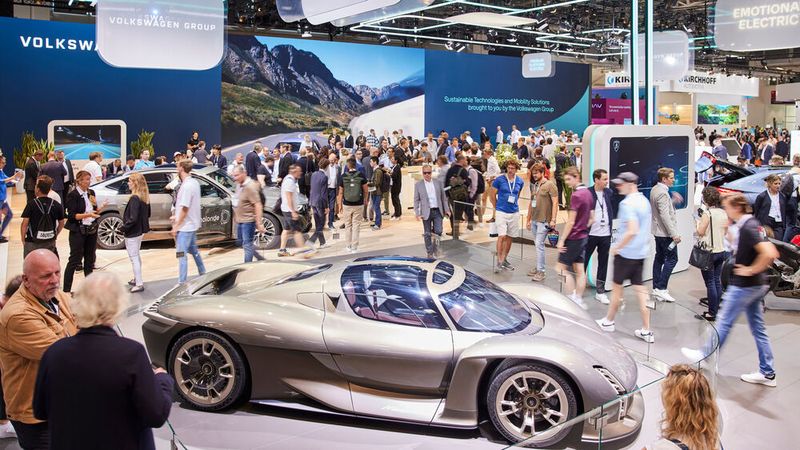
Volkswagen Group's booth at the IAA Mobility 2025.
(Image: VDA/IAA Mobility)
When the facades of the opera house or old town hall in Munich are brightly illuminated on the evening of September 9, it marks not just a light spectacle for the city. With the "Festival of Lights," the IAA Mobility 2025 begins, claiming to be the largest mobility platform. From the exhibition grounds to the shopping streets, Munich is set to become a laboratory and showcase for the future of transportation, technology, and urban life for six days from 11 a.m. to 9 p.m.
The German Association of the Automotive Industry (VDA) expects a record number of exhibitors and visitors this year. Even though companies like Toyota, Fiat, or Peugeot are skipping this event as they have with others, more than 30 manufacturers will be present, including all German brands, many Asian ones, Renault, and a host of other mobility brands ranging from rail companies to bicycle manufacturers and sharing providers.
Munich as a permanent IAA location?
Jürgen Mindel, Managing Director of the VDA, describes it as a "global showcase of our industry" and emphasizes the economic dimension. In 2023, the trade fair already generated 169 million euros in additional purchasing power for the city — and in 2025, another nine-figure sum is expected. For this reason, the partners are very optimistic about holding three more IAA events in Munich through 2031. This collaboration could already be formally extended in the coming weeks.
The structure of the event is once again divided into two parts this year. At the exhibition grounds in Riem, professional and industry discussions take place with an entrance fee. The IAA Summit, over 200 panels, technical demonstrations, and product innovations are also held there. Major corporations like Mercedes-Benz, BMW, and Google are tripling their booth spaces to showcase software solutions, new batteries, and concepts for urban mobility. And, at times, likely to ensure they don't visually fall behind Chinese newcomers, who dominated the exhibition grounds with spectacular appearances two years ago.
With more than 500 international speakers from business and science, the IAA at the exhibition grounds will once again serve as a discussion forum for professional visitors. The CEOs of Opel, BMW, and Polestar will be present, as well as representatives from Google, Samsung, and numerous research institutes. After all, battery technology from China, chip developments from South Korea, and cloud solutions from the USA are shaping the future of mobility.
Open Space: Free and for end customers
In the center of Munich, however, traditional German manufacturers like Audi, BMW, Mercedes, Porsche, and VW remain the undisputed top players. The so-called Open Space extends there, where visitors can view the latest innovations free of charge. Between Odeonsplatz and Ludwigstraße, they can not only see many vehicles but also test them directly. A total of 231 models are available for test drives — ranging from electric SUVs to cargo bikes. A dedicated area in the English Garden is focused on bicycles and micromobility, where visitors can experience the technical possibilities on test tracks and courses.
A special focus is on autonomous driving. Twenty-five vehicles will demonstrate what computer-controlled driving feels like. Studies, such as those by McKinsey, predict a market value of more than 300 billion dollars for automated driving services alone by 2030. Test drives will be offered in clearly defined zones, accompanied by safety personnel and experts. The industry trend is clear: more and more manufacturers are advancing software-defined vehicles. In the discussion rounds of the IAA Summit and at the central Marienplatz, questions regarding traffic safety, ethics, and regulation play a significant role.
Experience instead of exhibition: Interactive formats for families
In the city, however, the focus is primarily on the big show: this year, the fair places even greater emphasis on experiential programs. The Family Trail serves as an interactive scavenger hunt, leading through various interactive stations. Families and children can discover sustainable drives, hands-on technology, and small competitions there. A dedicated Kids Day with music shows is designed to introduce the next generation to such topics.
Date: 08.12.2025
Naturally, we always handle your personal data responsibly. Any personal data we receive from you is processed in accordance with applicable data protection legislation. For detailed information please see our privacy policy.
Consent to the use of data for promotional purposes
I hereby consent to Vogel Communications Group GmbH & Co. KG, Max-Planck-Str. 7-9, 97082 Würzburg including any affiliated companies according to §§ 15 et seq. AktG (hereafter: Vogel Communications Group) using my e-mail address to send editorial newsletters. A list of all affiliated companies can be found here
Newsletter content may include all products and services of any companies mentioned above, including for example specialist journals and books, events and fairs as well as event-related products and services, print and digital media offers and services such as additional (editorial) newsletters, raffles, lead campaigns, market research both online and offline, specialist webportals and e-learning offers. In case my personal telephone number has also been collected, it may be used for offers of aforementioned products, for services of the companies mentioned above, and market research purposes.
Additionally, my consent also includes the processing of my email address and telephone number for data matching for marketing purposes with select advertising partners such as LinkedIn, Google, and Meta. For this, Vogel Communications Group may transmit said data in hashed form to the advertising partners who then use said data to determine whether I am also a member of the mentioned advertising partner portals. Vogel Communications Group uses this feature for the purposes of re-targeting (up-selling, cross-selling, and customer loyalty), generating so-called look-alike audiences for acquisition of new customers, and as basis for exclusion for on-going advertising campaigns. Further information can be found in section “data matching for marketing purposes”.
In case I access protected data on Internet portals of Vogel Communications Group including any affiliated companies according to §§ 15 et seq. AktG, I need to provide further data in order to register for the access to such content. In return for this free access to editorial content, my data may be used in accordance with this consent for the purposes stated here. This does not apply to data matching for marketing purposes.
Right of revocation
I understand that I can revoke my consent at will. My revocation does not change the lawfulness of data processing that was conducted based on my consent leading up to my revocation. One option to declare my revocation is to use the contact form found at https://contact.vogel.de. In case I no longer wish to receive certain newsletters, I have subscribed to, I can also click on the unsubscribe link included at the end of a newsletter. Further information regarding my right of revocation and the implementation of it as well as the consequences of my revocation can be found in the data protection declaration, section editorial newsletter.
For students and young professionals, new opportunities will open on Friday at Career Day, and for women, there will be a special evening for networking with potential employers. Sports and culture are also part of the program. Musicians like Alice Viola and DJs at evening events aim to further position the IAA Mobility as a festival, while sports enthusiasts will have their own Generation & Sports Day.
Citizen dialogue and sustainability at the center
Bringing together technical applications, culture, and citizen participation is the underlying goal, also to preempt protests from car skeptics. The organizers emphasize the central role of sustainability. With the open Citizens Lab in the city center, a forum is being created where experts can engage with citizens on topics such as bike paths, public transport, and climate goals. Issues like the circular economy and charging infrastructure take center stage.
In doing so, the fair aims to position itself as a forum for addressing current challenges. Studies on the transition in transportation in Germany, such as those by Agora Verkehrswende, indicate that by 2030 at least 15 million fully electric cars must be on the roads to meet climate targets. The IAA Mobility uses this target as an opportunity to showcase and discuss e-cars, bicycles, and sharing concepts.
Train, bus, and Lego – new partnerships for new mobility
New partnerships highlight this expanded concept of mobility at the fair. Deutsche Bahn is presenting the Munich XXL S-Bahn to scale for the first time, which is set to be in operation starting in 2028. Municipal transport companies and the German Transport Research Society are participating in initiatives for local public transport. Lego is a partner for the Festival of Lights, and the insurer Allianz is sponsoring the Kids Day.
This will likely once again attract many visitors beyond the classic car enthusiasts to Munich in 2025, much to the delight of local restaurants, department stores, and hotels. Studies by the ifo Institute have repeatedly shown how trade fairs generate economic side effects. Munich is expecting half a million guests again — which doesn't please every local who just wants to shop in the city. Many residents still find it somewhat difficult to embrace the mobile spectacle in the city center.
Hoping for good weather
The two previous IAA events in the city, despite some critics, spread a positive festival atmosphere — largely thanks to one significant factor: summer vibes with bright sunshine. Therefore, the weather forecast might be the only factor that could truly unsettle the organizers in the coming days. Current trend: it won't be all sunshine and roses.



:quality(80)/p7i.vogel.de/wcms/dd/08/dd086510d9ae7b50181f6070e4463b44/0129363730v1.jpeg "Typical application for ionizing devices: Wrapping films. (Picture: ©Adobe Stock/SMC)")
:quality(80)/p7i.vogel.de/wcms/35/57/3557c819943c53acec41a0ccba87da4f/0130049064v1.jpeg "Researchers at the Fraunhofer IWU in Chemnitz have long known that many typical sheet metal parts can be manufactured more cost-effectively using hollow embossing rollers. Now there is news to report ... (Image:Fraunhofer IWU)")
:quality(80)/p7i.vogel.de/wcms/59/02/590246e3b3f415c65edbee377c14ca77/26-06-pi-fraunhofer-iws-41450-direktplattieren-pic-01-7771x4369v1v1.jpeg "The Fraunhofer IWS has developed the new \"direct laser cladding\" process, which creates a functional layer directly on the base body by applying a strip-shaped metal to rotationally symmetrical components in a spiral and bonding it locally by laser. (Image:Christoph Wilsnack/Fraunhofer IWS)")
:quality(80)/p7i.vogel.de/wcms/73/60/73608418789b1d9c393f5e2fa974eda2/0130209906v1.jpeg "The robots of the X6 generation from b+m enable very high painting quality and are also particularly compact and easy to maintain. (Image:Beckhoff)")
:quality(80)/p7i.vogel.de/wcms/78/e9/78e9188c25a8a94e67c34c9bf8ffe495/visual-agile-20robots-20and-20google-20deepmind-20partner-20to-20bring-20intelligence-20to-20robotics-2500x1406v1v1.jpeg "Together, the partners are developing adaptable, intelligent robots for a wide range of applications (Image:Agile Robots SE)")
:quality(80)/p7i.vogel.de/wcms/e7/66/e7669ecf0260ae8fc54c214e34e4902a/0130316817v1.jpeg "Siemens and Palo Alto Networks offer tested cybersecurity solution for industrial 5G. (Image:Siemens)")
:quality(80)/p7i.vogel.de/wcms/9f/55/9f55324832c4f426958031375124d9de/siemens-20ubtech-20hmnd-1920x1079v1v1.png "Ready for the factory floor: While Ubtech is planning mass production, Siemens is already testing humanoids in real factory applications in Erlangen. (Image:Siemens)")
:quality(80)/p7i.vogel.de/wcms/11/36/113695ed260e29c8c2d9d39dc5f9d869/0130213768v1.jpeg "AI can work cheaply in China and deliver the results rapidly all over the world. (Image:Dall-E / AI-generated)")
:quality(80)/p7i.vogel.de/wcms/62/5f/625f41e87ebfef156a98c8e6393e32fd/0130211654v1.jpeg "Axial flux motors have some advantages over radial flux motor—but their production is currently still expensive. (Image:RWTH Aachen University)")
:quality(80)/p7i.vogel.de/wcms/77/9b/779b0685d010dfe45c9c2cb1cfecd467/0128886425v1.jpeg "The BlueEye is the first \"real\" hyperspectral camera for the UV range and covers the wavelength range from 220 to 380nm. (Image:Inno-spec GmbH)")
:quality(80)/p7i.vogel.de/wcms/e4/51/e451d52ce0182fb0aaa46a5774f832ef/26-04-pi-fraunhofer-iws-21160-bioslide-pic-01-4128x2321v1v1.jpeg "With the BioSlide research project, the Fraunhofer IWS is investigating how sliding systems can be designed to be more sustainable and energy-efficient. New materials can be tested in a particularly application-oriented manner on this plain bearing test stand. (Image:Fraunhofer IWS)")
![Thanks to advanced 3D printing technology, a more efficient use of resources should contribute to lower-emission aviation—this is the goal of ['skai]-lab. (Image:Oleksandr Pashchenko - stock.adobe.com / AI-generated)](https://cdn1.vogel.de/nghHNSbySccfOjG3n1qCA-FVOjQ=/288x162/smart/filters:format(jpg):quality(80)/p7i.vogel.de/wcms/62/64/626424c97a16e69f871bf216c9629c2a/adobestock-1927043193--c2-a9-20oleksandr-20pashchenko-20-e2-80-93-20stock-adobe-com-ki-generiertv1v1.jpeg "Thanks to advanced 3D printing technology, a more efficient use of resources should contribute to lower-emission aviation—this is the goal of ['skai]-lab. (Image:Oleksandr Pashchenko - stock.adobe.com / AI-generated)")
:quality(80)/p7i.vogel.de/wcms/c3/c4/c3c4ce270b083eeac55654148611f064/0130237945v1.jpeg "China is not giving up on hydrogen, but is intensifying its efforts. (Image:freely licensed from Pixabay)")
:quality(80)/p7i.vogel.de/wcms/4e/c0/4ec0bd19390b169edfa23677373dcdf1/0130260089v1.jpeg "Renewable fuels can supply European road traffic, according to a study. (Image:Aral)")
:quality(80)/p7i.vogel.de/wcms/6f/c9/6fc9050301d745cad25585c6780f8f51/0130197341v1.jpeg "Production facilities are a worthwhile target and are therefore at risk. (Image:ABB Robotics)")
:quality(80)/p7i.vogel.de/wcms/b6/62/b662adc2cec8227d8172509bbfb6ee42/25c0207-107-4961x2789v1v1.jpeg "The GLB is the second model based on Mercedes' new MMA platform. Apparently, Geely's platform is better and cheaper, which is why the two companies are negotiating a partnership. (Image:Mercedes-Benz)")
:quality(80)/p7i.vogel.de/wcms/4d/dd/4dddf438e91f394c04a095dbfd109d1c/0130236430v1.jpeg "Measurement modules: The 720301 module in combination with the SL2000 enables RMS and power calculations, among other things. (Image:Yokogawa)")
:quality(80)/p7i.vogel.de/wcms/61/fc/61fcf95f5cca15494ad18343901ae585/0130317237v1.jpeg "With the AGI CPU, Arm says it is taking a \"historic step\": With the processor aimed at AI in data centers, the company is presenting itself for the first time as a provider of its own chips, not just as a pure IP licensor. (Image:Arm)")
:quality(80)/p7i.vogel.de/wcms/82/90/8290dfe3595b6c6b33726ae8b76172c7/0130319587v1.jpeg "The concept image illustrates how the pattern of tiny protrusions and depressions created on the substrate (MgO, bottom) controls the arrangement of atoms in the superconducting material (YBCO, top). At the interface between the two layers, an electronic structure enables superconductivity to occur at higher temperatures than previously possible. (Image:Chalmers University of Technology / Riccardo Arpaia)")
:fill(fff,0)/p7i.vogel.de/companies/67/eb/67eba621ef6ea/logo2.png "logo2 (Wuxi InfiMotion)")
:quality(80)/p7i.vogel.de/wcms/40/fc/40fcac9926b43ab201b1dad48ff60bb0/iaa-20mobility-202025-jf-1-05817-8078x4544v1.jpeg "With a total of more than 13% more visitors, the IAA Summit recorded a new attendance record. (Image: VDA)")
:quality(80)/p7i.vogel.de/wcms/9e/5e/9e5e5b09350f50c122417082f0cb0434/9946-1536x864v1.png "9946-1536x864v1 (Image:AI-generated / DALL-E)")