Hyundai has announced several novelties. These include many facelifts and derivatives. In the medium term, new electric vehicle platforms are expected to offer more range and more flexible applications.
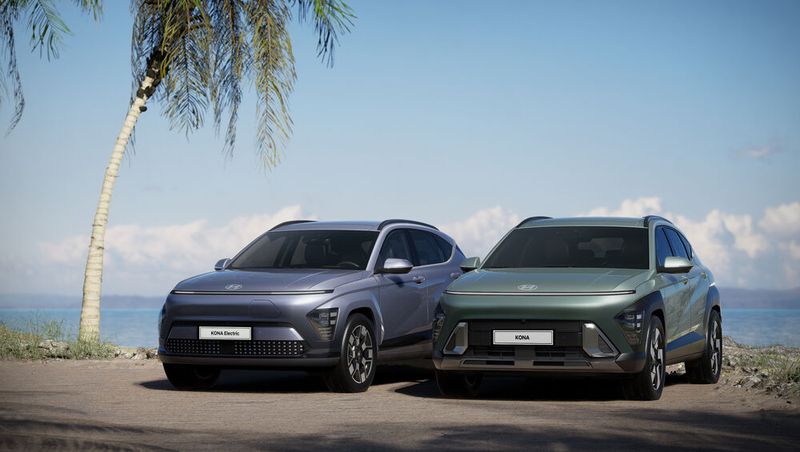
The new Hyundai Kona is the most interesting Hyundai novelty of 2023 in terms of volume.
(Image: Hyundai)
Hyundai was relatively quiet in terms of new models last year. However, in 2023, the Koreans are planning a model offensive. "Almost all models will be tackled this year," says Jürgen Keller, Managing Director of Hyundai Motor Germany.
Hyundai Ioniq 6 scores with high range
The highlight at the beginning of the year is the new Ioniq 6, which has recently hit the market. The electric sedan is the second model on Hyundai's E-GMP electric platform and promises space, efficiency, fast charging - and all at a quite reasonable price. Buyers must invest at least around 44,000 euros. For this price, they will get the entry-level version with 111 kW of power, rear-wheel drive, and a 53 kWh battery.
Those who are willing to spend more money at the dealership will get the Ioniq 6 with a 77 kWh battery and up to 239 kW of power. In full equipment, the Ioniq 6 costs well over 60,000 euros.
The new electric vehicle is expected to deliver best-in-class efficiency. Due to its aerodynamic body - with a coefficient of drag of 0.21 - the electric vehicle is projected to achieve a WLTP range of over 610 kilometers under optimal conditions. This is more than 100 kilometers further than the relatively tall platform sibling Ioniq 5 achieves, despite having the same battery and motor configuration.
Expansion of the Ioniq range
The sportier version of the Ioniq 5, the Hyundai Ioniq 5 N, is in the pipeline. However, there may still be some time before Hyundai releases this model to the market: the sports model is expected to be available at the end of the year. Technical details have not been revealed yet. In terms of the powertrain, the Ioniq 5 N is expected to draw inspiration from its sister model, the Kia EV6 GT, which is equipped with two electric motors producing 430 kW of power.
Hyundai had announced another Hyundai Ioniq model on the corporate E-GMP electric platform a while ago. It will likely be called the Ioniq 7, is set to be launched in 2024, and will be a large SUV. Hyundai provided a preview of it at the end of 2021 with the "Seven" concept.
Nine-seater expands Staria lineup
At the beginning of 2023, alongside the Ioniq 6, Hyundai launched the Staria van in the nine-seater version. Previously, in Germany, only the luxuriously equipped seven-seater model was available. The nine-seater variant is more simply equipped and priced at 53,600 euros, making it around 4,000 euros cheaper. It is primarily targeted towards fleet customers.
The powertrain remains the same. Like in the seven-seater, a 2.2-liter diesel engine with 130 kW/177 PS is used, which is coupled to an eight-speed automatic transmission. The cargo variant is currently not available in the German market. It is unclear if and when it will be introduced.
Hyundai intends to stay in the lower segments
In early 2020, Hyundai launched the third generation of the i10. In May 2023, the Koreans will release the facelift of their smallest model. The options in this vehicle class have recently become more limited. For Jürgen Keller, the fact that the manufacturer has updated A-segment vehicles is a commitment to not abandoning this segment. This is despite the challenges of building a car of this size economically due to increasingly stringent legal requirements.
"We want to continue offering affordable mobility," Keller stated. Therefore, a facelift will also be introduced to the B-segment in late summer – approximately three years after the current generation was launched. However, a small electric car is not expected from Hyundai in the foreseeable future.
Hyundai's bestseller Kona is being relaunched
The new generation of the Hyundai Kona is expected to be the most interesting Hyundai novelty of the year in terms of volume, as the Kona was the bestseller for the Koreans in Germany last year. The electric variant, in particular, is popular.
As in the current generation, Hyundai will offer the Kona not only as a battery-electric version but also as a full hybrid and a traditional combustion engine. Data on the powertrains are not yet available. However, what Hyundai has already revealed is that the new Kona will be significantly larger than its predecessor, both internally and externally. The hybrid and combustion engine models will start in the middle of the year, with the electric version being introduced by the Koreans in late summer.
Date: 08.12.2025
Naturally, we always handle your personal data responsibly. Any personal data we receive from you is processed in accordance with applicable data protection legislation. For detailed information please see our privacy policy.
Consent to the use of data for promotional purposes
I hereby consent to Vogel Communications Group GmbH & Co. KG, Max-Planck-Str. 7-9, 97082 Würzburg including any affiliated companies according to §§ 15 et seq. AktG (hereafter: Vogel Communications Group) using my e-mail address to send editorial newsletters. A list of all affiliated companies can be found here
Newsletter content may include all products and services of any companies mentioned above, including for example specialist journals and books, events and fairs as well as event-related products and services, print and digital media offers and services such as additional (editorial) newsletters, raffles, lead campaigns, market research both online and offline, specialist webportals and e-learning offers. In case my personal telephone number has also been collected, it may be used for offers of aforementioned products, for services of the companies mentioned above, and market research purposes.
Additionally, my consent also includes the processing of my email address and telephone number for data matching for marketing purposes with select advertising partners such as LinkedIn, Google, and Meta. For this, Vogel Communications Group may transmit said data in hashed form to the advertising partners who then use said data to determine whether I am also a member of the mentioned advertising partner portals. Vogel Communications Group uses this feature for the purposes of re-targeting (up-selling, cross-selling, and customer loyalty), generating so-called look-alike audiences for acquisition of new customers, and as basis for exclusion for on-going advertising campaigns. Further information can be found in section “data matching for marketing purposes”.
In case I access protected data on Internet portals of Vogel Communications Group including any affiliated companies according to §§ 15 et seq. AktG, I need to provide further data in order to register for the access to such content. In return for this free access to editorial content, my data may be used in accordance with this consent for the purposes stated here. This does not apply to data matching for marketing purposes.
Right of revocation
I understand that I can revoke my consent at will. My revocation does not change the lawfulness of data processing that was conducted based on my consent leading up to my revocation. One option to declare my revocation is to use the contact form found at https://contact.vogel.de. In case I no longer wish to receive certain newsletters, I have subscribed to, I can also click on the unsubscribe link included at the end of a newsletter. Further information regarding my right of revocation and the implementation of it as well as the consequences of my revocation can be found in the data protection declaration, section editorial newsletter.
Revised compact series will be launched at the end of the year
Shortly thereafter, the revised versions of the i30 including the sporty i30 N will be launched. The third generation of the Golf competitor, which was launched in 2017, had already received an update in 2020. Now, Hyundai has revisited the model.
"And it's not a minor facelift," emphasizes Jürgen Keller. The i30 has been visually altered both externally and internally. In addition, new technology is being introduced. Also, after three years, Hyundai will introduce the updated version of the compact SUV Tucson at the end of 2023.
Two new electric platforms in the medium term
Keller also gives a brief glimpse into the mid-term future. Hyundai is currently working on two new architectures for electric vehicles. The eM platform is intended for vehicles of all sizes. It is expected to offer 50% more range compared to current models. Additionally, it will feature autonomous driving functions at Level 3+. The eS platform is designed for "Purpose Built Vehicles" (PBV) and can be flexibly adapted to different requirements. It will be used for specialized vehicles in delivery, logistics, and ride-sharing services.



:quality(80)/p7i.vogel.de/wcms/a0/47/a04725ef9bd09fb6c9341a1bea1b5d93/0130443083v1.jpeg "Here, a type of plastic pallet is produced by thermoforming (vacuum forming or deep drawing) at the corresponding division of New England Plastics in the USA. This division, which specializes in so-called liners, is now part of Ringmetall ... (Image:New England Plastics)")
:quality(80)/p7i.vogel.de/wcms/e3/42/e342b3c593ea92d56604d3be969e9c9a/0130437231v1.jpeg "Daimler Truck will be building even more trucks at its Czech plant in Cheb in the future. This is because it is now being expanded for strategic cost-saving reasons ... (Image:Daimler Truck)")
:quality(80)/p7i.vogel.de/wcms/23/99/23992bf2dcdc432c9b7209c34a4a7c48/0129733089v1.jpeg "Stork relies on the modular Neoswiss turning system from Iscar to shorten the set-up times for its sliding headstock lathes and work more productively. (Image:Iscar)")
:quality(80)/p7i.vogel.de/wcms/7d/e2/7de2923434b2f1a78ba5482d8d335269/0113143253v1.jpeg "In our China Market Insider we regularly provide you with relevant information directly from China. (Image:© Eisenhans - stock.adobe.com)")
:quality(80)/p7i.vogel.de/wcms/b7/36/b736dfebc16c42d6901d0d0e1f390493/3d-druck-20factory-20--20ki-20generiert-1920x1079v1.png "(Source: AI-generated)")
:quality(80)/p7i.vogel.de/wcms/79/b2/79b21aad663f4a7bd4472afc1c1afc62/0130433994v1.jpeg "Mission Joyride: The free-flying robot (shown here in the rendering) will relieve the ISS crew of logistics tasks from 2027 with its two mechanical arms. (Image:Icarus Robotics)")
:quality(80)/p7i.vogel.de/wcms/6b/45/6b4546fa6ebf305c3660326909363f32/0130437089v1.jpeg "Industrial AI in action: Rockwell Automation presents practical solutions for self-controlling production systems at the Hannover Messe. (Image:Rainer Jensen, Deutsche Messe)")
:quality(80)/p7i.vogel.de/wcms/78/e9/78e9188c25a8a94e67c34c9bf8ffe495/visual-agile-20robots-20and-20google-20deepmind-20partner-20to-20bring-20intelligence-20to-20robotics-2500x1406v1v1.jpeg "Together, the partners are developing adaptable, intelligent robots for a wide range of applications (Image:Agile Robots SE)")
:quality(80)/p7i.vogel.de/wcms/59/a2/59a2b11f0aa1b700eff02addd5de8703/adobestock-1788280853--c2-a9-20satria-20-e2-80-93-20stock-adobe-com-5081x2860v1v1.jpeg "Quantum computers require extreme cooling to temperatures close to absolute zero in order to keep qubits stable. (Image:satria - stock.adobe.com)")
:quality(80)/p7i.vogel.de/wcms/62/5f/625f41e87ebfef156a98c8e6393e32fd/0130211654v1.jpeg "Axial flux motors have some advantages over radial flux motor—but their production is currently still expensive. (Image:RWTH Aachen University)")
:quality(80)/p7i.vogel.de/wcms/f6/ae/f6aec4f6241b36ed5e3a990ac9176b42/0130429460v1.jpeg "Verne, Pony.ai and Uber want to launch a robotaxi service in Europe. (Image:Verne)")
:quality(80)/p7i.vogel.de/wcms/d7/88/d788699f2974708a332baa4e7a62fa9e/0130438967v1.jpeg "Skoda is withdrawing from China. The brand has produced well over three million vehicles there. (Image:Skoda car)")
:quality(80)/p7i.vogel.de/wcms/b0/43/b043b86899837532aad62d63368a917a/0130371361v1.jpeg "Skoda leaves the chinese market.
(Image:Skoda)")
:quality(80)/p7i.vogel.de/wcms/c3/c4/c3c4ce270b083eeac55654148611f064/0130237945v1.jpeg "China is not giving up on hydrogen, but is intensifying its efforts. (Image:freely licensed from Pixabay)")
:quality(80)/p7i.vogel.de/wcms/ee/09/ee09acbd6dc896df25affaa9e871e6e5/0130440053v1.jpeg "IMS chip module for simple system integration into an ion mobility spectrometer. (Image:Fraunhofer IPMS)")
:quality(80)/p7i.vogel.de/wcms/10/6c/106cd22de5f68a0f74639d654827228c/0130345302v1.jpeg "Made in India: According to the India Electronics and Semiconductor Association (IESA), the country should be able to produce between 75 and 80 million chips by the beginning of 2027, once the plants currently under construction become operational. (Image:Pixabay (Montage: Sebastian Gerstl))")
:quality(80)/p7i.vogel.de/wcms/a5/ed/a5ed6fda029d362732a293d6b19d74c4/0130444216v1.jpeg "Thirteen executives from the Chinese chip industry have drawn up a plan to achieve an 80% self-sufficiency rate for semiconductors by 2030. (Image:Maxim_Kazmin - stock.adobe.com)")
:quality(80)/p7i.vogel.de/wcms/31/a6/31a646018b34d8e0a44bfc8bf17837f6/0130361632v1.jpeg "For many companies, PFAS are considered indispensable in electronics production. (Image:freely licensed)")
:quality(80)/p7i.vogel.de/wcms/6e/b1/6eb167fde07444684634d4de51ec4f68/0125731800v1.jpeg "Hyundai has a new electric flagship with the Ioniq 9. (Image:Hyundai)")
:quality(80)/p7i.vogel.de/wcms/d5/1a/d51a49fa24cb8b583132d80dd145dfc0/0126051299v1.jpeg "Thailand could serve as a gateway to Europe for Chinese OEMs. (Image:Adobe Stock)")