They move upright, grasp objects and recognize their surroundings. Humanoid robots are seen as a beacon of hope against the growing shortage of skilled workers. However, the more versatile their use, the higher the requirements for safe and controllable processes.
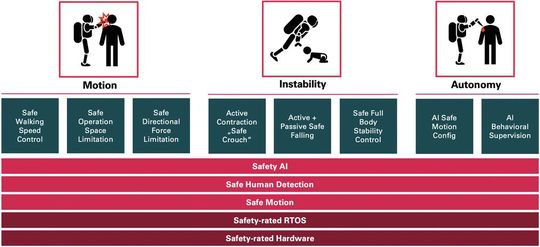
Positron combines several security-relevant functions in one system, allowing both planned and unplanned movements to be monitored and secured in real time.
(Image: Synapticon)
The market for humanoid robots is developing rapidly. According to the report "Humanoid Robots: The AI accelerant" by Goldman Sachs Research, it could grow to a volume of 150 billion US dollars by 2035. A key driver is the demographically induced shortage of skilled workers, which is already posing challenges for many industries. This is precisely where fields of application are emerging for robots that can adapt flexibly to existing environments.
Humanoid systems can be integrated in areas where people used to work, for example in logistics, assembly or care. They operate efficiently and do not require any specially adapted infrastructure. However, it is precisely this proximity to humans that places new demands on functional safety. Robots no longer work in isolation, but in direct interaction. Safety systems must therefore react proactively and adapt flexibly to changing situations.
Static Concepts Are No Longer Enough
Classic safety concepts are based on fixed rules. Safe rooms, emergency stop switches and automatic interruptions are designed for controlled environments. In open areas with mobile, adaptive robots, they reach their limits. What is needed here are systems that think for themselves.
With Positron Safety AI, automation specialist Synapticon has created a platform that meets these requirements. The special feature is the complete separation between control and safety. The application AI acts freely, while a separate safety unit monitors all movements in real time. If the robot reacts atypically, safety actions are automatically activated to return it to a safe operating state.
Real-Time Response, Background Monitoring
"If safety remains static while the robot evolves, it doesn't fit together," says Nikolai Ensslen, founder of Synapticon. "That's why safety solutions need to be dynamic, context-sensitive and technologically on a par with robot intelligence."
Positron makes this principle possible thanks to a dedicated hardware architecture with its own security logic, secure interfaces and deterministic response times. Powerful processors such as the ARM R52 or the Nvidia IGX Jetson Thor system are used. The platform meets safety requirements up to SIL3/PLe and can be flexibly integrated into existing IT and control environments.
Safety At All Levels of Movement
Positron combines several safety-relevant functions in one system: Safe Motion, Safe Human Detection and Behavioral AI Safety. This allows both planned and unintentional movements to be monitored and safeguarded in real time. The platform enables safe motion control for more than 50 degrees of freedom. It offers safety kinematics calculations for parallel and serial kinematics, making it possible to reliably monitor the movements of a complex humanoid movement apparatus.
A particular focus is on dealing with unstable situations. The Safe Guided Falling function ensures that humanoid robots do not tip over uncontrollably in the event of a fall. They sink to the ground in a controlled manner and reduce their kinetic energy in the process. This protects people and equipment. Other modules such as Safe Situational Motion enable an adapted movement speed depending on the environment.
Technology That Grows With You
Humanoid robots reduce changeover costs and make automation more accessible, even for smaller companies. Their ability to integrate into existing processes reduces technical and economic barriers to entry. With safety systems such as Positron, complex applications can be implemented more quickly and safeguarded in accordance with standards. This makes automation not only scalable, but also reliable for everyday use.
The platform has a modular structure. Manufacturers can flexibly combine sensors, controls and actuators. This lowers the integration effort and reduces costs. At the same time, a uniform level of safety is created that can be transferred across different robot platforms.
Certified And Digitally Secured
Positron complies with the ISO 13849 and IEC 61508 standards, and the platform is also prepared for future requirements. These include the new ISO/IEC TR 5469 standard, which deals with functional safety in AI-controlled systems. Synapticon is also actively working on ISO 25785, the standard for "dynamically stable industrial robots". The separation of AI and safety components is a key requirement for this. Positron already meets this requirement today.
Date: 08.12.2025
Naturally, we always handle your personal data responsibly. Any personal data we receive from you is processed in accordance with applicable data protection legislation. For detailed information please see our privacy policy.
Consent to the use of data for promotional purposes
I hereby consent to Vogel Communications Group GmbH & Co. KG, Max-Planck-Str. 7-9, 97082 Würzburg including any affiliated companies according to §§ 15 et seq. AktG (hereafter: Vogel Communications Group) using my e-mail address to send editorial newsletters. A list of all affiliated companies can be found here
Newsletter content may include all products and services of any companies mentioned above, including for example specialist journals and books, events and fairs as well as event-related products and services, print and digital media offers and services such as additional (editorial) newsletters, raffles, lead campaigns, market research both online and offline, specialist webportals and e-learning offers. In case my personal telephone number has also been collected, it may be used for offers of aforementioned products, for services of the companies mentioned above, and market research purposes.
Additionally, my consent also includes the processing of my email address and telephone number for data matching for marketing purposes with select advertising partners such as LinkedIn, Google, and Meta. For this, Vogel Communications Group may transmit said data in hashed form to the advertising partners who then use said data to determine whether I am also a member of the mentioned advertising partner portals. Vogel Communications Group uses this feature for the purposes of re-targeting (up-selling, cross-selling, and customer loyalty), generating so-called look-alike audiences for acquisition of new customers, and as basis for exclusion for on-going advertising campaigns. Further information can be found in section “data matching for marketing purposes”.
In case I access protected data on Internet portals of Vogel Communications Group including any affiliated companies according to §§ 15 et seq. AktG, I need to provide further data in order to register for the access to such content. In return for this free access to editorial content, my data may be used in accordance with this consent for the purposes stated here. This does not apply to data matching for marketing purposes.
Right of revocation
I understand that I can revoke my consent at will. My revocation does not change the lawfulness of data processing that was conducted based on my consent leading up to my revocation. One option to declare my revocation is to use the contact form found at https://contact.vogel.de. In case I no longer wish to receive certain newsletters, I have subscribed to, I can also click on the unsubscribe link included at the end of a newsletter. Further information regarding my right of revocation and the implementation of it as well as the consequences of my revocation can be found in the data protection declaration, section editorial newsletter.
Positron also offers protection in the area of security. With encrypted communication, secure boot processes and the separation of safety-critical functions, the platform remains in a secure operating state even in the event of an external attack. The architecture separates safety from all other software levels, which makes targeted manipulation considerably more difficult.
Applications With Perspective
In logistics, humanoid robots with Positron transport goods, sort products and relocate them. They recognize human movements at an early stage and adapt their processes accordingly. This keeps productivity high while minimizing risk. They also reduce physically demanding tasks, which is a particular advantage in an ageing workforce.
New possibilities are also opening up in the healthcare sector. Robots assist with the repositioning of patients or the transfer of medical aids. Every movement must be precise and reliable. Situational monitoring by Positron ensures safe collaboration with staff and patients, even in unforeseen situations.
Other areas of application include assembly, quality assurance and maintenance. Wherever adaptability and human proximity are required, humanoid robots can operate without separating barriers. The ability to move safely and with context awareness is crucial here.
Future With Potential
The increasing demand for humanoid robotics is not only based on technological progress, but also on a structural change in the economy and society. Companies are under increasing pressure to make their processes efficient, adaptable and permanently available. Humanoid systems offer new scope for action here.
The decisive factor here is not just the ability to execute movements, but to adapt them safely and at the right moment. This is exactly what Positron is designed for. The platform combines intelligent monitoring with standard-compliant protection. It detects unexpected movements as well as proximity to people and adapts its behavior accordingly. The result is a system that adapts flexibly to real-life conditions. It remains controllable, even when tasks or environments change. "Positron works like an airbag," says Ensslen. "In normal operation, it holds back. But if necessary, it intervenes immediately and protects everything that is important."
The next step in the development of humanoid robotics lies not only in greater computing power or mechanical precision. It lies in the ability to work reliably with humans.
Positron Safety AI is a central building block for this. The platform does not see safety as a limitation, but as an essential component of modern robotics. It creates new freedoms in design, facilitates integration and makes intelligent systems suitable for everyday use. This makes safety a key factor for the success of humanoid robots in practice.



:quality(80)/p7i.vogel.de/wcms/72/a0/72a0ffc94f0929c8b193b4bc40638d72/0129755066v1.jpeg "Tens of billions less! After Ford and General Motors, Stellantis is now also feeling the painful consequences of Donald Trump's decision to change its electric car strategy ... (Image:Stellantis)")
:quality(80)/p7i.vogel.de/wcms/7f/fd/7ffd32863352c40f562f4245e4766e61/0129745849v1.jpeg "After US President Donald Trump once again resorted to his favorite weapon, tariffs, concerns rose in the EU that the so-called tariff deal could become invalid. But it looks as if the sea remains relatively calm ... (Image:F. Schneidler)")
:quality(80)/p7i.vogel.de/wcms/53/69/5369bed136061188d873441dfefd6d6e/0129245111v1.jpeg "The company revised the factory layout even though construction work had already begun. (Image:Efeso Management Consultants)")
:quality(80)/p7i.vogel.de/wcms/d2/d7/d2d79e3fb84663cb7e918c88f123989b/0129733908v1.jpeg "Mineral decision! This is how lithium is mined. There is a lot of it in Chile, Australia, Bolivia and also in Zimbabwe. However, the latter country has now announced that the export of all minerals, including lithium concentrate, will be stopped. Read more about the reasons here ... (Image:Largbatt)")
:quality(80)/p7i.vogel.de/wcms/d9/bd/d9bd1bfa7d02f586e092f06c61ee3d9a/0129464423v1.jpeg "This is what the Black Soldier Fly (BSF) looks like. The first impression is of a common two-winged insect. But appearances are deceptive, because its larvae are true protein reactors, whose industriousness is now to be exploited for food ... (Image:Fly Friends)")
:quality(80)/p7i.vogel.de/wcms/13/4d/134dee0c2b8af6b4f28937ca5b586e0d/0129499541v1.jpeg "The industry now needs to build a flexible, powerful and sovereign infrastructure that can exploit the full potential of artificial intelligence while guaranteeing control over data and processes. (Picture: ©Gorodenkoff - stock.adobe.com)")
:quality(80)/p7i.vogel.de/wcms/c6/71/c671ce338f12be49d39d1b04b40a54f7/0129697443v1.jpeg "Claas is working on making its combine harvesters fit for refurbishment. (Image:Claas)")
:quality(80)/p7i.vogel.de/wcms/f2/4b/f24b8f1c3070e7f13e4f0ffd7854e75a/0129653538v1.jpeg "The production of the BMW iX3 is to be taken as far as possible in terms of sustainability. This is also ensured by the climate-friendly Blueprint recycled steel from Thyssenkrupp Steel ... (Image:BMW)")
:quality(80)/p7i.vogel.de/wcms/f5/7e/f57ef535ee35e7b3b7ff15a8a63cef10/eds-keyvisual-8000x4496v1.jpeg "(Source: European Defence Supply)")
:quality(80)/p7i.vogel.de/wcms/af/a3/afa312176d956068af20491957eef642/newsimage418262-3100x1745v1v1.jpeg "The autonomous shuttle of the Aula AI project during a demonstration of sensor data with artificial fog. (Image:University of Magdeburg)")
:quality(80)/p7i.vogel.de/wcms/84/2d/842d51915fa4fe69c72da5cc4ba52ed1/newsimage418103-3408x1917v1v1.jpeg "3 Printing can also be sustainable—if recyclable ink is used. (Image:Hereon/Steffen Niemann)")
:quality(80)/p7i.vogel.de/wcms/b0/78/b078e07634ffd4d5ee6b73af42cc7c55/newsimage418259-1000x563v1v1.jpeg "Magnesium during forming. (Image:TU Bergakademie Freiberg)")
:quality(80)/p7i.vogel.de/wcms/c7/5e/c75e5942cd1d7e6bce973391af6dafe8/0129757614v1.jpeg "Pony.ai is cooperating with Moore Threads to bring Level 4 autonomous driving to the roads in China more quickly. (Image:Pony.ai)")
:quality(80)/p7i.vogel.de/wcms/a8/9f/a89ff7a3e28a19c03a22fd16cf3404b4/0129761837v1.jpeg "KD and Hitachi High-Tech have concluded a distribution agreement. (Image:KD)")
:quality(80)/p7i.vogel.de/wcms/29/b5/29b536a22d9b5ac80387b02620cce554/20260212-sue-60-6000x3372v1v1.jpeg "The People Mover at its world premiere. The large polycarbonate windshield is clearly visible. One of several materials contributed by Covestro. (Image:UE | STUDIOS)")
:quality(80)/p7i.vogel.de/wcms/a0/3e/a03e71cec3a956df095607a0b176a7b0/0129584071v1.jpeg "Andreas Mindt will be Head of Design at the Volkswagen Group from March. (Image:Volkswagen AG)")
:quality(80)/p7i.vogel.de/wcms/eb/4e/eb4e449562174ec95a5b3d30fb0137a2/0129648135v1.jpeg "The III-V germanium PV module with an efficiency of 34.2% is currently the most efficient solar module in the world. (Image:Jacob Forster)")
:quality(80)/p7i.vogel.de/wcms/92/c2/92c23fd5d95286c8c8c634314f6b22f8/0129722027v1.jpeg "The Meta Group has signed a five-year contract for GPU and CPU deliveries to expand its AI capacities. The agreement covers the delivery of up to 6 gigawatts of GPU computing power with a total value of around USD 60 billion. (Image:freely licensed)")
:quality(80)/p7i.vogel.de/wcms/01/77/017742db7d5eb5964c297bb8917df701/0129696639v1.jpeg "Mini-STX K3921-N: The motherboard masters Intel's Core i3 and N-Series processors and can connect multiple monitors with Full HD. (Image:Kontron)")
:quality(80)/p7i.vogel.de/wcms/17/21/1721b98b7580a86c7790f607395878a1/0129697493v1.jpeg "Universal: Motors are used everywhere. (Image:Microchip Technology)")
:fill(fff,0)/images.vogel.de/vogelonline/companyimg/76800/76895/65.jpg "FAULHABER_120mm.jpg ()")
:fill(fff,0)/p7i.vogel.de/companies/69/88/69882c428938e/tmts2026-ticec-banner-en-2000px.png "tmts2026-ticec-banner-en-2000px (https://www.tmts.tw/en)")
:fill(fff,0)/p7i.vogel.de/companies/67/eb/67eba621ef6ea/logo2.png "logo2 (Wuxi InfiMotion)")
:quality(80):fill(efefef,0)/p7i.vogel.de/wcms/67/ad/67adf4a647532/elatec-wp-machine-authentication.png "Elatec WP Machine Authentication")
:quality(80)/p7i.vogel.de/wcms/b3/13/b3138c48f538e3a8fe804a007d0c1b04/0126902345v1.jpeg "The drive technology specialist Maxon announced a minority stake in Synapticon in July 2025. This now offers potential in the field of motion control. (Image:Maxon Group)")
:quality(80)/p7i.vogel.de/wcms/62/93/62934fd6900b930a0db9493be3d931ba/0127310246v1.jpeg "Servomotors without housings can be used very efficiently in confined spaces. (Image:TQ-Robotics)")