"We must adapt to new realities": Thomas Rudel on the challenges of global supply chains and strategic future plans
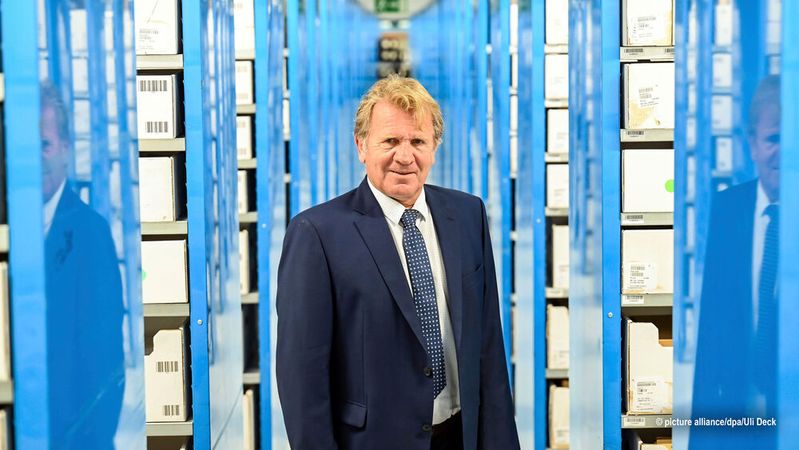
Thomas Rudel, Managing Director of Rutronik Elektronische Bauelemente GmbH, in a company warehouse.
(Image: picture alliance/dpa)
Geopolitical tensions, especially between the US and China, as well as ongoing crises such as the war in Ukraine, pose immense challenges to the electronics industry. In our interview, Thomas Rudel, CEO of globally operating Rutronik GmbH, discusses the need to diversify sources of supply, the increasing pressure on medium-sized companies, and how the distributor is preparing for the future through digitalization and a regionalization strategy.
ELEKTRONIKPRAXIS: How do the current geopolitical tensions, especially between the US and China, affect your supply chains at Rutronik? Do you believe that a restructuring or diversification of your sourcing is necessary?
Thomas Rudel: Considering that about 85 percent of the components market or 80 percent of the semiconductor market is in American hands today, that's something that could be reviewed.
We are already observing today that the components industry is strongly influenced by America, and this will certainly be exploited. We saw this in the whole issue when the USA said: "We no longer deliver components to China." The result was the reaction of the BRICS countries, who said: "Guys, pay attention. We need to create something against this, because if we're dependent on foreign components, then our industry is dependent and can possibly be influenced by forces we cannot control." And to add to the complexity: the world has changed. We have seen what happens when a ship gets stranded in the Suez Canal—the impact it has.
And when you look at the supply chains, how quickly they can be influenced—just when, here in Europe, interest rates rise to 7 percent, which we all experienced, starting from a zero interest policy. Smaller medium-sized companies, suffering under such interest burdens, immediately reduce their inventory: This means they need capital and slip into a different rating of credit insurances. The rating of the industry can change from one day to the next. We live in a very nervous time today— geopolitically speaking. And then the next topic: the war in Ukraine. Of course, this has also had a tremendous impact, especially on small and medium-sized enterprises. No one knew where we stand today or how far this could still spread. It is far from over, but the situation is becoming increasingly complex and difficult. Then you have the issue of Taiwan, as one of the most important countries for semiconductor production. China is flexing its muscles and saying: "If we are not supplied properly, then there will be problems." In the last 40 years, we have never had such a fragile situation, where it’s burning everywhere.
Has the complexity reached a point where it is too difficult to adapt?
No, we are already preparing for it. We have adjusted very well. Of course, some cost-saving measures had to be taken, but our industry is not functioning currently as one would imagine. There are impacts, and we are trying to establish a second solution path. What do I do if something happens? For example, if China were to attack Taiwan tomorrow, then I would have a problem with the entire supply chain. We already saw this in connection with the coronavirus pandemic, which turned out to be less dramatic afterward than initially assumed. But at first, I thought: Gosh, what happens if this really turns into a pandemic, like what you see in science fiction movies, and tomorrow many of my customers no longer exist?
We have been through quite a lot in the last four to five years. And then we have a German federal government that today is primarily focused on delivering top stories, such as the establishment of semiconductor or e-mobility production sites in the eastern part of Germany by large, well-known companies—and we know very well that less will come of it than promised.
Or sustainability is being pushed as a topic, but there is no money available for the industry in Germany, especially for small and medium-sized enterprises.
(Image:Rutronik)
How do you assess the current political situation in Europe and what impact does it have on the electronics industry? What political measures do you think are necessary to strengthen the competitiveness of European companies?
This is the biggest catastrophe of all times that we have experienced so far. For us entrepreneurs, it is becoming increasingly difficult to manage everything. From the start of the supply chain down to the smallest detail. Tax offices are becoming stricter, and companies have to meet more and more regulations. We entrepreneurs are being overwhelmed with more and more bureaucracy, what I all have to report. Then the whole issue is withdrawn, and we have to start all over again. Nowadays, we are extremely burdened by administration and all the bureaucracy in Europe. It is not like this in America. When I look at the committees in the USA, for example for semiconductors, there are competent people from large companies involved. And here in the EU—in the committee for electronic components—there are people who hardly bring any industry and expert knowledge about electrical engineering and the related markets. This shows for me the difference in competence in the careful assembly of committees in America compared to Europe.
Date: 08.12.2025
Naturally, we always handle your personal data responsibly. Any personal data we receive from you is processed in accordance with applicable data protection legislation. For detailed information please see our privacy policy.
Consent to the use of data for promotional purposes
I hereby consent to Vogel Communications Group GmbH & Co. KG, Max-Planck-Str. 7-9, 97082 Würzburg including any affiliated companies according to §§ 15 et seq. AktG (hereafter: Vogel Communications Group) using my e-mail address to send editorial newsletters. A list of all affiliated companies can be found here
Newsletter content may include all products and services of any companies mentioned above, including for example specialist journals and books, events and fairs as well as event-related products and services, print and digital media offers and services such as additional (editorial) newsletters, raffles, lead campaigns, market research both online and offline, specialist webportals and e-learning offers. In case my personal telephone number has also been collected, it may be used for offers of aforementioned products, for services of the companies mentioned above, and market research purposes.
Additionally, my consent also includes the processing of my email address and telephone number for data matching for marketing purposes with select advertising partners such as LinkedIn, Google, and Meta. For this, Vogel Communications Group may transmit said data in hashed form to the advertising partners who then use said data to determine whether I am also a member of the mentioned advertising partner portals. Vogel Communications Group uses this feature for the purposes of re-targeting (up-selling, cross-selling, and customer loyalty), generating so-called look-alike audiences for acquisition of new customers, and as basis for exclusion for on-going advertising campaigns. Further information can be found in section “data matching for marketing purposes”.
In case I access protected data on Internet portals of Vogel Communications Group including any affiliated companies according to §§ 15 et seq. AktG, I need to provide further data in order to register for the access to such content. In return for this free access to editorial content, my data may be used in accordance with this consent for the purposes stated here. This does not apply to data matching for marketing purposes.
Right of revocation
I understand that I can revoke my consent at will. My revocation does not change the lawfulness of data processing that was conducted based on my consent leading up to my revocation. One option to declare my revocation is to use the contact form found at https://contact.vogel.de. In case I no longer wish to receive certain newsletters, I have subscribed to, I can also click on the unsubscribe link included at the end of a newsletter. Further information regarding my right of revocation and the implementation of it as well as the consequences of my revocation can be found in the data protection declaration, section editorial newsletter.
What measures would be necessary?
Politicians are appointed to positions for which they have the appropriate education for the tasks they are supposed to perform. You can't make someone who has no schooling a heart surgeon tomorrow. Otherwise, one would not have studied to be able to practice certain professions. A certain basic knowledge is required. As already hinted, we are also overregulated.
What strategic goals do you have for Rutronik in the next five to ten years? Are there plans to expand into new markets or product areas?
The strategic goals of our organization are significantly influenced by the political landscape. Current global events, such as the ongoing crises in Ukraine and the Middle East, play a crucial role in shaping these objectives. Additionally, the outcome of the upcoming U.S. presidential election will also have a considerable impact on our strategy. For Rutronik, it's vital to consider whether conditions in Germany will stabilize, as this directly affects our operations. As part of our commitment to global expansion, we are particularly focusing on markets in America and Asia. To support our regionalization strategy, we have initiated efforts to decentralize operations across Europe, North America, China, and Southeast Asia.
And as for the workforce: We look for workers wherever we can find them. In countries like Lithuania or Singapore, for example, we have development teams.
Markets are expanding rapidly, and we must focus on developing our future markets as well. This doesn’t imply that Europe is losing relevance—Eastern Europe, in particular, remains a key market. However, Europe's share of the global electronic components market has dropped from 33% to just 8%. This significant decline prompts reflection on the future direction of the industry and where new growth opportunities may lie. Adapting to these shifts is essential for staying competitive and exploring emerging markets that are growing more quickly.
In Europe, we therefore have an even stronger focus on technology and specific markets. In France, for example, we see a strong focus on automotive and aerospace technology, while in Southern Europe, a larger share goes to the energy and industry sectors. Therefore, the technological orientations in the regions differ. But everything we do is part of the Rutronik strategy to position ourselves more strongly in the high-tech sector. We want to continue to remain neutral in distribution across locations, but also offer solutions that are technologically complex and help the customer to assert themselves in their market.
How has digitalization impacted your business processes, and what role does Industry 4.0 play in your logistics and distribution?
Everything in the future revolves around data, and this is becoming increasingly important. Utilizing the advantages of digitalization also means that if I can't find employees in the market, I can fill this gap through process control and digitalization. We as a company are very, very well positioned in digitalization and work with the latest systems. We even have cyber insurance today. You only get such insurance if you meet certain insurance requirements. This is also an especially important topic for our customers. Consider this: Who even has cyber insurance as a supplier today? Because if a hacker attack happens tomorrow, our customer has a problem. At Rutronik, we know that digitalization is a benchmark in everything we do. We are also already heavily involved with artificial intelligence (AI) to optimize our processes. We develop solutions for ourselves, from which we would like our customers to benefit in the future. I can currently report that we are collaborating with the AI specialist collective mind from Leonberg near Stuttgart and have invested in the company. In doing so, we combine our competencies in component distribution with the software expertise of collective mind in areas such as AI-based image processing.
Another example: Digitalization optimizes manual ordering processes that used to be laborious. Automation and digitalization allow for more efficient scheduling and the realization of cost-saving potentials. An example of this is improved inventory management, which is optimized through digital processes. Today, with the market being so heavily influenced by digitalization, we cannot avoid this topic. It is crucial for success.
What does such an application of AI look like?
While I can't go into every detail at this moment, the core of our approach is about automating workflows to enhance efficiency. We're moving towards fully paperless operations, as manual data entry is time-consuming and costly. Our AI-driven solutions will help optimize the entire spectrum of business processes—whether it's purchasing, scheduling, inventory management, or order processing—so that our clients can simplify their work. We will optimize these processes in the future with our increasingly AI-based solutions, so that our customers can make life a little easier. The major challenges we face in the supply chain today are essentially self-made, and with our solutions, we aim to improve these.
Are these challenges related to not foreseeing shortages?
Not quite. To me that is in the nature of things. A manufacturing company primarily focuses on manufacturing. Software is actually a minor matter there. Expertise in this area is purchased. It was the same with the Electronic Data Interchange (EDI) process back then. Customer wanted to do it at the beginning because they said, "I'm happy if my SAP system is running. That's good enough for me." But we were able to convince the customers and had our own consultants who partly implemented the EDI systems at the customers' sites. The same principle is now to help customers with intelligent AI solutions to optimize their ordering behavior—at least for commodities, the standard goods that do not have the highest value but can cause major problems if they are missing. This approach will streamline operations for both us and our clients, making life easier across the board.
As a globally operating company, how do you manage to meet the needs of local markets while simultaneously benefiting from the advantages of globalization?
That is quite a comprehensive topic. Every local market—every distribution market—Italy, France, UK, Germany— has different needs. We have been doing that for a long time. That is our business. A distributor is there to adapt to the needs of its customers and also its suppliers. These needs vary depending on the industry and market. That is why we are still here today. The flexibility of a distributor lies in finding the right solution for each customer. This extends to the application level, where we provide a suitable solution for every application in principle. If a customer is in the development phase, we make sure that they receive the necessary support. That's why we have application engineers who provide technical support directly.
A distributor today is no longer just someone who "pushes" components. There are certain distributors who do this overseas and move containers like commodities. But today, a distributor is more of a solution provider for its customers, who carefully considers what the customer needs. That's why we also have product marketing teams that specialize in specific products and applications. We have Field Application Engineers (FAEs), specialists responsible for developing the respective solutions, covering all areas of the electronics industry. Additionally, we rely on the expertise of our manufacturers who provide us with the necessary support and resources. Thus, the customer receives comprehensive support to successfully develop their application.
What advice would you give to young people pursuing a career in the electronics industry? What skills and qualifications are crucial for success in this field?
I can only say one thing: The electrical engineer is nowadays a dying breed because many are rushing into business administration studies. Yet electrical engineering offers a huge opportunity to earn more money than in other industries—provided one has the necessary skills. That's an important point. Secondly, the electrical engineering sector is actually the industry of the future, because the products that will hit the market in two or three years are already being developed today. So, the technologies needed to produce the end products of the future are already available today. And I think that's quite an interesting thing. I want to work for the future, not for the past.
The electrical engineer is a dying breed these days, as many are flocking to business administration programs.
Thomas Rudel
What key skills and qualifications have contributed to your personal success?
Personal success is never achieved alone; it comes from the entire team. I was fortunate that my father entered this industry. It might be interesting for you to know: I am the second generation in an industry that is still very young. And now the third generation is coming. The industry was very competitive at the beginning and has been characterized by consolidations in recent years. We have grown so large because we had a great team and managed our business well.
The business model of "everything from a single source" has been successfully implemented over the past decades. Our competitors do it differently, but every large distributor has its own strengths and weaknesses. Another important aspect is our employee retention. If someone has been with us for five years, they usually stay until the end of their life, unless there are personal changes like moving or a new partnership. Most employees feel comfortable with us. We keep statistics on this, and we do not deceive ourselves. If an employee has been with us for over 20 years—even the janitor, they may have reached a salary after many years that I had as a graduate newcomer in the company. That's something a company must be able to achieve. The success of the whole company actually only comes from motivated and competent staff. We also do our part by setting our strategy, but without good people, you are nothing. That's the whole game.
What personally motivates you, and how do you bring your visions and ideas to life within a large company like Rutronik? What core values are most important to you in your role as CEO?
What drives me personally is the constant evolution of the market. It's not like we can say, "Let's take a break for a year." Every year over the past few decades has presented new challenges. We’ve always had to adapt, and we’ve done so successfully—though our competitors have had to do the same. This industry is far from simple. Many people assume it's just about trading, but you need to stay on top of the latest technologies. You can never afford to stand still.
Originally, we were a German company, but our manufacturers pushed us to expand across Europe, which wasn’t easy, especially given the diverse cultures we had to navigate. Communication is a huge challenge today. Going global wasn't part of the original plan, but we had to adapt. Each step brought major tasks, and we overcame them. Now, we’re entering a new era: digitalization. I find it incredibly exciting, and I even regret being older, as I’d love to immerse myself more in this transformation. It’s fascinating to see how digitalization and AI are making us more efficient and productive.
When I reflect on the evolution of technology since I started, it’s remarkable how far we’ve come—from early computers to today’s advanced systems. I still remember when the first Macintosh was launched while I was in school. Today, mobile phones are more powerful than we could have ever imagined 20 years ago. This rapid technological advancement highlights just how fast the world changes.
A calculator was already a small revolution. Back then, we still worked with the slide rule. What I really find important is that we had to learn mental arithmetic back then. That was an advantage because we sat in school and had to be creative ourselves to solve problems. Today, technology takes a lot of the thinking work off our hands. If I need to write an essay or develop something today, I can give an AI three words, and it does the rest. I'm afraid that this will cause humans to lose their abilities and creativity.
Every advancement has always been driven by laziness as well.
Thomas Rudel
Humans probably often take the path of least resistance. Today, you have the entire world’s knowledge in your pocket, yet it seems people are thinking independently less and less.
Yes, and people easily lose their creativity as a result. Every advancement has always been driven by laziness too. Think about the calculator— laziness drives progress.
How does Rutronik ensure that it remains innovative in the increasingly intense competition of the electronics industry? Are there specific initiatives or programs to promote innovation within the company?
How do we ensure this? We have been ensuring it for over 50 years. We believe that our creativity and adaptability are the reasons why we are one of the few European distributors still in the market. If we hadn't been creative, we wouldn't be here today. We operate in the middle market under tough conditions—fiscally and politically—compared to other distributors worldwide. You have to be creative to survive.
We operate in the SME sector under tough conditions—fiscally and politically—compared to other distributors worldwide. You have to be creative.
Thomas Rudel
How have the requirements and expectations of your customers changed in recent years? How does Rutronik respond to these changes to remain a reliable partner?
The requirements—the business—is essentially very old. It has always been the same. Today, you need to have the right products and meet the needs of the customers, whether through logistics, technical support, or the right products. For that, you also need the right manufacturers. The distribution business has always been complex. We don't just sell components—we offer a complete service, from development to the finished development tool. (mbf)
This interview first appeared on our sister website www.ELEKTRONIKPRAXIS.de in German language
*Maria Beyer-Fistrich is editor-in-chief of ELEKTRONIKPRAXIS



:quality(80)/p7i.vogel.de/wcms/dd/08/dd086510d9ae7b50181f6070e4463b44/0129363730v1.jpeg "Typical application for ionizing devices: Wrapping films. (Picture: ©Adobe Stock/SMC)")
:quality(80)/p7i.vogel.de/wcms/35/57/3557c819943c53acec41a0ccba87da4f/0130049064v1.jpeg "Researchers at the Fraunhofer IWU in Chemnitz have long known that many typical sheet metal parts can be manufactured more cost-effectively using hollow embossing rollers. Now there is news to report ... (Image:Fraunhofer IWU)")
:quality(80)/p7i.vogel.de/wcms/59/02/590246e3b3f415c65edbee377c14ca77/26-06-pi-fraunhofer-iws-41450-direktplattieren-pic-01-7771x4369v1v1.jpeg "The Fraunhofer IWS has developed the new \"direct laser cladding\" process, which creates a functional layer directly on the base body by applying a strip-shaped metal to rotationally symmetrical components in a spiral and bonding it locally by laser. (Image:Christoph Wilsnack/Fraunhofer IWS)")
:quality(80)/p7i.vogel.de/wcms/73/60/73608418789b1d9c393f5e2fa974eda2/0130209906v1.jpeg "The robots of the X6 generation from b+m enable very high painting quality and are also particularly compact and easy to maintain. (Image:Beckhoff)")
:quality(80)/p7i.vogel.de/wcms/78/e9/78e9188c25a8a94e67c34c9bf8ffe495/visual-agile-20robots-20and-20google-20deepmind-20partner-20to-20bring-20intelligence-20to-20robotics-2500x1406v1v1.jpeg "Together, the partners are developing adaptable, intelligent robots for a wide range of applications (Image:Agile Robots SE)")
:quality(80)/p7i.vogel.de/wcms/e7/66/e7669ecf0260ae8fc54c214e34e4902a/0130316817v1.jpeg "Siemens and Palo Alto Networks offer tested cybersecurity solution for industrial 5G. (Image:Siemens)")
:quality(80)/p7i.vogel.de/wcms/9f/55/9f55324832c4f426958031375124d9de/siemens-20ubtech-20hmnd-1920x1079v1v1.png "Ready for the factory floor: While Ubtech is planning mass production, Siemens is already testing humanoids in real factory applications in Erlangen. (Image:Siemens)")
:quality(80)/p7i.vogel.de/wcms/11/36/113695ed260e29c8c2d9d39dc5f9d869/0130213768v1.jpeg "AI can work cheaply in China and deliver the results rapidly all over the world. (Image:Dall-E / AI-generated)")
:quality(80)/p7i.vogel.de/wcms/62/5f/625f41e87ebfef156a98c8e6393e32fd/0130211654v1.jpeg "Axial flux motors have some advantages over radial flux motor—but their production is currently still expensive. (Image:RWTH Aachen University)")
:quality(80)/p7i.vogel.de/wcms/77/9b/779b0685d010dfe45c9c2cb1cfecd467/0128886425v1.jpeg "The BlueEye is the first \"real\" hyperspectral camera for the UV range and covers the wavelength range from 220 to 380nm. (Image:Inno-spec GmbH)")
:quality(80)/p7i.vogel.de/wcms/e4/51/e451d52ce0182fb0aaa46a5774f832ef/26-04-pi-fraunhofer-iws-21160-bioslide-pic-01-4128x2321v1v1.jpeg "With the BioSlide research project, the Fraunhofer IWS is investigating how sliding systems can be designed to be more sustainable and energy-efficient. New materials can be tested in a particularly application-oriented manner on this plain bearing test stand. (Image:Fraunhofer IWS)")
![Thanks to advanced 3D printing technology, a more efficient use of resources should contribute to lower-emission aviation—this is the goal of ['skai]-lab. (Image:Oleksandr Pashchenko - stock.adobe.com / AI-generated)](https://cdn1.vogel.de/nghHNSbySccfOjG3n1qCA-FVOjQ=/288x162/smart/filters:format(jpg):quality(80)/p7i.vogel.de/wcms/62/64/626424c97a16e69f871bf216c9629c2a/adobestock-1927043193--c2-a9-20oleksandr-20pashchenko-20-e2-80-93-20stock-adobe-com-ki-generiertv1v1.jpeg "Thanks to advanced 3D printing technology, a more efficient use of resources should contribute to lower-emission aviation—this is the goal of ['skai]-lab. (Image:Oleksandr Pashchenko - stock.adobe.com / AI-generated)")
:quality(80)/p7i.vogel.de/wcms/c3/c4/c3c4ce270b083eeac55654148611f064/0130237945v1.jpeg "China is not giving up on hydrogen, but is intensifying its efforts. (Image:freely licensed from Pixabay)")
:quality(80)/p7i.vogel.de/wcms/4e/c0/4ec0bd19390b169edfa23677373dcdf1/0130260089v1.jpeg "Renewable fuels can supply European road traffic, according to a study. (Image:Aral)")
:quality(80)/p7i.vogel.de/wcms/6f/c9/6fc9050301d745cad25585c6780f8f51/0130197341v1.jpeg "Production facilities are a worthwhile target and are therefore at risk. (Image:ABB Robotics)")
:quality(80)/p7i.vogel.de/wcms/b6/62/b662adc2cec8227d8172509bbfb6ee42/25c0207-107-4961x2789v1v1.jpeg "The GLB is the second model based on Mercedes' new MMA platform. Apparently, Geely's platform is better and cheaper, which is why the two companies are negotiating a partnership. (Image:Mercedes-Benz)")
:quality(80)/p7i.vogel.de/wcms/4d/dd/4dddf438e91f394c04a095dbfd109d1c/0130236430v1.jpeg "Measurement modules: The 720301 module in combination with the SL2000 enables RMS and power calculations, among other things. (Image:Yokogawa)")
:quality(80)/p7i.vogel.de/wcms/61/fc/61fcf95f5cca15494ad18343901ae585/0130317237v1.jpeg "With the AGI CPU, Arm says it is taking a \"historic step\": With the processor aimed at AI in data centers, the company is presenting itself for the first time as a provider of its own chips, not just as a pure IP licensor. (Image:Arm)")
:quality(80)/p7i.vogel.de/wcms/82/90/8290dfe3595b6c6b33726ae8b76172c7/0130319587v1.jpeg "The concept image illustrates how the pattern of tiny protrusions and depressions created on the substrate (MgO, bottom) controls the arrangement of atoms in the superconducting material (YBCO, top). At the interface between the two layers, an electronic structure enables superconductivity to occur at higher temperatures than previously possible. (Image:Chalmers University of Technology / Riccardo Arpaia)")
:fill(fff,0)/p7i.vogel.de/companies/67/eb/67eba621ef6ea/logo2.png "logo2 (Wuxi InfiMotion)")
:quality(80)/p7i.vogel.de/wcms/eb/06/eb069fcd5423295876bad3277dbea0bf/0129955418v1.jpeg "The Iran war and the supply chains: Electronic components are currently hardly affected by bottlenecks. (Image:Markus Kammermann)")
:quality(80)/p7i.vogel.de/wcms/45/7f/457f855deb1536b76bc0c49f0e2e8bdb/0128319847v1-799x449v1.jpeg "0128319847v1-799x449v1 (Source: AI-generated)")