Suppliers who manufacture for passenger cars and agricultural machinery also exhibited at Agritechnica. What similarities and differences do they see?
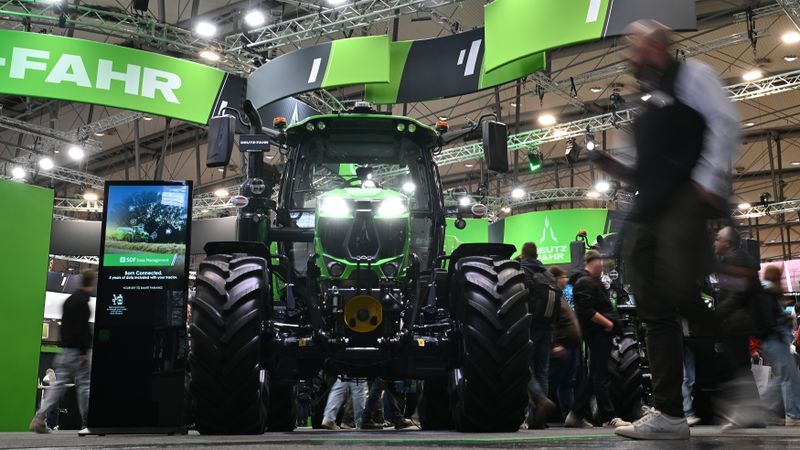
Agritechnica in Hanover brought together the agricultural machinery sector - which is also served by classic car suppliers.
(Image: Arnold NextG)
How many similarities are there between the passenger car industry and agricultural engineering? At the Agritechnica trade fair, a number of companies exhibited that are active on and off-road. Horse Powertrain, for example - a merger of the drive divisions of Renault, Geely and an investment by the Saudi Arabian oil company Aramco - has so far mainly offered passenger car drives and transmissions.
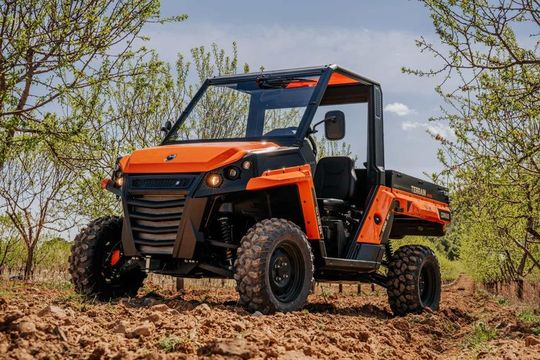
At Agritechnica, the company introduced its first engine in an agricultural vehicle that will go into production in spring 2026. It is a three-cylinder gasoline engine with approximately 60 kW, installed in a Utility Terrain Vehicle (UTV) from the Spanish manufacturer Corvus.
According to Horse Powertrain, the requirements for engines in passenger vehicles and agricultural applications are fundamentally similar. "The main difference is that agricultural machines are work equipment. Aspects such as efficiency, durability, and the availability of spare parts are clearly at the forefront," explained Alejandro Ruiz Luque, Business Development Manager of Horse Powertrain in Spain. "The most important thing is to understand the engine's work cycle. The idle speed is much more relevant in agricultural machines than in passenger cars."
For the future, Horse envisions a downsizing of the drive, where a powerful internal combustion engine could provide the energy that was previously supplied by three or four engines. By customizing the base engine with different calibrations, development costs can be scaled, and operating costs reduced. According to Alejandro Ruiz Luque, Horse received many visits from customers at Agritechnica who were looking for drives for their vehicles—specifically for UTVs and other agricultural vehicle segments.
More Digitalization in the Field
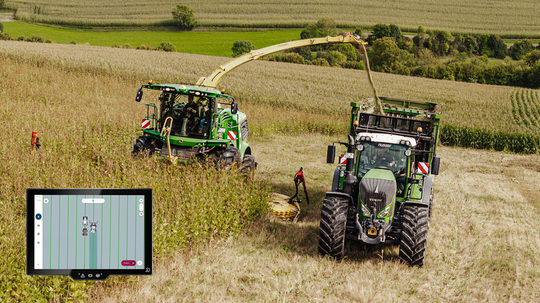
For years, the company "Arnold NextG" has known both worlds. Starting with a disability-friendly joystick control for passenger cars, the company has now developed a central control unit for complex drive-by-wire system architectures with "NX Next Motion"—implemented in dozens of (pre-)development projects with manufacturers of passenger cars, trucks, defense vehicles, agricultural machinery, and construction equipment.
The drive-by-wire system "NX Next Motion" enables autonomous lane keeping, teleoperated driving, and precise joystick steering.
(Source: Arnold NextG)
As a system supplier, Arnold NextG views the digital drive system architecture in passenger cars as somewhat more complex than in agricultural machinery, particularly in tractors. This is largely because a passenger car features additional electric steering support, high-dynamic steering requirements at higher speeds, and many additional safety and comfort functions. Additionally, there are more extensive proof and documentation obligations, quality processes, and higher safety requirements for "onroad" vehicles.
According to Arnold NextG, agricultural machinery is generally somewhat simpler in design, but no less demanding. Additionally, both passenger car and agricultural machinery manufacturers are similarly pragmatic and solutions-oriented, even though the agricultural machinery sector seems to represent more traditional engineering—while passenger car manufacturers have become noticeably more software-oriented. The main differences are the lower production volumes in agricultural machinery and somewhat less price pressure.
While Arnold NextG has already implemented several small series projects with up to several hundred drive-by-wire vehicles for passenger cars, trucks, construction, and military vehicles, so far, only prototypes and pre-development projects have been conducted for tractors. However, serious inquiries for the first small series projects for drive-by-wire tractors have already been received.
From Passenger Car to Tractor
Schaeffler has already implemented many series projects with agricultural technology customers. The supplier has equipped several fully electric and hybrid agricultural machines with electric traction motors, further developed from passenger car applications. Another carry-over product is the hydraulic adjustment of valve clearance in diesel engines to reduce emissions and increase efficiency.
Corvus aims to bring automotive standards to the world of so-called Utility Terrain Vehicles with the new drive from Horse Powertrain.
(Source: Corvus)
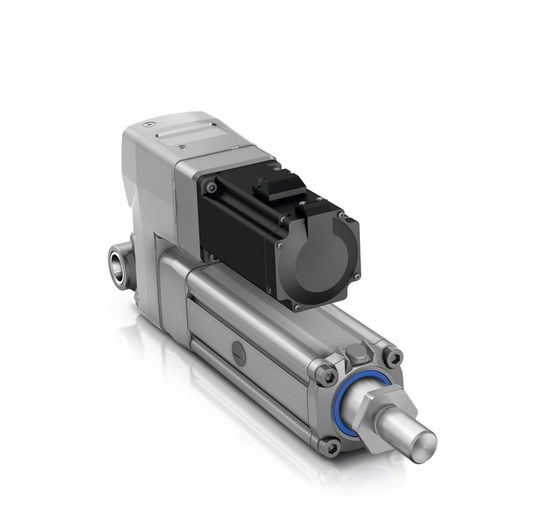
The company also traditionally markets "Schaeffler classics" such as bearings, electromechanical linear actuators, coupling, and damping systems in both realms, such as passenger car wheel bearings in modified forms for disc harrows. Electric auxiliary drives and exhaust sensors also fall into this category.
Durable Components in Demand
According to Schaeffler, the attributes of durability and robustness hold even greater significance in agricultural technology, as different operational times and load cycles are required. The environmental conditions—forces, temperatures, water, and dust—are also more demanding in agricultural technology. In combustion engines, the power split for main and auxiliary drives adds further requirements.
Date: 08.12.2025
Naturally, we always handle your personal data responsibly. Any personal data we receive from you is processed in accordance with applicable data protection legislation. For detailed information please see our privacy policy.
Consent to the use of data for promotional purposes
I hereby consent to Vogel Communications Group GmbH & Co. KG, Max-Planck-Str. 7-9, 97082 Würzburg including any affiliated companies according to §§ 15 et seq. AktG (hereafter: Vogel Communications Group) using my e-mail address to send editorial newsletters. A list of all affiliated companies can be found here
Newsletter content may include all products and services of any companies mentioned above, including for example specialist journals and books, events and fairs as well as event-related products and services, print and digital media offers and services such as additional (editorial) newsletters, raffles, lead campaigns, market research both online and offline, specialist webportals and e-learning offers. In case my personal telephone number has also been collected, it may be used for offers of aforementioned products, for services of the companies mentioned above, and market research purposes.
Additionally, my consent also includes the processing of my email address and telephone number for data matching for marketing purposes with select advertising partners such as LinkedIn, Google, and Meta. For this, Vogel Communications Group may transmit said data in hashed form to the advertising partners who then use said data to determine whether I am also a member of the mentioned advertising partner portals. Vogel Communications Group uses this feature for the purposes of re-targeting (up-selling, cross-selling, and customer loyalty), generating so-called look-alike audiences for acquisition of new customers, and as basis for exclusion for on-going advertising campaigns. Further information can be found in section “data matching for marketing purposes”.
In case I access protected data on Internet portals of Vogel Communications Group including any affiliated companies according to §§ 15 et seq. AktG, I need to provide further data in order to register for the access to such content. In return for this free access to editorial content, my data may be used in accordance with this consent for the purposes stated here. This does not apply to data matching for marketing purposes.
Right of revocation
I understand that I can revoke my consent at will. My revocation does not change the lawfulness of data processing that was conducted based on my consent leading up to my revocation. One option to declare my revocation is to use the contact form found at https://contact.vogel.de. In case I no longer wish to receive certain newsletters, I have subscribed to, I can also click on the unsubscribe link included at the end of a newsletter. Further information regarding my right of revocation and the implementation of it as well as the consequences of my revocation can be found in the data protection declaration, section editorial newsletter.
The electromechanical linear actuators from Schaeffler are designed to reduce energy consumption and operating costs.
(Source: Schaeffler)
In daily collaboration, Schaeffler considers experiential knowledge regarding the specific agricultural applications to be essential. "You simply have to know how a machine is used, whether in terms of operating times or working environment," was stated at the Schaeffler booth in Hannover. "Agricultural machines are pure work machines where efficiency and high functionality are crucial. Additionally, understanding the corporate culture of agricultural equipment manufacturers is important."
Schaeffler sees a future trend in intelligent sensor technology for smart farming and even greater functionality. User comfort is also becoming increasingly important. In terms of drives, the focus is on emission reduction and a higher integration of functions within the overall drive system. Additionally, Schaeffler expects that, similar to new automotive concepts, software-defined vehicles and new E/E architectures will be adopted in agricultural machinery in the medium term.



:quality(80)/p7i.vogel.de/wcms/a0/47/a04725ef9bd09fb6c9341a1bea1b5d93/0130443083v1.jpeg "Here, a type of plastic pallet is produced by thermoforming (vacuum forming or deep drawing) at the corresponding division of New England Plastics in the USA. This division, which specializes in so-called liners, is now part of Ringmetall ... (Image:New England Plastics)")
:quality(80)/p7i.vogel.de/wcms/e3/42/e342b3c593ea92d56604d3be969e9c9a/0130437231v1.jpeg "Daimler Truck will be building even more trucks at its Czech plant in Cheb in the future. This is because it is now being expanded for strategic cost-saving reasons ... (Image:Daimler Truck)")
:quality(80)/p7i.vogel.de/wcms/23/99/23992bf2dcdc432c9b7209c34a4a7c48/0129733089v1.jpeg "Stork relies on the modular Neoswiss turning system from Iscar to shorten the set-up times for its sliding headstock lathes and work more productively. (Image:Iscar)")
:quality(80)/p7i.vogel.de/wcms/7d/e2/7de2923434b2f1a78ba5482d8d335269/0113143253v1.jpeg "In our China Market Insider we regularly provide you with relevant information directly from China. (Image:© Eisenhans - stock.adobe.com)")
:quality(80)/p7i.vogel.de/wcms/b7/36/b736dfebc16c42d6901d0d0e1f390493/3d-druck-20factory-20--20ki-20generiert-1920x1079v1.png "(Source: AI-generated)")
:quality(80)/p7i.vogel.de/wcms/79/b2/79b21aad663f4a7bd4472afc1c1afc62/0130433994v1.jpeg "Mission Joyride: The free-flying robot (shown here in the rendering) will relieve the ISS crew of logistics tasks from 2027 with its two mechanical arms. (Image:Icarus Robotics)")
:quality(80)/p7i.vogel.de/wcms/6b/45/6b4546fa6ebf305c3660326909363f32/0130437089v1.jpeg "Industrial AI in action: Rockwell Automation presents practical solutions for self-controlling production systems at the Hannover Messe. (Image:Rainer Jensen, Deutsche Messe)")
:quality(80)/p7i.vogel.de/wcms/78/e9/78e9188c25a8a94e67c34c9bf8ffe495/visual-agile-20robots-20and-20google-20deepmind-20partner-20to-20bring-20intelligence-20to-20robotics-2500x1406v1v1.jpeg "Together, the partners are developing adaptable, intelligent robots for a wide range of applications (Image:Agile Robots SE)")
:quality(80)/p7i.vogel.de/wcms/59/a2/59a2b11f0aa1b700eff02addd5de8703/adobestock-1788280853--c2-a9-20satria-20-e2-80-93-20stock-adobe-com-5081x2860v1v1.jpeg "Quantum computers require extreme cooling to temperatures close to absolute zero in order to keep qubits stable. (Image:satria - stock.adobe.com)")
:quality(80)/p7i.vogel.de/wcms/62/5f/625f41e87ebfef156a98c8e6393e32fd/0130211654v1.jpeg "Axial flux motors have some advantages over radial flux motor—but their production is currently still expensive. (Image:RWTH Aachen University)")
:quality(80)/p7i.vogel.de/wcms/f6/ae/f6aec4f6241b36ed5e3a990ac9176b42/0130429460v1.jpeg "Verne, Pony.ai and Uber want to launch a robotaxi service in Europe. (Image:Verne)")
:quality(80)/p7i.vogel.de/wcms/d7/88/d788699f2974708a332baa4e7a62fa9e/0130438967v1.jpeg "Skoda is withdrawing from China. The brand has produced well over three million vehicles there. (Image:Skoda car)")
:quality(80)/p7i.vogel.de/wcms/b0/43/b043b86899837532aad62d63368a917a/0130371361v1.jpeg "Skoda leaves the chinese market.
(Image:Skoda)")
:quality(80)/p7i.vogel.de/wcms/c3/c4/c3c4ce270b083eeac55654148611f064/0130237945v1.jpeg "China is not giving up on hydrogen, but is intensifying its efforts. (Image:freely licensed from Pixabay)")
:quality(80)/p7i.vogel.de/wcms/ee/09/ee09acbd6dc896df25affaa9e871e6e5/0130440053v1.jpeg "IMS chip module for simple system integration into an ion mobility spectrometer. (Image:Fraunhofer IPMS)")
:quality(80)/p7i.vogel.de/wcms/10/6c/106cd22de5f68a0f74639d654827228c/0130345302v1.jpeg "Made in India: According to the India Electronics and Semiconductor Association (IESA), the country should be able to produce between 75 and 80 million chips by the beginning of 2027, once the plants currently under construction become operational. (Image:Pixabay (Montage: Sebastian Gerstl))")
:quality(80)/p7i.vogel.de/wcms/a5/ed/a5ed6fda029d362732a293d6b19d74c4/0130444216v1.jpeg "Thirteen executives from the Chinese chip industry have drawn up a plan to achieve an 80% self-sufficiency rate for semiconductors by 2030. (Image:Maxim_Kazmin - stock.adobe.com)")
:quality(80)/p7i.vogel.de/wcms/31/a6/31a646018b34d8e0a44bfc8bf17837f6/0130361632v1.jpeg "For many companies, PFAS are considered indispensable in electronics production. (Image:freely licensed)")
:fill(fff,0)/images.vogel.de/vogelonline/companyimg/76800/76895/65.jpg "FAULHABER_120mm.jpg ()")
:quality(80)/p7i.vogel.de/wcms/fd/83/fd83108740c3479dea41cb3157ac0296/0128163140v1.jpeg "After mechanization, the digitalization of agriculture now follows. (Source:Geringhoff)")
:quality(80)/p7i.vogel.de/wcms/53/ef/53ef65b954ddefadb2956dea1ca24369/bild1-deutz-agritechnica-4047x2275v1v1.jpeg "Telehandlers are pioneers in the application of electric drives. Pictured here: a Magni telehandler with a Deutz battery. (Image:Deutz AG)")