From
konstruktionspraxis | Translated by AI
12 min Reading Time
A wide range of sensors is available for level monitoring. But what technologies are there for level control, especially of bulk materials and liquid media? How do the different methods work, and for which applications are they suitable?
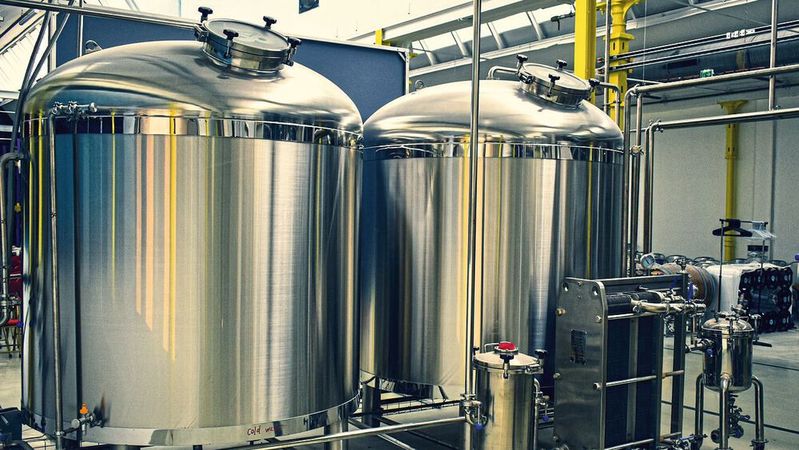
How much liquid might these tanks contain? A level measurement provides the answer.
Level measurement or level control is used to check the level of liquids and bulk materials in containers and vessels such as process and storage tanks, silos, or open channels. The measurement values obtained during level monitoring are converted into electronic signals and transferred to the control loop of process control.
Continuous monitoring or detection of a threshold level?
In general, a distinction can be made between a
continuous level monitoring and
detection of a fill limit level.
In continuous level measurement, the level of a medium or bulk material is determined permanently and the results are output, for example, in volume or mass units as an analog signal or digital value. Continuous level measurement can thus ensure that the level in a tank, for example, always remains within a certain, previously defined range.
The monitoring of a limit level, on the other hand, always refers to a previously defined medium level to avoid, for example, the overfilling of a container or the dry running of pumps for media conveyance. The measurement results from so-called level limit switches are usually output by evaluation electronics as a switching signal to initiate, for example, the refilling of a container via a system control.
Combination devices for level control feature both a switch and an analog output, allowing them to monitor both the fill limit level and continuously monitor a fill level.
Non-contact and contact-based level control
A key distinguishing criterion for level control sensors is the classification into non-contact and contact-based methods:
Contact-based methods work with measuring probes that come into direct contact with a bulk material or liquid for level monitoring.
Non-contact methods, on the other hand, operate without media contact and are therefore largely wear-free. They are preferred in applications where the level of particularly aggressive media, high-temperature liquids, or the level in particularly large or tall containers such as silo tanks needs to be monitored.
Methods for level monitoring and control
There are a multitude of possibilities and methods for querying levels or media levels. The selection of an appropriate solution primarily depends on the medium or material to be measured and the environmental conditions at the site of use. Various and mostly widely used methods are available, operating according to different measurement principles. They are divided into contact methods and non-contact methods.
The functioning and measurement principles of the mentioned methods are described below, along with some examples of their application areas.
—conductive level control
This is how conductive level control works: Conductive level measurement is probably one of the simplest methods for querying electrically conductive media based on water. Since it operates on the basic principle of an open or closed circuit, several probes or electrodes are required for measurements, between which the resistance of the medium to be monitored is measured.
For this purpose, a level relay is connected via signal lines to a reference electrode and a measuring electrode or multiple measuring electrodes. The AC voltage generated by the electronics in the probe relay is applied between the reference electrode and a single electrode or multiple measuring electrodes. As soon as the electrically conductive medium closes the circuit between the single or measuring electrodes and the reference electrode, an AC current flows and the relay output switches. The length of the single electrode or multiple measuring electrodes in a container thus determines the level at which a switching signal is output.
Possible applications of conductive level sensors: In conjunction with probes, the level relays can be used for two-point control of pump operation or as overfill protection and dry-run protection.
The key advantages of conductive level control arise from the relatively simple handling of the corresponding solutions, which offer a wide range of applications for monitoring fill or limit levels of electrically conductive liquid and pasty media based on water.
—capacitive level control
This is how capacitive level control works: Capacitive sensors for level control operate on the principle of a plate capacitor. The active surface of the sensors consists of two concentrically arranged electrodes or field plates (unfolded plate capacitor), between which an electric field is established. The capacitance of a capacitor is influenced, among other things, by the permittivity of the material between the field plates (in electrodynamics and electrostatics, permittivity ε indicates the ability of a material to polarize in response to electric fields). Consequently, the capacitance of the electrode arrangement of a capacitive sensor also depends on the material that is within its electric field.
Date: 08.12.2025
Naturally, we always handle your personal data responsibly. Any personal data we receive from you is processed in accordance with applicable data protection legislation. For detailed information please see our privacy policy.
Consent to the use of data for promotional purposes
I hereby consent to Vogel Communications Group GmbH & Co. KG, Max-Planck-Str. 7-9, 97082 Würzburg including any affiliated companies according to §§ 15 et seq. AktG (hereafter: Vogel Communications Group) using my e-mail address to send editorial newsletters. A list of all affiliated companies can be found here
Newsletter content may include all products and services of any companies mentioned above, including for example specialist journals and books, events and fairs as well as event-related products and services, print and digital media offers and services such as additional (editorial) newsletters, raffles, lead campaigns, market research both online and offline, specialist webportals and e-learning offers. In case my personal telephone number has also been collected, it may be used for offers of aforementioned products, for services of the companies mentioned above, and market research purposes.
Additionally, my consent also includes the processing of my email address and telephone number for data matching for marketing purposes with select advertising partners such as LinkedIn, Google, and Meta. For this, Vogel Communications Group may transmit said data in hashed form to the advertising partners who then use said data to determine whether I am also a member of the mentioned advertising partner portals. Vogel Communications Group uses this feature for the purposes of re-targeting (up-selling, cross-selling, and customer loyalty), generating so-called look-alike audiences for acquisition of new customers, and as basis for exclusion for on-going advertising campaigns. Further information can be found in section “data matching for marketing purposes”.
In case I access protected data on Internet portals of Vogel Communications Group including any affiliated companies according to §§ 15 et seq. AktG, I need to provide further data in order to register for the access to such content. In return for this free access to editorial content, my data may be used in accordance with this consent for the purposes stated here. This does not apply to data matching for marketing purposes.
Right of revocation
I understand that I can revoke my consent at will. My revocation does not change the lawfulness of data processing that was conducted based on my consent leading up to my revocation. One option to declare my revocation is to use the contact form found at https://contact.vogel.de. In case I no longer wish to receive certain newsletters, I have subscribed to, I can also click on the unsubscribe link included at the end of a newsletter. Further information regarding my right of revocation and the implementation of it as well as the consequences of my revocation can be found in the data protection declaration, section editorial newsletter.
When an object (e.g., a liquid medium) approaches the active area of the sensor, the electric field in front of the electrode surfaces changes, and thus the capacitance changes. This change in capacitance is converted into a switching signal by an evaluation unit.
Possible applications of capacitive level sensors: Capacitive level sensors are typically characterized by a large sensor area and thus high sensitivity. They are suitable for applications such as dry-run protection for pumps or overfill protection for containers.
In addition, there are solutions with special electrodes that have high response sensitivity and a wide adjustment range for calibration. Such devices allow for compensation of any adhesions on the sensor, such as residues of viscous or pasty media, during level measurement. These sensors are particularly suitable for measuring the fill level in containers, for instance, with cooling or lubricating agents for machine tools, or for monitoring levels in containers with acids, oils, alkalis, and cleaning agents.
—hydrostatic level control (cable probes, pressure sensors)
This is how hydrostatic level control works: Sensors for hydrostatic level monitoring determine the level based on the hydrostatic pressure exerted by the height of a liquid column in a container on a measuring membrane in the device. The downstream electronics convert the static pressure of the liquid column into an analog measurement signal.
The determination of the level depends on the specific density of a medium and the so-called gravitational constant (32,17 ft/s²). Due to gravity or Earth's attraction, the hydrostatic pressure increases as the height of a liquid column in a container rises.
The corresponding formula is:
h = p / ρ x g (h = height of the liquid column (m), p = hydrostatic pressure (Pa relative), ρ = density of the medium/liquid (kg/m³), g = gravity/gravitational constant (m/s²))
For water, as a rule of thumb, it can be assumed that a pressure of 100 kPa (= 1 bar) corresponds to a fill height of a 32.81 feet water column. This rule of thumb can then be used for selecting or specifying a solution suitable for a particular application, where hydrostatic pressure sensors (also referred to as cable or level probes) are typically calibrated to a specific water column and pressure range.
This is how pressure sensors for level control work: In addition to the described cable probes as devices specialized for level measurements, many pressure sensors are also among the solutions that enable hydrostatic level monitoring. The operating principle of such sensors is similar to that of cable probes and is based, for example, on a membrane construction widely used in electronic pressure measurement technology.
In piezoresistive thin- and thick-film sensors, resistors are applied to a membrane, whose values change under a pressure-induced mechanical stress. Each pressure measurement is a differential pressure measurement between the two surfaces of the membrane, distinguishing between absolute and relative pressure. In most cases, these sensors measure the relative pressure of a liquid or gaseous medium, in relation to atmospheric air pressure.
Pressure sensors are usually installed on the side at the lower part of a container filled with liquid for level measurement. For level control, the hydrostatic pressure measured at the installation point is converted into the corresponding fill height of the container.
Possible applications of hydrostatic level sensors: The applications of hydrostatic sensors typically extend to level monitoring of liquid media such as water, wastewater, and solvents.
Since such solutions measure the static pressure, they can also be used to monitor gel-like or pasty media, such as oil sludge or fats.
These sensors are thus suitable for a wide range of applications and are generally easy to install, as they can simply be lowered into a container.
For precise level monitoring, usually only one sensor and an evaluation unit are needed.
—Inductive level control
This is how inductive level control works: In principle, inductive level control is a specialized method for monitoring levels in so-called vibratory bowls or vibratory conveyors. Solutions operating by this method take advantage of the fact that inductive proximity switches can detect all conductive metals at a short distance without being influenced by other materials.
The solutions consist of a holder with an integrated inductive proximity switch and a movable pendulum containing a metal part for detection. In its initial position, the pendulum follows gravity and hangs vertically downward. Here, the metal part embedded in the pendulum is in contact with the active surface of the inductive sensor, which then emits a switching signal.
For level measurement, the device is mounted over a vibratory conveyor so that the pendulum extends into the container. When the conveyor is turned on, the material inside moves in a specific direction due to the vibrations. The pendulum is carried along by the material flow, causing the integrated metal part to move away from the inductive sensor, which then does not emit a switching signal. When there is little or no material left in the vibratory conveyor, the pendulum moves back to its vertical initial position. The inductive sensor switches and can thereby signal, among other things, that the conveyor needs to be refilled with new material.
Non-contact level monitoring
The functioning and measurement principles of the mentioned methods are described below, along with some examples of their application areas.
—optical level control
This is how optical level control works: There are a variety of different solutions for optical level control, for example:
sensors operating with visible red light or infrared light
very precise laser sensors with long ranges, as well as
single-beam photoelectric sensors
Optical sensors combine the transmitter and receiver in one device. The emitted light is reflected by the medium or material being measured and detected by the receiver, causing the sensor's switching output to change its state within the defined sensing range. Optical sensors operate without contact and mostly use red light, with devices featuring background suppression being particularly suitable for level measurements.
Such solutions have a precisely defined sensing range within which they detect objects almost independently of their surface and color. Beyond the sharply defined measuring range, in the background, all objects are ignored by the device regardless of their nature or surface.
The use of optical sensors with background suppression in level measurements always aims to obtain a clear switching signal from a certain fill level onwards. The choice of a suitable sensor therefore depends, among other things, on the type of medium or material to be measured and the sensor's range required for a specific application. Which solution ultimately proves ideal for an application can only be assessed by closely examining the specific task considering all influencing factors. Generally, devices with relatively long ranges are recommended for optical level monitoring.
If such solutions reach their limits in terms of range, optical sensors using infrared light can be an alternative, achieving much greater ranges. Such devices sometimes have a relatively large light spot and are therefore suitable for level measurements where materials with rather irregular surface structures need to be reliably detected.
A problem with bulk materials can be the so-called coning, where the material accumulates in the center while filling a container. In such a case, an optical sensor may detect a higher point of a material cone and switch even though the previously defined fill level has not yet been reached in the container.
Laser sensors with background suppression also integrate the transmitter and receiver in one device and allow for particularly precise level monitoring of liquid media from greater distances due to the focused laser light.
For continuous optical level control via an analog signal, optical sensors or laser sensors based on triangulation are recommended. In this method, the distance to an object is measured indirectly via the angle of incidence of the light signal reflected from the object (media surface) and converted into a measurement signal by the internal electronics. This operating principle enables distance and thus level measurement that is almost independent of color and surface.
High-performance light barriers are essentially used wherever other optical systems for level monitoring fail. These single-beam photoelectric sensors particularly show their strengths in applications with high dust and dirt levels.
High-performance light barriers consist of a three-part system comprising a transmitter, receiver, and an amplifier as the central component. The very long ranges that such systems can achieve are usually not fully utilized; instead, the performance reserves provided by the high transmission power are used at shorter distances for highly efficient contamination compensation. High-performance light barriers are therefore particularly suitable for level monitoring in applications where there is a high dust or dirt load.
Similar to optical sensors, it primarily depends on the specific application and the prevailing operating conditions to determine which system solution consisting of transmitter, receiver, and amplifier is ultimately suitable for level control.
—level monitoring with guided microwave
This is how level monitoring with guided microwave works: In this method, microwaves are conducted through a measuring rod or probe of a sensor. These waves are reflected upon contact with the medium. The level can be calculated from the travel time of the microwaves from the sensor through the measuring rod to the media surface and back. The lower end of a probe or measuring rod essentially marks the zero point of the level measurement in this method.
Level sensors operating on this method allow for very precise measurements without prior media calibration, with devices offering both switch and analog output available.
Tasks of such sensors include level/threshold level monitoring in containers with oils, alkalis, and cleaning agents. Additionally, there are solutions that respond exclusively to media contact at the measuring tip and are suitable for monitoring levels in plastic or metal containers, for example, with hydraulic oils, emulsions, powders, or granules, etc.
—level control with ultrasound
This is how level control with ultrasound works:
Ultrasonic sensors or switches operate based on the echo travel time method. For this, the transducer of the sensors, which also serves as the receiver, cyclically emits a high-frequency sound pulse that is reflected by a media surface. The fill level in a container is determined based on the time taken by the sound pulse to travel from the sensor to the surface and back to the transducer.
Ultrasonic sensors operate without contact and are therefore wear-free. They are thus ideal for level measurement of containers with aggressive media. Due to their long ranges, they are also suitable for level measurements from greater distances, such as in silos or deep tanks. The sensors can be used with all media that can sufficiently reflect sound, regardless of whether they are transparent or opaque. Ultrasonic sensors are therefore preferably used where highly transparent liquids need to be measured, for example.
This is how level monitoring with radar sensors works:
If optical sensors or ultrasonic sensors in level monitoring do not provide the desired results due to interfering ambient light, high temperatures, gases or vapors, overpressure, underpressure, or vacuum, as well as dust and dirt, radar sensors can help.
The non-contact and thus also wear-free devices operate using the time-of-flight method. Here, the sensor periodically emits a radar signal with a linearly increasing and decreasing frequency at a constant rate of change over time, which is reflected by a liquid medium, for example. The fill level in a container can then be measured based on the time shift and frequency deviation of the reflected radar signal.
Depending on the device type, radar sensors achieve very long ranges and offer the crucial advantage that they can be used in applications, for example, under pressure, gas stratifications, or foam formation on liquid media. Even measurements through container walls, such as IBC containers, or protective windows made of plastic are possible.
Suppliers of sensors for level monitoring
ABB
ACS
Afriso
Balluff
Bürkert
Endress + Hauser
Honeywell
IFM
IPF Electronic
Krohne
Leuze
Microsonic
Pepperl + Fuchs
Pulsar
Siap + Micros
Siemens
STS
TDK
Temposonics
Turck
UWT
Vega
Wika
Woerner
This list is an excerpt with no claim to completeness.



:quality(80)/p7i.vogel.de/wcms/dd/08/dd086510d9ae7b50181f6070e4463b44/0129363730v1.jpeg "Typical application for ionizing devices: Wrapping films. (Picture: ©Adobe Stock/SMC)")
:quality(80)/p7i.vogel.de/wcms/35/57/3557c819943c53acec41a0ccba87da4f/0130049064v1.jpeg "Researchers at the Fraunhofer IWU in Chemnitz have long known that many typical sheet metal parts can be manufactured more cost-effectively using hollow embossing rollers. Now there is news to report ... (Image:Fraunhofer IWU)")
:quality(80)/p7i.vogel.de/wcms/59/02/590246e3b3f415c65edbee377c14ca77/26-06-pi-fraunhofer-iws-41450-direktplattieren-pic-01-7771x4369v1v1.jpeg "The Fraunhofer IWS has developed the new \"direct laser cladding\" process, which creates a functional layer directly on the base body by applying a strip-shaped metal to rotationally symmetrical components in a spiral and bonding it locally by laser. (Image:Christoph Wilsnack/Fraunhofer IWS)")
:quality(80)/p7i.vogel.de/wcms/73/60/73608418789b1d9c393f5e2fa974eda2/0130209906v1.jpeg "The robots of the X6 generation from b+m enable very high painting quality and are also particularly compact and easy to maintain. (Image:Beckhoff)")
:quality(80)/p7i.vogel.de/wcms/78/e9/78e9188c25a8a94e67c34c9bf8ffe495/visual-agile-20robots-20and-20google-20deepmind-20partner-20to-20bring-20intelligence-20to-20robotics-2500x1406v1v1.jpeg "Together, the partners are developing adaptable, intelligent robots for a wide range of applications (Image:Agile Robots SE)")
:quality(80)/p7i.vogel.de/wcms/e7/66/e7669ecf0260ae8fc54c214e34e4902a/0130316817v1.jpeg "Siemens and Palo Alto Networks offer tested cybersecurity solution for industrial 5G. (Image:Siemens)")
:quality(80)/p7i.vogel.de/wcms/9f/55/9f55324832c4f426958031375124d9de/siemens-20ubtech-20hmnd-1920x1079v1v1.png "Ready for the factory floor: While Ubtech is planning mass production, Siemens is already testing humanoids in real factory applications in Erlangen. (Image:Siemens)")
:quality(80)/p7i.vogel.de/wcms/11/36/113695ed260e29c8c2d9d39dc5f9d869/0130213768v1.jpeg "AI can work cheaply in China and deliver the results rapidly all over the world. (Image:Dall-E / AI-generated)")
:quality(80)/p7i.vogel.de/wcms/62/5f/625f41e87ebfef156a98c8e6393e32fd/0130211654v1.jpeg "Axial flux motors have some advantages over radial flux motor—but their production is currently still expensive. (Image:RWTH Aachen University)")
:quality(80)/p7i.vogel.de/wcms/77/9b/779b0685d010dfe45c9c2cb1cfecd467/0128886425v1.jpeg "The BlueEye is the first \"real\" hyperspectral camera for the UV range and covers the wavelength range from 220 to 380nm. (Image:Inno-spec GmbH)")
:quality(80)/p7i.vogel.de/wcms/e4/51/e451d52ce0182fb0aaa46a5774f832ef/26-04-pi-fraunhofer-iws-21160-bioslide-pic-01-4128x2321v1v1.jpeg "With the BioSlide research project, the Fraunhofer IWS is investigating how sliding systems can be designed to be more sustainable and energy-efficient. New materials can be tested in a particularly application-oriented manner on this plain bearing test stand. (Image:Fraunhofer IWS)")
![Thanks to advanced 3D printing technology, a more efficient use of resources should contribute to lower-emission aviation—this is the goal of ['skai]-lab. (Image:Oleksandr Pashchenko - stock.adobe.com / AI-generated)](https://cdn1.vogel.de/nghHNSbySccfOjG3n1qCA-FVOjQ=/288x162/smart/filters:format(jpg):quality(80)/p7i.vogel.de/wcms/62/64/626424c97a16e69f871bf216c9629c2a/adobestock-1927043193--c2-a9-20oleksandr-20pashchenko-20-e2-80-93-20stock-adobe-com-ki-generiertv1v1.jpeg "Thanks to advanced 3D printing technology, a more efficient use of resources should contribute to lower-emission aviation—this is the goal of ['skai]-lab. (Image:Oleksandr Pashchenko - stock.adobe.com / AI-generated)")
:quality(80)/p7i.vogel.de/wcms/c3/c4/c3c4ce270b083eeac55654148611f064/0130237945v1.jpeg "China is not giving up on hydrogen, but is intensifying its efforts. (Image:freely licensed from Pixabay)")
:quality(80)/p7i.vogel.de/wcms/4e/c0/4ec0bd19390b169edfa23677373dcdf1/0130260089v1.jpeg "Renewable fuels can supply European road traffic, according to a study. (Image:Aral)")
:quality(80)/p7i.vogel.de/wcms/6f/c9/6fc9050301d745cad25585c6780f8f51/0130197341v1.jpeg "Production facilities are a worthwhile target and are therefore at risk. (Image:ABB Robotics)")
:quality(80)/p7i.vogel.de/wcms/b6/62/b662adc2cec8227d8172509bbfb6ee42/25c0207-107-4961x2789v1v1.jpeg "The GLB is the second model based on Mercedes' new MMA platform. Apparently, Geely's platform is better and cheaper, which is why the two companies are negotiating a partnership. (Image:Mercedes-Benz)")
:quality(80)/p7i.vogel.de/wcms/4d/dd/4dddf438e91f394c04a095dbfd109d1c/0130236430v1.jpeg "Measurement modules: The 720301 module in combination with the SL2000 enables RMS and power calculations, among other things. (Image:Yokogawa)")
:quality(80)/p7i.vogel.de/wcms/61/fc/61fcf95f5cca15494ad18343901ae585/0130317237v1.jpeg "With the AGI CPU, Arm says it is taking a \"historic step\": With the processor aimed at AI in data centers, the company is presenting itself for the first time as a provider of its own chips, not just as a pure IP licensor. (Image:Arm)")
:quality(80)/p7i.vogel.de/wcms/82/90/8290dfe3595b6c6b33726ae8b76172c7/0130319587v1.jpeg "The concept image illustrates how the pattern of tiny protrusions and depressions created on the substrate (MgO, bottom) controls the arrangement of atoms in the superconducting material (YBCO, top). At the interface between the two layers, an electronic structure enables superconductivity to occur at higher temperatures than previously possible. (Image:Chalmers University of Technology / Riccardo Arpaia)")
:quality(80)/p7i.vogel.de/wcms/3a/86/3a8618de50c8f35e889d023a7b38b3bf/0119132899v1.jpeg "Foreign objects in the field can be better detected by radar than by alternative technologies. (Image:Hans Turck GmbH & Co. KG)")
:quality(80)/p7i.vogel.de/wcms/8a/f2/8af20d95ddeec478c65ff77a3f2ae66a/0109887294.jpeg "Scientists from the Max Planck Institute for Medical Research and the Institute for Molecular Systems Engineering and Advanced Materials at the University of Heidelberg have developed a new technology that allows matter to be 3D printed in just one step. In this process, ultrasound creates a sound field in which particles are shaped into an object. (Image:Kai Melde - MPI for Medical Research)")
:quality(80)/p7i.vogel.de/wcms/5e/64/5e64642e4ef21cf70cb1aba8c9bbf6f6/0128040232v1.jpeg "As a system and solution provider, Jumo not only supplies individual measuring devices but also offers a holistic concept for process monitoring connected to the implemented process control in one of the two truck trailers. (Image:Jumo)")
:quality(80)/p7i.vogel.de/wcms/a9/18/a9189a26e5a3b3347658eb3babe10637/0127958464v1.jpeg "The photoelectric mini sensors from Contrinex are, according to the manufacturer, the smallest optical sensors with integrated electronics on the market. They are available as diffuse sensors or through-beam sensors. (Image:Contrinex, Shutterstock/asharkyu)")