Many radar sensors for collision avoidance measure the distance and thereby provide only one dimension as a measurement value. Turck's new radar scanner MR15-Q80, on the other hand, provides real 3D data, substantially improving the representation of objects and spaces.
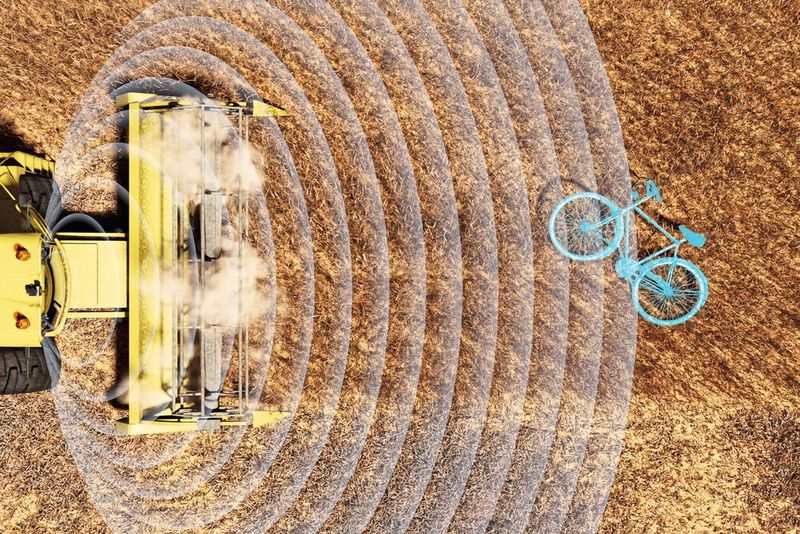
Foreign objects in the field can be better detected by radar than by alternative technologies.
(Image: Hans Turck GmbH & Co. KG)
Raphael Penning is Product Manager for Distance Sensors at Turck
Radar technology is often associated with speed controls in road traffic or with flight monitoring devices. However, since the 2000s, the technology has increasingly found its use in the car itself. Active distance control systems, so-called ACC systems (Adaptive Cruise Control), use radars to determine the distance to cars driving ahead and their speed. Radars have been increasingly established in industrial automation in recent years. Especially in level and classic distance measurements, the advantages over ultrasound, optosensor, or media-touching technologies pay off in many applications.
Third party in the alliance
In 2020, Turck had already introduced its first radar sensors for level measurement with the LRS series, followed in 2021 by the DR-M30 radar sensors for distance measurement. Both device families operate in the 120-GHz range, which particularly benefits the range and resolution, meaning the accuracy of the signal. As the third member of the radar portfolio, Turck is now launching the MR15-Q80 radar sensor.
Gallery
The housing shape already makes it apparent that another type of device is supplementing the product range: Unlike the cylindrical devices for distances and levels, the MR15-Q80 is flat and cuboid in design. The underlying technology also differs: inside the robust IP69K housing, an antenna operates at 60 GHz. Compared to the 120-GHz frequency band, the lower frequency provides less resolution, but the radiation angle significantly broadens. Thus, the MR15-Q80 sensors capture objects with an opening angle of 120 degrees horizontally and 100 degrees vertically.
Mobile work machines on a safe course
The sensor achieves a range of up to an impressive 15 meters, although this maximum value can be reduced depending on the material, angle, and surface condition of the objects. Since the target applications are primarily object detection and collision avoidance, users do not need to worry about a lack of range.
Turck's new radar scanner achieves IP69K, the maximum protection against ingress of water and dust, and in this respect, meets all the requirements for the robustness of components for the mobile equipment sector. The M15-Q80 also scores points when it comes to mechanical resistance, as it can withstand shocks and impacts up to 100 g. This noticeably distinguishes radar technology from laser-based Lidar technology. Lidar systems require movable mirrors to guide the laser beams into every angle of the space to be captured. These movable mirrors are naturally susceptible to mechanical damage from shocks and vibration.
Robust in many respects
Therefore, radars are not only less sensitive to interference factors such as dust, fog, or light reflections, but are also much more mechanically robust. In addition to withstanding strong shocks, the MR15-Q80 also tolerates supply voltages of 12 or 24 volts, which are used in the electrical systems of mobile work machines – the sensor also survives any potential voltage peaks unscathed.
Turck positions the MR15-Q80 as a collision avoidance and object detection sensor for all non-safety-related tasks. It captures objects in its surroundings and - unlike similar devices - outputs measurements for all three dimensions. For mobile work machines, the new radar scanner is currently the only device on the market that can output a three-dimensional measurement via the SAE J1939 communication protocol for the CAN bus.
The MR15-Q80 provides distance and speed values for objects along all three spatial axes. This allows the environment and all objects within it to be represented much more precisely. Particularly machines that operate at different heights with arms or booms receive valuable additional information about their environment. Thanks to the 3D information, the control not only knows where an obstacle begins, but also where it ends and where the machine can operate with its arms. There are many more fields of application where having a precise knowledge of the space in front of machines can be helpful, for example in capturing topography and rock outcrops in mining.
Date: 08.12.2025
Naturally, we always handle your personal data responsibly. Any personal data we receive from you is processed in accordance with applicable data protection legislation. For detailed information please see our privacy policy.
Consent to the use of data for promotional purposes
I hereby consent to Vogel Communications Group GmbH & Co. KG, Max-Planck-Str. 7-9, 97082 Würzburg including any affiliated companies according to §§ 15 et seq. AktG (hereafter: Vogel Communications Group) using my e-mail address to send editorial newsletters. A list of all affiliated companies can be found here
Newsletter content may include all products and services of any companies mentioned above, including for example specialist journals and books, events and fairs as well as event-related products and services, print and digital media offers and services such as additional (editorial) newsletters, raffles, lead campaigns, market research both online and offline, specialist webportals and e-learning offers. In case my personal telephone number has also been collected, it may be used for offers of aforementioned products, for services of the companies mentioned above, and market research purposes.
Additionally, my consent also includes the processing of my email address and telephone number for data matching for marketing purposes with select advertising partners such as LinkedIn, Google, and Meta. For this, Vogel Communications Group may transmit said data in hashed form to the advertising partners who then use said data to determine whether I am also a member of the mentioned advertising partner portals. Vogel Communications Group uses this feature for the purposes of re-targeting (up-selling, cross-selling, and customer loyalty), generating so-called look-alike audiences for acquisition of new customers, and as basis for exclusion for on-going advertising campaigns. Further information can be found in section “data matching for marketing purposes”.
In case I access protected data on Internet portals of Vogel Communications Group including any affiliated companies according to §§ 15 et seq. AktG, I need to provide further data in order to register for the access to such content. In return for this free access to editorial content, my data may be used in accordance with this consent for the purposes stated here. This does not apply to data matching for marketing purposes.
Right of revocation
I understand that I can revoke my consent at will. My revocation does not change the lawfulness of data processing that was conducted based on my consent leading up to my revocation. One option to declare my revocation is to use the contact form found at https://contact.vogel.de. In case I no longer wish to receive certain newsletters, I have subscribed to, I can also click on the unsubscribe link included at the end of a newsletter. Further information regarding my right of revocation and the implementation of it as well as the consequences of my revocation can be found in the data protection declaration, section editorial newsletter.
Identification of animals and objects in the field
Another application in the mobile equipment sector is the detection of animals and objects in fields. Turck's radar scanner can be mounted directly on the thresher of the combine harvester to monitor the field in front of it. Due to the different reflection properties of animals or objects and grain stalks, the sensor can detect foreign bodies in the field that would either get damaged themselves or could damage the threshing mechanism. Thanks to the large opening angles of 120 degrees horizontally and 100 degrees vertically and a range of up to 15 meters, the radar scanner can reliably detect whether the field in front of the combine harvester can be harvested without any problems.
For these and other applications, users can define warning radii that trigger a switching signal as soon as an object is inside them. Switching signals can also be reliably triggered by certain intensity thresholds, which are important for distinguishing between objects. However, the control can also fully evaluate the IO-Link signal to make use of the entire information density. Up to six freely definable warning fields and three three-dimensional signal spaces can be taught and linked with one of the two switching outputs. If one of these warning fields is in the radar shadow because an object is between the sensor and the field, the sensor also recognizes this and issues a corresponding message.
Keeping an eye on the blind spot
Another possible application on mobile work machines is blind spot warnings, i.e., the monitoring of areas on the machine that are difficult to see. If objects are located there, the vehicle can be damaged. The warning radii and signal spaces are also helpful for this purpose to issue warning signals in time.
Alternative fields of application are also emerging in intralogistics. In particular, floor conveyors and driverless transport systems (DTS) need sensors for navigation and collision avoidance. In general, LIDAR scanners are used for safety-oriented environment monitoring. However, they are only partly suitable for vertical monitoring of lifting operations on autonomous forklifts, as they usually capture a small vertical opening angle. Special safety radars and scanners would also be oversized and therefore too expensive for the non-safety-relevant function of height control.
Exact and safe control of lifting movements
Turck's 3D radar scanner provides the necessary information for all three spatial dimensions and thus fully detects obstacles and environment. This information also makes the exact and safe control of lifting operations easier. The scanned data can additionally be used to secure drive-through heights and prevent damage to vehicles, goods, and plant components. Frequently, camera systems are used for these tasks, but they are usually more expensive and much more complex to commission.
The parameterization of such complex sensors, which output more than just an analog signal or one to two switching signals, often presents a challenge. Turck supports users with its configuration and IIoT software TAS (Turck Automation Suite). The toolkit greatly simplifies the commissioning and optimal setting of signal and intensity filters, capture angles, or warning radii. The software visualizes all raw data from the sensor in quasi-real-time in the web browser. Objects are displayed as points and clouds of points on two graphs, one for the vertical data and the other for the horizontal capture angles.
Turck offers two variants of the 3D radar scanner: one with IO-Link and one with an SAE-J1939 interface, which is mainly used for mobile work machines. Both devices have two conventional switching outputs in addition to the interface for the 3D data, which can be triggered by different threshold values.



:quality(80)/p7i.vogel.de/wcms/eb/2b/eb2bd1b8487afe577b37363cd02f16ff/0113143253v1.jpeg "In our China Market Insider, we regularly provide you with relevant information straight from China. (Image:© Eisenhans - stock.adobe.com)")
:quality(80)/p7i.vogel.de/wcms/dd/b8/ddb8edc98c49b384734ab2432b297eb5/adobestock-1913662309--irene-stock-adobe-com-ki-generiertv1.jpeg "Rotary joints are used in grippers and swivel mechanisms to allow assemblies to rotate or swivel smoothly relative to one another, even under very high loads (illustrative image). (Source: Irene - stock.adobe.com / KI-generiert)")
:quality(80)/p7i.vogel.de/wcms/d1/ef/d1ef6b6f7d4543f7999980bacccaf22b/0133499261v1.jpeg "As the growing imbalance in trade relations with China continues to widen, the EU Chamber of Commerce foresees a day when trade with China will have to be seriously reevaluated ... (Image: AI-generated)")
:quality(80)/p7i.vogel.de/wcms/fe/1f/fe1fa5ee713f94deaba963dc24c3abc5/0133299273v1.jpeg "The Flexistar enables highly flexible production of laser-welded tubes thanks to its tool-free clamping system. (Image:Because Technology, LLC)")
:quality(80)/p7i.vogel.de/wcms/60/ef/60ef4f07e4829b2c2929befc0f353c58/0133511729v1.jpeg "Humanoid robots can match human performance in certain tasks. (Image:Gemini / AI-generated)")
:quality(80)/p7i.vogel.de/wcms/2e/99/2e99726b522e4b35b690e25eb6a42643/0133463991v1.jpeg "Robotics: In AMR applications, connection technology must reliably transmit power, signals, and data despite vibration and shock loads—in very confined spaces and in a way that allows for regular maintenance. (Image:Hyperever)")
:quality(80)/p7i.vogel.de/wcms/d0/18/d01801e3d5dbd7bc9d0b4f60408b630c/0133468429v1.jpeg "Quality requirements for film packaging are on the rise. At the same time, many companies are turning to recyclable film materials, which, however, have their own challenges. Fraunhofer researchers have therefore developed a fast system that detects problems in real time. (Image:Fraunhofer IKTS)")
:quality(80)/p7i.vogel.de/wcms/b1/06/b106cf44923ce39565c3264982fd20eb/0133414574v1.jpeg "Robots Build Robots: At the new Ubtech factory, automated systems even handle parts of the material supply and logistics for the production of humanoid robots. (Image:Ubtech)")
:quality(80)/p7i.vogel.de/wcms/c0/52/c052f405eb55fc3d08c4837e77206fc0/adobestock-2021845957--aucartstudio-stock-adobe-com-ki-generiertv1.jpeg "An innovation from China to combat extreme summer heat: A novel coating lowers temperatures. (Source: © AucArtStudio – stock.adobe.com_AI-generated)")
:quality(80)/p7i.vogel.de/wcms/66/a7/66a7b78159caeacce57136529688799f/0133503398v1.jpeg "Sunlight Makes Stone! These stone blocks weren't made the traditional way. Instead, they were additively manufactured from sand using a laser. In the future, however, the laser is set to be replaced by concentrated sunlight—if the startup Addisol is successful... (Image:Addisol / F. Fiedler)")
:quality(80)/p7i.vogel.de/wcms/72/b9/72b995c2c8d812c5e2115cbef31e035a/0133462727v1.jpeg "Eggl manufactures center hoods that are precisely tailored to each cooking island—whether standard size or custom shape. They are made entirely of stainless steel and are individually customized in terms of size and filter arrangement. (Image:SPI)")
:quality(80)/p7i.vogel.de/wcms/13/5d/135dfae6229ceaf5c55467a43e8f7257/adobestock-1879961393--ardi-stock-adobe-com-ki-generiertv1.jpeg "Annoying chatterboxes or awkward silences in response to questions—a moderator should specifically prepare for difficult situations in order to navigate them effectively. (Image:ardi - stock.adobe.com_AI-generated)")
:quality(80)/p7i.vogel.de/wcms/aa/a2/aaa2c6dd2daa24b485cddbf9297590c0/0133467318v1.jpeg "Battery Monitoring: Battery monitoring using electrochemical impedance spectroscopy offers several advantages. (Image:TI)")
:quality(80)/p7i.vogel.de/wcms/39/b2/39b21bf03be1683831862239a369987c/0133469638v1.jpeg "Data from autonomous vehicles and robots operating autonomously is in high demand, and Ruqi wants to capitalize on this. (Image:Ruqi Mobility)")
:quality(80)/p7i.vogel.de/wcms/8a/bb/8abbb6217220595edc1549ac9b84f307/0133429906v1.jpeg "The IAA in Hanover showcased the ambitions of Chinese commercial vehicle manufacturers in Europe. (Image:Wehner - VCG)")
:quality(80)/p7i.vogel.de/wcms/0c/53/0c5313ef91c14b6df0d0996efc33c8ad/jpg03568-bearbeitetv1.jpeg "The category winners of the 2027 German Car of the Year award. (Source: GCOTY)")
:quality(80)/p7i.vogel.de/wcms/48/15/4815da27c45973ca629a99b375ac3aef/0133509585v1.jpeg "Ventuno Q RoadTest: Designed to help the Element14 community gain practical insights from real-world tests using the Ventuno Q. (Image:Farnell/Element14)")
:quality(80)/p7i.vogel.de/wcms/17/2b/172bd132f9febdfcbcedba292ad0504d/aufmacherv1.jpeg "Micro-Epsilon offers a wide range of IO-Link-compatible sensors. (Source: Micro-Epsilon Messtechnik GmbH & Co. KG)")
:quality(80)/p7i.vogel.de/wcms/ca/b4/cab46fd26d19d6a2febca032048200b6/0133471827v1.jpeg "Photonics SDK for C and Python: Computational operations are now abstracted as standard mathematical functions. (Image:Q.ANT)")
:quality(80)/p7i.vogel.de/wcms/92/b2/92b2ed5299cde450c0764f4f64468395/0133505895v1.jpeg "The \"Iris 100\" test system for high-precision volume production of microLEDs uses a spectrometer and a high-resolution camera. (Image:Teradyne)")
:fill(fff,0)/p7i.vogel.de/companies/69/de/69de1b7403b0d/simtos-logo.jpeg "simtos-logo (SIMTOS)")
:quality(80)/p7i.vogel.de/wcms/1e/a5/1ea5374ffb06b5c8fc5f86c6e30ca394/0118330330v1.jpeg "The radar scanner at the top of the forklift also detects the height of the roller conveyor.(Image: Hans Turck GmbH & Co. KG)")
:quality(80)/p7i.vogel.de/wcms/54/9e/549e954e9e67d2dcf6063577077dd7e3/0118330326v1.jpeg "Turck's radar scanner MR15-Q80 is currently the only device with a SAE-J1993 interface for the CAN bus, an IO-Link version is also available.(Image: Hans Turck GmbH & Co. KG)")
:quality(80)/p7i.vogel.de/wcms/c0/a2/c0a2449593413fad2df59d0ae4d28bc8/0118330332v1.jpeg "The Turck Automation Suite TAS assists the user in parameterizing the scanner via the \"Radar Monitor\" app, which represents the raw signal in three graphs.(Image: Hans Turck GmbH & Co. KG)")
:quality(80)/p7i.vogel.de/wcms/64/ab/64ab4e8221ece6df3b69235b6f217ef6/0119132889v1.jpeg "Foreign objects in the field can be better detected by radar than by alternative technologies.(Image: Hans Turck GmbH & Co. KG)")
:quality(80)/p7i.vogel.de/wcms/ad/f3/adf31e538b66f477213ac14ce4bd1c99/0127633288v1.jpeg "The AI-based sensor solution Visionary AI Assist from Sick enables outdoor collision protection and environmental monitoring, reliably detecting people and objects. (Image:Sick)")
:quality(80)/p7i.vogel.de/wcms/20/d6/20d67956343287c2365a5eca2eb0a8b7/aufmacher-bihl-2bwiedemann-diagnoserepeater-20--20kopiev1.jpeg "With the ASi-5/ASi-3 diagnostic repeater, the cable length of an ASi network can be significantly extended. (Source: Bihl+Wiedemann)")