Edge Meets ConnectivityHow Colocation Data Centers Can Create Competitive Advantages
From
Carolina Heyder | Translated by AI
5 min Reading Time
Real-time data processing, GDPR compliance, and low latency are advantages of edge computing. However, maintaining an in-house data center infrastructure is challenging for many companies. A hyperscaler, on the other hand, incurs costs, latency, and dependency without offering full data sovereignty. As an alternative to choosing between edge or cloud, local colocation data centers are a viable option.
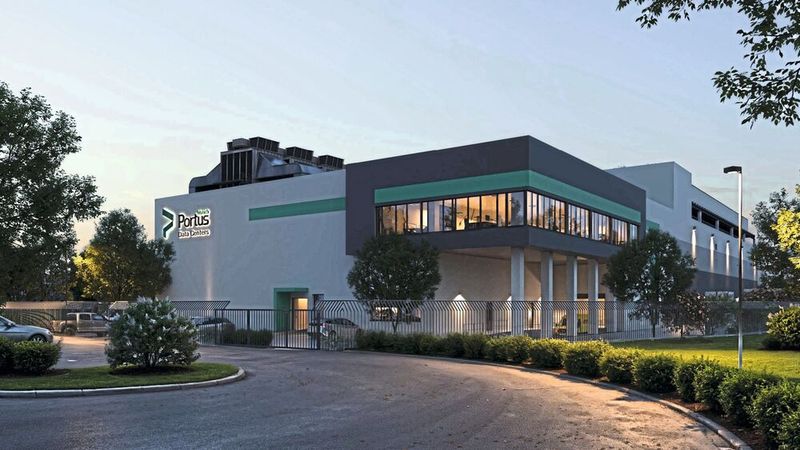
Portus colocation data center: The alternative to on-premises and hyperscalers
(Image: Portus Data Centers)
If an automotive supplier equips its production lines with AI-supported quality control today, the company can quickly reach its limits: image recognition must analyze components in real-time, identify defects, and immediately intervene in the production process in case of deviations. If data transmission to the cloud and back takes too long, defective parts can be produced on the assembly line.
Companies are more challenged than ever to develop applications that process data in real time and respond instantly. Delays can disrupt critical business processes or create competitive disadvantages.
Edge data centers address exactly this problem: data processing happens where data is generated, at the "edge" of the network, close to the endpoint. Where central clouds are too slow, local data centers enable time-critical processing with latency often under ten milliseconds.
While traditional data centers often focus on centralization and massive scaling—a typical hyperscaler data center includes tens of thousands of servers over several thousand square meters—edge data centers are generally more compact, decentralized, and positioned closer to the user.
Germany differs from other markets: While in the USA edge computing is often driven by consumer applications and content delivery networks, industrial applications dominate here. According to Bitkom, 43 percent of German industrial companies with more than 500 employees already use edge solutions, with the trend rising.
Relief for Central Clouds And Networks
The advantages of local data processing go far beyond low latency. Bandwidth savings is often an underestimated factor. For example, a modern factory generates several terabytes of machine data, sensor readings, and quality metrics daily. Transmitting all of this data to central clouds would be technically and economically inefficient.
The relief of central clouds and networks is crucial with increasing digitalization. According to Gartner, the number of connected IoT devices will exceed 75 billion by the end of 2025. If all these devices were to send their raw data to central clouds, network capacities would quickly be exhausted.
Edge Data Centers And Colocation: Local, Practical, Effective
Building and operating their own infrastructure pushes many companies to their limits. Even small edge locations require high upfront investments and sufficient skilled personnel, which are not always available.
With colocation, on the other hand, companies use professional data center infrastructure while retaining control over hardware and data. The provider merely provides space, power, cooling, physical security, and network connectivity.
In addition, the cost structure is transparent and predictable: floor space (per rack or kilowatt), electricity based on consumption, network ports, and optional managed services. Monitoring services continuously track server status, power consumption, temperature, and network connectivity. Automatic alerts are triggered in case of irregularities, with direct escalation in emergencies. This compensates for the lack of in-house 24/7 IT teams. This is a real alternative not only for medium-sized companies.
Compliance And Resilience
Digital sovereignty means more than storing data within one's own country: it represents control over digital value chains, independence from non-European providers, and the ability to operate key data processes within one's own legal framework. Local data centers are the foundation of this autonomy and indispensable for regulatory requirements: GDPR, the Telecommunications Act, and industry-specific regulations such as TISAX or KRITIS demand verifiable data localization in regional data centers.
The NIS2 directive tightens cybersecurity requirements across the EU and increases the burden of proof for risk management and incident response. Local data storage also offers resilience: edge locations continue to operate autonomously even in the event of connection failures to the central cloud—a critical advantage during network disruptions or cyberattacks.
Date: 08.12.2025
Naturally, we always handle your personal data responsibly. Any personal data we receive from you is processed in accordance with applicable data protection legislation. For detailed information please see our privacy policy.
Consent to the use of data for promotional purposes
I hereby consent to Vogel Communications Group GmbH & Co. KG, Max-Planck-Str. 7-9, 97082 Würzburg including any affiliated companies according to §§ 15 et seq. AktG (hereafter: Vogel Communications Group) using my e-mail address to send editorial newsletters. A list of all affiliated companies can be found here
Newsletter content may include all products and services of any companies mentioned above, including for example specialist journals and books, events and fairs as well as event-related products and services, print and digital media offers and services such as additional (editorial) newsletters, raffles, lead campaigns, market research both online and offline, specialist webportals and e-learning offers. In case my personal telephone number has also been collected, it may be used for offers of aforementioned products, for services of the companies mentioned above, and market research purposes.
Additionally, my consent also includes the processing of my email address and telephone number for data matching for marketing purposes with select advertising partners such as LinkedIn, Google, and Meta. For this, Vogel Communications Group may transmit said data in hashed form to the advertising partners who then use said data to determine whether I am also a member of the mentioned advertising partner portals. Vogel Communications Group uses this feature for the purposes of re-targeting (up-selling, cross-selling, and customer loyalty), generating so-called look-alike audiences for acquisition of new customers, and as basis for exclusion for on-going advertising campaigns. Further information can be found in section “data matching for marketing purposes”.
In case I access protected data on Internet portals of Vogel Communications Group including any affiliated companies according to §§ 15 et seq. AktG, I need to provide further data in order to register for the access to such content. In return for this free access to editorial content, my data may be used in accordance with this consent for the purposes stated here. This does not apply to data matching for marketing purposes.
Right of revocation
I understand that I can revoke my consent at will. My revocation does not change the lawfulness of data processing that was conducted based on my consent leading up to my revocation. One option to declare my revocation is to use the contact form found at https://contact.vogel.de. In case I no longer wish to receive certain newsletters, I have subscribed to, I can also click on the unsubscribe link included at the end of a newsletter. Further information regarding my right of revocation and the implementation of it as well as the consequences of my revocation can be found in the data protection declaration, section editorial newsletter.
Connectivity: The Underestimated Success Factor
Edge computing thrives on connectivity. An edge location without excellent network connectivity is worthless. This is where a key difference between colocation providers becomes evident. Carrier-neutral data centers allow customers the freedom to choose from dozens of network providers. This fosters competition, lowers costs, and enables optimal connections to various destinations. For example, a company can choose one provider for connectivity to AWS, another for Azure, and a third for connections to its own sites.
Direct peering opportunities and access to Internet Exchanges are invaluable. Companies connected to DE-CIX can reach thousands of networks worldwide without detours through transit providers. This not only reduces latency but also significantly lowers bandwidth costs.
For edge scenarios with 5G integration, proximity to telecommunications providers is relevant. Colocation data centers where Deutsche Telekom, Vodafone, or other carriers are already present enable short paths between the mobile network and edge infrastructure.
Strategic Locations for Edge Infrastructure
The geographical location of edge sites is crucial. Germany offers several strategic advantages: Frankfurt am Main, as the largest internet hub in Europe (DE-CIX), guarantees excellent connectivity. Munich stands out with direct access to southern Germany's economic regions and outstanding fiber optic infrastructure, while Hamburg (Germany) is relevant as a gateway to Scandinavia and its proximity to offshore wind farms, making it significant for the energy industry and logistics.
Luxembourg is also increasingly gaining importance as a data center location: the Grand Duchy is centrally located in Europe, in close proximity to Germany, France, and Belgium, and offers a stable legal and economic environment as an international financial hub. With the presence of DE-CIX Luxembourg, companies benefit from direct access to one of Europe's most important internet hubs.
Data centers in these regions achieve latencies of under five milliseconds to the key German and European economic regions.
Portus Data Centers: Regionally Anchored, Internationally Connected
Since 2020, the Portus Data Centers (PDC) Group has been offering carrier-neutral edge colocation services across Germany and the surrounding regions. Currently, the provider operates in three strategic locations: Hamburg, Munich, and Luxembourg.
The data center operator enables data processing at the company’s location—wherever customers need it. “We work closely with our customers to support their individual requirements and ensure that the needs of both their business and their end customers are met,” emphasizes Falk Weinreich, Group CEO of Portus Data Centers. “We create a state-of-the-art platform for companies of any size—regionally rooted, but with excellent international connectivity.” The goal is to provide the operation of a high-performance IT infrastructure with low latency, a critical prerequisite for business success. (mc)
Secure and Compliant Authentication in Laboratories



:quality(80)/p7i.vogel.de/wcms/51/1b/511b420dbcc296aec09e3bffb051b8a8/0133581587v1.jpeg "The cables connect numerous machine components—often in confined spaces. (Image:Helu)")
:quality(80)/p7i.vogel.de/wcms/b5/67/b5676f3bfb36251ed31f9a0cccf650b6/0133167827v1.jpeg "Thanks to JumboFlex Generation 2, employees can effortlessly move wheelchairs weighing as much as 40 kilograms. (Image:Lard)")
:quality(80)/p7i.vogel.de/wcms/5e/c6/5ec615b7a51440f668259f2af9158cb9/0132654694v1.jpeg "Strategic Partnerships in Industry: As buyers and restructuring partners, Chinese investors are increasingly helping to preserve jobs in Germany. (Image: ©Anatolii Rymarchuk - stock.adobe.com)")
:quality(80)/p7i.vogel.de/wcms/eb/2b/eb2bd1b8487afe577b37363cd02f16ff/0113143253v1.jpeg "In our China Market Insider, we regularly provide you with relevant information straight from China. (Image:© Eisenhans - stock.adobe.com)")
:quality(80)/p7i.vogel.de/wcms/aa/3e/aa3e2603a812f8e7d33c00ba8ae28c9f/0133507886v1.jpeg "With the Iggy Rob, igus is bringing a humanoid robot into factories for a price of 47,999 euros ($54,718). (Image: igus)")
:quality(80)/p7i.vogel.de/wcms/92/64/92645c64ffbb6980976d39102388d120/0113143253v1.jpeg "In our China Market Insider, we regularly provide you with relevant information straight from China. (Image:© Eisenhans - stock.adobe.com)")
:quality(80)/p7i.vogel.de/wcms/c7/05/c70542511e0824ee491f7b55e21fa429/0133598424v1.jpeg "In logistics, AI is often implemented only on a case-by-case basis; data is stored in separate systems, and inventory levels, status values, and priorities are not defined consistently. (Image: ©m-project - stock.adobe.com)")
:quality(80)/p7i.vogel.de/wcms/3a/9c/3a9c1fd546e1f041b86bb1d03cf39101/0133610524v1.jpeg "The Mason W-01 combines industrial-grade humanoid hardware, Physical AI-based perception, and autonomous task planning. (Image:Nova X Robotics)")
:quality(80)/p7i.vogel.de/wcms/e7/94/e794290f265afbd0ffc7a06c4fe9d425/adobestock-1887113836--hypnotics-14-stock-adobe-com-ki-generiertv1.jpeg "In both autonomous driving and industrial production, there is growing skepticism as to whether full autonomy is always desirable. (Source: © Hypnotics 14 – stock.adobe.com / AI-generated)")
:quality(80)/p7i.vogel.de/wcms/a8/71/a8712e5c6ef536228444ab5275cedfe2/adobestock-340905887--gorodenkoff-stock-adobe-comv1.jpeg "A new position paper outlines the conditions that the business community, academia, and policymakers must jointly establish in order to ensure the long-term viability of industry in Germany and Europe. (Source: © Gorodenkoff – stock.adobe.com)")
:quality(80)/p7i.vogel.de/wcms/7d/eb/7deb25ca674fa4c781a9d1fab083f7cf/parker-entwicklungszentrum-hresv1.jpeg "The centerpiece of the Parker Center for Drive and Control Technology in Offenbach is the exhibition area. (Source: Parker Hannifin)")
:quality(80)/p7i.vogel.de/wcms/3d/ff/3dff5e51c24b30c8dc37c1d024887157/0133602931v1.jpeg "Just a few years ago, SpaceX specialists were working on the world’s largest rocket—the Starship. Now, Elon Musk’s company has reached a milestone during a test flight: Earth’s orbit! But there was also a downside... (Image: SpaceX)")
:quality(80)/p7i.vogel.de/wcms/78/ab/78abbfbab0565fabb19efe637aea30e8/nio-power-swap-station-4-china-guangzhou-2024-1400x933-jpgv1.webp "Nio and Geely are collaborating on battery replacement for electric cars. (Source: Nio)")
:quality(80)/p7i.vogel.de/wcms/2e/58/2e58c664e733dd182666606f850c5da4/0133400664v1.jpeg "The IM6 is sort of the crossover version of the IM5. (Image:MG Motor)")
:quality(80)/p7i.vogel.de/wcms/40/5f/405f41f4075e8798878011f0932a8195/0133509065v1.jpeg "Caruso has integrated Hyundai into its platform. (Image:Hyundai)")
:quality(80)/p7i.vogel.de/wcms/06/98/06989beb3f95b8fb06d71190c86cffde/tabletv1.jpeg "The cockpit view during a test drive in the simulator. (Source: Uccello et al., IEEE OJITS 2026)")
:quality(80)/p7i.vogel.de/wcms/40/34/4034915f85470ad8264659267e4f02d0/0133655653v1.jpeg "Cariad, Volkswagen's software subsidiary, continues to struggle. Now, another round of layoffs has been announced, which will result in the loss of many jobs ... (Image:Cariad)")
:quality(80)/p7i.vogel.de/wcms/e4/2a/e42af12e2a0816bb3d25fac9932903e9/0133646920v1.jpeg "TSMC's U.S. headquarters in Arizona: According to various media reports, the world's largest contract semiconductor manufacturer may be planning to build up to six additional fabs in the state of Texas. (Image:TSMC)")
:quality(80)/p7i.vogel.de/wcms/de/8c/de8c694e560ce8e8d7d43fa5b91917b3/0133668420v1.jpeg "Open-source AI tools: DeepSeek and Huawei are making programming tools for Ascend processors available, with the aim of simplifying development, chip communication, and AI computations on Huawei's hardware—and thereby intensifying competition with Nvidia. (Image:Dall-E / AI-generated)")
:quality(80)/p7i.vogel.de/wcms/86/25/8625a62499a6e70e629a2ddde2f01dcb/0133671173v1.jpeg "\"OpenAI\" has repeatedly experienced problems in which AI models have accessed the internet without authorization in order to carry out their tasks. The company has now fired three people whom it no longer trusts ... (Image:AI-generated)")
:quality(80):fill(efefef,0)/p7i.vogel.de/wcms/67/ac/67acb931a438c/elatec-wp-gmp.png "Elatec WP GMP")
:quality(80)/p7i.vogel.de/wcms/13/4d/134dee0c2b8af6b4f28937ca5b586e0d/0129499541v1.jpeg "The industry now needs to build a flexible, powerful and sovereign infrastructure that can exploit the full potential of artificial intelligence while guaranteeing control over data and processes. (Picture: ©Gorodenkoff - stock.adobe.com)")
:quality(80)/p7i.vogel.de/wcms/64/23/6423f908210800cc6d916694cf37cb13/0127873005v1.jpeg "Google's cloud regions in Germany include the Hesse area and the Berlin-Brandenburg region. (Image:Google Cloud)")