Bahama designs and produces high-quality large umbrellas and sun sails. Tricky components provide opportunities for special tools from Ingersoll Werkzeuge GmbH, enabling fast and process-reliable manufacturing.
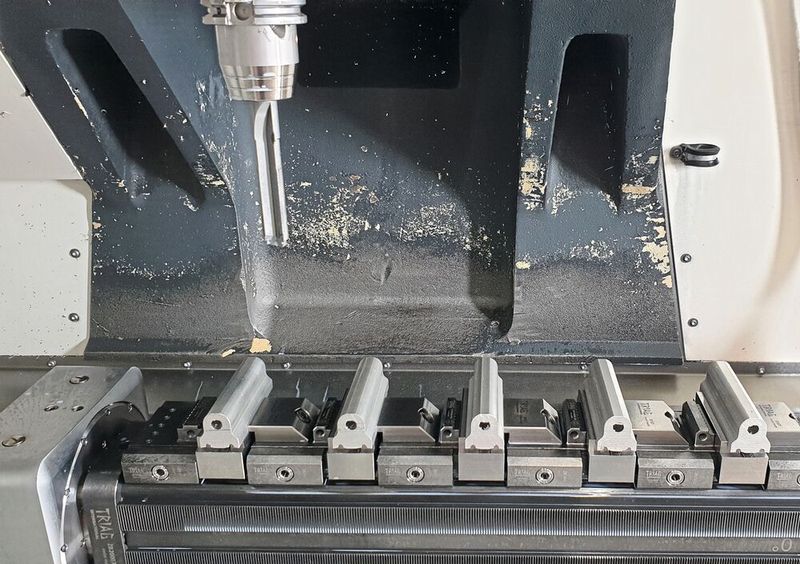
On a DMG CMX 1100 V, multiple components are processed sequentially. High process reliability is essential.
(Image: Ingersoll)
Sun umbrellas in the parking lot, sun umbrellas at the entrance, sun umbrellas in the stairwell, sun umbrellas in the meeting area, sun umbrellas in the showroom, sun umbrellas in the assembly hall. A visit to Bahama GmbH in Reichshof, Germany, leaves no doubt about what is produced here: sun umbrellas. However, these are not ordinary sun umbrellas but highly premium products, primarily for gastronomy and hospitality, which stand out clearly from the competition and especially from sun umbrellas from hardware stores due to their quality features and technology.
Bahama originated from Becher Textil- und Stahlbau GmbH, which began manufacturing tarpaulins for trucks and tent roofs for the showman trade in 1950. Large umbrellas have been the focus since the 1980s, and Bahama brought the expertise for sun sails in-house in 2018. In Reichshof, 75 employees are at work.
The robust, durable umbrellas not only provide shade but also offer protection from wind and weather. To be able to provide a wind guarantee, Bahama tested them in the wind tunnel at Mercedes-Benz. The result: Stationary-mounted umbrellas can remain open almost all year round and withstand wind speeds of up to 130 kilometers per hour (approx. 80 mph).
The smallest sun umbrellas from Bahama measure 2 meters × 2 meters (approx. 7 ft × 7 ft), while the largest cover an area of over 140 square meters (approx. 1500 sq ft) with dimensions of 12 meters × 12 meters (approx. 40 ft × 40 ft). Bahama produces several thousand umbrellas per year, with a rising trend. Customers can be found worldwide, especially in countries with a lot of sunshine. However, most umbrellas remain in Germany. The most commonly sold model is the 4 meters × 4 meters (approx. 13 ft × 13 ft)Jumbrella.
An umbrella consists of 150 to 180 individual parts, depending on the type. Approximately 80 percent of these are aluminum components, which the company processes on seven CNC machines with three or four axes. Steel, stainless steel, and plastic account for a small portion. The main column in the center and the struts are made from extruded profiles. The material is not mass-produced but is pressed specifically for Bahama using special tools. The reason for this is the specific functions that the manufacturer integrates into the components.
Anyone who associates the term "fully equipped" only with buying a car hasn't seen Bahama's accessory list yet. Everything is possible, from sidewalls and theft protection to LED lighting, heaters, Wi-Fi, USB charging ports, speakers, and even a TV screen for public viewing. Bahama delivers the desired configuration starting from just one umbrella.
Tools Instead of a New Machine
The connection to the tool manufacturer Ingersoll came about rather by chance. When a new machine for machining was to be purchased, there was the opportunity to view the corresponding model beforehand at the Ingersoll TechCenter in Haiger. Although the machine purchase was temporarily put on hold, the technicians from Bahama came into contact with the tooling specialists from Ingersoll, who quickly found a task to take on.
When machining a specific component, we repeatedly encountered problems and therefore asked Ingersoll if a special tool could reduce machining time but, above all, increase process reliability.
Sven Altmann, Head of CNC / Metalworking at Bahama
The 84-millimeter-long (approx. 3 inches) aluminum part serves as a mounting bracket for an electric switch. It uses a sliding bushing to automatically turn the LED lighting on and off when the umbrella is opened and closed. Four of these elements are installed in each umbrella with lighting. Originally, Bahama manufactured the component using three HSS tools and then switched to carbide cutters. However, the results remained unsatisfactory.
"Since Reichshof is not far from Haiger, we just took a look on-site," explains Christopher Hees, application technician at Ingersoll. The blank for the component is cut from a profile bar. Depending on the batch, the material exhibits deviations of 1/10 to 4/10 millimeters. Certain tolerances always arise during the extrusion process. With the majority of its parts, Bahama manages quite well and can account for them.
Extruded Cast Part Presents Challenges
This was not the case with this mounting bracket. "With the extruded part, we often had difficulties in precisely finding the center for the drilling," explains Altmann. In addition to the centricity of the 72-millimeter (approx. 3 inches) deep hole, tight fitting dimensions also had to be met. There were also issues with process reliability, as an interrupted cut was required here. The hole passes through an already existing elongated slot, which later accommodates a set screw to guide the switch in the finished component.
Date: 08.12.2025
Naturally, we always handle your personal data responsibly. Any personal data we receive from you is processed in accordance with applicable data protection legislation. For detailed information please see our privacy policy.
Consent to the use of data for promotional purposes
I hereby consent to Vogel Communications Group GmbH & Co. KG, Max-Planck-Str. 7-9, 97082 Würzburg including any affiliated companies according to §§ 15 et seq. AktG (hereafter: Vogel Communications Group) using my e-mail address to send editorial newsletters. A list of all affiliated companies can be found here
Newsletter content may include all products and services of any companies mentioned above, including for example specialist journals and books, events and fairs as well as event-related products and services, print and digital media offers and services such as additional (editorial) newsletters, raffles, lead campaigns, market research both online and offline, specialist webportals and e-learning offers. In case my personal telephone number has also been collected, it may be used for offers of aforementioned products, for services of the companies mentioned above, and market research purposes.
Additionally, my consent also includes the processing of my email address and telephone number for data matching for marketing purposes with select advertising partners such as LinkedIn, Google, and Meta. For this, Vogel Communications Group may transmit said data in hashed form to the advertising partners who then use said data to determine whether I am also a member of the mentioned advertising partner portals. Vogel Communications Group uses this feature for the purposes of re-targeting (up-selling, cross-selling, and customer loyalty), generating so-called look-alike audiences for acquisition of new customers, and as basis for exclusion for on-going advertising campaigns. Further information can be found in section “data matching for marketing purposes”.
In case I access protected data on Internet portals of Vogel Communications Group including any affiliated companies according to §§ 15 et seq. AktG, I need to provide further data in order to register for the access to such content. In return for this free access to editorial content, my data may be used in accordance with this consent for the purposes stated here. This does not apply to data matching for marketing purposes.
Right of revocation
I understand that I can revoke my consent at will. My revocation does not change the lawfulness of data processing that was conducted based on my consent leading up to my revocation. One option to declare my revocation is to use the contact form found at https://contact.vogel.de. In case I no longer wish to receive certain newsletters, I have subscribed to, I can also click on the unsubscribe link included at the end of a newsletter. Further information regarding my right of revocation and the implementation of it as well as the consequences of my revocation can be found in the data protection declaration, section editorial newsletter.
Bahama produces several thousand pieces of this relatively complex-to-manufacture component each year. Christopher Hees compared possible production times and tool technologies and concluded that the use of a custom tool would be worthwhile. After some considerations, Ingersoll selected a tool with a solid carbide body, brazed PCD cutting edges, and long guide rails.
The tool is equipped with a slightly tapered design. When it enters the interrupted cut, it is still properly guided in the rear section that was previously drilled. Thanks to the guide rail, secure guidance is maintained until it exits the interrupted cut.
Johannes Post, Product Manager PKD-CBN at Ingersoll
Chip Formation is Slowed Down
The pre-drilling of the raw part can always vary slightly. To counteract this and minimize radial forces, Ingersoll opted for a 180-degree cutting edge at the tip. The tool is designed as a step drill, which also creates a second diameter with an additional side-mounted cutting edge. To achieve the shortest possible chips with the AlMgSi05 material and its low silicon content, it required not only the right tool and the cutting parameters set by Ingersoll but also an appropriate machining strategy. With a series of imperceptibly short feed stops, the chips are repeatedly broken before they can cause problems.
"The collaboration with Ingersoll impressed us right from the planning phase, and we were very satisfied with the two tools provided," assures Sven Altmann. While the previously used carbide tool required two and a half minutes per hole, the component is now completed in just under 20 seconds. The gain in process reliability is also important to Bahama because 16 parts are clamped and machined consecutively on the DMG CMX 1100 V. If a tool were to break at the beginning, the remaining parts would also be scrapped.
Although the demand for these components is very high, Bahama only produces batch sizes of up to 500 pieces at a time. The manufacturing process relies on a continuous workflow to ensure the supply of parts for all umbrellas. As a result, different components are almost daily on the machines. In-house production makes it possible to produce spare parts for older products as needed. The company's sun umbrellas are often used for decades.
It is quite possible that production will switch from profile material to solid material at an appropriate time. Some other parts are already milled from aluminum blocks today. The step drill could still be used even after such a transition. Sven Altmann can imagine using additional custom tools from Ingersoll in the future production—either to further optimize the existing manufacturing process or to start with optimal machining for newly developed products right from the beginning.



:quality(80)/p7i.vogel.de/wcms/93/33/93337b12f88eb2c776c80d4f9e49d323/0129247650v1.jpeg "Isolated IoT data becomes connected real-time personalization. (Image: ©PB Studio Photo - stock.adobe.com)")
:quality(80)/p7i.vogel.de/wcms/8e/fa/8efad6aa006fcf624d07c645b774d8ce/screenshot-202026-01-21-20113324-764x430v1v1.png "The system processes heavy sheets weighing up to 200 kg fully automatically, without programming or teaching. (Image:Teqram)")
:quality(80)/p7i.vogel.de/wcms/0c/58/0c587c8221ae96052b5dcc0f40eb3dcd/0128880879v1.jpeg "A chip surfer with a solid carbide head is used for finishing in the third operation. (Image:Ingersoll)")
:quality(80)/p7i.vogel.de/wcms/a2/9b/a29bb02b3f1e34962e28579dccfbbc49/0129266114v1.jpeg "Bevel gears on workpiece carriers in the rotary indexing conveyor of the VSC 400 DDS - the pick-up spindle removes the workpiece precisely and reproducibly for hard machining at EWS. (Image:Emag)")
:quality(80)/p7i.vogel.de/wcms/4d/74/4d745446555110ca9797db1eabb7c9d3/0129551585v1.jpeg "Jochen Gemeinhardt is responsible for NTT Data's AI business in the DACH region as Head of Production & Supply Chain and Head of Industry Line Global Business. (Image:NTT Data)")
:quality(80)/p7i.vogel.de/wcms/7a/c8/7ac81c41bab1cc98fbe7b20c95644c6c/0129575667v1.jpeg "For the live gala show celebrating the New Year festival, Unitree rehearsed an impressive performance with its robots. (Image:Unitree/YouTube)")
:quality(80)/p7i.vogel.de/wcms/a3/0c/a30c4c3a36910e92d6082fde37261730/0129555015v1.jpeg "From command recipient to decision-maker: thanks to Agentic AI, robots no longer just stubbornly execute pre-programmed scripts. Instead, they analyze visual data in real time and decide autonomously on the next process step (Image:Nano Banana / AI-generated)")
:quality(80)/p7i.vogel.de/wcms/60/00/6000deb595c3e6b2dd0bfe508aa71653/newsimage418166-5084x2861v1v1.jpeg "The robot-guided friction stir welding gun \"Steppwelder\" in use on a conventional 6-axis industrial robot. (Image:Image: Dominik Walz, MPA, University of Stuttgart)")
:quality(80)/p7i.vogel.de/wcms/48/38/4838074eab3f29ec319797fb63881b18/adobestock-693942839--c2-a9-20wirot-20-e2-80-93-20stock-adobe-com-3389x1907v1v1.jpeg "Leaves or bird droppings can cause hotspots on solar modules and reduce performance. (Image:Wirot stock.adobe.com.)")
:quality(80)/p7i.vogel.de/wcms/3f/7f/3f7f9f45ebccd4751d41106866314aea/newsimage418028-2772x1559v1v1.jpeg "Live in the ice channel—detailed recordings in real time make the smallest mistakes and thus time losses in the luge run visible. (Image:Mittweida University of Applied Sciences)")
:quality(80)/p7i.vogel.de/wcms/05/b7/05b7c58dcf5a7fc900348d1c30f7c116/0129540459v1.jpeg "Researchers from Stuttgart have investigated whether the \"technology\" behind hairy elephant trunks, which function as a sensitive gripping system, can also be used in robotics. (Image:Zoo Magic)")
:quality(80)/p7i.vogel.de/wcms/6b/6f/6b6fff754fedf05375e5255460743297/0129197850v1.jpeg "A new core-shell design for anodes aims to reduce storage losses during the first charge cycle of sodium-ion batteries. (Image:BAM)")
:quality(80)/p7i.vogel.de/wcms/37/23/372374e00db2f1803ae5cde2f00aff31/0129599814v1.jpeg "The new Euro 7 standard sets requirements for the wear of service brakes. These can be met with some technical methods. (Image:Aumovio)")
:quality(80)/p7i.vogel.de/wcms/0c/1d/0c1da1d70af62238b11e22b102bd256d/0129108406v1.jpeg "At the first ADAC glare symposium, experts illustrated and analyzed the topic of glare under real conditions. (Image:Dominsky – VCG)")
:quality(80)/p7i.vogel.de/wcms/95/00/95009ae2972690e3fdab0dc701e202c3/0129621847v1.jpeg "Last year, Airbus's revenue increased by six percent to 81 billion US dollars. (Image:Airbus SAS 2024)")
:quality(80)/p7i.vogel.de/wcms/ae/cf/aecf874a057676aa69b3b5e4c7b52411/0129609464v1.jpeg "Glass storage in action: Microsoft has stored map data from the Flight Simulator on this piece of glass. (Image:Microsoft Research)")
:quality(80)/p7i.vogel.de/wcms/2c/8d/2c8da4b72e35ded278178929afb94d55/0129561713v1.jpeg "Change in direction: The shift away from PFAS in semiconductor manufacturing and the move toward sustainable chip production is demonstrated by the trilateral collaboration between Fraunhofer ENAS, the Paul Scherrer Institute PSI, and Memsstar Limited, which rely on the environmentally friendly Gas-MacEtch technology. (Image:andreyarmyagov/Canva)")
:quality(80)/p7i.vogel.de/wcms/a3/df/a3df18dc04ecd4cffbf933b32018facb/0129644484v1.jpeg "Acquisition complete: Finnish Incap has finalized the takeover of EMS manufacturer Lacon. (Image:Gerd Altmann from Pixabay)")
:quality(80)/p7i.vogel.de/wcms/41/85/41855b7e5c57936c33039a7e785462c9/0129633555v1.jpeg "A chip processing method developed by MIT could help cryptographic processes keep data secure by allowing two chips within the same system to authenticate each other using a common fingerprint. (Image:freely licensed)")
:fill(fff,0)/p7i.vogel.de/companies/69/88/69882c428938e/tmts2026-ticec-banner-en-2000px.png "tmts2026-ticec-banner-en-2000px (https://www.tmts.tw/en)")
:fill(fff,0)/p7i.vogel.de/companies/67/eb/67eba621ef6ea/logo2.png "logo2 (Wuxi InfiMotion)")
:quality(80)/p7i.vogel.de/wcms/67/74/6774a79a86478b12313a5f0143f94e7a/0125666269v1.jpeg "A look into the assembly hall at Bahama in Reichshof.(Image: Ingersoll)")
:quality(80)/p7i.vogel.de/wcms/80/00/8000962c569dfdb1e7ec3905ca81e992/0125666265v1.jpeg "The special tool from Ingersoll and the component. The step drill supplied by Ingersoll, with a solid carbide body, brazed PCD cutting edges, and long guide rails, ensures both position and a good surface finish despite interrupted cutting on the top of the workpiece.(Image: Ingersoll)")
:quality(80)/p7i.vogel.de/wcms/1a/c3/1ac3bbcb53ffed551501e69486ab4179/0125666000v1.jpeg "Bahama provides a wind guarantee on its umbrellas. To ensure that even the large models don't simply blow away during a storm, there are XXL screws, as Sven Altmann demonstrates here.(Image: Ingersoll)")
:quality(80)/p7i.vogel.de/wcms/a8/2a/a82a3b52881e64eb0ca4e70996027106/0125665977v1.jpeg "In the showroom, the manufacturer demonstrates all equipment options for its umbrellas.(Image: Ingersoll)")
:quality(80):fill(efefef,0)/p7i.vogel.de/wcms/67/ad/67adf92d254d2/elatec-wp-smart-factory.png "Elatec WP Smart Factory")
:quality(80)/p7i.vogel.de/wcms/81/1a/811a8115760f095ec9f4e06844f92e51/0123844452v1.jpeg "Long drill chips not only filled the chip bins quickly but also affected process reliability. (Image:Ingersoll Werkzeuge GmbH)")
:quality(80)/p7i.vogel.de/wcms/3e/fd/3efdf8fd64c647d45f2b1dec1fac7a0e/0124865851v1.jpeg "Contract manufacturer Lehner introduces the 30 through-holes using an exchangeable head drill from Iscar's Sumogun family. (Image:Iscar)")