Anyone still investing in fuel cell cars today has not grasped the seriousness of the situation, says consultant Andreas Radics. He sees no global markets for the technology - not even for trucks.
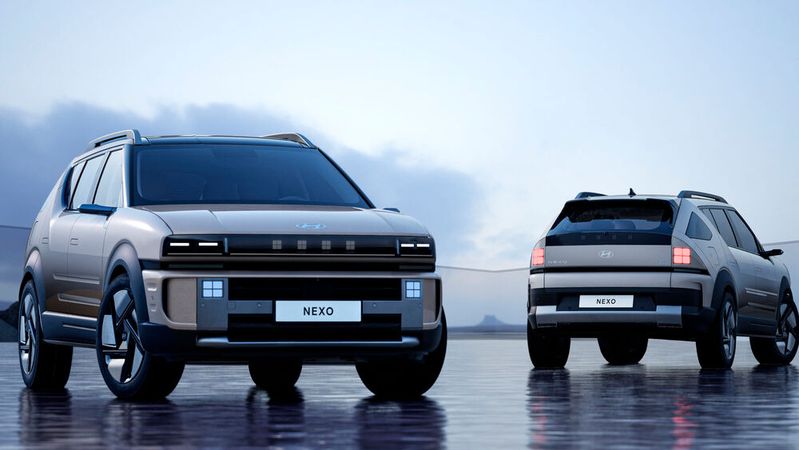
Hyundai has unveiled a new generation of the Nexo hydrogen SUV.
(Image: Hyundai)
It is something like the eternal undead among alternative drive systems. For decades, the idea of the fuel cell as a climate-friendly technology of the future has been popping up again and again. Now, for example, Hyundai is once again drawing attention to the mobile power plant with the second generation of the Nexo. This produces electricity for electric motors on board the car from hydrogen in a process known as cold combustion, emitting nothing other than water vapor. Alongside the Toyota Mirai and a small series of the BMW X5, which also uses Mirai technology in cooperation with Toyota, the Nexo is the only passenger car to use this drive system. And there is also little choice in Europe when it comes to commercial vehicles: Hyundai has the Xcient heavy-duty truck in fleet testing, especially in Switzerland, Mercedes at least has prototypes of the converted Actros running and Stellantis has a few vans with built-in hydrogen converters.
The lack of success is not due to the technology itself, as a look at the new Nexo shows: With a tank for seven kilos of hydrogen, it has a range of 700 kilometers, drives at speeds of up to 179 km/h with 204 hp and when the tank is empty, it takes less than five minutes to refill. Even the most powerful e-architecture can't keep up with that. And while previous fuel cell vehicles had a trunk full of technology, the space available in the 4.75-metre-long Nexo is at least as good as an electric SUV, with plenty of knee room in the rear and up to 1,719 liters of storage space. The Koreans can now even offer a trailer coupling.
Lack of infrastructure
Drive far, refuel quickly - at first glance, the fuel cell is therefore a pleasing alternative to battery-electric driving that is suitable for everyday use, because many of the disadvantages of the classic electric car can be overcome. But the first impression is deceptive. The problem for the customer starts with the infrastructure. After more than three decades of research and pre-series production, during which the fuel cell came onto the road, at least in homeopathic numbers, there are only 100 filling stations in Germany. And instead of closing the huge gaps in the network, the first of these are already being dismantled. And even if the price is generally set arbitrarily and in no way reflects the gigantic development costs and the small quantities, fuel cell vehicles are by no means a bargain. Not to mention the loss of value and resale problems.
The problem is even more serious for the manufacturer than for the customer. "In these times of transformation, capital and know-how resources are too scarce for the industry to be able to further develop every alternative drive system," says Andreas Radics from Munich-based strategy consultants Berylls by AlixPartners. "And now that the world has apparently decided in favor of the battery and at best accepts the range extender as a variant, every euro invested in the fuel cell is a waste," judges the expert: "None of the major sales markets has even a rudimentary strategy to drive forward the introduction of this technology in passenger cars."
Gallery
Anyone who spends money on fuel cell cars today has not yet grasped the seriousness of the situation," Radics is convinced: "The requirements for a nationwide infrastructure are currently no longer affordable, even for Germany. In the current situation, unsettling customers about the future viability of their car drive is certainly the least effective measure.
Millions in subsidies wasted
Radics also advises society to make better use of its resources and stop supporting the fuel cell. With a shake of the head, he talks about the millions of euros in funding that are being spent on barely more than a handful of vehicles. For example, there are 1.8 billion euros in the EU pot for hydrogen infrastructure, of which 455 million was distributed for hydrogen infrastructure projects in Europe in February - with no prospect of this infrastructure ever being used.
Instead of at least slowly increasing, the registration figures for fuel cell vehicles are continuing to fall: while 900 cars with hydrogen technology were sold in 2022, the figure was only 260 in 2023 and just 150 last year. Things are no better worldwide: Global figures have fallen from 15,000 to 8,800 and most recently to 4,800.
Many see better opportunities for the technology in commercial vehicles because there is more space for the fuel cell and the heavy batteries use up the payload of the trucks. But here too, the figures speak for themselves, says Radics: "Not many more than 7,000 new fuel cell trucks and vans are put on the road every year - worldwide.
Date: 08.12.2025
Naturally, we always handle your personal data responsibly. Any personal data we receive from you is processed in accordance with applicable data protection legislation. For detailed information please see our privacy policy.
Consent to the use of data for promotional purposes
I hereby consent to Vogel Communications Group GmbH & Co. KG, Max-Planck-Str. 7-9, 97082 Würzburg including any affiliated companies according to §§ 15 et seq. AktG (hereafter: Vogel Communications Group) using my e-mail address to send editorial newsletters. A list of all affiliated companies can be found here
Newsletter content may include all products and services of any companies mentioned above, including for example specialist journals and books, events and fairs as well as event-related products and services, print and digital media offers and services such as additional (editorial) newsletters, raffles, lead campaigns, market research both online and offline, specialist webportals and e-learning offers. In case my personal telephone number has also been collected, it may be used for offers of aforementioned products, for services of the companies mentioned above, and market research purposes.
Additionally, my consent also includes the processing of my email address and telephone number for data matching for marketing purposes with select advertising partners such as LinkedIn, Google, and Meta. For this, Vogel Communications Group may transmit said data in hashed form to the advertising partners who then use said data to determine whether I am also a member of the mentioned advertising partner portals. Vogel Communications Group uses this feature for the purposes of re-targeting (up-selling, cross-selling, and customer loyalty), generating so-called look-alike audiences for acquisition of new customers, and as basis for exclusion for on-going advertising campaigns. Further information can be found in section “data matching for marketing purposes”.
In case I access protected data on Internet portals of Vogel Communications Group including any affiliated companies according to §§ 15 et seq. AktG, I need to provide further data in order to register for the access to such content. In return for this free access to editorial content, my data may be used in accordance with this consent for the purposes stated here. This does not apply to data matching for marketing purposes.
Right of revocation
I understand that I can revoke my consent at will. My revocation does not change the lawfulness of data processing that was conducted based on my consent leading up to my revocation. One option to declare my revocation is to use the contact form found at https://contact.vogel.de. In case I no longer wish to receive certain newsletters, I have subscribed to, I can also click on the unsubscribe link included at the end of a newsletter. Further information regarding my right of revocation and the implementation of it as well as the consequences of my revocation can be found in the data protection declaration, section editorial newsletter.
No hope in China
Not even a look at China gives us hope. Yes, there are also researchers and companies there who believe in the fuel cell. And 4,000 new fuel cell trucks are registered in China every year, Radics admits. But in the same period, 75,000 battery-electric trucks are put on the road, he says, which immediately negates the success of the project.
And as if that wasn't hopeless enough, there is also a lack of fuel. "Because there is not enough green hydrogen to make it worthwhile to build an infrastructure," says the Berylls expert. So it's no wonder that a kilo of hydrogen now costs between 16 and 18 euros. The expert is convinced that even e-fuels are cheaper and better. To be competitive, it should only cost half as much.
It is still far too expensive, hydrogen is not sufficiently available, if it is, then not from renewable energies and too expensive, and there is also no infrastructure to distribute it. "As promising as the fuel cell may have been in the beginning, it has lost the race against the battery in cars," says Radics. The fuel cell is a horse that has long been ridden to death. Anyone who continues to saddle it up these days has not recognized the signs of the times and cannot be successful."



:quality(80)/p7i.vogel.de/wcms/dd/08/dd086510d9ae7b50181f6070e4463b44/0129363730v1.jpeg "Typical application for ionizing devices: Wrapping films. (Picture: ©Adobe Stock/SMC)")
:quality(80)/p7i.vogel.de/wcms/35/57/3557c819943c53acec41a0ccba87da4f/0130049064v1.jpeg "Researchers at the Fraunhofer IWU in Chemnitz have long known that many typical sheet metal parts can be manufactured more cost-effectively using hollow embossing rollers. Now there is news to report ... (Image:Fraunhofer IWU)")
:quality(80)/p7i.vogel.de/wcms/59/02/590246e3b3f415c65edbee377c14ca77/26-06-pi-fraunhofer-iws-41450-direktplattieren-pic-01-7771x4369v1v1.jpeg "The Fraunhofer IWS has developed the new \"direct laser cladding\" process, which creates a functional layer directly on the base body by applying a strip-shaped metal to rotationally symmetrical components in a spiral and bonding it locally by laser. (Image:Christoph Wilsnack/Fraunhofer IWS)")
:quality(80)/p7i.vogel.de/wcms/73/60/73608418789b1d9c393f5e2fa974eda2/0130209906v1.jpeg "The robots of the X6 generation from b+m enable very high painting quality and are also particularly compact and easy to maintain. (Image:Beckhoff)")
:quality(80)/p7i.vogel.de/wcms/78/e9/78e9188c25a8a94e67c34c9bf8ffe495/visual-agile-20robots-20and-20google-20deepmind-20partner-20to-20bring-20intelligence-20to-20robotics-2500x1406v1v1.jpeg "Together, the partners are developing adaptable, intelligent robots for a wide range of applications (Image:Agile Robots SE)")
:quality(80)/p7i.vogel.de/wcms/e7/66/e7669ecf0260ae8fc54c214e34e4902a/0130316817v1.jpeg "Siemens and Palo Alto Networks offer tested cybersecurity solution for industrial 5G. (Image:Siemens)")
:quality(80)/p7i.vogel.de/wcms/9f/55/9f55324832c4f426958031375124d9de/siemens-20ubtech-20hmnd-1920x1079v1v1.png "Ready for the factory floor: While Ubtech is planning mass production, Siemens is already testing humanoids in real factory applications in Erlangen. (Image:Siemens)")
:quality(80)/p7i.vogel.de/wcms/11/36/113695ed260e29c8c2d9d39dc5f9d869/0130213768v1.jpeg "AI can work cheaply in China and deliver the results rapidly all over the world. (Image:Dall-E / AI-generated)")
:quality(80)/p7i.vogel.de/wcms/62/5f/625f41e87ebfef156a98c8e6393e32fd/0130211654v1.jpeg "Axial flux motors have some advantages over radial flux motor—but their production is currently still expensive. (Image:RWTH Aachen University)")
:quality(80)/p7i.vogel.de/wcms/77/9b/779b0685d010dfe45c9c2cb1cfecd467/0128886425v1.jpeg "The BlueEye is the first \"real\" hyperspectral camera for the UV range and covers the wavelength range from 220 to 380nm. (Image:Inno-spec GmbH)")
:quality(80)/p7i.vogel.de/wcms/e4/51/e451d52ce0182fb0aaa46a5774f832ef/26-04-pi-fraunhofer-iws-21160-bioslide-pic-01-4128x2321v1v1.jpeg "With the BioSlide research project, the Fraunhofer IWS is investigating how sliding systems can be designed to be more sustainable and energy-efficient. New materials can be tested in a particularly application-oriented manner on this plain bearing test stand. (Image:Fraunhofer IWS)")
![Thanks to advanced 3D printing technology, a more efficient use of resources should contribute to lower-emission aviation—this is the goal of ['skai]-lab. (Image:Oleksandr Pashchenko - stock.adobe.com / AI-generated)](https://cdn1.vogel.de/nghHNSbySccfOjG3n1qCA-FVOjQ=/288x162/smart/filters:format(jpg):quality(80)/p7i.vogel.de/wcms/62/64/626424c97a16e69f871bf216c9629c2a/adobestock-1927043193--c2-a9-20oleksandr-20pashchenko-20-e2-80-93-20stock-adobe-com-ki-generiertv1v1.jpeg "Thanks to advanced 3D printing technology, a more efficient use of resources should contribute to lower-emission aviation—this is the goal of ['skai]-lab. (Image:Oleksandr Pashchenko - stock.adobe.com / AI-generated)")
:quality(80)/p7i.vogel.de/wcms/c3/c4/c3c4ce270b083eeac55654148611f064/0130237945v1.jpeg "China is not giving up on hydrogen, but is intensifying its efforts. (Image:freely licensed from Pixabay)")
:quality(80)/p7i.vogel.de/wcms/4e/c0/4ec0bd19390b169edfa23677373dcdf1/0130260089v1.jpeg "Renewable fuels can supply European road traffic, according to a study. (Image:Aral)")
:quality(80)/p7i.vogel.de/wcms/6f/c9/6fc9050301d745cad25585c6780f8f51/0130197341v1.jpeg "Production facilities are a worthwhile target and are therefore at risk. (Image:ABB Robotics)")
:quality(80)/p7i.vogel.de/wcms/b6/62/b662adc2cec8227d8172509bbfb6ee42/25c0207-107-4961x2789v1v1.jpeg "The GLB is the second model based on Mercedes' new MMA platform. Apparently, Geely's platform is better and cheaper, which is why the two companies are negotiating a partnership. (Image:Mercedes-Benz)")
:quality(80)/p7i.vogel.de/wcms/4d/dd/4dddf438e91f394c04a095dbfd109d1c/0130236430v1.jpeg "Measurement modules: The 720301 module in combination with the SL2000 enables RMS and power calculations, among other things. (Image:Yokogawa)")
:quality(80)/p7i.vogel.de/wcms/61/fc/61fcf95f5cca15494ad18343901ae585/0130317237v1.jpeg "With the AGI CPU, Arm says it is taking a \"historic step\": With the processor aimed at AI in data centers, the company is presenting itself for the first time as a provider of its own chips, not just as a pure IP licensor. (Image:Arm)")
:quality(80)/p7i.vogel.de/wcms/82/90/8290dfe3595b6c6b33726ae8b76172c7/0130319587v1.jpeg "The concept image illustrates how the pattern of tiny protrusions and depressions created on the substrate (MgO, bottom) controls the arrangement of atoms in the superconducting material (YBCO, top). At the interface between the two layers, an electronic structure enables superconductivity to occur at higher temperatures than previously possible. (Image:Chalmers University of Technology / Riccardo Arpaia)")
:fill(fff,0)/images.vogel.de/vogelonline/companyimg/76800/76895/65.jpg "FAULHABER_120mm.jpg ()")
:quality(80)/p7i.vogel.de/wcms/cb/33/cb3306e823e251651e99e015b693c2f9/0124347476v1.jpeg "Hyundai has the heavy-duty Xcient in the fleet test, especially in Switzerland.(Image: Hyundai)")
:quality(80)/p7i.vogel.de/wcms/6d/74/6d74af3fe1b4b6a370b3c29d58fcdf8e/0124347475v1.jpeg "Mercedes at least has prototypes of the converted Actros running.(Image: Daimler Truck)")
:quality(80)/p7i.vogel.de/wcms/1c/44/1c4419ab4047b579487eda7cc6550b23/0124347474v1.jpeg "BMW has produced a small series of the X5, which is not for sale and also uses Mirai technology in cooperation with Toyota.(Image: BMW)")
:quality(80)/p7i.vogel.de/wcms/f5/9f/f59f64a4c09ac48ec651fc4cea6ca41f/0124347481v1.jpeg "Toyota's Mirai also remains a marginal phenomenon in the automotive circus of the future.(Image: Toyota)")
:quality(80)/p7i.vogel.de/wcms/a9/6e/a96e80603d2fbc37cf78bb7ce2dc10f0/0123940273v1.jpeg "Farizon, the commercial vehicle division of Geely, and vehicle manufacturer Jinbei are working on methanol-hydrogen-electric drive systems for heavy commercial vehicles. (Image:Farizon)")
:quality(80)/p7i.vogel.de/wcms/ad/72/ad72626a52c9a9332591f457e5afabca/0129497458v1.jpeg "BMW's new Board Member for Development Joachim Post in the new iX3 model. (Image:BMW)")