Software testing is an exciting discipline, not least because of unforeseen events. However, precisely because the workday is unpredictable, the job also presents challenges. Testing coordinator Frank Krahl provides insight into his area of responsibility.
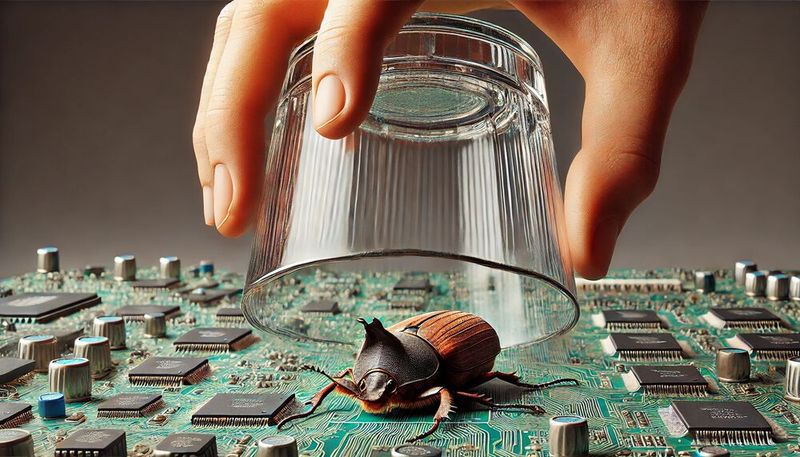
A bug hunter does not always have it easy, but every day holds a new, exciting challenge.
(Image: Dall-E / AI-generated)
It's Friday afternoon. Normally, my colleagues and I finish our last tasks at this time, look forward to the weekend, and share what we have planned for our days off. Today is different. Instead of "Friday from one o'clock...", we have to go full throttle again. Because my team and I are dealing with a truly extraordinary problem.
In advance, a customer contacted us because he was experiencing hundreds of error messages, but only on Mondays. During the week, we were already able to identify the problem through detective work. Now it's about testing the bug fix and getting the patch ready. Otherwise, our customer would face another Monday with very limited work possible.
Despite the time pressure, we also have to proceed carefully to ensure no further errors slip in with the patch. The minute hand seems to move faster and faster, and we are slowly sweating.
Dream Job: Software Tester?
As a child, I once wanted to become an astronaut, but later I thought that staying on Earth isn't so bad either. That's why I trained as a technical assistant for quality assurance, and I had many ideas about what I could do with it.
Software tester wasn't at the top of the list, though. I wanted to help people and joined support. There, I occasionally came into contact with colleagues from testing. In 2017, I switched to KIX, and both my team leads and I quickly realized - it fits. Today, I coordinate the testing team.
Like me, my colleagues have come here through very different paths - from development, support or sales. And as stressful as initially described, the job is really only in exceptional cases. Of course, we prefer to find bugs before our customers and partners notice them. To do this, we conduct RC, release, or regression tests, in which we put new features and hopefully fixed bugs to the test.
We also use a tool for test automation that takes a lot of work off our hands. However, we still can't put our feet up: We have to feed it with requirements and test scenarios so that it processes regularly recurring steps and informs us of any incidents.
But what do we do once a user reports a problem to us? First, we try to replicate it on a current system with their settings. If that doesn't work, we repeat the process on a system with the same version as our customer's. Errors often occur due to many different configurations. And sometimes it also comes down to every minute on a late Friday afternoon until we have a solution.
I have never regretted the step into testing. I find it particularly interesting that you need to have a certain nose for things. It is not necessary to know a program in every detail - that is more the job of the developers. It is much more important to be open to new ideas in order to solve very specific cases. We often have to think outside the box and look at a problem from the customer's perspective. This way, we learn something new every day, both technically and professionally.
Bugs in the Space Shuttle
What I can only advise newcomers in the testing field: Don't feel personally offended if a bug slips through - it happens! This of course does not mean to approach the job completely carelessly, after all, there are enough examples of bugs that have caused damage worth millions. A few years ago, a chocolate manufacturer wanted to reduce costs through an ERP change. However, due to faulty software, there was an overproduction, tons of unsellable sweets, and a loss of 14 million euros.
A completely error-free software is and remains utopian. In addition to the individual circumstances of the users, it is often due to the code itself. With often hundreds of thousands of lines of code that interact and ideally harmonize with each other, even a small change can lead to problems that did not exist the day before. Some people also refer to very complex constructs as spaghetti code because everything is intertwined.
However, the greatest natural limit of testing is usually its cost-effectiveness. Every company must find a compromise between error costs and error prevention costs, creating a gray area where errors can never be completely avoided. In our company, for example, we work with five error classes, divided from A to E.
Date: 08.12.2025
Naturally, we always handle your personal data responsibly. Any personal data we receive from you is processed in accordance with applicable data protection legislation. For detailed information please see our privacy policy.
Consent to the use of data for promotional purposes
I hereby consent to Vogel Communications Group GmbH & Co. KG, Max-Planck-Str. 7-9, 97082 Würzburg including any affiliated companies according to §§ 15 et seq. AktG (hereafter: Vogel Communications Group) using my e-mail address to send editorial newsletters. A list of all affiliated companies can be found here
Newsletter content may include all products and services of any companies mentioned above, including for example specialist journals and books, events and fairs as well as event-related products and services, print and digital media offers and services such as additional (editorial) newsletters, raffles, lead campaigns, market research both online and offline, specialist webportals and e-learning offers. In case my personal telephone number has also been collected, it may be used for offers of aforementioned products, for services of the companies mentioned above, and market research purposes.
Additionally, my consent also includes the processing of my email address and telephone number for data matching for marketing purposes with select advertising partners such as LinkedIn, Google, and Meta. For this, Vogel Communications Group may transmit said data in hashed form to the advertising partners who then use said data to determine whether I am also a member of the mentioned advertising partner portals. Vogel Communications Group uses this feature for the purposes of re-targeting (up-selling, cross-selling, and customer loyalty), generating so-called look-alike audiences for acquisition of new customers, and as basis for exclusion for on-going advertising campaigns. Further information can be found in section “data matching for marketing purposes”.
In case I access protected data on Internet portals of Vogel Communications Group including any affiliated companies according to §§ 15 et seq. AktG, I need to provide further data in order to register for the access to such content. In return for this free access to editorial content, my data may be used in accordance with this consent for the purposes stated here. This does not apply to data matching for marketing purposes.
Right of revocation
I understand that I can revoke my consent at will. My revocation does not change the lawfulness of data processing that was conducted based on my consent leading up to my revocation. One option to declare my revocation is to use the contact form found at https://contact.vogel.de. In case I no longer wish to receive certain newsletters, I have subscribed to, I can also click on the unsubscribe link included at the end of a newsletter. Further information regarding my right of revocation and the implementation of it as well as the consequences of my revocation can be found in the data protection declaration, section editorial newsletter.
If users cannot create a ticket, this would be a class A error for us - and all sirens would go off because we need to fix the problem as quickly as possible. The lowest category, on the other hand, includes more trivial things, such as spelling mistakes or a crooked icon, which in all likelihood do not have a detrimental effect on the business. We also address these errors, but they do not have the highest priority.
To illustrate the financial aspect: In the 1970s, the development of the Space Shuttle along with its associated software began. And even in this high-tech marvel for its time, there were software bugs. Although admittedly not many.
On 420,000 lines of code, NASA had less than one error. How did they achieve that? Well, it was a prestige project of the USA with a huge budget. A written, tested, and documented line of code cost around $1,000 at the time. By today's purchasing power, about $7,000 - or roughly three billion dollars just for the software. Without the rocket, launch pad, and fuel.
Bug, Feature – or Both!?
However, such a bug can also be helpful. It can happen that they save users a few clicks or make the system more stable. There are several examples of this.
Even about 50 years ago, there was a bug in the computer game Space Invaders that might have even contributed to its success: Whenever the player shot down an enemy spaceship, the remaining aliens moved towards him faster because less computing power was required. The developers hadn't planned this, but since it made the game more exciting, they never fixed this bug.
Every now and then, things can get a bit bizarre in the world of bugs. For example, one of our customers had random first and last names generated in contact synchronization. While names like Harald Lee or Montgomery Müller might exist, they seemed a bit strange to us. We quickly found the cause of the problem – instead of the customer data, our demo data was being loaded.
Significantly trickier was the sweat-inducing Monday bug from the beginning: Ultimately, it was a formatting error in a database field that led to the error messages. A small hidden problem, then, but with big impacts. Incidentally, we were able to fix it in time that Friday afternoon. That's what makes the job as a bug hunter so appealing to me – it's never boring.
*Frank Krahl is the Testing Coordinator at the Chemnitz-based IT company KIX Service Software. Together with his team, he runs various testing scenarios daily—from automated workflows to regression tests.



:quality(80)/p7i.vogel.de/wcms/40/c5/40c5051cebdb10fdee9a283303434d9d/0129881741v1.jpeg "3D-printed tools and other components contribute to energy-saving, precise processes. (Image:Gerhard Schubert GmbH)")
:quality(80)/p7i.vogel.de/wcms/e5/fa/e5fa9fa2e3b44ee1894fdf95bbe828fe/0129904146v1.jpeg "Airports and other critical infrastructure in Europe are to be better protected against drones. (Picture: ©assetseller - stock.adobe.com)")
:quality(80)/p7i.vogel.de/wcms/ae/bd/aebda515c684825e97579175874ea6bd/0129920231v1.jpeg "Hensoldt, a sensor specialist for critical defense applications among other things, now has a strategic milestone ahead of it. The company is planning to acquire Nedinsco, an optronics company from Venlo in the Netherlands. Here's what's to come ... (Image:Hensoldt)")
:quality(80)/p7i.vogel.de/wcms/c3/6f/c36f031df46d22615d941d077d32313c/0129800025v1.jpeg "The laser-assisted process is intended to make wafer cutting significantly more productive. (Image:Trumpf)")
:quality(80)/p7i.vogel.de/wcms/e8/dc/e8dc27a8d9fba8fbd081987400bf6848/0127426198v1.jpeg "3D FEM models are detailed, large and computationally intensive. Thanks to ROM and the support of Cadfem, Wago has succeeded in setting up an e-shop for thermal simulation. (Image:WAGO)")
:quality(80)/p7i.vogel.de/wcms/9c/ac/9cac6246660e746c5a3989399ac4d250/0128561645v1.jpeg "Artificial intelligence can drive efficiency in smart factories through centralized data management and predictive maintenance. (Picture: ©Fardived - stock.adobe.com)")
:quality(80)/p7i.vogel.de/wcms/6b/e2/6be235b5ad8a442ccd9d164b0b300d8b/0129763992v1.jpeg "As early as 2020, the Zimmer Group announced that it would convert its production to be sustainably CO2-neutral. (Image:Zimmer Group)")
:quality(80)/p7i.vogel.de/wcms/d4/ba/d4bab9481e66f8570f40eb8ef2a90198/0129795613v1.jpeg "A camera inspection during removal ensures that the components are placed correctly in the KLTs. (Image:Yaskawa Europe)")
:quality(80)/p7i.vogel.de/wcms/76/81/7681b6450512b2cce1e453cd3d732543/0129479309v1.jpeg "Symbolic image: Model-based design combines virtual system models with real machines and systems in order to simulate, validate and coordinate functions, control and software early on in the development process. (Image:Dall-E / AI-generated)")
:quality(80)/p7i.vogel.de/wcms/5c/0f/5c0fee074c4b6c8e8c0993f3217c2f5a/0129773718v1.jpeg "The General Fusion demonstration reactor. (Image:General Fusion)")
:quality(80)/p7i.vogel.de/wcms/b5/5e/b55ed9355e0395ec0caf111d6af6b494/adobestock-495980372--c2-a9-20natali-mis-20-e2-80-93-20stock-adobe-com-6720x3778v1v1.jpeg "Which engineering skills will be in vogue in 2026? (Image:natali_mis - stock.adobe.com)")
:quality(80)/p7i.vogel.de/wcms/bf/a5/bfa5d882e93f159ce93e933742272b00/nord-vibn-cmyk-2196x1235v1v1.jpeg "With digital twins for virtual commissioning, Nord supports customers in ensuring that systems are available more quickly, even with complex drive systems. (Image:Nord Drivesystems)")
:quality(80)/p7i.vogel.de/wcms/e4/01/e40186c9a7d04cbecb20fab20ff79094/0129886097v1.jpeg "Skoda has inaugurated a new battery plant in Mlada Boleslav to meet rising demand, but also to reduce battery costs by 30 percent. (Image:Skoda)")
:quality(80)/p7i.vogel.de/wcms/74/7b/747b6bc4d758c5dd4b5c24a763ae493d/0129897614v1.jpeg "Huawei Intelligent Automotive Solutions has presented a lidar with a resolution of 896 lines. (Image:HIMA via ChinaEVHome)")
:quality(80)/p7i.vogel.de/wcms/ba/b7/bab7bfd052f35da3c39388508faa350e/0129851977v1.jpeg "The third generation of the Mazda CX-5 scores above all with its inner values. (Image:Mauritz - VCG)")
:quality(80)/p7i.vogel.de/wcms/81/24/8124e33f53ec73fa99374f407cc11b61/0129727992-541x304v1v1.jpeg "The development of control elements and HMI systems for commercial vehicles can lead to interactions. (Image:Preh / AI-generated)")
:quality(80)/p7i.vogel.de/wcms/8b/46/8b46730ba87a86f16d696f043cf0e3d1/0129887022v1.jpeg "Linyi Yunchuan's S2000 platform has risen to a height of two kilometers and fed the energy generated into the grid. (Image:Linyi Yunchuan)")
:quality(80)/p7i.vogel.de/wcms/92/f8/92f8bf81914500bcda78f63dab8da720/0129926751v1.jpeg "Only recently, the US government allowed high-end chips for AI such as Nvidia's H200 series (pictured) to be exported to China under certain conditions. But now the tax is being pulled back all the harder: An eDraft envisages tighter controls on the export of hardware for AI technologies worldwide. Even allies would be affected. (Image:Nvidia)")
:quality(80)/p7i.vogel.de/wcms/84/cc/84cc506003388ecffaab464677c7afa6/0129843694v1.jpeg "Launched last year, ASML's TWINSCAN XT:260 is an i-line scanner with a throughput of 270 wafers per hour. With a focus on the increased demands of AI chips, ASML wants to shift its focus away from pure front-end tools for chip production in the next ten to fifteen years with packaging and bonding technologies. (Image:ASML)")
:quality(80)/p7i.vogel.de/wcms/8f/48/8f48b0ed0d6c5c4f299b1310a7b577e9/0129830738v1.jpeg "Data centers in orbit are indeed dreams of the future, while data centers under water are already being tested. (Image:Dall-E / AI-generated)")
:fill(fff,0)/p7i.vogel.de/companies/68/a4/68a47beec75ce/logo-cmyk-de.jpeg "logo-cmyk-de (https://www.datatec.eu/)")
:fill(fff,0)/p7i.vogel.de/companies/67/eb/67eba621ef6ea/logo2.png "logo2 (Wuxi InfiMotion)")
:quality(80)/p7i.vogel.de/wcms/05/5c/055c523a3be81da64c15c017bbd25348/0129529705v1.jpeg "Memory errors such as buffer overflows or use-after-free jeopardize the stability of vehicle software. Formal verification helps to turn tested software into verifiably safe systems. (Image:Dall-E / AI-generated)")
:quality(80)/p7i.vogel.de/wcms/38/c9/38c95a3804617599a550b5258bfb6b2c/0123693678v1.jpeg "A consistent UX can become a challenge: A project by Porsche Holding demonstrates how unified user experiences can be developed across countries and brands. (Image:Virtual Art Studio - stock.adobe.com)")