How Intel is shaping the transition to chiplet systems with EMIB, Foveros and hybrid bonding and why advanced packaging is becoming the key technology for the data center of the future. Housing expert Bernd Waidhas from Intel spoke about this.
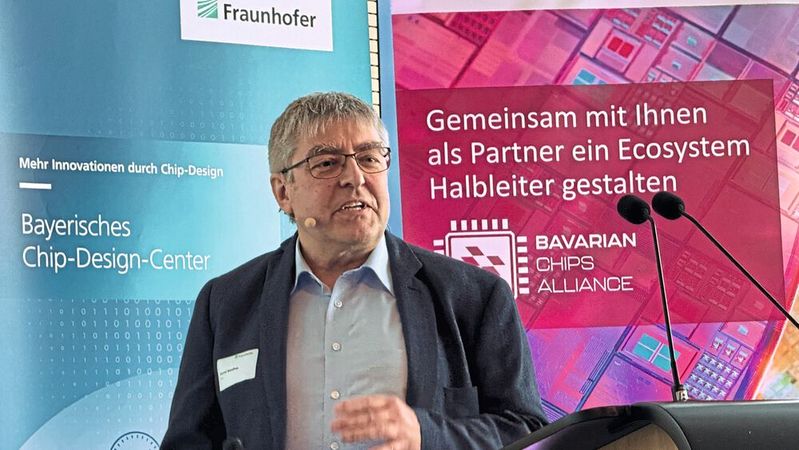
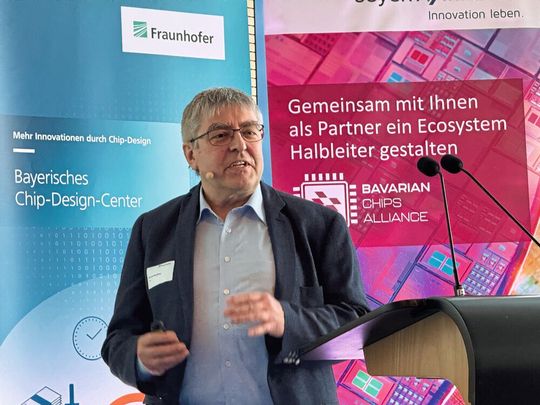
Bernd Waidhas, Principal Engineer - Silicon Packaging Architecture at Intel Germany, explained the importance of advanced packaging for the future of chiplets at the 'Chip Development' symposium.
(Image: Manuel Christa)
Moore's Law has long since lost its significance. Apart from the long-correct prediction that transistors in integrated circuits would double every two years, Gordon Moore made another, but now more topical, statement in the same article:
"It could prove to make more economic sense to assemble large systems from smaller functions, with assembly and connection technologies offering the necessary flexibility."
Although less succinct than the more well-known prediction, the Intel co-founder described the current relevance of packaging technologies in chip development back in 1956. Bernd Waidhas, an expert in package development at Intel, introduced his presentation on advanced packaging with this quote at the Specialist Conference "Chip Development" on April 9, 2025 at Fraunhofer IIS in Erlangen. The most important contents and findings of his presentation are summarized below.
Modular Packaging: The Chiplet Era
However, advanced packaging is more than just a packaging technology: it is becoming the system architecture at package level and therefore the foundation of modern data center chips. This is because classic monolithic designs are increasingly reaching their physical, economic and technological limits. Chiplets that are connected via high-performance interposers and standardized interfaces make it possible to build modular and scalable systems and thus react flexibly to changing requirements in data centers.
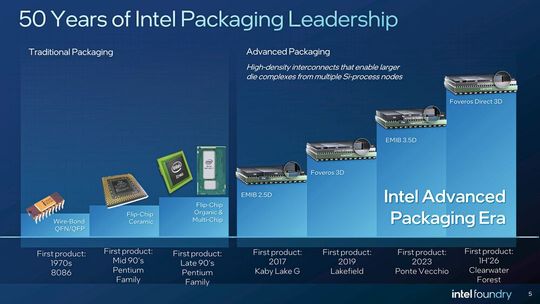
50 years of packaging: Intel's history of traditional and advanced enclosure development.
(Image: Intel)
At the same time, advanced packaging improves energy efficiency, increases the bandwidth between functional units and allows the integration of a wide variety of process nodes in a small space. As a result, the focus of innovation is increasingly shifting from silicon to packaging - making packaging itself the decisive architectural component of the next generation of chips.
In comparison, monolithic chips continue to offer advantages such as lower power consumption and lower latency, as the components are physically closer together. Monolithic designs are particularly suitable for high-performance applications where tight integration and fast communication between components is required. Despite the clear emergence of modular designs, monolithic chips still dominate.
Chiplet technology offers numerous advantages, including the possibility of targeted disaggregation of functions, improved reusability of intellectual property (IP) and optimization of yield in chip production. However, chiplet integration is also associated with challenges, such as greater design complexity and implementation costs.
Standards for Die-to-Die Connections
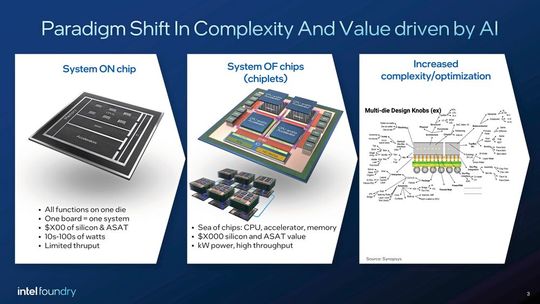
Intel's paradigm shift: from a monolithic system "on" chip to a modular system "of" chips.
(Image: Intel)
Standardized connections between individual dies, so-called die-to-die interconnects, are a decisive factor in the implementation of chiplet architectures. Bernd Waidhas presented in particular the open standard Universal Chiplet Interconnect Express (UCIe), which is being developed primarily by Intel and other industry partners.
UCIe covers various package types and differentiates between standard packages with coarser pitches (100 to 130 µm), advanced packages with interposers (25 to 55 µm) and highly complex 3D packages with hybrid bonding (less than 10 µm). UCIe also offers solutions for the interoperability of chiplets with different pitch sizes, enabling a wide range of possible combinations.
Interposer Technologies: It's the Connection That Counts
With the trend towards more highly integrated chiplet systems, high-performance interposers are becoming increasingly relevant. These connecting elements between chiplets and substrates have undergone significant technological development. While silicon interposers were initially mainly used, for example to connect high bandwidth memory (HBM), RDL (redistribution layer) interposers and organic interposers are now increasingly being used. The latter enable larger dimensions at lower costs and offer better thermal and mechanical performance.
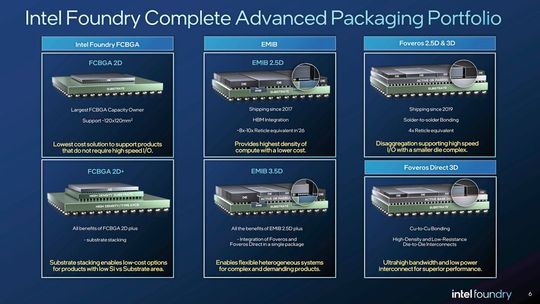
Intel Foundry Advanced Packaging Portfolio: Six different packaging technologies, such as FCBGA 2D, EMIB, Foveros 2.5D & 3D and Foveros Direct 3D.
(Image: Intel)
In his presentation, Waidhas also points out the different production methods for these interposers. Depending on the application, chip-first or chip-load processes are used. TSMC, for example, differentiates between CoWoS-R (chip-load) and CoWoS-L or InFO-L (chip-first) in its packaging technologies. Both variants offer different advantages and disadvantages in terms of process control, yield and system integration.
Date: 08.12.2025
Naturally, we always handle your personal data responsibly. Any personal data we receive from you is processed in accordance with applicable data protection legislation. For detailed information please see our privacy policy.
Consent to the use of data for promotional purposes
I hereby consent to Vogel Communications Group GmbH & Co. KG, Max-Planck-Str. 7-9, 97082 Würzburg including any affiliated companies according to §§ 15 et seq. AktG (hereafter: Vogel Communications Group) using my e-mail address to send editorial newsletters. A list of all affiliated companies can be found here
Newsletter content may include all products and services of any companies mentioned above, including for example specialist journals and books, events and fairs as well as event-related products and services, print and digital media offers and services such as additional (editorial) newsletters, raffles, lead campaigns, market research both online and offline, specialist webportals and e-learning offers. In case my personal telephone number has also been collected, it may be used for offers of aforementioned products, for services of the companies mentioned above, and market research purposes.
Additionally, my consent also includes the processing of my email address and telephone number for data matching for marketing purposes with select advertising partners such as LinkedIn, Google, and Meta. For this, Vogel Communications Group may transmit said data in hashed form to the advertising partners who then use said data to determine whether I am also a member of the mentioned advertising partner portals. Vogel Communications Group uses this feature for the purposes of re-targeting (up-selling, cross-selling, and customer loyalty), generating so-called look-alike audiences for acquisition of new customers, and as basis for exclusion for on-going advertising campaigns. Further information can be found in section “data matching for marketing purposes”.
In case I access protected data on Internet portals of Vogel Communications Group including any affiliated companies according to §§ 15 et seq. AktG, I need to provide further data in order to register for the access to such content. In return for this free access to editorial content, my data may be used in accordance with this consent for the purposes stated here. This does not apply to data matching for marketing purposes.
Right of revocation
I understand that I can revoke my consent at will. My revocation does not change the lawfulness of data processing that was conducted based on my consent leading up to my revocation. One option to declare my revocation is to use the contact form found at https://contact.vogel.de. In case I no longer wish to receive certain newsletters, I have subscribed to, I can also click on the unsubscribe link included at the end of a newsletter. Further information regarding my right of revocation and the implementation of it as well as the consequences of my revocation can be found in the data protection declaration, section editorial newsletter.
The connecting elements between chiplets and substrates have undergone significant technological development. While silicon interposers were initially mainly used, for example to connect high bandwidth memory (HBM), RDL (redistribution layer) interposers and organic interposers are now increasingly being used. The latter enable larger dimensions at lower costs and offer better thermal and mechanical performance.
(No) Interposer
Intel is pursuing different approaches to packaging with two platforms: EMIB (Embedded Multi-die Interconnect Bridge) realizes a point connection without a full-surface interposer. Small silicon bridges are embedded directly in the substrate. Foveros, a 3D packaging technology that stacks active dies vertically on top of each other, is also used. The combination of both approaches, referred to by Intel as EMIB 3.5D, allows particularly flexible design variants for high-performance multi-die systems.
Waidhas also mentioned EMIP technology (Embedded Multi-die Interconnect without Interposer) in his presentation, in which an active connection chip is embedded directly into the BGA substrate - without a classic interposer. This makes it possible to further simplify the packaging structure and at the same time achieve high signal quality.
Hybrid Bonding: Copper Instead of Solder
Hybrid bonding is a particularly sophisticated approach to connecting chiplets. Unlike conventional soldering processes, the connection is made by direct metallic contact, typically copper-to-copper, without the use of solder. Bernd Waidhas explained the multi-stage process, which includes chemical-mechanical polishing (CMP) to align the surfaces, plasma activation and precise alignment of the dies. Finally, the chips are fused under slight pressure and at elevated temperatures, creating an intermetallic compound that no longer has a visible interface.
Hybrid bonding allows pitch sizes below 10 micrometers and is therefore particularly suitable for 3D stacking applications where high connection densities are required. The technology was originally used in CMOS image sensors, for example by Sony, and is now also increasingly being used in high-performance processors. However, the process is complex and places high demands on production tolerances and thermal management, warns the speaker.
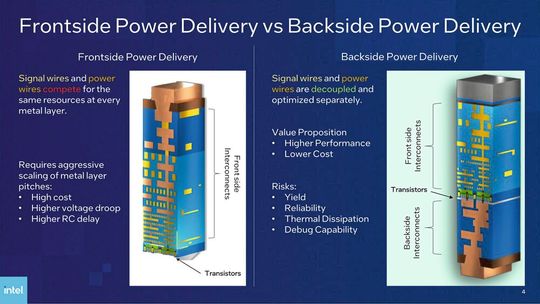
Backside Power Delivery: Power Supply from Below
PowerVia: Intel separates the power supply from the signal logic.
(Image: Intel)
Another point that Bernd Waidhas addressed in his presentation concerns the future power supply in chiplet systems: so-called backside power delivery. Here, power and signal lines are routed separately - signals at the top, power supply via the back of the chip. This reduces the vertical complexity in the package and enables shorter signal paths. In combination with gate-all-around transistors, which Intel calls RibbonFET, this can lead to more efficient integration and higher performance.
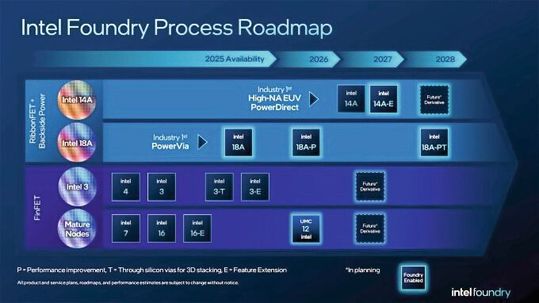
Roadmap and Market Potential: 5% of Chips to Account for 50% of Sales
Intel Foundry's current roadmap: several new packaging technologies will be used by 2028.
(Image: Intel)
Advanced packaging has long been more than just a production step - it is developing into a key economic and strategic component of the semiconductor industry. According to Yole Intelligence, the global market for advanced packaging will grow from 44.3 billion US dollars in 2022 to 78.6 billion US dollars in 2028 - with an average annual growth rate of 10.6%. Waidhas added in his presentation that, according to the forecast for 2028, only around five percent of chip packages will be accounted for by advanced packaging (unit split). However, due to the higher complexity and added value, the industry expects these technologies to account for more than 50% of revenue (revenue split).
Intel itself sees advanced packaging as a key to future high-performance systems. Among other things, Waidhas presented plans for future chiplet systems with four reticle-sized compute dies and up to 16 HBM4 components. These designs require large-area interposers and place high demands on signal and power supply as well as thermal management.
Bernd Waidhas' presentation shows how chiplet-based systems enable new degrees of freedom in system integration. Technological hybrids can reduce development costs in the long term. At the same time, this change requires a high degree of coordination: the selection of suitable interconnect standards, thermal management, mechanical stability and electrical integrity must be carefully coordinated.
Bernd Waidhas, Principal Engineer - Silicon Packaging Architecture at Intel Germany, explained the importance of advanced packaging for the future of chiplets at the 'Chip Development' symposium.
(Image: Manuel Christa)
"There are of course many ways to create new architectures using these packaging technologies. However, you should think carefully about whether it makes sense for your system or whether you should stick with the SoC. Because of course you also have an overhead due to all the die-to-die connections and you have additional costs due to advanced packaging," warns engineer Waidhas and considers a "multidimensional analysis" to be necessary.
Successful chiplet strategies require not only technical expertise, but also early and close coordination with partners along the value chain. Standardized interfaces such as UCIe, advanced interposer technologies and flexible packaging platforms such as EMIB and Foveros form the basis for this - but are not a sure-fire success:
"Many years ago, there was euphoria at panel discussions where it was said that you could buy chiplets from different companies, combine them in a package and it would work - it's not quite that simple," warns housing expert Bernd Waidhas in his concluding appeal. (mc)



:quality(80)/p7i.vogel.de/wcms/dd/08/dd086510d9ae7b50181f6070e4463b44/0129363730v1.jpeg "Typical application for ionizing devices: Wrapping films. (Picture: ©Adobe Stock/SMC)")
:quality(80)/p7i.vogel.de/wcms/35/57/3557c819943c53acec41a0ccba87da4f/0130049064v1.jpeg "Researchers at the Fraunhofer IWU in Chemnitz have long known that many typical sheet metal parts can be manufactured more cost-effectively using hollow embossing rollers. Now there is news to report ... (Image:Fraunhofer IWU)")
:quality(80)/p7i.vogel.de/wcms/59/02/590246e3b3f415c65edbee377c14ca77/26-06-pi-fraunhofer-iws-41450-direktplattieren-pic-01-7771x4369v1v1.jpeg "The Fraunhofer IWS has developed the new \"direct laser cladding\" process, which creates a functional layer directly on the base body by applying a strip-shaped metal to rotationally symmetrical components in a spiral and bonding it locally by laser. (Image:Christoph Wilsnack/Fraunhofer IWS)")
:quality(80)/p7i.vogel.de/wcms/73/60/73608418789b1d9c393f5e2fa974eda2/0130209906v1.jpeg "The robots of the X6 generation from b+m enable very high painting quality and are also particularly compact and easy to maintain. (Image:Beckhoff)")
:quality(80)/p7i.vogel.de/wcms/78/e9/78e9188c25a8a94e67c34c9bf8ffe495/visual-agile-20robots-20and-20google-20deepmind-20partner-20to-20bring-20intelligence-20to-20robotics-2500x1406v1v1.jpeg "Together, the partners are developing adaptable, intelligent robots for a wide range of applications (Image:Agile Robots SE)")
:quality(80)/p7i.vogel.de/wcms/e7/66/e7669ecf0260ae8fc54c214e34e4902a/0130316817v1.jpeg "Siemens and Palo Alto Networks offer tested cybersecurity solution for industrial 5G. (Image:Siemens)")
:quality(80)/p7i.vogel.de/wcms/9f/55/9f55324832c4f426958031375124d9de/siemens-20ubtech-20hmnd-1920x1079v1v1.png "Ready for the factory floor: While Ubtech is planning mass production, Siemens is already testing humanoids in real factory applications in Erlangen. (Image:Siemens)")
:quality(80)/p7i.vogel.de/wcms/11/36/113695ed260e29c8c2d9d39dc5f9d869/0130213768v1.jpeg "AI can work cheaply in China and deliver the results rapidly all over the world. (Image:Dall-E / AI-generated)")
:quality(80)/p7i.vogel.de/wcms/62/5f/625f41e87ebfef156a98c8e6393e32fd/0130211654v1.jpeg "Axial flux motors have some advantages over radial flux motor—but their production is currently still expensive. (Image:RWTH Aachen University)")
:quality(80)/p7i.vogel.de/wcms/77/9b/779b0685d010dfe45c9c2cb1cfecd467/0128886425v1.jpeg "The BlueEye is the first \"real\" hyperspectral camera for the UV range and covers the wavelength range from 220 to 380nm. (Image:Inno-spec GmbH)")
:quality(80)/p7i.vogel.de/wcms/e4/51/e451d52ce0182fb0aaa46a5774f832ef/26-04-pi-fraunhofer-iws-21160-bioslide-pic-01-4128x2321v1v1.jpeg "With the BioSlide research project, the Fraunhofer IWS is investigating how sliding systems can be designed to be more sustainable and energy-efficient. New materials can be tested in a particularly application-oriented manner on this plain bearing test stand. (Image:Fraunhofer IWS)")
![Thanks to advanced 3D printing technology, a more efficient use of resources should contribute to lower-emission aviation—this is the goal of ['skai]-lab. (Image:Oleksandr Pashchenko - stock.adobe.com / AI-generated)](https://cdn1.vogel.de/nghHNSbySccfOjG3n1qCA-FVOjQ=/288x162/smart/filters:format(jpg):quality(80)/p7i.vogel.de/wcms/62/64/626424c97a16e69f871bf216c9629c2a/adobestock-1927043193--c2-a9-20oleksandr-20pashchenko-20-e2-80-93-20stock-adobe-com-ki-generiertv1v1.jpeg "Thanks to advanced 3D printing technology, a more efficient use of resources should contribute to lower-emission aviation—this is the goal of ['skai]-lab. (Image:Oleksandr Pashchenko - stock.adobe.com / AI-generated)")
:quality(80)/p7i.vogel.de/wcms/c3/c4/c3c4ce270b083eeac55654148611f064/0130237945v1.jpeg "China is not giving up on hydrogen, but is intensifying its efforts. (Image:freely licensed from Pixabay)")
:quality(80)/p7i.vogel.de/wcms/4e/c0/4ec0bd19390b169edfa23677373dcdf1/0130260089v1.jpeg "Renewable fuels can supply European road traffic, according to a study. (Image:Aral)")
:quality(80)/p7i.vogel.de/wcms/6f/c9/6fc9050301d745cad25585c6780f8f51/0130197341v1.jpeg "Production facilities are a worthwhile target and are therefore at risk. (Image:ABB Robotics)")
:quality(80)/p7i.vogel.de/wcms/b6/62/b662adc2cec8227d8172509bbfb6ee42/25c0207-107-4961x2789v1v1.jpeg "The GLB is the second model based on Mercedes' new MMA platform. Apparently, Geely's platform is better and cheaper, which is why the two companies are negotiating a partnership. (Image:Mercedes-Benz)")
:quality(80)/p7i.vogel.de/wcms/4d/dd/4dddf438e91f394c04a095dbfd109d1c/0130236430v1.jpeg "Measurement modules: The 720301 module in combination with the SL2000 enables RMS and power calculations, among other things. (Image:Yokogawa)")
:quality(80)/p7i.vogel.de/wcms/61/fc/61fcf95f5cca15494ad18343901ae585/0130317237v1.jpeg "With the AGI CPU, Arm says it is taking a \"historic step\": With the processor aimed at AI in data centers, the company is presenting itself for the first time as a provider of its own chips, not just as a pure IP licensor. (Image:Arm)")
:quality(80)/p7i.vogel.de/wcms/82/90/8290dfe3595b6c6b33726ae8b76172c7/0130319587v1.jpeg "The concept image illustrates how the pattern of tiny protrusions and depressions created on the substrate (MgO, bottom) controls the arrangement of atoms in the superconducting material (YBCO, top). At the interface between the two layers, an electronic structure enables superconductivity to occur at higher temperatures than previously possible. (Image:Chalmers University of Technology / Riccardo Arpaia)")
:fill(fff,0)/images.vogel.de/vogelonline/companyimg/76800/76895/65.jpg "FAULHABER_120mm.jpg ()")
:fill(fff,0)/p7i.vogel.de/companies/67/eb/67eba621ef6ea/logo2.png "logo2 (Wuxi InfiMotion)")
:quality(80)/p7i.vogel.de/wcms/84/cc/84cc506003388ecffaab464677c7afa6/0129843694v1.jpeg "Launched last year, ASML's TWINSCAN XT:260 is an i-line scanner with a throughput of 270 wafers per hour. With a focus on the increased demands of AI chips, ASML wants to shift its focus away from pure front-end tools for chip production in the next ten to fifteen years with packaging and bonding technologies. (Image:ASML)")
:quality(80)/p7i.vogel.de/wcms/2d/04/2d045816e056f236eb7ff9638cebbb2b/0129005497v1.jpeg "3D IC technologies are driving semiconductor innovation. The precise analysis of signal and power integrity is crucial here. (Image:Siemens EDA)")