Chinese manufacturers are setting new standards in functional integration with 12-in-1 electric axles. Suppliers like Schaeffler and ZF are countering with modular system architectures. An overview of the trends.
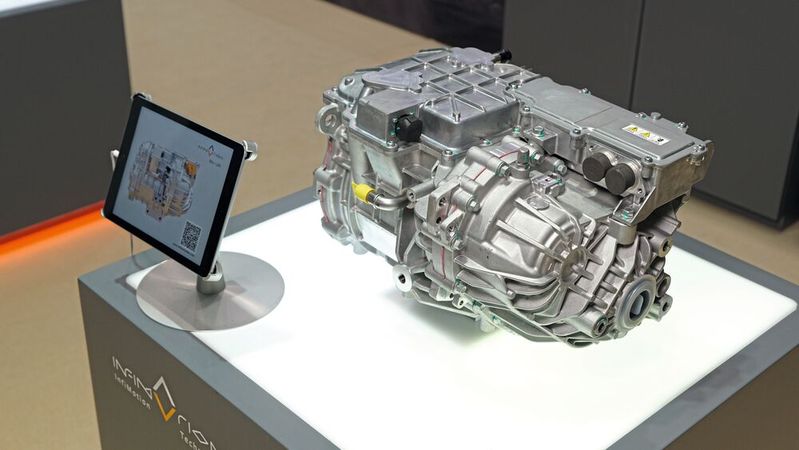
The Infimotion L300 drive unit is a 3-in-1 system with a release mechanism for high integration and low weight.
(Image: Vogel Communications Group/Stefan Hafen)
Manufacturers are particularly outdoing each other in China. BYD launched the first 12-in-1 electric axle in series production in 2024. In addition to the electric motor, transmission, and control unit, it includes a DC/DC converter, an onboard charger, a distribution box, a battery management system, a vehicle control unit, two booster modules for increased voltage and current during charging, and two functions for battery temperature management. Geely has followed suit with a similar 12-in-1 electric axle with slightly different functionality.
The goal of this forced function integration is to reduce components, development and production costs, as well as the overall effort. Additionally, it aims to achieve weight and space reductions and lower energy consumption. For example, the German Tier-1 supplier Schaeffler states that its 4-in-1 electric axle can save up to 14 percent energy and 10 percent costs compared to a 3-in-1 solution, thanks to the complete integration of thermal management – with the same installation space and improved functionality. An advantage of the integrated cooling circuit is heat harvesting, the targeted collection and dissipation of heat from the drive unit and its use for purposes such as cabin climate control or battery heating.
The Modular Principle
European electric axle manufacturers like Schaeffler and ZF do not focus exclusively on maximum integration but rather on moderate integration, with an increased emphasis on an intelligent module strategy and adaptation to the Software Defined Vehicle. At the IAA 2025, ZF is presenting its new "Select" platform, which consists of separate modular systems for electric machines, power electronics, reduction gears, and software. The electric motors include both permanent magnet and externally excited synchronous machines as well as asynchronous machines. A new development is the externally excited synchronous machine I2SM, which, through an improved rotor design and space-efficient construction, is intended to offer comparable performance data to a permanent magnet synchronous machine while eliminating the need for magnets and, therefore, rare earth elements.
Stators with different outer diameters, lengths, and wire geometries allow for various performance classes. Additionally, ZF leverages its expertise in gear construction for reduction gears in both axle-parallel and coaxial configurations. This enables various axle and drive layouts, including differential functionality.
The inverter modular system provides voltage levels of 400 and 800 volts. Defined assemblies and especially power switch modules are intended to offer greater flexibility in design and sourcing strategies. ZF also relies on standardized functions and interfaces for the converters, enabling future hardware and functionality expansions. The software for the electric drivetrain is modular and, according to ZF, can be easily expanded with additional functionalities or adapted for different drivetrain layouts. According to ZF, the Select platform is designed to enable tailored electric drives – more efficient, faster, and more versatile.
Gallery
E-Axles Tailored to Customer Requirements
Schaeffler relies on a similarly modular portfolio of system components for electric axles. According to the company, adapting an existing standard 3-in-1 electric axle (e-machine plus transmission plus power electronics) can reduce development costs for a new application by up to 80 percent compared to a new development. Scalability and modularity are also responses to diverging market needs: on the one hand, highly integrated "X-in-1" electric axles, and on the other hand, standard electric axles. The former (such as BYD and Geely) impress with many functions, very high efficiency, compact packaging, but require considerable development effort. The latter are a good and cost-effective base for individual applications, such as add-on all-wheel drives.
These drives, referred to as secondary axles, have only limited operating times, which allows for simplifications. Firstly, the power electronics of the electric axle can be housed in a central drivetrain control unit. Secondly, due to the temporary operating times of the add-on electric axle, less waste heat is generated, making an air-cooled electric axle without external liquid cooling sufficient, which significantly reduces the integration effort in the vehicle.
Operating Modes: Boosting and All-Wheel Drive Passages Off-Road
The dissipation of heat from critical points is managed, for example, through an internal oil circuit, whose reservoir is designed as a high-sump and directly transfers the heat to the housing and further to the air via convection. According to Schaeffler, such an electric axle with a peak output of 80 kilowatts has already been successfully tested. The intended operating modes of the electric axle (mainly boosting during acceleration or short all-wheel-drive phases off-road) have all been thermodynamically handled without the vehicle underbody being aerodynamically optimized for this application.
Date: 08.12.2025
Naturally, we always handle your personal data responsibly. Any personal data we receive from you is processed in accordance with applicable data protection legislation. For detailed information please see our privacy policy.
Consent to the use of data for promotional purposes
I hereby consent to Vogel Communications Group GmbH & Co. KG, Max-Planck-Str. 7-9, 97082 Würzburg including any affiliated companies according to §§ 15 et seq. AktG (hereafter: Vogel Communications Group) using my e-mail address to send editorial newsletters. A list of all affiliated companies can be found here
Newsletter content may include all products and services of any companies mentioned above, including for example specialist journals and books, events and fairs as well as event-related products and services, print and digital media offers and services such as additional (editorial) newsletters, raffles, lead campaigns, market research both online and offline, specialist webportals and e-learning offers. In case my personal telephone number has also been collected, it may be used for offers of aforementioned products, for services of the companies mentioned above, and market research purposes.
Additionally, my consent also includes the processing of my email address and telephone number for data matching for marketing purposes with select advertising partners such as LinkedIn, Google, and Meta. For this, Vogel Communications Group may transmit said data in hashed form to the advertising partners who then use said data to determine whether I am also a member of the mentioned advertising partner portals. Vogel Communications Group uses this feature for the purposes of re-targeting (up-selling, cross-selling, and customer loyalty), generating so-called look-alike audiences for acquisition of new customers, and as basis for exclusion for on-going advertising campaigns. Further information can be found in section “data matching for marketing purposes”.
In case I access protected data on Internet portals of Vogel Communications Group including any affiliated companies according to §§ 15 et seq. AktG, I need to provide further data in order to register for the access to such content. In return for this free access to editorial content, my data may be used in accordance with this consent for the purposes stated here. This does not apply to data matching for marketing purposes.
Right of revocation
I understand that I can revoke my consent at will. My revocation does not change the lawfulness of data processing that was conducted based on my consent leading up to my revocation. One option to declare my revocation is to use the contact form found at https://contact.vogel.de. In case I no longer wish to receive certain newsletters, I have subscribed to, I can also click on the unsubscribe link included at the end of a newsletter. Further information regarding my right of revocation and the implementation of it as well as the consequences of my revocation can be found in the data protection declaration, section editorial newsletter.
Another market niche is emerging with the advent of zone-oriented electric architectures and Software Defined Vehicles. In these, the drive control logic could be housed outside the electric axle in one of the vehicle's central computers. The electric axle, containing the traction motor and transmission, would then only integrate the power modules of the inverter. Schaeffler sees great market potential for such 2.5-in-1 axles.
Another development trend could be the integration of mechanical auxiliary functions. Here, Schaeffler leverages its clutch expertise and has developed a "wet" brake integrated into the electric axle housing. According to Schaeffler, the test vehicle with electromechanical actuation and six discs can provide braking power of up to 400 kW at the rear axle, thereby replacing conventional wheel brakes (along with their underutilization due to regenerative braking). Additionally, the complete encapsulation prevents brake dust from escaping into the environment.
Significantly closer to series production is a decoupling unit from Schaeffler, which, starting at the end of 2026, will disengage the 3-in-1 electric axle from the wheels in a production vehicle, thereby reducing drag losses. Such freewheel solutions can generally achieve a consumption advantage of up to seven percent in the WLTC cycle compared to a permanently engaged electric axle when operating in freewheel mode about 80 percent of the time.
Another electric axle innovation from Schaeffler is also nearing series production: the rigid axle made of formed sheets, to which an electric axle is mounted as a non-load-bearing system. This design trick allows the housing of the electric drive to be constructed very thin, offering a weight advantage of up to 40 kilograms compared to a conventional rigid axle with a structurally load-bearing electric axle housing. According to Schaeffler, this solution is set to go into series production in a pickup truck by 2028.



:quality(80)/p7i.vogel.de/wcms/51/1b/511b420dbcc296aec09e3bffb051b8a8/0133581587v1.jpeg "The cables connect numerous machine components—often in confined spaces. (Image:Helu)")
:quality(80)/p7i.vogel.de/wcms/b5/67/b5676f3bfb36251ed31f9a0cccf650b6/0133167827v1.jpeg "Thanks to JumboFlex Generation 2, employees can effortlessly move wheelchairs weighing as much as 40 kilograms. (Image:Lard)")
:quality(80)/p7i.vogel.de/wcms/5e/c6/5ec615b7a51440f668259f2af9158cb9/0132654694v1.jpeg "Strategic Partnerships in Industry: As buyers and restructuring partners, Chinese investors are increasingly helping to preserve jobs in Germany. (Image: ©Anatolii Rymarchuk - stock.adobe.com)")
:quality(80)/p7i.vogel.de/wcms/eb/2b/eb2bd1b8487afe577b37363cd02f16ff/0113143253v1.jpeg "In our China Market Insider, we regularly provide you with relevant information straight from China. (Image:© Eisenhans - stock.adobe.com)")
:quality(80)/p7i.vogel.de/wcms/aa/3e/aa3e2603a812f8e7d33c00ba8ae28c9f/0133507886v1.jpeg "With the Iggy Rob, igus is bringing a humanoid robot into factories for a price of 47,999 euros ($54,718). (Image: igus)")
:quality(80)/p7i.vogel.de/wcms/92/64/92645c64ffbb6980976d39102388d120/0113143253v1.jpeg "In our China Market Insider, we regularly provide you with relevant information straight from China. (Image:© Eisenhans - stock.adobe.com)")
:quality(80)/p7i.vogel.de/wcms/c7/05/c70542511e0824ee491f7b55e21fa429/0133598424v1.jpeg "In logistics, AI is often implemented only on a case-by-case basis; data is stored in separate systems, and inventory levels, status values, and priorities are not defined consistently. (Image: ©m-project - stock.adobe.com)")
:quality(80)/p7i.vogel.de/wcms/3a/9c/3a9c1fd546e1f041b86bb1d03cf39101/0133610524v1.jpeg "The Mason W-01 combines industrial-grade humanoid hardware, Physical AI-based perception, and autonomous task planning. (Image:Nova X Robotics)")
:quality(80)/p7i.vogel.de/wcms/e7/94/e794290f265afbd0ffc7a06c4fe9d425/adobestock-1887113836--hypnotics-14-stock-adobe-com-ki-generiertv1.jpeg "In both autonomous driving and industrial production, there is growing skepticism as to whether full autonomy is always desirable. (Source: © Hypnotics 14 – stock.adobe.com / AI-generated)")
:quality(80)/p7i.vogel.de/wcms/a8/71/a8712e5c6ef536228444ab5275cedfe2/adobestock-340905887--gorodenkoff-stock-adobe-comv1.jpeg "A new position paper outlines the conditions that the business community, academia, and policymakers must jointly establish in order to ensure the long-term viability of industry in Germany and Europe. (Source: © Gorodenkoff – stock.adobe.com)")
:quality(80)/p7i.vogel.de/wcms/7d/eb/7deb25ca674fa4c781a9d1fab083f7cf/parker-entwicklungszentrum-hresv1.jpeg "The centerpiece of the Parker Center for Drive and Control Technology in Offenbach is the exhibition area. (Source: Parker Hannifin)")
:quality(80)/p7i.vogel.de/wcms/3d/ff/3dff5e51c24b30c8dc37c1d024887157/0133602931v1.jpeg "Just a few years ago, SpaceX specialists were working on the world’s largest rocket—the Starship. Now, Elon Musk’s company has reached a milestone during a test flight: Earth’s orbit! But there was also a downside... (Image: SpaceX)")
:quality(80)/p7i.vogel.de/wcms/78/ab/78abbfbab0565fabb19efe637aea30e8/nio-power-swap-station-4-china-guangzhou-2024-1400x933-jpgv1.webp "Nio and Geely are collaborating on battery replacement for electric cars. (Source: Nio)")
:quality(80)/p7i.vogel.de/wcms/2e/58/2e58c664e733dd182666606f850c5da4/0133400664v1.jpeg "The IM6 is sort of the crossover version of the IM5. (Image:MG Motor)")
:quality(80)/p7i.vogel.de/wcms/40/5f/405f41f4075e8798878011f0932a8195/0133509065v1.jpeg "Caruso has integrated Hyundai into its platform. (Image:Hyundai)")
:quality(80)/p7i.vogel.de/wcms/06/98/06989beb3f95b8fb06d71190c86cffde/tabletv1.jpeg "The cockpit view during a test drive in the simulator. (Source: Uccello et al., IEEE OJITS 2026)")
:quality(80)/p7i.vogel.de/wcms/40/34/4034915f85470ad8264659267e4f02d0/0133655653v1.jpeg "Cariad, Volkswagen's software subsidiary, continues to struggle. Now, another round of layoffs has been announced, which will result in the loss of many jobs ... (Image:Cariad)")
:quality(80)/p7i.vogel.de/wcms/e4/2a/e42af12e2a0816bb3d25fac9932903e9/0133646920v1.jpeg "TSMC's U.S. headquarters in Arizona: According to various media reports, the world's largest contract semiconductor manufacturer may be planning to build up to six additional fabs in the state of Texas. (Image:TSMC)")
:quality(80)/p7i.vogel.de/wcms/de/8c/de8c694e560ce8e8d7d43fa5b91917b3/0133668420v1.jpeg "Open-source AI tools: DeepSeek and Huawei are making programming tools for Ascend processors available, with the aim of simplifying development, chip communication, and AI computations on Huawei's hardware—and thereby intensifying competition with Nvidia. (Image:Dall-E / AI-generated)")
:quality(80)/p7i.vogel.de/wcms/86/25/8625a62499a6e70e629a2ddde2f01dcb/0133671173v1.jpeg "\"OpenAI\" has repeatedly experienced problems in which AI models have accessed the internet without authorization in order to carry out their tasks. The company has now fired three people whom it no longer trusts ... (Image:AI-generated)")
:fill(fff,0)/images.vogel.de/vogelonline/companyimg/76800/76895/65.jpg "FAULHABER_120mm.jpg ()")
:fill(fff,0)/p7i.vogel.de/companies/69/de/69de1b7403b0d/simtos-logo.jpeg "simtos-logo (SIMTOS)")
:quality(80)/p7i.vogel.de/wcms/54/11/5411a25c25de331fd4e504327583efff/0127702531v1.jpeg "Under the hood of the cross-coupe is a twin-rotor rotary engine with turbocharging. (Image:Michael Specht/SP-X)")
:quality(80)/p7i.vogel.de/wcms/68/36/6836ae3fe9bbedbeab4abc43d00ac9e8/0127743472v1.jpeg "More integration, efficiency, and range: E-axles still have significant optimization potential.(Image: Schaeffler)")
:quality(80)/p7i.vogel.de/wcms/af/1b/af1b853a648262cd8f366a30f79dd532/0127743476v1.jpeg "The externally excited synchronous machine I2SM from ZF is designed to offer comparable performance data to a permanently excited synchronous machine while eliminating the need for rare earths.(Image: ZF)")
:quality(80)/p7i.vogel.de/wcms/c6/7c/c67cc8f3ab80147ed8aa59d1b98802f7/bmw-1490x838v1.png "The sixth generation of the BMW drive system also does not require magnets or rare earth elements. (Image: BMW)")
:quality(80)/p7i.vogel.de/wcms/97/6b/976b8b47233ce9ba3ac56dca6ac6b3a9/0127259658v1.jpeg "The technologies in the Ferrari Elettrica. (Image:Ferrari)")
:quality(80)/p7i.vogel.de/wcms/58/63/5863c101435cf9c29ff718bf9bfd54a4/0128878544v1.jpeg "In all fully electric models of the BMW M Neue Klasse, two electric drive units on the front and rear axles, each with one electric motor per wheel, ensure typical BMW M driving performance. (Image: BMW AG)")