While the world is talking about the Donut Lab battery, a really exciting concept is coming from BYD. The Chinese electric vehicle manufacturer combines a robust lithium iron phosphate (LFP) chemistry with an unusual cell and pack design.
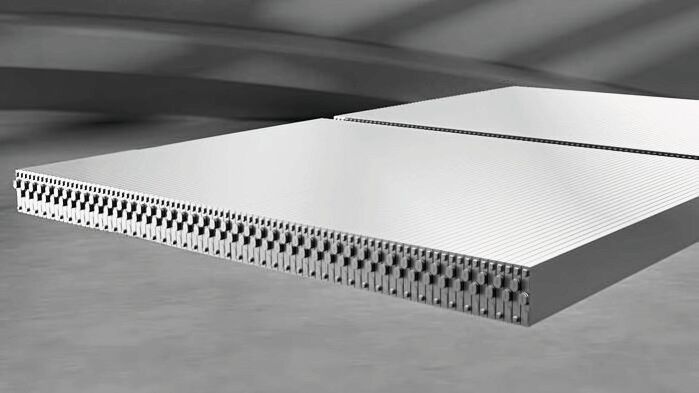
The concept of the blade battery.
(Image: BYD Europe B.V.)
The currently presented performance data show exceptional charging characteristics. Under normal ambient conditions, the state of charge can be increased from 10 % to 70 % in just five minutes. The values in the higher charging range are even more impressive: from 10 % to 97 %, the battery should only need nine minutes at room temperature. Even at extremely low temperatures of −22 °F, the charging time for the same range is around twelve minutes, according to the manufacturer.
This last value in particular is technologically interesting. Lithium-based batteries normally lose much of their charging capacity at low temperatures because ion diffusion in the electrolyte and electrodes decreases significantly. An almost complete charge in just a few minutes at −22 °F therefore indicates a very well coordinated interaction between cell chemistry, internal resistance, thermal management and charging electronics.
Charging Infrastructure
Anyone wondering what kind of charging infrastructure will make such charging times possible will quickly come to the next element of BYD's strategy. The manufacturer is working on a so-called "flash charging" system that will achieve charging capacities of up to 1,000 kW. The basis for this is a new 1,000-volt vehicle platform, which is used in models such as the BYD Han L EV and the BYD Tang L EV.
In China, the extreme charging performance is currently being achieved using an unusual approach. Vehicles there have two charging ports so that two charging cables can be connected in parallel. Both connections feed energy into the battery at the same time, enabling charging capacities in the megawatt range.
However, BYD is apparently planning a different approach for Europe. According to industry reports, the flash charging system will work here with just one CCS connection. This would continue to use the Combined Charging System (CCS) established in Europe, but with significantly higher performance than today's fast chargers.
Technical development on the infrastructure side is already underway. Manufacturers of fast-charging systems are working on new connectors and cooling concepts that are capable of transmitting such power. The Alpitronic HYC1000 system, for example, already enables charging capacities of several hundred kilowatts per connection. At the same time, Phoenix Contact is developing CCS connectors with improved cooling structures, which should enable outputs in the megawatt range in the future.
According to BYD, it is also planning to develop flash charging technology in Europe. Several hundred fast-charging stations could be built by the second quarter of 2026.
LFP As the Basis for Safety And Service Life
Technologically, the second generation of the blade battery is based on lithium iron phosphate (LFP). Although this chemistry is traditionally considered to be somewhat less energy dense than nickel-cobalt-manganese (NCM) systems, it offers decisive advantages in terms of stability and service life.
The LFP structure is characterized by high thermal stability and does not release oxygen when overheated. This significantly reduces the risk of thermal runaway. At the same time, the chemistry enables a very high cycle stability. BYD specifies a service life of over 5,000 charging cycles for the blade battery, which can correspond to an operating life of well over ten years for a typical vehicle battery.
Unusual Cell Format
A key feature of the blade technology is the cell format itself. Instead of classic prismatic or cylindrical cells, BYD uses long, flat cell bodies that are visually reminiscent of narrow blades—hence the name "blade". These cells are integrated directly into the battery pack, where they form a honeycomb-like structure.
By dispensing with additional module housings, the available installation space in the battery pack can be utilized much better. At the same time, the elongated cell geometry improves heat distribution within the system. In newer vehicle platforms, the battery pack is also structurally integrated into the body, so that it can take on some of its own load-bearing functions.
Date: 08.12.2025
Naturally, we always handle your personal data responsibly. Any personal data we receive from you is processed in accordance with applicable data protection legislation. For detailed information please see our privacy policy.
Consent to the use of data for promotional purposes
I hereby consent to Vogel Communications Group GmbH & Co. KG, Max-Planck-Str. 7-9, 97082 Würzburg including any affiliated companies according to §§ 15 et seq. AktG (hereafter: Vogel Communications Group) using my e-mail address to send editorial newsletters. A list of all affiliated companies can be found here
Newsletter content may include all products and services of any companies mentioned above, including for example specialist journals and books, events and fairs as well as event-related products and services, print and digital media offers and services such as additional (editorial) newsletters, raffles, lead campaigns, market research both online and offline, specialist webportals and e-learning offers. In case my personal telephone number has also been collected, it may be used for offers of aforementioned products, for services of the companies mentioned above, and market research purposes.
Additionally, my consent also includes the processing of my email address and telephone number for data matching for marketing purposes with select advertising partners such as LinkedIn, Google, and Meta. For this, Vogel Communications Group may transmit said data in hashed form to the advertising partners who then use said data to determine whether I am also a member of the mentioned advertising partner portals. Vogel Communications Group uses this feature for the purposes of re-targeting (up-selling, cross-selling, and customer loyalty), generating so-called look-alike audiences for acquisition of new customers, and as basis for exclusion for on-going advertising campaigns. Further information can be found in section “data matching for marketing purposes”.
In case I access protected data on Internet portals of Vogel Communications Group including any affiliated companies according to §§ 15 et seq. AktG, I need to provide further data in order to register for the access to such content. In return for this free access to editorial content, my data may be used in accordance with this consent for the purposes stated here. This does not apply to data matching for marketing purposes.
Right of revocation
I understand that I can revoke my consent at will. My revocation does not change the lawfulness of data processing that was conducted based on my consent leading up to my revocation. One option to declare my revocation is to use the contact form found at https://contact.vogel.de. In case I no longer wish to receive certain newsletters, I have subscribed to, I can also click on the unsubscribe link included at the end of a newsletter. Further information regarding my right of revocation and the implementation of it as well as the consequences of my revocation can be found in the data protection declaration, section editorial newsletter.
Safety in the Stress Test
The safety strategy of the blade battery is often demonstrated using the so-called nail penetration test. This involves driving a metal nail through a cell to simulate an internal short circuit. According to the manufacturer, the battery shows neither flame formation nor heavy smoke development in this scenario, while the surface temperature remains comparatively low.
This is primarily due to the stable LFP chemistry and the mechanical design of the cell pack. The combination of chemical stability and structural design reduces the likelihood of uncontrolled heat spreading within the battery block.
Use in Series Vehicles
The blade battery is already being used in several vehicle models, including the BYD Dolphin, the BYD Seal electric saloon and the BYD Tang SUV. It is used in both fully electric vehicles and plug-in hybrid models.
BYD gives a warranty of eight years or 155,000 miles for the battery, whereby at least 70% of the original capacity should be retained.
Evolution Instead of A Spectacular Breakthrough
In contrast to many battery concepts currently under discussion, BYD is focusing less on radically new chemistries and more on the consistent further development of proven technologies. The combination of LFP cell chemistry, optimized pack design and structural integration into the vehicle shows that considerable progress can also be made with familiar materials.
If the extremely short charging times in particular—especially the almost complete charge within twelve minutes at −22 °F—are confirmed in practical use, blade technology could represent one of the most realistic solutions currently available for two challenges of electromobility: fast charging and reliable operation under extreme climatic conditions. (mr)



:quality(80)/p7i.vogel.de/wcms/33/ab/33abf15b4b5625a8904cb57c51597709/0129982307v1.jpeg "This is a new development from Fraunhofer IFAM and partners: an automated adhesive splitting system for the reliable and more productive bonding of composite parts. Here, a frame for an airplane window is measured in real time and a precise amount of adhesive is applied. (Image:Fraunhofer IFAM)")
:quality(80)/p7i.vogel.de/wcms/df/26/df26e72a2f7c890171a1059b48eef68e/0129962397v1.jpeg "The Swedish cutting tool manufacturer Sandvik Coromant now has two additional geometries for its Corodrill DE10 replaceable head drilling system, which it says will further expand the already wide range of applications - for example for cast materials ... (Image:Sandvik Coromant)")
:quality(80)/p7i.vogel.de/wcms/81/c6/81c6f01476cd66350d1a6467efede21d/screenshot-202026-01-28-20174921-783x440v1v1.png "Vacuum-brazed probes. (Image:iew inductive heating systems)")
:quality(80)/p7i.vogel.de/wcms/40/c5/40c5051cebdb10fdee9a283303434d9d/0129881741v1.jpeg "3D-printed tools and other components contribute to energy-saving, precise processes. (Image:Gerhard Schubert GmbH)")
:quality(80)/p7i.vogel.de/wcms/92/5e/925ee98ea36ad9bd574fa1cea11d0e53/0129964352v1.jpeg "The production of hardware components for humanoid robots offers great market potential. (Image:Fraunhofer IPA)")
:quality(80)/p7i.vogel.de/wcms/08/72/0872dd2dd119a54824c41e0e580e45a8/0129576591v1.jpeg "The Rose enclosure systems can be customized on request. (Image:Rose Systemtechnik GmbH)")
:quality(80)/p7i.vogel.de/wcms/73/17/7317794432521bf911711b91287cfc28/0129961259v1.jpeg "ABB Robotics and Nvidia are enabling the widespread use of physical AI in the world of robotics. This means that systems can be created virtually and with high precision and optimized much more cost-effectively. In the large image the virtual system, next to it the real robot cell ... (Image:ABB)")
:quality(80)/p7i.vogel.de/wcms/09/a2/09a2e832b1c0271d299fc130201e5717/adobestock-1767409934-4191x2360v1.jpeg "(Source: © ImageFlow - stock.adobe.com)")
:quality(80)/p7i.vogel.de/wcms/9e/98/9e984afbf9c6f2bcc8963bd13465b180/26-02-pi-fraunhofer-iws-41300-ultragrain-project-closing-pic-02-1562x878v1v1.png "The process of laser wire build-up welding (DED-LB) with pulse laser-induced plasma, which contributed to the success of the Ultra Grain project, is shown at high speed. (Image:Fraunhofer IWS)")
:quality(80)/p7i.vogel.de/wcms/28/00/28008d9477bb07daa3b28ce4ac0ae907/newsimage418436-1536x864v1v1.jpeg "Researchers have produced elastic ear cartilage from human cells in the laboratory, which remains dimensionally stable in animal models. (Image:ETH Zurich)")
:quality(80)/p7i.vogel.de/wcms/1e/7d/1e7d6a316cdd7a7ba5e84d7c9a3efb80/newsimage418837-3000x1687v1v1.jpeg "Driverless shuttles can strengthen public transport, especially in rural areas. (Image:ZF Friedrichshafen)")
:quality(80)/p7i.vogel.de/wcms/85/e8/85e89606edeeec55feac9ab5617e2440/newsimage418885-3500x1969v1v1.jpeg "Flexible: The solid electrolyte based on silicone is expandable and thus compensates for the cavities that form in solid-state batteries during charging and discharging. (Image:Empa)")
:quality(80)/p7i.vogel.de/wcms/c5/d2/c5d2655e427c7cbfe2f537dccfbd06e3/0129971639v1.jpeg "Volkswagen Group Charging, Elli, has connected its first electricity storage system to the grid. (Image:Elli)")
:quality(80)/p7i.vogel.de/wcms/b4/fc/b4fc9420fca6915b291eca0ae2532688/0129978040v1.jpeg "MAN has completed winter tests with nine buses. (Image:Bulent Camci)")
:quality(80)/p7i.vogel.de/wcms/a7/22/a722a06c823b5d7405eb9fb15a0b4e7d/0129931201v1.jpeg "The company offers access to its charging network, which now has more than 1,000,000 charging points across Europe, via the Elli app. (Image:Elli | Volkswagen)")
:quality(80)/p7i.vogel.de/wcms/89/5d/895dfb4fb9a90c33ddd287c7d09c9ffd/0129938355v1.jpeg "Ganfeng Lithium has developed semi-solid batteries for eVTOLs together with Geely subsidiary Aerofugia. (Image:Aerofugia)")
:quality(80)/p7i.vogel.de/wcms/aa/4c/aa4cd2c6c10199015d47caf72eca2115/0129962687v1.jpeg "Bosch Rexroth and AMD are working together on Software-Defined Automation: ctrlX OS now also supports AMD Embedded x86 CPUs and adaptive SoCs, promising even greater hardware design flexibility, seamless scalability and a secure, modular operating system foundation. (Image:Bosch Rexroth AG)")
:quality(80)/p7i.vogel.de/wcms/7b/10/7b108d8ec7bf09cb1a20998364483525/0129923685v1.jpeg "The concept of the blade battery. (Image:BYD Europe B.V.)")
:quality(80)/p7i.vogel.de/wcms/64/97/6497d264fcf62cf4325443498b3826f3/0129930890v1.jpeg "Switching without mechanical contacts (Image:Endrich)")
:quality(80)/p7i.vogel.de/wcms/f3/c0/f3c0040f2b655e91b80158029c65b0cc/0127314142v1.jpeg "Nexperia's assembly and testing fab in Guangdong, China. (Image:Nexperia)")
:fill(fff,0)/p7i.vogel.de/companies/67/eb/67eba621ef6ea/logo2.png "logo2 (Wuxi InfiMotion)")
:quality(80):fill(efefef,0)/p7i.vogel.de/wcms/67/ad/67adf4a647532/elatec-wp-machine-authentication.png "Elatec WP Machine Authentication")
:quality(80)/p7i.vogel.de/wcms/4e/98/4e98e270d1f4b2a2854ed842296125db/0124409362v1.jpeg "In the search for the superbattery, CATL has introduced \"Naxtra,\" a sodium-ion battery. (Image:Redwood Materials)")
:quality(80)/p7i.vogel.de/wcms/d6/11/d611c03c0e5295f971753064c76d16b2/100d8a012u9685c41272efa4bb35cc26-2560x1439v1v1.png "The schematic structure of CATL's new Shenxing Pro battery. (Source: CATL)")