Programmable LogicFPGA Development: Interfaces to external SPI components
From
Eugen Krassin* | Translated by AI
7 min Reading Time
The Serial Peripheral Interface is something like the bread and butter interface for connecting external components to a logic chip in electronics. This article shows what to consider when implementing a SPI in a Field Programmable Gate Array, or FPGA for short.
In FPGA circuit design, it's all about thoughtfully assembling the right puzzle pieces to achieve optimal function, performance, and space utilization. PLC2 offers a free basic webinar series for FPGA developers.
Eugen Krassin is the founder and trainer of the training center PLC2 GmbH - and a veteran of the Programmable Logic industry.
Different approaches can be utilized to implement an SPI interface in an FPGA - for instance, using one or two clock domains. This article illustrates how this can be done, as well as different strategies in the development and definition of timing constraints.
During the implementation of the SPI interface, two fundamentally different approaches to implementation were used. The first approach describes a concept with two clock domains (Two Clock Domain). The second approach implements the circuit with only one clock domain (Single Clock Domain).
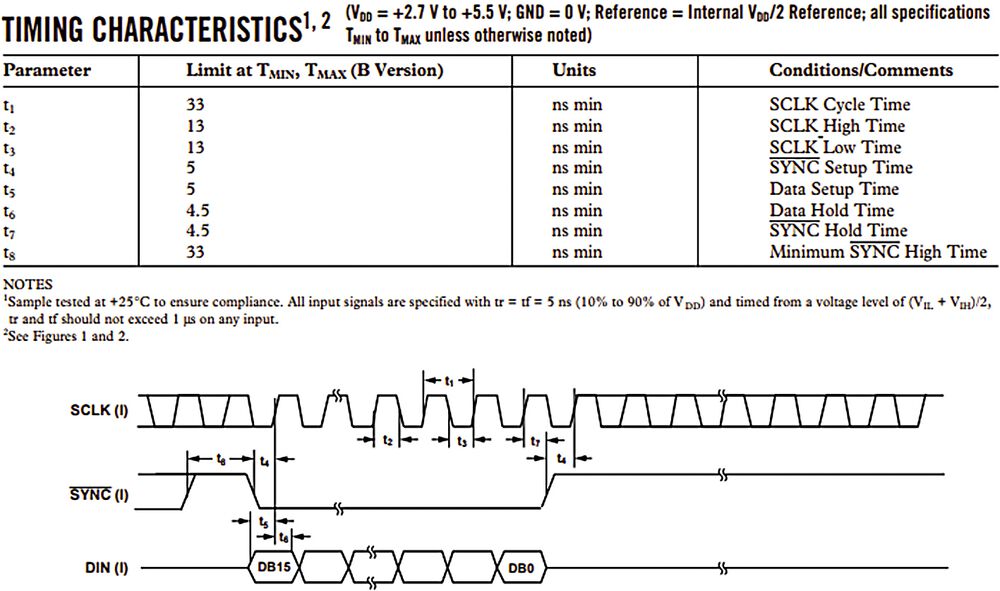
The DAC AD7303 from Analog Devices serves as a typical representative of an SPI interface here. Figure 1 shows the timing diagram of the interface as well as the timing parameters. In this example, the SCLK frequency is chosen to be 30 MHz. Particular attention must be paid to the timing parameters t4, t5 and t6 when defining the timing requirements (timing constraints).
Figure 1: AD7303 Timing Diagram and Timing Requirements.
(Image:PLC2 GmbH)
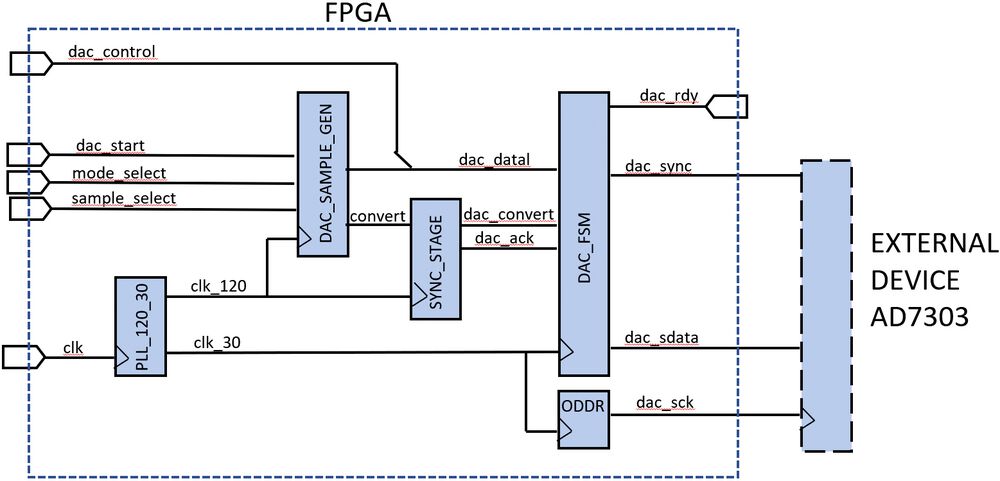
For the implementation with two clock domains, two clocks, which do not necessarily have to be synchronous, are used. In the present case, the clocks are 120 MHz and 30 MHz. The sequence control is clocked at 120 MHz, while the actual SPI FSM is controlled at 30 MHz.
As can be seen from Image 2, a synchronization stage between the two clock domains is therefore necessary (if the two clock domains are synchronous to each other, the synchronization stage can be omitted). The implementation of the SPI interface with two clock domains is shown in Image 2.
Image 2: SPI interface implementation with two clock domains.
(Image:Image:)
Used parameters:
Input clock: 100 MHz
Internal clock CLK_120: 120 MHz
Internal clock CLK_30: 30 MHz
Generated clock dac_sck: 30 MHz
The PLL_120_30: The PLL generates two internal, phase-synchronous clocks CLK_120 and CLK_30 from the external clock CLK (100 MHz).
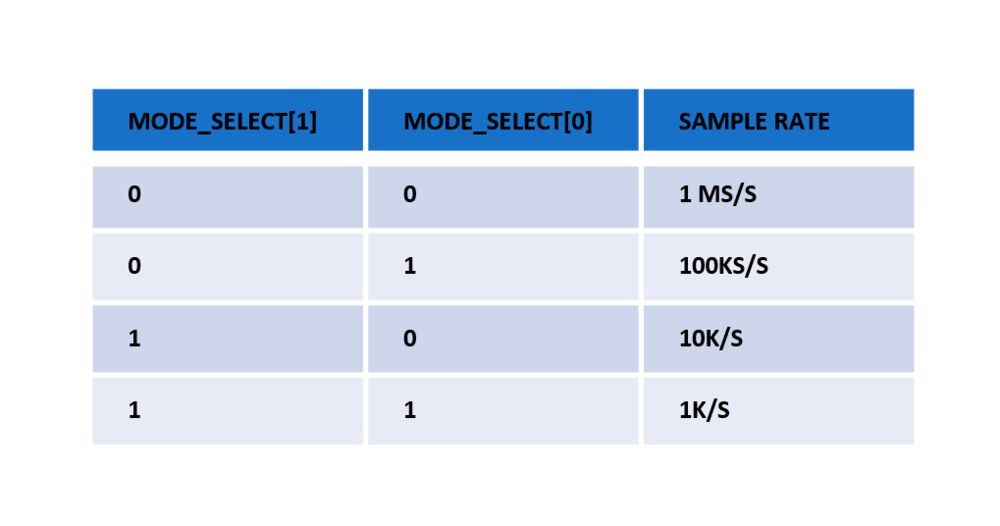
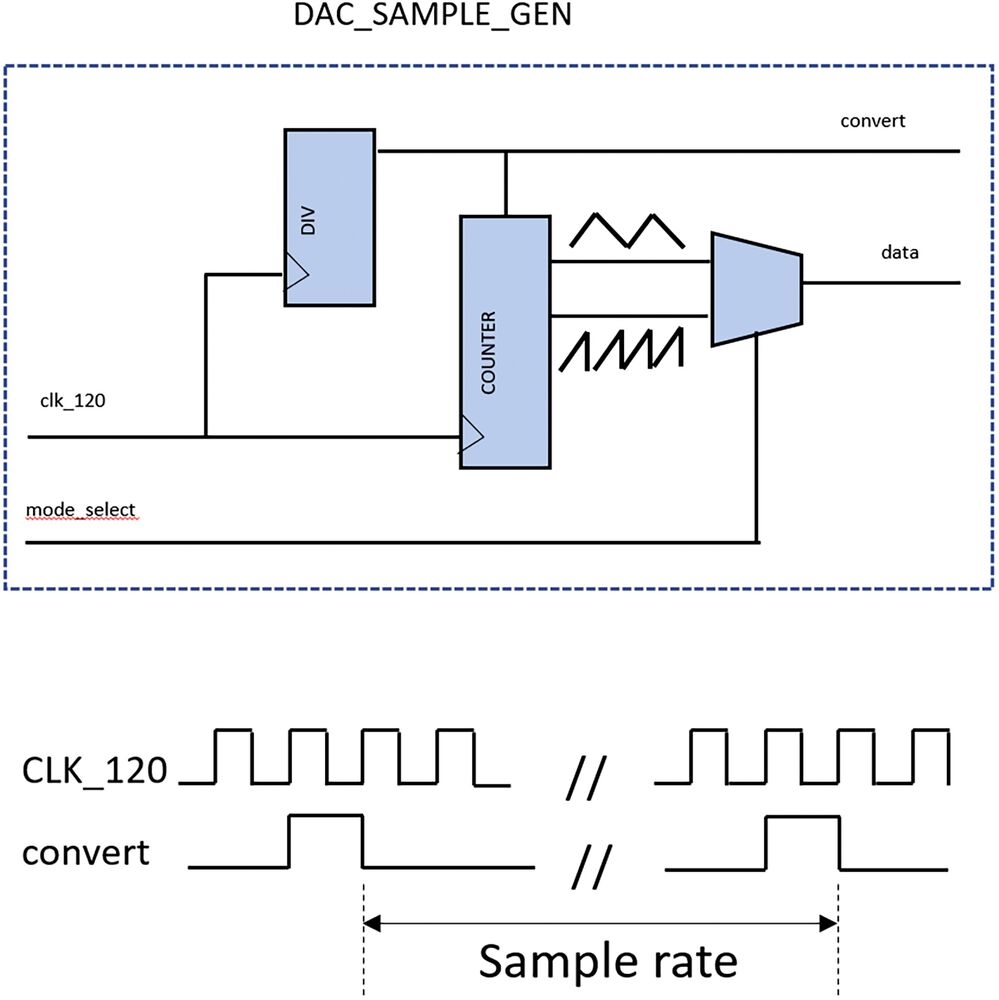
Module dac_sample_gen: The dac_sample_gen module generates the sample signal (convert) for the dac_fsm. The sample signal initiates the transmission of digital data to the DAC. The sample rate is set via sample_select [1:0] and is given in the table shown. The block diagram of dac_sample_gen is shown in Figure 3.
Table 1: The sample rate is set via sample_select [1:0].
(Image:PLC2 GmbH)
Image 3: Block diagram dac_sample_gen.
(Bild:PLC2 GmbH)
Control signal mode_select: The control signal mode_select generates either a square signal or a triangular signal as input data for the DAC.
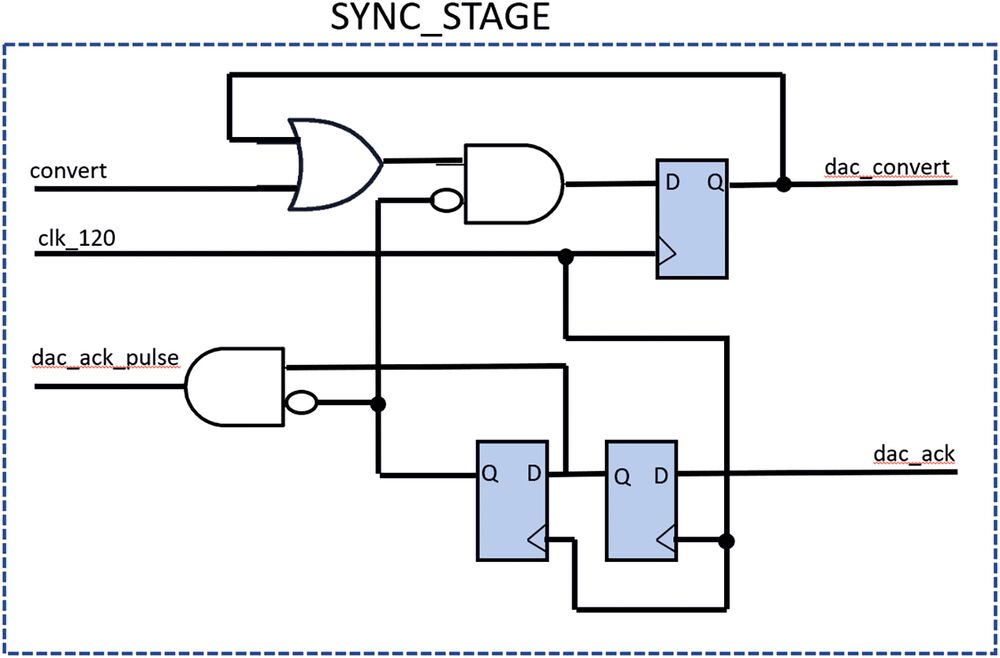
Module sync_stage: The dac_sample_gen module operates with CLK_120. The control unit dac_fsm is part of the CLK_30 domain. The sync_stage module transports the convert signal from the CLK_120 domain to the CLK_30 domain. Corresponding signals from the dac_fsm are transferred from the CLK_30 domain to the CLK_120. The block diagram of sync_stage is shown in Figure 4.
Image: Block diagram of sync_stage.
(Image:Image: PLC2 GmbH)
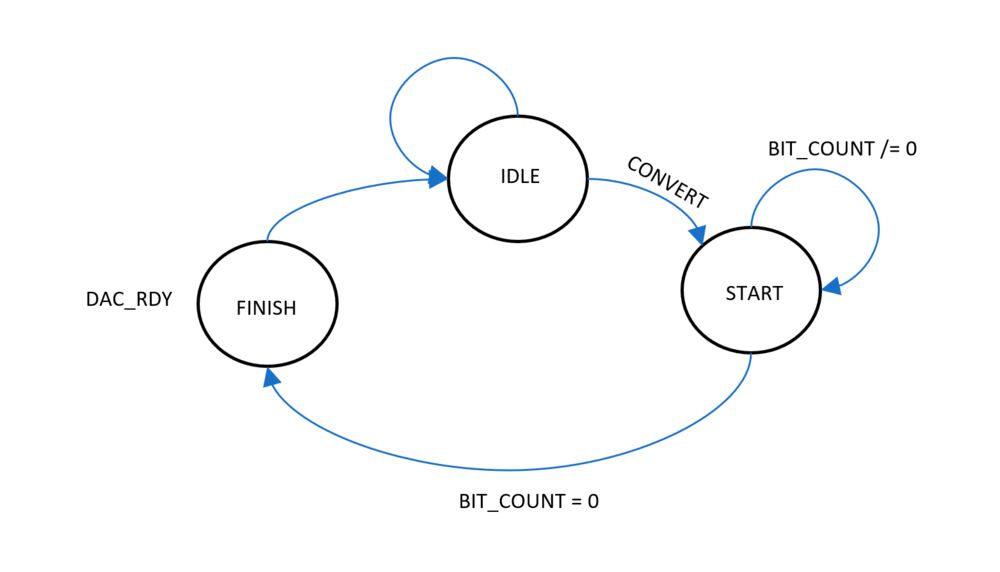
Module dac_fsm: The module dac_fsm controls the generation of the control/data signals to the DAC. In order to meet the values of t4, t5 and t6 given in Image 1, dac_fsm operates on the falling edge of CLK_30. dac_fsm is implemented as a state machine as shown in Image 5.
The clock signals CLK_120 and CLK_30 do not need to be explicitly specified as they are automatically defined by the design software. These two clocks are also referred to as "automatically generated clock".
The signal connected to port dac_sck is a copy of the internal clock CLK_30. This signal is interpreted as a clock by the external DAC. Therefore, this signal must also be defined as a clock in order to correctly describe the time requirements t4, t5 and t6. This clock is a so-called "manually generated clock."
The times t4, t5 and t6 describe the setup / hold requirements for the external device. These requirements are described with the set_output_delay constraint.
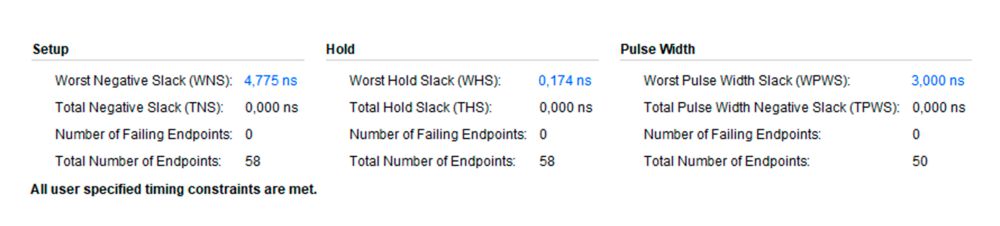
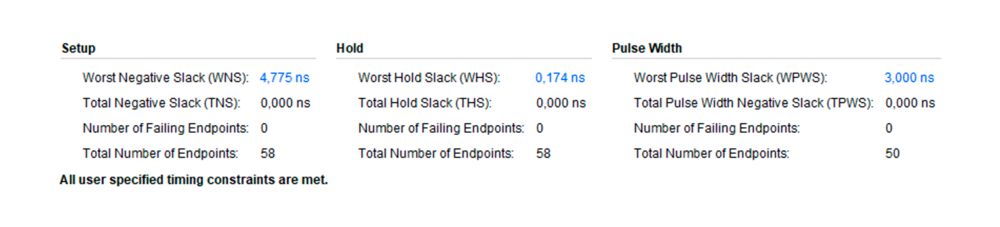
The timing analysis confirms the proper implementation of the design.
The timing analysis confirms the proper implementation of the design.
(Image:Image:)
Guidance to Accelerate your Programmable Solution
Areas of application for programmable logic circuits are as diverse as the available solutions that can be developed with them. Whether FPGA, GPU, or Adaptive Computing SoC: Each technology has its justification but also requires explanation.The FPGA Conference Europe – as the most important platform in Europe for manufacturer- and technology-independent and application-crossing exchange between experts and developers – provides embedded developers with orientation and practical assistance.
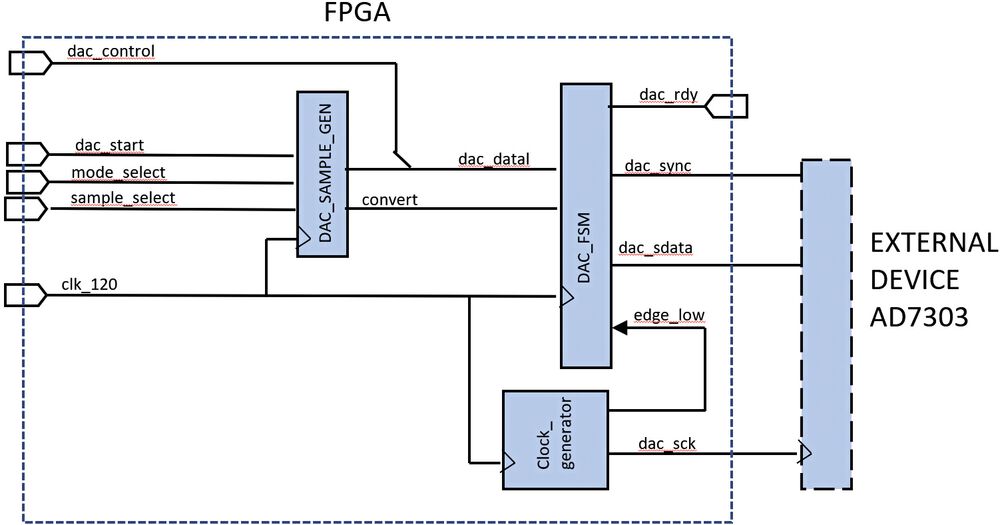
The implementation of the single-clock SPI interface is shown in Figure 6.
Image: The implementation of the single-clock SPI interface.
(Image:PLC2 GmbH)
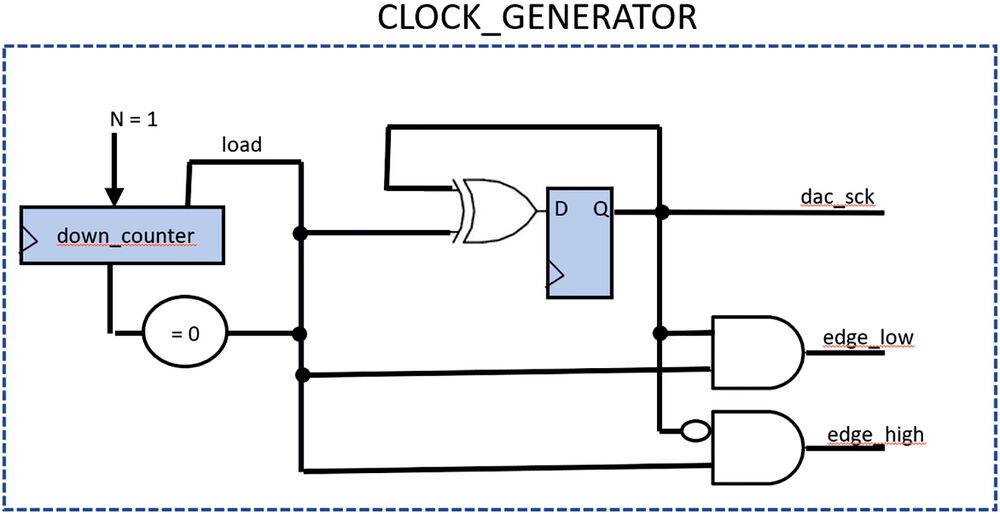
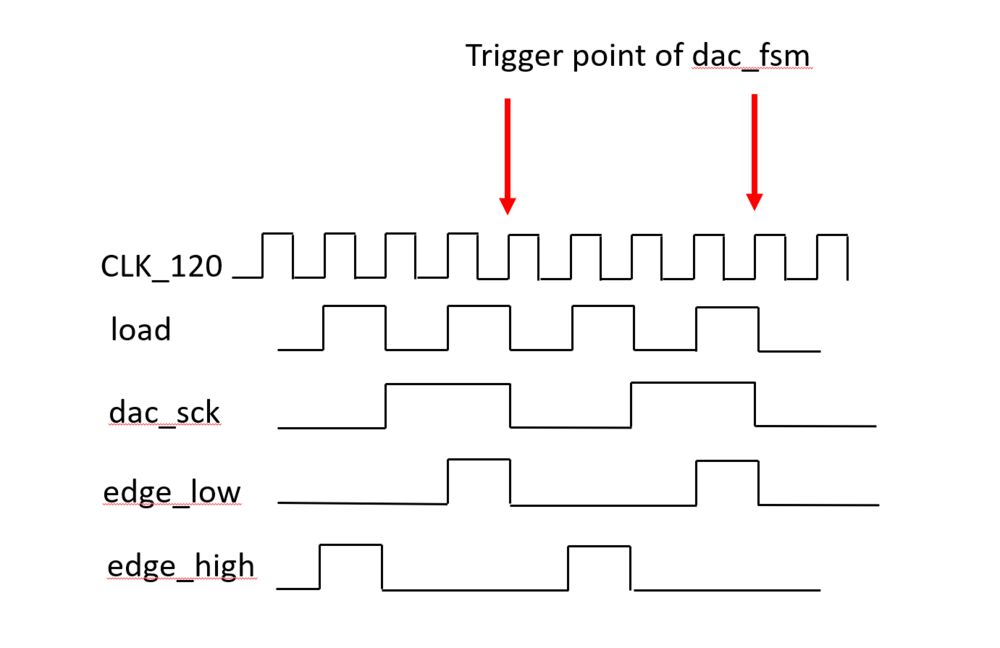
The concept of SPI implementation with a single clock domain is similar to implementation with two clock domains. To illustrate this, the PLL is not used. Also, the sync_stage module is not needed. Because of the single clock, the clock_generator module is needed to signal the falling edge of the dac_sck, which is used as the trigger condition for the state machine dac_fsm.
Date: 08.12.2025
Naturally, we always handle your personal data responsibly. Any personal data we receive from you is processed in accordance with applicable data protection legislation. For detailed information please see our privacy policy.
Consent to the use of data for promotional purposes
I hereby consent to Vogel Communications Group GmbH & Co. KG, Max-Planck-Str. 7-9, 97082 Würzburg including any affiliated companies according to §§ 15 et seq. AktG (hereafter: Vogel Communications Group) using my e-mail address to send editorial newsletters. A list of all affiliated companies can be found here
Newsletter content may include all products and services of any companies mentioned above, including for example specialist journals and books, events and fairs as well as event-related products and services, print and digital media offers and services such as additional (editorial) newsletters, raffles, lead campaigns, market research both online and offline, specialist webportals and e-learning offers. In case my personal telephone number has also been collected, it may be used for offers of aforementioned products, for services of the companies mentioned above, and market research purposes.
Additionally, my consent also includes the processing of my email address and telephone number for data matching for marketing purposes with select advertising partners such as LinkedIn, Google, and Meta. For this, Vogel Communications Group may transmit said data in hashed form to the advertising partners who then use said data to determine whether I am also a member of the mentioned advertising partner portals. Vogel Communications Group uses this feature for the purposes of re-targeting (up-selling, cross-selling, and customer loyalty), generating so-called look-alike audiences for acquisition of new customers, and as basis for exclusion for on-going advertising campaigns. Further information can be found in section “data matching for marketing purposes”.
In case I access protected data on Internet portals of Vogel Communications Group including any affiliated companies according to §§ 15 et seq. AktG, I need to provide further data in order to register for the access to such content. In return for this free access to editorial content, my data may be used in accordance with this consent for the purposes stated here. This does not apply to data matching for marketing purposes.
Right of revocation
I understand that I can revoke my consent at will. My revocation does not change the lawfulness of data processing that was conducted based on my consent leading up to my revocation. One option to declare my revocation is to use the contact form found at https://contact.vogel.de. In case I no longer wish to receive certain newsletters, I have subscribed to, I can also click on the unsubscribe link included at the end of a newsletter. Further information regarding my right of revocation and the implementation of it as well as the consequences of my revocation can be found in the data protection declaration, section editorial newsletter.
Module clock_generator: The module clock_generator shown in Figure 7 generates the clock signal dac_clk and the display of the falling edge of dac_sck. Figure 8 shows the relationship between dac_sclk and edge_low.
Image 7: Block diagram of the clock_generator module.
(Image:Image:)
Image: Relationship between dac_sclk and edge_low.
(Image:PLC2 GmbH)
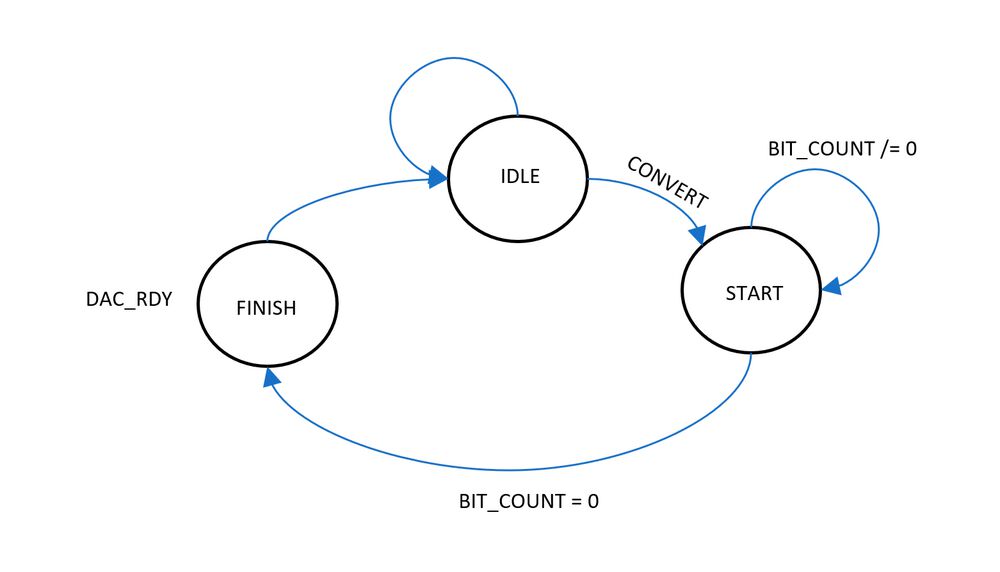
The dac_fsm module for the single clock implementation: The dac_fsm module controls the generation of control/data signals to the DAC. To comply with the t4, t5 and t6 values given in Figure 1, dac_fsm always operates on the rising edge of CLK_120, but only when the edge_low signal is active. Dac_fsm is implemented as a state machine.
The state machine dac_fsm has the same structure as the state machine in the implementation of the solution with two clock domains. The only difference is the evaluation of the falling edge of dac_sck instead of using the clock clk_30.
Image 9: Structure of the dac_fsm state machine.
(Image:PLC2 GmbH)
After the convert signal has been recognized, the bit_count counter is loaded with the value 15. The serial data is output on the dac_sdata line with the rising edge of the CLK_120 clock signal whenever edge_low is active. After 16 data bits have been transferred, dac_fsm again signals readiness and waits for the next convert signal.
Timing Constraints for Single Clock Domain Implementation
The clock signal connected to the port dac_sck is generated by the clock_generator. The relationship between CLK_120 and dac_sck is divided by 4 (compare with Figure 7).
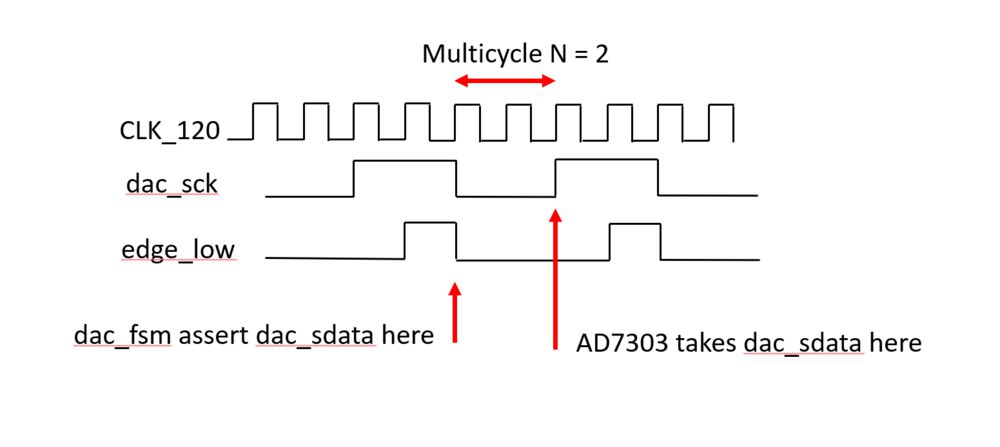
The timing parameters t4, t5, and t6 describe the setup/hold requirements for the external DAC AD7303. These requirements are described using the set_output_delay constraint. Due to the single clock domain, a multicycle constraint is also necessary.
Due to the single clock domain, a multicycle constraint is also necessary. See image 10.
(Image:PLC2 GmbH)
Timing Analysis
The timing analysis of the design with one clock domain shows the same results as the design with two clock domains.
The timing analysis confirms the proper implementation of the design.
(Image:PLC2 GmbH)
Summary
Both concepts can be used to implement low-speed SPI interfaces. However, the two-clock domain has an advantage in terms of power consumption, as part of the design runs at a lower speed. Also, the timing constraints are easier to specify. The single clock domain concept uses a single clock distribution network, which is an advantage as no synchronization stages are needed. Both project templates are available on request at info@plc2.de. (me)



:quality(80)/p7i.vogel.de/wcms/93/33/93337b12f88eb2c776c80d4f9e49d323/0129247650v1.jpeg "Isolated IoT data becomes connected real-time personalization. (Image: ©PB Studio Photo - stock.adobe.com)")
:quality(80)/p7i.vogel.de/wcms/8e/fa/8efad6aa006fcf624d07c645b774d8ce/screenshot-202026-01-21-20113324-764x430v1v1.png "The system processes heavy sheets weighing up to 200 kg fully automatically, without programming or teaching. (Image:Teqram)")
:quality(80)/p7i.vogel.de/wcms/0c/58/0c587c8221ae96052b5dcc0f40eb3dcd/0128880879v1.jpeg "A chip surfer with a solid carbide head is used for finishing in the third operation. (Image:Ingersoll)")
:quality(80)/p7i.vogel.de/wcms/a2/9b/a29bb02b3f1e34962e28579dccfbbc49/0129266114v1.jpeg "Bevel gears on workpiece carriers in the rotary indexing conveyor of the VSC 400 DDS - the pick-up spindle removes the workpiece precisely and reproducibly for hard machining at EWS. (Image:Emag)")
:quality(80)/p7i.vogel.de/wcms/4d/74/4d745446555110ca9797db1eabb7c9d3/0129551585v1.jpeg "Jochen Gemeinhardt is responsible for NTT Data's AI business in the DACH region as Head of Production & Supply Chain and Head of Industry Line Global Business. (Image:NTT Data)")
:quality(80)/p7i.vogel.de/wcms/7a/c8/7ac81c41bab1cc98fbe7b20c95644c6c/0129575667v1.jpeg "For the live gala show celebrating the New Year festival, Unitree rehearsed an impressive performance with its robots. (Image:Unitree/YouTube)")
:quality(80)/p7i.vogel.de/wcms/a3/0c/a30c4c3a36910e92d6082fde37261730/0129555015v1.jpeg "From command recipient to decision-maker: thanks to Agentic AI, robots no longer just stubbornly execute pre-programmed scripts. Instead, they analyze visual data in real time and decide autonomously on the next process step (Image:Nano Banana / AI-generated)")
:quality(80)/p7i.vogel.de/wcms/60/00/6000deb595c3e6b2dd0bfe508aa71653/newsimage418166-5084x2861v1v1.jpeg "The robot-guided friction stir welding gun \"Steppwelder\" in use on a conventional 6-axis industrial robot. (Image:Image: Dominik Walz, MPA, University of Stuttgart)")
:quality(80)/p7i.vogel.de/wcms/48/38/4838074eab3f29ec319797fb63881b18/adobestock-693942839--c2-a9-20wirot-20-e2-80-93-20stock-adobe-com-3389x1907v1v1.jpeg "Leaves or bird droppings can cause hotspots on solar modules and reduce performance. (Image:Wirot stock.adobe.com.)")
:quality(80)/p7i.vogel.de/wcms/3f/7f/3f7f9f45ebccd4751d41106866314aea/newsimage418028-2772x1559v1v1.jpeg "Live in the ice channel—detailed recordings in real time make the smallest mistakes and thus time losses in the luge run visible. (Image:Mittweida University of Applied Sciences)")
:quality(80)/p7i.vogel.de/wcms/05/b7/05b7c58dcf5a7fc900348d1c30f7c116/0129540459v1.jpeg "Researchers from Stuttgart have investigated whether the \"technology\" behind hairy elephant trunks, which function as a sensitive gripping system, can also be used in robotics. (Image:Zoo Magic)")
:quality(80)/p7i.vogel.de/wcms/6b/6f/6b6fff754fedf05375e5255460743297/0129197850v1.jpeg "A new core-shell design for anodes aims to reduce storage losses during the first charge cycle of sodium-ion batteries. (Image:BAM)")
:quality(80)/p7i.vogel.de/wcms/37/23/372374e00db2f1803ae5cde2f00aff31/0129599814v1.jpeg "The new Euro 7 standard sets requirements for the wear of service brakes. These can be met with some technical methods. (Image:Aumovio)")
:quality(80)/p7i.vogel.de/wcms/0c/1d/0c1da1d70af62238b11e22b102bd256d/0129108406v1.jpeg "At the first ADAC glare symposium, experts illustrated and analyzed the topic of glare under real conditions. (Image:Dominsky – VCG)")
:quality(80)/p7i.vogel.de/wcms/95/00/95009ae2972690e3fdab0dc701e202c3/0129621847v1.jpeg "Last year, Airbus's revenue increased by six percent to 81 billion US dollars. (Image:Airbus SAS 2024)")
:quality(80)/p7i.vogel.de/wcms/ae/cf/aecf874a057676aa69b3b5e4c7b52411/0129609464v1.jpeg "Glass storage in action: Microsoft has stored map data from the Flight Simulator on this piece of glass. (Image:Microsoft Research)")
:quality(80)/p7i.vogel.de/wcms/2c/8d/2c8da4b72e35ded278178929afb94d55/0129561713v1.jpeg "Change in direction: The shift away from PFAS in semiconductor manufacturing and the move toward sustainable chip production is demonstrated by the trilateral collaboration between Fraunhofer ENAS, the Paul Scherrer Institute PSI, and Memsstar Limited, which rely on the environmentally friendly Gas-MacEtch technology. (Image:andreyarmyagov/Canva)")
:quality(80)/p7i.vogel.de/wcms/a3/df/a3df18dc04ecd4cffbf933b32018facb/0129644484v1.jpeg "Acquisition complete: Finnish Incap has finalized the takeover of EMS manufacturer Lacon. (Image:Gerd Altmann from Pixabay)")
:quality(80)/p7i.vogel.de/wcms/41/85/41855b7e5c57936c33039a7e785462c9/0129633555v1.jpeg "A chip processing method developed by MIT could help cryptographic processes keep data secure by allowing two chips within the same system to authenticate each other using a common fingerprint. (Image:freely licensed)")

:quality(80)/p7i.vogel.de/wcms/2f/d9/2fd90797f91e85e50e8c5dddfd0ec911/0117450610.jpeg "Figure 1: AD7303 Timing Diagram and Timing Requirements.(Image: PLC2 GmbH)")
:quality(80)/p7i.vogel.de/wcms/d8/2c/d82c504aaaaef54a5c0272ec9f0df251/0117447536.jpeg "Image 2: SPI interface implementation with two clock domains.(Image: Image:)")
![Table 1: The sample rate is set via sample_select [1:0].(Image: PLC2 GmbH)](https://cdn1.vogel.de/m6aPGWmMrrE17WfR_wk7mqzQ21I=/300x300/smart/filters:format(jpg):quality(80)/p7i.vogel.de/wcms/6d/24/6d24bc725370d455f1df2545e4336eeb/0116126142.jpeg "Table 1: The sample rate is set via sample_select [1:0].(Image: PLC2 GmbH)")
:quality(80)/p7i.vogel.de/wcms/c9/62/c9622dff82139ea7396c2aa4762020a1/0117447552.jpeg "Image 3: Block diagram dac_sample_gen.(Bild: PLC2 GmbH)")

:quality(80)/p7i.vogel.de/wcms/81/b7/81b73f2c8b898627e2f8fc18fea47b2b/0127093609v1.jpeg "Figure 1: An example of setting up an A²B network and the connected blocks. (Image:ADI)")
:quality(80)/p7i.vogel.de/wcms/03/34/0334e241b497d0ddce82012e1fdcdd46/0122984399v1.jpeg "Design RF signal chains more flexibly: View of the evaluation module TRF1108-DAC39RFEVM, which combines a D2S RF amplifier with RF DACs. (Image:TI)")