"Differential to Single-Ended" HF amplifiers offer signal bandwidths from DC to 12 GHz, complementing RF DACs. The result of the combination is a higher packing density and performance of the system, as well as more flexible RF transmission signal chains.
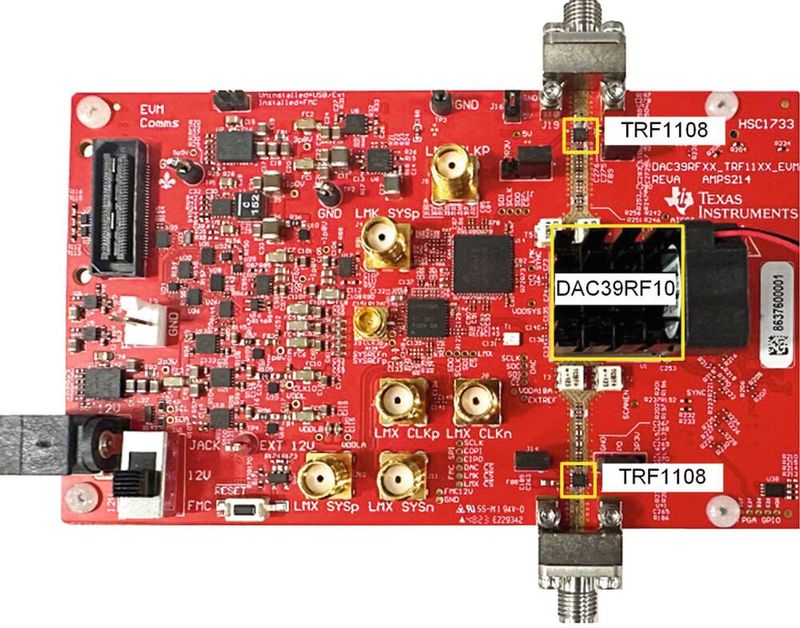
Design RF signal chains more flexibly: View of the evaluation module TRF1108-DAC39RFEVM, which combines a D2S RF amplifier with RF DACs.
(Image: TI)
In conventional RF transmission signal chains, D/A converters (DACs) are typically used to generate a baseband signal, which is then upconverted to the desired RF frequencies using an RF mixer and a local oscillator. However, the technology of RF D/A converters has now reached such an advanced level that the signal can be generated directly at the desired RF frequency. This reduces complexity and significantly simplifies the design of RF transmission signal chains.
While RF DACs have symmetrical differential outputs, both the transmission signal chain and the antenna are ground-referenced. To convert the differential signal into a ground-referenced signal (Differential to Single-Ended, or D2S) and boost the power of the RF signal, two separate components have traditionally been used—a passive balun and an RF intermediate amplifier. However, passive baluns have certain disadvantages, including large space requirements on the circuit board, high insertion loss, poor matching and amplification properties, and phase imbalance when operating over wide bandwidths. Additionally, passive RF baluns are not suitable for operation at or near DC.
Gallery
A D2S RF amplifier converts the differential signal into a ground-referenced signal and amplifies the signal over a wide bandwidth. The article outlines the advantages of D2S RF amplifiers over conventional solutions consisting of a passive balun and an RF amplifier block.
The block diagram in image 1 shows the D2S RF amplifier TRF1108, which serves as a DAC buffer and driver for the power amplifier (PA) here.
D2S conversion and amplification on an area of 4 mm² (0.0062 square inches)
Passive baluns used at the output of an RF DAC for D2S conversion are often bulky and expensive, especially when they are required to have a wide bandwidth. The large dimensions of the passive balun require more space on the circuit board and necessitate long traces, which in turn negatively affect the RF properties. This is particularly true when multi-channel RF DACs are used. Moreover, passive baluns with wide bandwidths have high insertion losses, requiring a particularly powerful RF amplifier block to compensate for the reduced signal strength.
The D2S RF amplifier TRF1108 is a monolithic component that performs D2S conversion and provides amplification. With its bandwidth from DC to 12 GHz, this component can serve as a broadband DAC buffer in applications ranging from DC to several gigahertz. The chip occupies only an area of 2 mm x 2 mm (0.0787 inches) on the circuit board, which reduces the necessary board space and allows for shorter traces and improved RF performance. The leading image shows the TRF1108 on the associated evaluation module DAC39RF10.
Radar application example with high component density
In designing radar systems, the operating frequency is determined based on the desired range, resolution, and antenna size. An RF DAC with wide bandwidth, combined with a D2S RF amplifier, allows the same hardware design to be used for applications in different frequency bands, requiring only minimal modifications to the RF transmission signal chain.
The combination of an RF DAC and a D2S RF amplifier offers numerous advantages for densely packed phased-array radar applications with digital beamforming. In such applications, multiple DAC outputs drive numerous antennas that emit the phase-shifted RF signals. Multi-channel RF sampling DACs and transceivers integrate many D/A converters on a single chip and in one package, simplifying system design and reducing both the dimensions and complexity of the hardware. However, this setup requires a small yet powerful D2S RF amplifier to maximize the density possible with these multi-channel RF DACs.
Matched inputs and outputs in D2S RF amplifiers
With broadband passive baluns, which are traditionally used with RF DACs, it is challenging to achieve good return loss values at both the input and output. This is further complicated by the fact that the return losses are also influenced by the termination impedances at the input and output. This alters the impedance across the RF bands of interest, leading to undesirable fluctuations in the amplification of the transmitted signal.
The differential inputs of the TRF1108 are matched to an impedance of 100 Ω, while the ground-referenced output of the component has a broadband matching to 50 Ω. This improves return loss and results in a very flat frequency response over a large RF bandwidth (image 3).
Image 4 illustrates how the matched inputs and outputs of the TRF1108, in combination with an RF DAC, ensure a flat frequency response from 100 MHz to 8 GHz.
Performance of D2S RF amplifiers compared to baluns
Broadband passive RF baluns exhibit high insertion losses, which reduce the maximum signal level coming from RF DACs. Therefore, a ground-referenced, powerful RF amplifier block must follow the passive balun to compensate for this insertion loss and boost the RF signal level. However, ground-referenced RF amplifier blocks often have insufficient second-order nonlinearity. The resulting distortions cannot be filtered out if the signal bandwidth spans several octaves. The large gain and phase imbalance of a broadband balun also leads to further imbalances, affecting the second-order nonlinearity of the RF signal.
Date: 08.12.2025
Naturally, we always handle your personal data responsibly. Any personal data we receive from you is processed in accordance with applicable data protection legislation. For detailed information please see our privacy policy.
Consent to the use of data for promotional purposes
I hereby consent to Vogel Communications Group GmbH & Co. KG, Max-Planck-Str. 7-9, 97082 Würzburg including any affiliated companies according to §§ 15 et seq. AktG (hereafter: Vogel Communications Group) using my e-mail address to send editorial newsletters. A list of all affiliated companies can be found here
Newsletter content may include all products and services of any companies mentioned above, including for example specialist journals and books, events and fairs as well as event-related products and services, print and digital media offers and services such as additional (editorial) newsletters, raffles, lead campaigns, market research both online and offline, specialist webportals and e-learning offers. In case my personal telephone number has also been collected, it may be used for offers of aforementioned products, for services of the companies mentioned above, and market research purposes.
Additionally, my consent also includes the processing of my email address and telephone number for data matching for marketing purposes with select advertising partners such as LinkedIn, Google, and Meta. For this, Vogel Communications Group may transmit said data in hashed form to the advertising partners who then use said data to determine whether I am also a member of the mentioned advertising partner portals. Vogel Communications Group uses this feature for the purposes of re-targeting (up-selling, cross-selling, and customer loyalty), generating so-called look-alike audiences for acquisition of new customers, and as basis for exclusion for on-going advertising campaigns. Further information can be found in section “data matching for marketing purposes”.
In case I access protected data on Internet portals of Vogel Communications Group including any affiliated companies according to §§ 15 et seq. AktG, I need to provide further data in order to register for the access to such content. In return for this free access to editorial content, my data may be used in accordance with this consent for the purposes stated here. This does not apply to data matching for marketing purposes.
Right of revocation
I understand that I can revoke my consent at will. My revocation does not change the lawfulness of data processing that was conducted based on my consent leading up to my revocation. One option to declare my revocation is to use the contact form found at https://contact.vogel.de. In case I no longer wish to receive certain newsletters, I have subscribed to, I can also click on the unsubscribe link included at the end of a newsletter. Further information regarding my right of revocation and the implementation of it as well as the consequences of my revocation can be found in the data protection declaration, section editorial newsletter.
In D2S RF amplifiers, feedback techniques are used to reduce gain and phase imbalances. The differential inputs also result in better second-order distortion values than what is possible with ground-referenced RF amplifier blocks. Overall, the D2S RF amplifier can thus offer improved second-order nonlinearity in RF transmission applications that cover multiple octaves.
Conclusion: The benefits of D2S RF amplifiers combined with RF DACs
Technological advancements in RF DACs have paved the way for flexible, broadband RF applications in radar systems and SDR (Software Defined Radio) as well as test and measurement systems for high frequencies. The integration of multiple RF DACs in multi-channel D/A converters and RF sampling transceivers simplifies the design of transmission signal chains and reduces the PCB area for multi-transmit RF and phased-array applications.
D2S RF amplifiers like the TRF1108 offer signal bandwidths from DC to 12 GHz and complement the high performance of RF DACs for large RF bandwidths. The single-chip D2S RF amplifier also provides an improvement over the traditional solution of a passive balun and RF amplifier block, as it reduces PCB area and trace lengths, coupled with better matching and performance. Ultimately, this results in higher packing density, enhanced performance, and more flexible designs for RF transmission signal chains. (kr)



:quality(80)/p7i.vogel.de/wcms/af/1e/af1ec4fca4636f521f780ba0ae009c8e/bild3-werkst-c3-bcck-20und-20werkzeug-5204x2928v1v1.jpeg "The main area of application for the new axial gear cutting machine is the production of rotor shafts for electric vehicles. (Image:Profiroll Technologies)")
:quality(80)/p7i.vogel.de/wcms/d1/ab/d1ab452217529e5c29a81add9aca7c22/0128871322v1.jpeg "Only one year to go: the new EU Machinery Regulation makes cybersecurity mandatory. Companies should act now. (Picture: ©Pisit - stock.adobe.com)")
:quality(80)/p7i.vogel.de/wcms/88/53/8853f7df2fe47a3d2c6f1879f6ac38e6/newsimage417073-1500x843v1v1.jpeg "Measuring setup for friction stir welding: Modular acoustic measuring system with flexibly positioned microphones for recording tool wear and process deviations in real time. (Image:Fraunhofer IDMT)")
:quality(80)/p7i.vogel.de/wcms/28/75/28751a17e2bcca46e53a1e7b8a84c433/schmersal-tiepner-029-6749x3796v1v1.jpeg "Tiepner's compact system produces ID cards made of laminated plastic, which are used as customer cards, ID cards or cheque cards, among other things. Left in the picture: Christian Höltge, Managing Director of Tiepner GmbH. (Image:Tiepner GmbH)")
:quality(80)/p7i.vogel.de/wcms/cd/fe/cdfe212a3b3206e2ff09dcdf71c11240/0129219561v1.jpeg "Extended S-series: The new Cobot models from Omron lift up to 30 kilograms and are now also protected against dust and water thanks to protection class IP65. (Image:Omron)")
:quality(80)/p7i.vogel.de/wcms/c3/6d/c36d161e7709095fd1de4cb9de27d927/0129133682v1.jpeg "Nanjing is Siemens' largest research and production center for CNC systems, drives and electric motors outside Germany. (Image:Siemens)")
:quality(80)/p7i.vogel.de/wcms/70/dc/70dc2fbc09e6958a72c63bd15e986e14/0129206156v1.jpeg "The global shoe machine manufacturer Desma relies on automation and has been revolutionizing shoe production—together with ABB Robotics for over 40 years. (Image:ABB Robotics)")
:quality(80)/p7i.vogel.de/wcms/60/fd/60fd12ddfe1fb623568736f27d1cfe61/0128606899v1.jpeg "The future of supply chains: AI and dashboards to ensure optimal OTIF values (Picture: ©immimagery - stock.adobe.com)")
:quality(80)/p7i.vogel.de/wcms/39/38/393873c2ed943bb715a6419d94049b63/geralt-entrepreneur-1340649-1280-1280x720v1v1.jpeg "Visual Components presents its forecast for production simulation in 2026. (Image:Pixabay)")
:quality(80)/p7i.vogel.de/wcms/60/4e/604e2a1ce26f177c5f28c2bff94c2f7d/der-20rotor-20mit-20aktiv-20verwindbaren-20rotorbl-c3-a4ttern-20im-20windkanal-1920x1079v1v1.jpeg "The rotor with actively twistable rotor blades in the wind tunnel: The open measuring section and sound-absorbing wall and model fuselage cladding enable high-quality acoustic measurements. (Image:DLR)")
:quality(80)/p7i.vogel.de/wcms/a8/9a/a89aef1cba3843fa06a1ec1f07cf659b/adobestock-95634179--c2-a9-20crazyforanimeart-20-e2-80-93-20stock-adobe-com-4762x2678v1v1.jpeg "Copied from the octopus: Researchers have developed a film-like thin-film platform that can dynamically change not only its color but also its surface structure. (Image:AdobeStock_95634179_ CrazyForAnimeArt)")
:quality(80)/p7i.vogel.de/wcms/2b/fb/2bfbb9fa26274cb8f6e8979c24a3d08e/0129243542v1.jpeg "In some cases, the new additively manufactured lightweight bearings only reach
11 percent of the weight of comparable steel bearings. (Image:Rosswag Engineering)")
:quality(80)/p7i.vogel.de/wcms/d2/40/d240b49c8edba464bf610f0e0b3628f0/p90629460-lowres-2250x1265v1.jpeg "(Source: BMW Group)")
:quality(80)/p7i.vogel.de/wcms/e9/60/e960f8c34a847b11fc576c54d9d46ea6/0129325747v1.jpeg "Robobuses, like WeRide here, are well on the way to becoming an integral part of local public transport. (Image:WeRide)")
:quality(80)/p7i.vogel.de/wcms/e3/8d/e38d7a9b1bcb87f6ef6546654a2ee40f/bild1v1.jpeg "(Source: InfiMotion)")
:quality(80)/p7i.vogel.de/wcms/a6/cc/a6cc273294dbe8ab9534fb4316fc8d2b/0129255976v1.jpeg "Porsche sees battery expertise as a key strategic competence and has developed the battery modules for the new Cayenne Electric itself. (Image:Porsche)")
:quality(80)/p7i.vogel.de/wcms/6f/8f/6f8ff5bf9b81829ef22736bc790cecca/0129224894v1.jpeg "View of the quantum optics laboratory at the University of Stuttgart: here, researchers are experimenting with new photon sources for quantum computing and quantum networks. (Image:Barz Group, University of Stuttgart)")
:quality(80)/p7i.vogel.de/wcms/52/3a/523ac3157ae4b4f596c7241c89127061/0129260553v1.jpeg "This artistic illustration shows a thermal analog calculator that performs calculations using excess heat and is embedded in a microelectronic system. (Image:Jose-Luis Olivares, MIT)")
:quality(80)/p7i.vogel.de/wcms/d1/f4/d1f4508c6b79ec2f0432b34a6fa33a98/0114966184v1.jpeg "The Infineon headquarters Campeon in Neubiberg, Munich. (Image:Infineon)")
:quality(80)/p7i.vogel.de/wcms/fa/d3/fad3872cf3f110f43411f2dce9e8f23a/0129265762v1.jpeg "Siemens Energy has discovered the USA as a prosperous growth market for network technology and gas turbines! In order to be able to meet demand at some point, the company is already digging deeper into its pockets ... (Image:Siemens Energy)")
:fill(fff,0)/images.vogel.de/vogelonline/companyimg/76800/76895/65.jpg "FAULHABER_120mm.jpg ()")
:fill(fff,0)/p7i.vogel.de/companies/67/eb/67eba621ef6ea/logo2.png "logo2 (Wuxi InfiMotion)")
:quality(80)/p7i.vogel.de/wcms/80/5f/805ff3c2b4f486e651ca40fdbd26a10b/0122531446v1.jpeg "Design RF signal chains more flexibly: View of the evaluation module TRF1108-DAC39RFEVM, which combines a D2S RF amplifier with RF DACs.(Image: TI)")
:quality(80)/p7i.vogel.de/wcms/dc/45/dc4530a9962556376018caf77e516153/0122529508v1.jpeg "Image 1: Simplified representation of a transmission signal chain with a D2S RF amplifier functioning as a DAC buffer and driver for the power amplifier PA.(Image: TI)")
:quality(80)/p7i.vogel.de/wcms/4b/16/4b165ff3f1c7595404bb05dce1943554/0122531713v1.jpeg "Image 3: Smith chart with the input and output S-parameters of the TRF1108.(Image: TI)")
:quality(80)/p7i.vogel.de/wcms/bc/3e/bc3ef9b1786d91a92f5df5a101039b2a/0122529519v1.jpeg "Image 4: Frequency response of the components TRF1108 and DAC39RF10 in a range from 100 MHz to 8 GHz.(Image: TI)")
:quality(80)/p7i.vogel.de/wcms/f0/76/f0760e33dd1f62c48f3cc5a0c6189020/0124126712v1.jpeg "Efficiency leap: The Wi-Fi HaLow SoC MM8108 from Morse Micro achieves up to 37% transmitter efficiency. (Image:Morse Micro)")
:quality(80)/p7i.vogel.de/wcms/eb/0c/eb0c2c80a7777aa7a7855fea4b8417f0/0125301890v1.jpeg "Keysight's vector component analyzer is based on the current N524XB series PNA-X microwave network analyzers, which are equipped with digital predistortion techniques. It optimizes signal integrity and minimizes distortion to achieve high data transmission speed. (Image:Keysight)")