The international competition demands efficient, flexible, and economical production and supply chains. Transport and conveyor systems play a key role in this. In particular, it's worth looking at modern multi-carrier systems, whose strengths are revealed in the details.
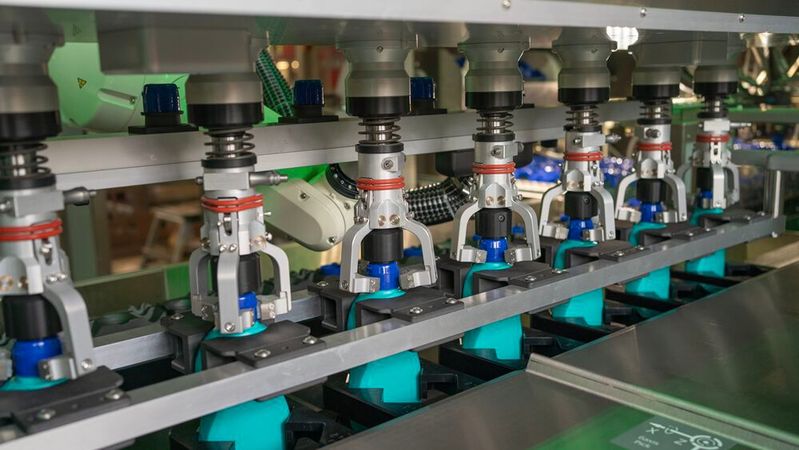
The carriers of the Lexium MC12 can now carry loads up to 10 kg with a new workpiece carrier, which is held on the track by a form-fit.
(Image: Schneider Electric)
The order of the day: produce customized products cost-effectively even in small quantities and respond quickly to dynamic customer needs. Multi carriers, which transport products individually through a system, play a crucial role in this. But where are multi carriers used, and what added value do they offer? This can be clearly illustrated by the example of the Multi Carrier solution Lexium MC12 from Schneider Electric.
Carriers Move Independently of Each Other
Launched in 2021, tech company Schneider Electric developed the Lexium MC12, a multi carrier designed for flexibility. Unlike conventional conveyors, it can be used, modified, and expanded for a variety of products and tasks. The assembly of the rail system itself is customized. Various straight and curved motor segments are available, which can be combined as desired and connected to form open or closed tracks. The workpiece carrier, called a carrier, is freely placed on the drive system and held on the track solely by the magnetic field. The highlight: all carriers—and thus each individual product—can be controlled separately and moved with an individual motion profile over the track. The carriers are independent of each other and can flexibly adjust their transport speed to the production process—in precise synchronization with other mechanisms, such as a positioning robot.
Gallery
Since multi carriers like the Lexium MC12 can be set up and operated so flexibly, they can be used in a wide variety of industries. Their particular strengths are especially noticeable where individual product variants and careful handling of raw materials are important—such as in the pharmaceutical industry, medical technology, or consumer goods industry. They are also frequently used in the food and beverage industry, for example, when filling and packaging liquid containers.
Individual Movement Profiles
Example smoothies: Here, an oval rail layout can be used, positioned horizontally in the middle of the system. The production process is as follows: In the first step, the empty bottles are placed on the carriers and aligned. Then, they move through various stations (filling, sealing, labeling, packaging) to the discharge station and finally to the shipping or storage area. The empty carriers are automatically returned to the production cycle after product removal, meaning they remain in constant use.
It gets really interesting when we look at the details. First, there are the individual motion profiles of the carriers. Carriers can be temporarily slowed down and precisely positioned for processing in the working area, such as when labeling bottles. Between the processing stations, they are accelerated again and transported to the next step. Then there's the independent timing. This means each station operates at the optimal pace and is fully utilized at all times. For example, the labeling station can work faster while the filling station runs at a slower pace. The carriers can be flexibly adapted to production requirements and ensure both millimeter-precise accuracy and shorter throughput times and higher output. Additionally, processing stations that operate quickly can be reduced in size, thus saving costs and space.
Produce Different Product Formats Simultaneously
Small, handy smoothies for quick enjoyment, XXL bottles for the family, and special editions at Christmas: for consumers, the variety of products and seasonal items is a beloved part of daily life, but for the beverage industry, it's a constant challenge—especially with regard to efficient and resource-efficient production. Against this backdrop, multi carrier systems pay off twice over. Thanks to the individual control of each carrier, various product formats with different filling quantities can be produced and packaged simultaneously on one line. Even during ongoing operations, quick adjustments to different bottle sizes, packaging types or filling quantities are easily possible. In the software, only the parameters of the new bottle size need to be entered or pre-programmed motion profiles activated. The motor segments and carriers automatically adjust to the new format, enabling the system to produce even small batch sizes cost-effectively.
"In the food and beverage industry, where there are many highly automated production processes, details make the difference," explains Michael Vögele, Senior Product Manager PacDrive & Robotics at Schneider Electric. "In exchange with our customers, we are constantly working on the further development of the Lexium MC 12." This includes, for example, the new anti-slosh function. Taking into account parameters such as viscosity and diameter, the software calculates the ideal motion profile of the carriers and adjusts the acceleration curve to the physical properties of the respective liquid. This ensures that no liquid spills over, even with rapid accelerations or abrupt decelerations, while the carriers are still moved at maximum speed. This is a decisive advantage, especially in filling processes where open containers are quickly filled and transported.
Date: 08.12.2025
Naturally, we always handle your personal data responsibly. Any personal data we receive from you is processed in accordance with applicable data protection legislation. For detailed information please see our privacy policy.
Consent to the use of data for promotional purposes
I hereby consent to Vogel Communications Group GmbH & Co. KG, Max-Planck-Str. 7-9, 97082 Würzburg including any affiliated companies according to §§ 15 et seq. AktG (hereafter: Vogel Communications Group) using my e-mail address to send editorial newsletters. A list of all affiliated companies can be found here
Newsletter content may include all products and services of any companies mentioned above, including for example specialist journals and books, events and fairs as well as event-related products and services, print and digital media offers and services such as additional (editorial) newsletters, raffles, lead campaigns, market research both online and offline, specialist webportals and e-learning offers. In case my personal telephone number has also been collected, it may be used for offers of aforementioned products, for services of the companies mentioned above, and market research purposes.
Additionally, my consent also includes the processing of my email address and telephone number for data matching for marketing purposes with select advertising partners such as LinkedIn, Google, and Meta. For this, Vogel Communications Group may transmit said data in hashed form to the advertising partners who then use said data to determine whether I am also a member of the mentioned advertising partner portals. Vogel Communications Group uses this feature for the purposes of re-targeting (up-selling, cross-selling, and customer loyalty), generating so-called look-alike audiences for acquisition of new customers, and as basis for exclusion for on-going advertising campaigns. Further information can be found in section “data matching for marketing purposes”.
In case I access protected data on Internet portals of Vogel Communications Group including any affiliated companies according to §§ 15 et seq. AktG, I need to provide further data in order to register for the access to such content. In return for this free access to editorial content, my data may be used in accordance with this consent for the purposes stated here. This does not apply to data matching for marketing purposes.
Right of revocation
I understand that I can revoke my consent at will. My revocation does not change the lawfulness of data processing that was conducted based on my consent leading up to my revocation. One option to declare my revocation is to use the contact form found at https://contact.vogel.de. In case I no longer wish to receive certain newsletters, I have subscribed to, I can also click on the unsubscribe link included at the end of a newsletter. Further information regarding my right of revocation and the implementation of it as well as the consequences of my revocation can be found in the data protection declaration, section editorial newsletter.
New Workpiece Carrier Moves Loads Up To 10 kg (22 pounds) in Weight
Another innovation of the Lexium MC12 concerns the load capacity of the carriers. With a new workpiece carrier held on the track by a positive fit, it is now possible to carry loads of up to 10 kilograms (22 pounds). "The load capacity of our standard carriers is already around 2.2 kilograms (4.9 pounds) and can be doubled by using two carriers per workpiece," Vögele states. "This is usually sufficient. However, in some applications, such as special filling systems, the carriers reach their limits." The robust heavy-duty variant offers entirely new possibilities. "For a customer in the F&B segment, we have installed the multi carrier system vertically and equipped it with multiple product carriers on the side. Now, not only can higher loads be moved, but larger curve speeds as well as torsional and process forces can also be optimally absorbed."
Multi carriers showcase their strengths not only in the process industry but also in discrete manufacturing, where the flexible transport systems can be profitably used—such as in the assembly of electronic or mechanical components. Since precision and accuracy are paramount here, it pays off that carriers can be positioned with a motion accuracy of 0.001 inches on the straights and 0.002 inches in the curves. Additionally, the workpiece carriers as well as the entire system—including robotics—are controlled by one controller, ensuring high process accuracy and precise synchronization with other mechanisms.
Positioning Accuracy Increased Tenfold
In assembly applications such as the production of circuit breakers, it is essential to position and assemble individual components precisely. Only in this way can joining processes be performed reliably and seamlessly synchronized with robotics. Two new software functions from Schneider Electric—Track Calibration and Carrier Control Loop—optimize this process. During Track Calibration, following the installation of an MC12 system, a reference run is conducted with one of the carriers. During this reference run, positional deviations and inaccuracies are recorded and corresponding compensation values are determined. In later operations, mechanical errors are automatically compensated. The result: a tenfold increase in positional accuracy, smoother operation, and significantly reduced fluctuation of the entire system. With the new Carrier Control Loop function, it is now also possible to individually, flexibly, and precisely adjust the control parameters of the carriers even during operation. This guarantees precise positioning as well as stable and vibration-free control, even with varying loads from loading and unloading workpieces.
Costly downtimes can never be completely avoided but should be kept as short as possible in an emergency. Against this backdrop, Schneider Electric has developed the Smart Carrier. Its outstanding feature: it can be uniquely identified. This means, for example, that it is immediately apparent which carrier with which workpiece holder is currently at what position. This is an invaluable advantage in the event of power interruptions or safety stops. After all, the carriers can be traced back without errors, and production can be ramped up significantly faster after a cold start. Thus, multi carrier systems can also hold their own in terms of availability.



:quality(80)/p7i.vogel.de/wcms/53/f7/53f7dadbe4d656a3fd4f4077445f29f6/0129828707v1.jpeg "Thanks to its compact design and drilling/unscrewing function, the Fire Birdie is suitable for applications with limited installation space and frequent tool changes. (Image:Marcel Kraibühler)")
:quality(80)/p7i.vogel.de/wcms/da/4d/da4da8d34671dc6bce80e496212de877/0129850788v1.jpeg "Mate-XT Go supports the arms and shoulders during overhead work and repetitive tasks and is designed to significantly reduce muscle strain in everyday working life. (Image:Comau)")
:quality(80)/p7i.vogel.de/wcms/95/97/95976dbaac68b249eb65e74c5aad5300/0129651893v1.jpeg "The C2.0 centric clamps, the S2 fixed jaw clamps and the \"gredoc\" zero-point clamping systems are used for machining the raw parts. Fastening is carried out with width across flats 27. (Image:Gressel)")
:quality(80)/p7i.vogel.de/wcms/57/1b/571b8895efb299d70846bbdbd7af2338/0130043886v1.jpeg "Servo hydraulics independent of the control system: The servo hydraulics software module is integrated directly into the b Maxx 5500 servo drive (pictured: Mehmet Sari, Export Sales Manager at Hürsan Pres (left), Özgür Deniz Demirbaş, Country Manager at Baumüller Turkey) (Image:Baumüller)")
:quality(80)/p7i.vogel.de/wcms/3b/27/3b27f6c5848be73acecb04054bf0a146/0130115209v1.jpeg "Spectroscopic glucose measurement with infrared spectroscopy enables more regular measurements without physical strain. (Image:Endrich)")
:quality(80)/p7i.vogel.de/wcms/3f/cc/3fccb748b0fe16f1f61249d94c72f126/0130149439v1.jpeg "Requirements for integrated power supply systems: Precise AC and DC power supply systems that not only provide energy, but also reliably combine measurement, analysis and system integration. (Image:Schulz Electronic)")
:quality(80)/p7i.vogel.de/wcms/fd/93/fd93e01c16f5a4709278499d981a459c/0130061090v1.jpeg "Revealed: These servo drives are assembled at Aerotech in Fürth. (Image:Aerotech)")
:quality(80)/p7i.vogel.de/wcms/cb/8a/cb8ae7f5205365efce3e7285154fc3cf/0130132198v1.jpeg "Markus Huber (left) and Nicolai Friis from TU Wien know how to make quantum computers multidimensional in order to perform computing operations even better. (Image:TU Vienna / A. Rommel)")
:quality(80)/p7i.vogel.de/wcms/63/21/6321beb732bf7d92640df46d7aa77573/0130125122v1.jpeg "As part of the Carbon Lab Factory Lausitz, a pilot plant for the production of sustainable, cost-effective and competitive carbon fibers will be built at the Guben site. (Image:Fraunhofer IAP / Kristin Stein)")
:quality(80)/p7i.vogel.de/wcms/53/4f/534fe0f168f6ee070ded4a48faca4cef/business-wire-main-image-1103x620v1.jpeg "The new UR AI Trainer, developed by Universal Robots and Scale AI, is the first direct lab-to-factory solution for AI model training.
(Source: Universal Robots)")
:quality(80)/p7i.vogel.de/wcms/08/70/087062e2e1a9b9add5777410dd746ee9/adobestock-1923991605-5607x3156v1v1.jpeg "A new type of tactile sensor, inspired by human skin, even recognizes grains of sand. (Image:Curioso.Photography - stock.adobe.com)")
:quality(80)/p7i.vogel.de/wcms/7f/08/7f087d7013424d123ab7275cd2e3fe55/adobestock-809456218--c2-a9-20degimages-20-e2-80-93-20stock-adobe-com-ki-generiert-4179x2351v1v1.jpeg "The digital upgrading of existing machines conserves resources, saves energy and reduces the need for new production. (Image:Degimages - stock.adobe.com/AI-generated)")
:quality(80)/p7i.vogel.de/wcms/90/db/90db3087d3af0560fcdb4dbc42443ce1/0130157448v1.jpeg "The switch to SDV is the most complex transformation the industry has ever had to master. The end consumer gets a vehicle that gains rather than loses value over its lifetime. (Image:Sonatus)")
:quality(80)/p7i.vogel.de/wcms/73/f0/73f00bb99a23197db05bb584fe78f20f/0130080581v1.jpeg "The \"China Speed\" analysis by Roland Berger shows that the speed of development has only a limited connection with labor costs. (Image:freely licensed at Pexels)")
:quality(80)/p7i.vogel.de/wcms/2f/5b/2f5ba6a150b52c2b8efada560c5cdafe/0130143442v1.jpeg "Automotive suppliers are facing a severe crisis, which is primarily due to a combination of structural change and economic problems. (Image:freely licensed at Pexels)")
:quality(80)/p7i.vogel.de/wcms/22/d0/22d03cd48e992435338b59464c428d41/0129739814v1.jpeg "More electric vehicles on the roads mean a higher demand for electricity - which should ideally be covered by renewable energies. (Image:BMW)")
:quality(80)/p7i.vogel.de/wcms/94/7a/947ac066b98cbcd3470e83ff9da3e25f/0130096114v1.jpeg "The use of amorphous steels in the stator enables a significant reduction in losses and increases the efficiency of modern electric motors in vehicle drives. (Image:Horse Powertrain)")
:quality(80)/p7i.vogel.de/wcms/e5/f1/e5f171d3d7ae021332cc0aeae4d6e299/0130127049v1.jpeg "In collaboration with Shanghai Jiao Tong University, Lenovo has presented a silicon anode battery under the name \"ED1000\" as a proof of concept for mobile workstations. (Image:Lenovo)")
:quality(80)/p7i.vogel.de/wcms/fa/69/fa696e59706b96fff02283dd74cc2398/0130129635v1.jpeg "Samsung Co-CEO Jun Young-hyun wants to respond to the AI-driven boom in demand in the memory market with contracts for up to five years. This should provide more planning security in the traditionally volatile storage business. At the same time, however, this is likely to increase the pressure on customers to secure precise long-term requirements, prices and supply chains. (Image:Samsung)")
:quality(80)/p7i.vogel.de/wcms/31/a8/31a883a47b86634c382923e78fd9a4c9/0130133225v1.jpeg "Figure 1: GMSL-capable point-to-point connection. (Image:ADI)")
:fill(fff,0)/images.vogel.de/vogelonline/companyimg/76800/76895/65.jpg "FAULHABER_120mm.jpg ()")
:fill(fff,0)/p7i.vogel.de/companies/67/eb/67eba621ef6ea/logo2.png "logo2 (Wuxi InfiMotion)")
:quality(80)/p7i.vogel.de/wcms/49/6a/496af2dbfb79620477d20d29262579ba/0124565925v1.jpeg "The carriers of the Lexium MC12 can now carry loads up to 10 kg with a new workpiece carrier, which is held on the track by a form-fit.(Image: Schneider Electric)")
:quality(80)/p7i.vogel.de/wcms/67/d5/67d5502e393f35e08f1f0465647aa0a8/0123346985v1.jpeg "Thanks to the new anti-slosh function of the Lexium MC12, the software calculates the ideal movement profile of the carriers and adjusts the acceleration curve to the physical properties of the respective liquid. This ensures that no liquid spills over, even when the carriers are moved at maximum speed.(Image: Schneider Electric)")
:quality(80)/p7i.vogel.de/wcms/90/2e/902ee7976be3510ba93a23fd40ab0e94/0123346983v1.jpeg "Various straight and curved motor segments are available for constructing the rail system, which can be freely combined and assembled into open or closed tracks.(Image: Schneider Electric)")
:quality(80)/p7i.vogel.de/wcms/11/58/1158cf67e50dd0be6c5b0cdccb6b52f5/0123346966v1.jpeg "Thanks to the individual control of the carriers, different product formats with varying fill quantities can be produced and packaged simultaneously on one line.(Image: Schneider Electric)")
:quality(80):fill(efefef,0)/p7i.vogel.de/wcms/67/ad/67adf4a647532/elatec-wp-machine-authentication.png "Elatec WP Machine Authentication")
:quality(80)/p7i.vogel.de/wcms/c9/42/c9425fec7007276903d13e30dcd2da4e/0125381940v1.jpeg "The lift-rotate unit from Expert-Tünkers is used, for example, for manipulating entire car bodies in body-in-white lines. (Image:Expert-Tünkers)")
:quality(80)/p7i.vogel.de/wcms/82/47/82479c15ba77893b563e4a25f6b3d0a4/0126381950v1.jpeg "The flat vacuum gripping system, which is quickly interchangeable for the different-sized wafers, consistently maintains the specified positioning accuracy of ± 0.1 millimeters during the loading of the workpiece carriers. (Image:Azur Space Solar Power)")