Researchers at Penn State University in the USA have developed a complete CMOS computer made entirely of 2D materials for the first time, capable of performing simple computational operations.
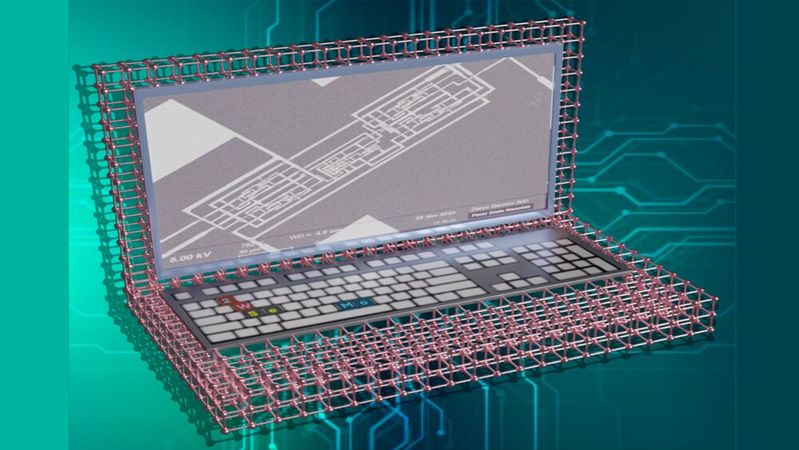
Render illustration of a computer based on 2D molecules: Researchers at Penn State University have developed a functional computer based on the 2D materials molybdenum disulfide and tungsten diselenide, using OSIC architecture (One Instruction Set Computer).
(Image: Krishnendu Mukhopadhyay/Penn State)
Silicon, through its miniaturization, has enabled advances in semiconductor technology but is increasingly reaching the limits of what is physically possible. This drives the exploration of new materials to meet the future demand for ever more compact and efficient electronic systems at the lowest possible cost. Two-dimensional (2D) materials, which are only a few atomic layers thick and simultaneously possess high charge carrier mobility, represent a promising alternative in research.
Researchers at Penn State University have used two such 2D materials to develop, in a world first, the first computer that is only a few atomic layers thick yet can still perform simple operations. The research team used 2D molybdenum disulfide (MoS2) for the n-channel devices and tungsten diselenide (WSe2) for the p-channel to build the complementary structures with a thickness of one atom.
These materials are key to building transistors with structures smaller than 1 nm, as the researchers state in the accompanying study in the journal Nature. The successful 2D implementation represents a significant step towards thinner, faster, and more energy-efficient electronics.
The work is an advancement of previous research on simple computers using carbon nanotubes (CNT) and a flexible 2D-PMOS machine built with MoS2 transistors at the Vienna University of Technology. 2D materials were recently also used for embedded high-performance memory. The development is independent of the creation of the first planar 32-bit RISC-V processor, which also based on 2D molybdenum disulfide (MoS2) and was introduced by Chinese researchers at the end of April in the journal Nature.
"We have, for the first time, demonstrated a CMOS computer entirely constructed from 2D materials, combining large-area grown molybdenum disulfide and tungsten diselenide transistors," says Saptarshi Das, Ackley Professor of Engineering and Professor of Engineering Science and Mechanics at Penn State, who led the research. The developed system includes an SRAM cell with six transistors and pull-up and pull-down transistors, as well as an arithmetic logic unit. The resulting computer was capable of executing a five-stage RSSB instruction (Reverse Subtract and Skip if Borrow) using five separate OISC structures (One Instruction Set Computer).
The team utilized metal-organic chemical vapor deposition (MOCVD) in the Materials Innovation Platform of the 2D Crystal Consortium (2DCC-MIP) to grow large layers of molybdenum disulfide and tungsten diselenide, enabling the production of more than 1,000 transistors of each type. By tuning the device fabrication and post-processing steps, they were able to adjust the threshold voltages of both the n-type and p-type transistors, which allowed for the construction of fully functional CMOS logic circuits at 3 V.
"Our 2D-CMOS computer operates at low supply voltages with minimal power consumption and can perform simple logical operations at frequencies up to 25 kHz," said Subir Ghosh, a doctoral student at Penn State who, along with Das, led the research.
The frequency was limited by parasitic capacitances, along with an extremely low power consumption in the picowatt range and a switching energy of up to 100 pJ.
"We also developed a computational model calibrated with experimental data that accounts for variations between the devices to project the performance of our 2D CMOS computer and compare it to state-of-the-art silicon technology," says Ghosh. This involved projecting the performance of the one instruction set computer and comparing it with the most advanced silicon technology, using a BSIM-BULK model compatible with the industry-standard SPICE.
Transistor Development With 2D Materials is Still in its Infancy
Ghosh admits that there is still much room for further optimization. The system is a proof of concept, and there is currently no practical application for the simple computer. Nevertheless, this work represents an important milestone in the use of 2D materials to advance the field of electronics.
His colleague Das also confirms that more work is needed to further develop the 2D CMOS computer approach for widespread application. However, he also emphasizes that the research field is evolving rapidly compared to the development of silicon technology: "Silicon technology has been in development for about 80 years, whereas research on 2D materials is relatively young and only really took off in 2010," says Das. "We anticipate that the development of computers from 2D materials will also be a step-by-step process, but compared to silicon technology, this is a major leap forward." (sg)
Date: 08.12.2025
Naturally, we always handle your personal data responsibly. Any personal data we receive from you is processed in accordance with applicable data protection legislation. For detailed information please see our privacy policy.
Consent to the use of data for promotional purposes
I hereby consent to Vogel Communications Group GmbH & Co. KG, Max-Planck-Str. 7-9, 97082 Würzburg including any affiliated companies according to §§ 15 et seq. AktG (hereafter: Vogel Communications Group) using my e-mail address to send editorial newsletters. A list of all affiliated companies can be found here
Newsletter content may include all products and services of any companies mentioned above, including for example specialist journals and books, events and fairs as well as event-related products and services, print and digital media offers and services such as additional (editorial) newsletters, raffles, lead campaigns, market research both online and offline, specialist webportals and e-learning offers. In case my personal telephone number has also been collected, it may be used for offers of aforementioned products, for services of the companies mentioned above, and market research purposes.
Additionally, my consent also includes the processing of my email address and telephone number for data matching for marketing purposes with select advertising partners such as LinkedIn, Google, and Meta. For this, Vogel Communications Group may transmit said data in hashed form to the advertising partners who then use said data to determine whether I am also a member of the mentioned advertising partner portals. Vogel Communications Group uses this feature for the purposes of re-targeting (up-selling, cross-selling, and customer loyalty), generating so-called look-alike audiences for acquisition of new customers, and as basis for exclusion for on-going advertising campaigns. Further information can be found in section “data matching for marketing purposes”.
In case I access protected data on Internet portals of Vogel Communications Group including any affiliated companies according to §§ 15 et seq. AktG, I need to provide further data in order to register for the access to such content. In return for this free access to editorial content, my data may be used in accordance with this consent for the purposes stated here. This does not apply to data matching for marketing purposes.
Right of revocation
I understand that I can revoke my consent at will. My revocation does not change the lawfulness of data processing that was conducted based on my consent leading up to my revocation. One option to declare my revocation is to use the contact form found at https://contact.vogel.de. In case I no longer wish to receive certain newsletters, I have subscribed to, I can also click on the unsubscribe link included at the end of a newsletter. Further information regarding my right of revocation and the implementation of it as well as the consequences of my revocation can be found in the data protection declaration, section editorial newsletter.



:quality(80)/p7i.vogel.de/wcms/6c/7b/6c7bd9f4d139a19fabb4827af99aae44/bild-01-fa-con-sept-01-entwicklung-abstimmung-ventiltrieb-kits-300dpi-gr-c3-b6-c3-9ferv1.jpeg "The valve train is a critical component in the combustion engine. Tolerance management and material selection are crucial. (Source: Con‑Sept)")
:quality(80)/p7i.vogel.de/wcms/85/82/858260a185cd5d1c4837b241a09c84fe/0131909549v1.jpeg "In the future, the European Parliament wants this situation to be only a temporary phase, not a permanent one. That’s because a new regulation stipulates that cars will soon have to be designed so that their individual parts can be removed and reused as easily as possible ... (Image:Scrap King)")
:quality(80)/p7i.vogel.de/wcms/9a/d4/9ad4b344d2a55a0ab294d6b5df706c25/0131921459v1.jpeg "The Chinese yuan is actually worth more than the valuation allowed by the Beijing government! This artificial devaluation costs Germany billions. According to experts, a fair exchange rate is therefore necessary. And China could also benefit more from it than suffer ... (Image: Cinbi-yuan)")
:quality(80)/p7i.vogel.de/wcms/d0/4c/d04c032c8e1e150bf33ba84def4ed9a6/0130721540v1.jpeg "Müller Precision Tools supports its customers with customized, application-specific tools. (Image: Müller)")
:quality(80)/p7i.vogel.de/wcms/b9/bf/b9bf31d5b4ca0bdb517f78cc2e5f4afe/japanische-20flagge-1365x768v1v1.jpeg "Japan plans larger investments in the fields of artificial intelligence, semiconductor technology, and space exploration. (Image:)")
:quality(80)/p7i.vogel.de/wcms/df/9a/df9aa8af9dbdfea96a7d952b3bdab940/260422-pm-abb-robotics-powa-3v1.jpeg "Six payload classes ranging from 7 to 30 kilograms, the longest reach, highest additional arm load, and a leading top speed of up to 5.8 m/s distinguish the new PoWa cobot family from ABB Robotics. (Image:ABB Robotics)")
:quality(80)/p7i.vogel.de/wcms/24/db/24dbdaca5cda28ec5f2742f6c582ae35/0131055501v1.jpeg "With SurfaceControl Automotive, Micro-Epsilon offers a robot-based inspection system for fully automated surface inspection of raw car bodies (body-in-white). (Image:Micro-Epsilon)")
:quality(80)/p7i.vogel.de/wcms/24/44/2444962c9c322838487c67597a5d591d/0131850457v1.jpeg "(Image: Neurawork AI / Leonardo.ai / AI-generated)")
:quality(80)/p7i.vogel.de/wcms/0b/ff/0bffa42ea605978169d5e25eedb2c1ee/0131826953v2v1.jpeg "In the picture: from right to left, Pascale Herman, Christophe Delhovren, Antoine de Ryckel, Olivier de Laet. They intend to work together in the future. (Image:Valeo)")
:quality(80)/p7i.vogel.de/wcms/3c/f8/3cf83e1d11902f2e6a4a921cc13af926/sb1-260520-7177v1.webp "Małgorzata Zboińska with samples of the 3D-printed material. (Source: Chalmers University of Technology)")
:quality(80)/p7i.vogel.de/wcms/4f/99/4f99d2a7711e404111d5acc3857691a5/comsolv1.jpeg "Trionda in its natural habitat. (Source: Comsol)")
:quality(80)/p7i.vogel.de/wcms/57/ee/57ee3d6f18d0fb35638d80a85158af35/0131921474v1v1.jpeg "The EU Commission believes that new means must be developed to help minimize the Union's dependency on critical raw materials from China. However, as the saying goes, the details are unclear ... (Image: EU)")
:quality(80)/p7i.vogel.de/wcms/a7/12/a7127af2ca9a5d452b61213dccfe8e34/0131827191v2v1.jpeg "Rivian is launching the electric car R2 in the USA. The model is also set to debut in Europe. (Image:Image: Rivian/Eric Anderson)")
:quality(80)/p7i.vogel.de/wcms/4d/2a/4d2a53e944dff81dc2b06c149e509fd6/0131904075v1.jpeg "The highly precise maneuvering and coupling of the driveboard and capsules is a key function to enable the modular approach of U-Shift. (Image:DLR)")
:quality(80)/p7i.vogel.de/wcms/bb/91/bb91c197aa157f87831e5bed406dd81e/keyou-hice40-actros-h2-sattelzugmaschine-key-visual-pressphoto-02-cmykv1.jpeg "Keyou will offer the retrofitted trucks under the designation \"Keyou Hice 4.0\" in the future. (Source: Keyou)")
:quality(80)/p7i.vogel.de/wcms/6a/6f/6a6f71b7f8067cb4274a7fc476cbfa8f/0131933181v1.jpeg "With the QSE-5, QuantumScape has already unveiled its first product intended for commercial use. Now, the company has also secured Honda R&D as a research partner. (Image:QuantumScape)")
:quality(80)/p7i.vogel.de/wcms/10/33/10337e60c95e1fec578aca8a93c17df1/0131899287v1.jpeg "(Image:Codesys)")
:quality(80)/p7i.vogel.de/wcms/a0/c0/a0c0b94a965844b86119153280a1cb81/0131920022v1.jpeg "A battery-free encapsulated sensor transmits the temperature from inside the body. (Image: MIT News)")
:quality(80)/p7i.vogel.de/wcms/45/99/459982625e5f27bee3c16c402a380707/0131930816v1.jpeg "Autonomous mobile robotics applications: quickly developed using the robotics reference platform from Arrow and STMicroelectronics. (Image:Arrow ST)")
:quality(80)/p7i.vogel.de/wcms/a4/6a/a46ad22b3de9ea56320405b63ead0250/0131913830v1.jpeg "Renesas has acquired Pictorus to simplify and accelerate software development for embedded applications within the Renesas 365 platform. The purchase price was not disclosed in the available information. (Image:Reneas)")
:fill(fff,0)/images.vogel.de/vogelonline/companyimg/76800/76895/65.jpg "FAULHABER_120mm.jpg ()")
:fill(fff,0)/p7i.vogel.de/companies/69/de/69de1b7403b0d/simtos-logo.jpeg "simtos-logo (SIMTOS)")
:quality(80)/p7i.vogel.de/wcms/01/6f/016f631f2b62a06f83113c1ac458d4ac/0124286267v1.jpeg "Chinese researchers have built a 32-bit RISC-V processor from molybdenum disulphide (MoS2) on a sapphire substrate. (Image:Mingrui Ao, et. al.)")
:quality(80)/p7i.vogel.de/wcms/b3/f3/b3f3af814cc53594c8578026eed04a98/0125300370v1.jpeg "A GaN block on a chip (symbolic image): Researchers have developed a new manufacturing process that enables powerful gallium nitride transistors to be integrated into standard silicon CMOS chips cost-effectively and on a scalable basis. (Image:MIT News)")
:quality(80)/p7i.vogel.de/wcms/b5/32/b532d819a7aec29f1cd85ad30f4cf516/0128508030v1.jpeg "A new manufacturing technique, in which multiple active components are stacked on the back of a computer chip, could significantly increase the energy efficiency of microelectronics. (Image:Dall-E / AI-generated)")