EUFirst Exception from Electric Vehicle Tariffs—VW Guarantees Minimum Prices
From
Henrik Bork | Translated by AI
3 min Reading Time
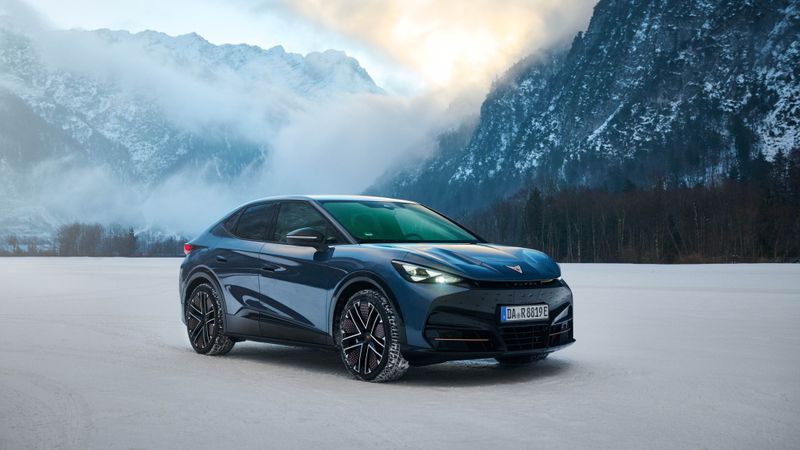
The EU Commission exempts the Cupra Tavascan from additional customs duties. In return, VW promises minimum prices and caps sales. Chinese OEMs are already considering whether to submit similar applications.
The Tavascan model from Cupra is produced in China and imported into the EU. As a result, it has so far been subject to the regulation for punitive tariffs on electric cars from China.
(Image: Cupra Seat)
At least VW no longer has to pay additional EU tariffs on its e-car produced in China. The "Cupra Tavascan" SUV, which Volkswagen produces in a joint venture with its Chinese partner JAC, has been exempted from the tariffs. In return, the company had to accept a minimum price and quotas.
The agreement announced by the EU Commission with Volkswagen Anhui is the first of its kind. It could now offer a way for Chinese electric vehicle manufacturers to avoid the high import tariffs from Brussels. Several Chinese OEMs are already considering submitting a similar application to the EU, according to Chinese media reports citing the Chinese Chamber of Commerce in Brussels.
VW Compromise with Minimum Price and Quantity Limitation
As part of the agreement, Volkswagen (Anhui) Automotive Co., Ltd., which is three-quarters owned by the Wolfsburg-based company, has committed to minimum prices when importing the SUV produced in China into EU countries. The prices have not been disclosed.
A maximum quantity for these electric vehicle imports now also applies, reported the Chinese business magazine Caixin—the specific quantity has not been disclosed. In addition to these two commitments, the Spain-based VW subsidiary Seat had to promise to invest in electric drive projects within the EU. For the Cupra Tavascan, tariffs of 20.7 percent were applied in addition to the already applicable ten percent on imports from China.
Western Manufacturers Also Affected by Additional Tariffs
On October 4, 2023, the EU Commission began an investigation into manufacturers of electric vehicles in China. Last October, it imposed partially drastic additional tariffs on electric cars from China. This affected not only the electric vehicles of Chinese manufacturers but also those from VW and Tesla, keeping them expensive for European car buyers.
The EU Commission states that it aims to protect the domestic market against unfair practices in China. Beijing, on the other hand, accuses the EU Commission of protectionism. Chinese commentators noted that German manufacturers alone have sold more than 60 million cars in the People's Republic, while the "flood" of Chinese cars exported to Europe amounts to only several hundred thousand units so far.
German manufacturers protested against the EU tariffs on electric vehicles produced in China before they were imposed. The OEMs still generate significant profits in China, although these have recently decreased.
In particular, France, whose automotive industry has virtually nothing left to defend in China, advocated for the electric vehicle tariffs in Brussels. The EU Commission then came to the same conclusion as the U.S. government in Washington, believing that it was wise to shield the domestic market and followed the pressure from Paris.
For VW, the new price commitment is unfavorable, but it is better compared to the EU import tariffs. While the cars are artificially inflated in price in the EU market, limiting their sale, the profits made through higher prices remain within the company, rather than being transferred to the EU like the additional tariffs.
Electric Vehicle Tariffs Drive Import of Hybrids
However, a look at the latest statistics raises increasing doubts about the purpose and effectiveness of these EU tariffs on electric vehicles. Exports of electric vehicles and hybrids, categorized in China under the collective term "New Energy Vehicles" (NEV), have more than doubled in January compared to the previous year.
Chinese manufacturers were able to export significantly more cars to the EU but shifted their efforts more towards plug-in hybrids, which are not subject to the EU tariffs. As a result, the EU tariffs have contributed to an increase in the share of hybrids in total registrations in the EU compared to the share of electric vehicles. Additionally, exports of Chinese NEVs to other markets, such as Brazil and Southeast Asia, have also been growing rapidly, allowing them to take market shares from German automakers.
Date: 08.12.2025
Naturally, we always handle your personal data responsibly. Any personal data we receive from you is processed in accordance with applicable data protection legislation. For detailed information please see our privacy policy.
Consent to the use of data for promotional purposes
I hereby consent to Vogel Communications Group GmbH & Co. KG, Max-Planck-Str. 7-9, 97082 Würzburg including any affiliated companies according to §§ 15 et seq. AktG (hereafter: Vogel Communications Group) using my e-mail address to send editorial newsletters. A list of all affiliated companies can be found here
Newsletter content may include all products and services of any companies mentioned above, including for example specialist journals and books, events and fairs as well as event-related products and services, print and digital media offers and services such as additional (editorial) newsletters, raffles, lead campaigns, market research both online and offline, specialist webportals and e-learning offers. In case my personal telephone number has also been collected, it may be used for offers of aforementioned products, for services of the companies mentioned above, and market research purposes.
Additionally, my consent also includes the processing of my email address and telephone number for data matching for marketing purposes with select advertising partners such as LinkedIn, Google, and Meta. For this, Vogel Communications Group may transmit said data in hashed form to the advertising partners who then use said data to determine whether I am also a member of the mentioned advertising partner portals. Vogel Communications Group uses this feature for the purposes of re-targeting (up-selling, cross-selling, and customer loyalty), generating so-called look-alike audiences for acquisition of new customers, and as basis for exclusion for on-going advertising campaigns. Further information can be found in section “data matching for marketing purposes”.
In case I access protected data on Internet portals of Vogel Communications Group including any affiliated companies according to §§ 15 et seq. AktG, I need to provide further data in order to register for the access to such content. In return for this free access to editorial content, my data may be used in accordance with this consent for the purposes stated here. This does not apply to data matching for marketing purposes.
Right of revocation
I understand that I can revoke my consent at will. My revocation does not change the lawfulness of data processing that was conducted based on my consent leading up to my revocation. One option to declare my revocation is to use the contact form found at https://contact.vogel.de. In case I no longer wish to receive certain newsletters, I have subscribed to, I can also click on the unsubscribe link included at the end of a newsletter. Further information regarding my right of revocation and the implementation of it as well as the consequences of my revocation can be found in the data protection declaration, section editorial newsletter.
The more artificial trade barriers the EU imposes against China, the less European manufacturers are compelled to compete with Chinese rivals in terms of quality and price, analysts say. While this may temporarily slow the triumph of Chinese brands in the European market, it does little to help in the global market that is essential for German OEMs.



:quality(80)/p7i.vogel.de/wcms/0b/cd/0bcd6d502ffcd087c4fc12b7b760b3ce/0133317507v2v1.jpeg "The new Multi Center from J.G. Weisser. (Image:J.G. Weisser)")
:quality(80)/p7i.vogel.de/wcms/6a/ef/6aef8ea2d02622844db469c705a21222/0133322968v1v1.jpeg "Canada and the U.S. have been locked in a trade dispute ever since Donald Trump was re-elected as U.S. president. In the long run, however, Canada could end up being the loser. That is why the country is turning more toward its trading partner, the EU. Something very special is set to emerge... (Image:AI-generated)")
:quality(80)/p7i.vogel.de/wcms/dd/92/dd928ba2e2956aa2bfff4888af8b08f8/photo--1v1.jpeg "Catalog product for extreme operating conditions: The new NRTVG guide carriage from Bosch Rexroth withstands extreme environmental conditions. (Source: Bosch Rexroth AG)")
:quality(80)/p7i.vogel.de/wcms/5a/9e/5a9e57e26964ba5c9d8719a9ee520bb3/0133310195v1.jpeg "Germany and the United Arab Emirates have signed an agreement to stand shoulder to shoulder in times of crisis. This will bring Germany many billions, to say the least.
From left: Sheikh Mohammed bin Sajed al-Nahjan and Federal Chancellor Friedrich Merz. (Image:dpa / K. Nietfeld)")
:quality(80)/p7i.vogel.de/wcms/81/dc/81dc63ed24c562521413023779495e7d/chris-kramerv1.jpeg "Chris Kramar, Director and General Manager of OEM Solutions for Germany, Austria, and Switzerland at Dell Technologies (Source: Dell Technologies)")
:quality(80)/p7i.vogel.de/wcms/bb/f5/bbf5342f532debc1bd7c09c2b9a0bf42/0133176497v1.jpeg "Over the past two years, AI has emerged as the most important growth driver in the industry. (Image: ©Gorodenkoff - stock.adobe.com)")
:quality(80)/p7i.vogel.de/wcms/01/61/01615a0939754c41e9d2c8971bf0b38a/web-image-kuka-kmf-1500p-300-dpi-1v1.jpeg "Thanks to its design, the KMF 1500P-CB is suitable for the stable and flexible handling of closed and open pallets. (Source: Kuka)")
:quality(80)/p7i.vogel.de/wcms/0b/ef/0bef343dfe1c7f83a1be01e7e83cc5ac/delta-fabrikv1.jpeg "Autonomous mobile manipulation robots can perform a wide range of tasks in a modern factory, from loading machines to quality control. (Image:Delta)")
:quality(80)/p7i.vogel.de/wcms/98/73/98731d23cbd95ff22391993a74cfefbf/mit-bifurcatedcircuits-01-pressv1.jpeg "A sample of the variety of configurations that Bifur circuits can form. (Source: Courtesy of the researchers)")
:quality(80)/p7i.vogel.de/wcms/f4/3d/f43d1f4297d9ae0cd1b6d2adfcb5ffe1/0133276470v1.jpeg "Simulation: Electric arcs in the electrical industry, including associated field simulation. (Image:CADFEM)")
:quality(80)/p7i.vogel.de/wcms/1d/fb/1dfbb415cd837102a33ce21ecf052ec3/0133277411v1.jpeg "LED drivers: LED circuit boards connect the light fixture to the electronics. During design, the operating current, forward voltage, and temperature must be taken into account across the entire operating range. (Image: ©Maria - stock.adobe.com)")
:quality(80)/p7i.vogel.de/wcms/80/8a/808a0eccf49a2a4fe560bd1998506ef9/0133308770v1.jpeg "Just like that, the supports are gone! High-speed footage of the automated, ultrasound-based process for removing optimized support structures from additively manufactured metal parts. It will be presented for the first time at Formnext from November 17 to 20. (Image:Fraunhofer IAPT)")
:quality(80)/p7i.vogel.de/wcms/fe/a8/fea8f62ea056f3c5334931f38cb80c76/0133324887v1v1.jpeg "It's flying off the shelves! The ID.Polo electric compact car seems to be living up to Volkswagen's expectations. After all, there are already more than 30,000 orders. The three sister models are also selling well... (Image:Volkswagen)")
:quality(80)/p7i.vogel.de/wcms/cb/00/cb0048b5a5df1a016d82aafa60aab9a9/35fa3e8bcf12df84fcc0b7ade728c03dv1.jpeg "Xiaomi has unveiled four new models. The large SUVs all have a gasoline engine to charge the battery. (Image:Xiaomi)")
:quality(80)/p7i.vogel.de/wcms/6c/f3/6cf31c04485bcabbf3e7c0f605dd9986/iaa2026-bosch-sdv-truckv1.jpeg "In commercial vehicles as well, vehicle functions that were previously distributed are now being consolidated onto central computing platforms—for example, for the cockpit or vehicle domains—and software and hardware are being consistently decoupled. (Source: Bosch)")
:quality(80)/p7i.vogel.de/wcms/21/59/21592b60cc226c533272207ee4b1562c/25dt244-001v1.jpeg "Daimler Truck is showcasing the Actros with several powertrain options at the IAA Transportation; the focus is on battery-electric and hydrogen-powered systems. (Source: Daimler Truck)")
:quality(80)/p7i.vogel.de/wcms/b4/85/b48565f20a330043d0cd8c5f708f779f/0133316091v2v1.jpeg "The open Chiisai standard supports the cross-vendor development of HALs, middleware, and embedded software for small microcontrollers. (Image:Vector Informatics)")
:quality(80)/p7i.vogel.de/wcms/6c/a6/6ca6c6410e051401d5596d5cc6dfa277/0133283570v1.jpeg "From Core to Platform: With MIPS, ARC, and RISC-V, competition is shifting from individual processor IP blocks to integrated compute platforms for specialized applications. (Image:Dall-E / AI-generated)")
:quality(80)/p7i.vogel.de/wcms/73/17/73174a2afe684fa12d7d6a57b29b20e2/0133305506v1.jpeg "AI data centers are a key driver of direct current technologies. (Image:Pixabay / Brian Penny / AI-generated)")
:quality(80)/p7i.vogel.de/wcms/08/b2/08b2ce49b6d6d11d5953064bb0a62f37/0133308791v1.jpeg "If what Anthropics is accusing its Chinese AI competitors of is true, then the industry is in for quite a shakeup! At stake is nothing less than Chinese AI systems—such as Kimi and Deepseek—that were actually trained indirectly using U.S. AI systems. (Image: AI-generated)")
:quality(80)/p7i.vogel.de/wcms/d7/b4/d7b47f618f1b6812bb9693ec454c0f5b/0128841361v1.jpeg "Chinese manufacturers could set a minimum price for their electric cars in the EU in the future—and thus avoid tariffs. (Image:Xpeng)")
:quality(80)/p7i.vogel.de/wcms/28/93/2893fa639d50c6f0a4e5010b26c50383/denza-b5cv1.jpeg "The automotive group BYD is aggressively pushing its brands onto global markets. (Image:BYD)")