Especially small and medium-sized companies sometimes still struggle with digital transformation. How can Factory-X specifically support these companies on their journey?
The variety and complexity of systems and facilities require new approaches to data exchange and utilization.
(Image: lidiia - stock.adobe.com)
Rica Holzmann is a member of the management board at Soffico GmbH.
The desired transformation towards learning and agile organizations and productions poses major challenges for many SMEs and medium-sized companies. The traditional organizational and technological boundaries must be overcome and considered in a holistic integrated manner in the future. In particular, the heterogeneous, historically grown production landscapes in many small and medium-sized enterprises represent a challenge.
The challenges of historically grown production landscapes in SMEs
A major obstacle has proven to be the so-called spaghetti interfacing. This phenomenon describes an unstructured, tangled network of interfaces and connections between various systems and facilities, which has developed over time through incremental extensions and integrations. In many cases, small and medium-sized enterprises are particularly affected by this phenomenon, as they often rely on traditional, proven business models and technologies. Over the course of their long history, these companies have developed a multitude of systems and processes that are often incompatible with each other and lead to an additional patchwork of interfaces and connections.
The complex network not only complicates the efficiency and flexibility of production, but also poses significant risks for data inconsistencies and security gaps. The task is to rationalize and modernize these historically grown structures in order to remain competitive. To meet this challenge, therefore, a targeted strategy for the integration and standardization of interfaces is needed. Only in this way can smooth communication and collaboration between the various production components and across ecosystems be ensured.
Manufacturing-X and Factory-X as pioneers for the connected Industry 4.0
Based on the requirements of the industry, the cross-sector initiative Manufacturing-X was launched, which implements the conceptual framework of the Industry 4.0 data space. A functional data space requires easy access to and seamless networking of data, as well as a willingness to release data multilaterally. Manufacturing-X develops trustworthy data ecosystems that are based on open standards. The goal is to demonstrate concrete applications and implement them on a large scale.
The industrial lighthouse project Factory-X addresses these challenges by creating a cross-sector, open data network that covers the entire life cycle of products and production resources. By adhering to standards and scalability for businesses of any size, Factory-X enables new, data-based business models and application solutions. The planned data-driven solutions and software services are based on existing technologies and experiences and are specifically developed for factory operators, factory equipment manufacturers and their suppliers.
How can SMEs benefit from such a data space?
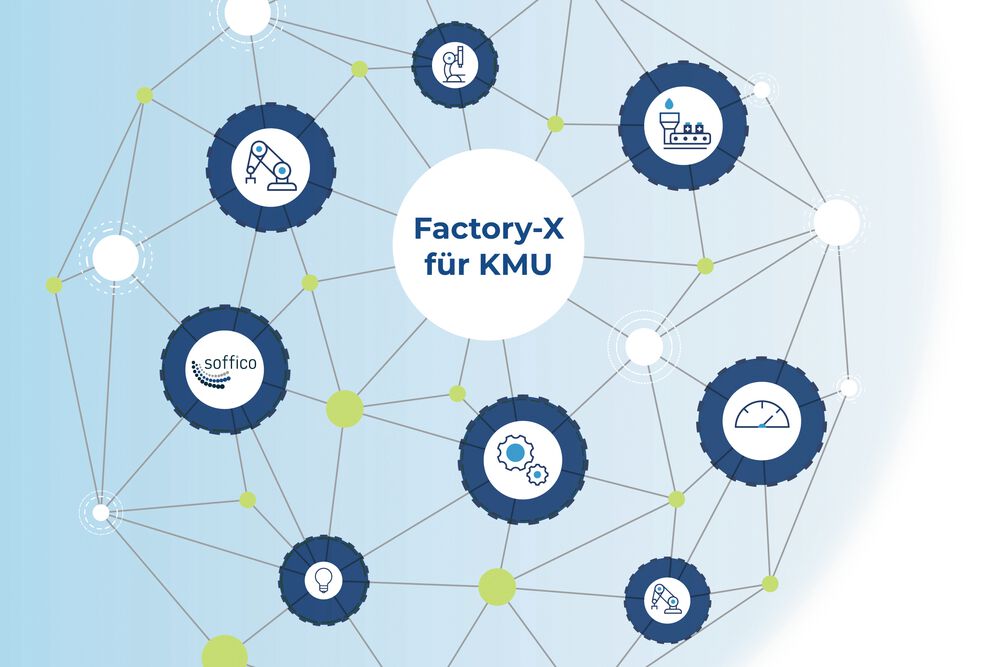
Factory-X: Paving the way for a seamlessly connected future for SMEs.
(Image:Soffico GmbH)
Digital data exchange enables seamless communication between devices, systems, and people. For SMEs, this is an opportunity to increase efficiency, minimize errors, and develop new business models. The networking of initial devices and the overcoming of limited possibilities of information exchange are the first steps on this path. Connectivity and engineering open up possibilities for remote access, the increase in the number of connected devices, and the transmission of time-series sensor data, which are essential for precise monitoring and predictive analysis.
Despite the obvious benefits, SMEs face significant challenges in digital transformation. These include issues with data quality, storage of large amounts of data, and integration of heterogeneous IoT data. Security concerns are also at the forefront, as traditional IT systems are often overwhelmed. In addition, there is an increased financial risk, as financing innovation projects is more difficult for SMEs. Government-funded initiatives such as Manufacturing-X can particularly enable SMEs to innovate and grow.
From the perspective of Soffico GmbH, also an SME in the IT sector, the implementation of basic services for seamless horizontal and vertical integration of use cases with each other, as well as integration into existing system landscapes, is of particular importance for the industrial medium-sized sector. This is crucial in order to protect investments and quickly realize the benefits of improved production efficiency and transparency. Standardized connectors, as part of a universal data platform for data aggregation, transformation and distribution across all levels and company boundaries, form the basis for the easy processing of the complex communication of systems, machines and facilities. One of the biggest challenges is that the operational data and context information often need to be derived from a plethora of different sources, which often do not align with each other. Furthermore, both performance and fail-safety need to be considered right from the architecture design phase, as devices and machines usually generate very large amounts of data. The innovative idea behind a uniform data infrastructure consists of combining the key requirements for data orchestration: interoperability, scalability, standardization, and the processing of large, partially unstructured data volumes.
Date: 08.12.2025
Naturally, we always handle your personal data responsibly. Any personal data we receive from you is processed in accordance with applicable data protection legislation. For detailed information please see our privacy policy.
Consent to the use of data for promotional purposes
I hereby consent to Vogel Communications Group GmbH & Co. KG, Max-Planck-Str. 7-9, 97082 Würzburg including any affiliated companies according to §§ 15 et seq. AktG (hereafter: Vogel Communications Group) using my e-mail address to send editorial newsletters. A list of all affiliated companies can be found here
Newsletter content may include all products and services of any companies mentioned above, including for example specialist journals and books, events and fairs as well as event-related products and services, print and digital media offers and services such as additional (editorial) newsletters, raffles, lead campaigns, market research both online and offline, specialist webportals and e-learning offers. In case my personal telephone number has also been collected, it may be used for offers of aforementioned products, for services of the companies mentioned above, and market research purposes.
Additionally, my consent also includes the processing of my email address and telephone number for data matching for marketing purposes with select advertising partners such as LinkedIn, Google, and Meta. For this, Vogel Communications Group may transmit said data in hashed form to the advertising partners who then use said data to determine whether I am also a member of the mentioned advertising partner portals. Vogel Communications Group uses this feature for the purposes of re-targeting (up-selling, cross-selling, and customer loyalty), generating so-called look-alike audiences for acquisition of new customers, and as basis for exclusion for on-going advertising campaigns. Further information can be found in section “data matching for marketing purposes”.
In case I access protected data on Internet portals of Vogel Communications Group including any affiliated companies according to §§ 15 et seq. AktG, I need to provide further data in order to register for the access to such content. In return for this free access to editorial content, my data may be used in accordance with this consent for the purposes stated here. This does not apply to data matching for marketing purposes.
Right of revocation
I understand that I can revoke my consent at will. My revocation does not change the lawfulness of data processing that was conducted based on my consent leading up to my revocation. One option to declare my revocation is to use the contact form found at https://contact.vogel.de. In case I no longer wish to receive certain newsletters, I have subscribed to, I can also click on the unsubscribe link included at the end of a newsletter. Further information regarding my right of revocation and the implementation of it as well as the consequences of my revocation can be found in the data protection declaration, section editorial newsletter.
As an SME in the context of Factory-X.
With its project participation, Soffico aims to develop and realize connectivity and data transformation without programming effort across the entire value chain in the context of Manufacturing-as-a-Service and modular production as well as basic services, together with the project partners from mechanical engineering. The focus is on the needs of medium-sized companies. The goal is to provide standardized IT/OT integration solutions based on the requirements of SMEs, leading manufacturing companies, and standardized scientific methods. These solutions form the starting point for overlap-free connectivity and interoperability of the business applications developed in the sub-projects. The solutions are basically cross-sector and are generally aimed at manufacturing companies.
By enabling modular production, the efficiency and agility of manufacturing processes are to be maximized in order to quickly respond to market changes and customer requirements and to increase resilience. In addition, the provision of a low-coding platform is expected to promote Manufacturing-as-a-Service initiatives, based on which companies can effectively use their capacities and offer their products and services via platforms.
The transformation to agile organizations poses challenges for SMEs. Factory-X offers solutions for data integration and standardization, facilitates SMEs' access to data-based business models and promotes efficient production. Nevertheless, challenges such as data quality and heterogeneity remain. Soffico, an SME involved in the project, aims for seamless integration and modular production with its participation. Maximum efficiency and agility enable quick adaptation to market changes and resilience. A low-coding platform is intended to facilitate the provision of services and make capacity usage more effective.



:quality(80)/p7i.vogel.de/wcms/a0/47/a04725ef9bd09fb6c9341a1bea1b5d93/0130443083v1.jpeg "Here, a type of plastic pallet is produced by thermoforming (vacuum forming or deep drawing) at the corresponding division of New England Plastics in the USA. This division, which specializes in so-called liners, is now part of Ringmetall ... (Image:New England Plastics)")
:quality(80)/p7i.vogel.de/wcms/e3/42/e342b3c593ea92d56604d3be969e9c9a/0130437231v1.jpeg "Daimler Truck will be building even more trucks at its Czech plant in Cheb in the future. This is because it is now being expanded for strategic cost-saving reasons ... (Image:Daimler Truck)")
:quality(80)/p7i.vogel.de/wcms/23/99/23992bf2dcdc432c9b7209c34a4a7c48/0129733089v1.jpeg "Stork relies on the modular Neoswiss turning system from Iscar to shorten the set-up times for its sliding headstock lathes and work more productively. (Image:Iscar)")
:quality(80)/p7i.vogel.de/wcms/7d/e2/7de2923434b2f1a78ba5482d8d335269/0113143253v1.jpeg "In our China Market Insider we regularly provide you with relevant information directly from China. (Image:© Eisenhans - stock.adobe.com)")
:quality(80)/p7i.vogel.de/wcms/b7/36/b736dfebc16c42d6901d0d0e1f390493/3d-druck-20factory-20--20ki-20generiert-1920x1079v1.png "(Source: AI-generated)")
:quality(80)/p7i.vogel.de/wcms/79/b2/79b21aad663f4a7bd4472afc1c1afc62/0130433994v1.jpeg "Mission Joyride: The free-flying robot (shown here in the rendering) will relieve the ISS crew of logistics tasks from 2027 with its two mechanical arms. (Image:Icarus Robotics)")
:quality(80)/p7i.vogel.de/wcms/6b/45/6b4546fa6ebf305c3660326909363f32/0130437089v1.jpeg "Industrial AI in action: Rockwell Automation presents practical solutions for self-controlling production systems at the Hannover Messe. (Image:Rainer Jensen, Deutsche Messe)")
:quality(80)/p7i.vogel.de/wcms/78/e9/78e9188c25a8a94e67c34c9bf8ffe495/visual-agile-20robots-20and-20google-20deepmind-20partner-20to-20bring-20intelligence-20to-20robotics-2500x1406v1v1.jpeg "Together, the partners are developing adaptable, intelligent robots for a wide range of applications (Image:Agile Robots SE)")
:quality(80)/p7i.vogel.de/wcms/59/a2/59a2b11f0aa1b700eff02addd5de8703/adobestock-1788280853--c2-a9-20satria-20-e2-80-93-20stock-adobe-com-5081x2860v1v1.jpeg "Quantum computers require extreme cooling to temperatures close to absolute zero in order to keep qubits stable. (Image:satria - stock.adobe.com)")
:quality(80)/p7i.vogel.de/wcms/62/5f/625f41e87ebfef156a98c8e6393e32fd/0130211654v1.jpeg "Axial flux motors have some advantages over radial flux motor—but their production is currently still expensive. (Image:RWTH Aachen University)")
:quality(80)/p7i.vogel.de/wcms/f6/ae/f6aec4f6241b36ed5e3a990ac9176b42/0130429460v1.jpeg "Verne, Pony.ai and Uber want to launch a robotaxi service in Europe. (Image:Verne)")
:quality(80)/p7i.vogel.de/wcms/d7/88/d788699f2974708a332baa4e7a62fa9e/0130438967v1.jpeg "Skoda is withdrawing from China. The brand has produced well over three million vehicles there. (Image:Skoda car)")
:quality(80)/p7i.vogel.de/wcms/b0/43/b043b86899837532aad62d63368a917a/0130371361v1.jpeg "Skoda leaves the chinese market.
(Image:Skoda)")
:quality(80)/p7i.vogel.de/wcms/c3/c4/c3c4ce270b083eeac55654148611f064/0130237945v1.jpeg "China is not giving up on hydrogen, but is intensifying its efforts. (Image:freely licensed from Pixabay)")
:quality(80)/p7i.vogel.de/wcms/ee/09/ee09acbd6dc896df25affaa9e871e6e5/0130440053v1.jpeg "IMS chip module for simple system integration into an ion mobility spectrometer. (Image:Fraunhofer IPMS)")
:quality(80)/p7i.vogel.de/wcms/10/6c/106cd22de5f68a0f74639d654827228c/0130345302v1.jpeg "Made in India: According to the India Electronics and Semiconductor Association (IESA), the country should be able to produce between 75 and 80 million chips by the beginning of 2027, once the plants currently under construction become operational. (Image:Pixabay (Montage: Sebastian Gerstl))")
:quality(80)/p7i.vogel.de/wcms/a5/ed/a5ed6fda029d362732a293d6b19d74c4/0130444216v1.jpeg "Thirteen executives from the Chinese chip industry have drawn up a plan to achieve an 80% self-sufficiency rate for semiconductors by 2030. (Image:Maxim_Kazmin - stock.adobe.com)")
:quality(80)/p7i.vogel.de/wcms/31/a6/31a646018b34d8e0a44bfc8bf17837f6/0130361632v1.jpeg "For many companies, PFAS are considered indispensable in electronics production. (Image:freely licensed)")
:fill(fff,0)/images.vogel.de/vogelonline/companyimg/76800/76895/65.jpg "FAULHABER_120mm.jpg ()")
:fill(fff,0)/p7i.vogel.de/companies/69/88/69882c428938e/tmts2026-ticec-banner-en-2000px.png "tmts2026-ticec-banner-en-2000px (https://www.tmts.tw/en)")

:quality(80)/p7i.vogel.de/wcms/9f/98/9f983060697cb89b66255079a593082e/0126380880v1.jpeg "Digital transformation requires a strategic structure strengthened by a central project office to consolidate initiatives, promote IT affinity across all departments, and enable SMEs to sustainably create digital structures and strengthen their market position. (Image:freely licensed)")
:quality(80)/p7i.vogel.de/wcms/9c/c0/9cc0c88cd103899f584b60601919752e/0125075768v1.jpeg "Digital twins and 3D streaming enable efficient real-time processing, promote direct collaboration, and reduce costs in the industry. (Image:Threedy GmbH)")