The extreme bike tuner Dangerholm makes science fiction rideable. His vision of the bike of the future poses challenges for manufacturers. However, together with Trumpf and the Truprint metal 3D printers, a rideable prototype was achieved for Eurobike 2024.
Joint project: Syncros, the component forge of Scott, extreme bike tuner Dangerholm, and high-tech company Trumpf are building a handlebar for the bike of the future.
(Image: Trumpf)
Denim vest, shorts, and a bike that the cycling world envies. This is how the extreme bike tuner Dangerholm, aka Gustav Gullholm, is known from countless photos. His concept: He builds bikes out of a pure passion for aesthetics and driving. With creativity and perfectionism, the tuner has produced bikes that have made him one of the stars in the bicycle industry.
One of his ideas: a completely new handlebar. This handlebar was first built with wood by the mechanic born in Norway and living in Sweden, who commented: "Compared to what the Trumpf engineers have achieved, my design was rather caveman-like." Besides its futuristic design, the handlebar is based primarily on a unit with semi-internal channels for the brake cables. And: assembly and maintenance should work without the complicated disassembly and bleeding of the brakes. A so-called snap-push connection made this possible: The cables run in channels and are held by clips. These clips have undercuts, which would require a very complicated shape to produce the handlebar with carbon. 3D printing is technically better and allows for a more elegant design.
Maxime Lallemand, Syncros Components Engineer at Scott, one of the major brand manufacturers in the bicycle industry, reports: "We have been working with Dangerholm for many years. This time, he wanted to produce the prototype of his idea of the bike of the future with us for Eurobike 2024—not just a design study, but a fully operational mountain bike. A particular challenge for us was also the new handlebar concept."
The clock began to tick: There were five months left until Eurobike. For the development, production on the Truprint 3000, and ISO certification of the handlebar, it was a tight schedule. Therefore, Scott developers Maxime Lallemand and Quentin Beauregard, MTB Lead Designer at Scott, activated their contacts with Trumpf specialists for 3D printers: "For prototype development, aluminum 3D printing is unbeatable compared to traditional carbon/mold construction in terms of costs and speed. Technically speaking, 3D printing breaks the boundaries in terms of shape and function. This allows us to build a technically perfect handlebar for Gustav, where all visually disturbing elements are eliminated."
Two years earlier: Door-to-door in the bike scene
Maxime Lallemand and Quentin Beauregard met application developers Chris Lengwenat and his colleague Nicolas Haydt, Technology Expert in Additive Manufacturing at Trumpf, at Eurobike in 2022. The two brought with them a brake lever, a brake caliper, and a pedal—developed by the Trumpf experts and printed on a Truprint using aluminum and titanium. "We went from stand to stand with our suitcase," recalls Lengwenat—and Haydt adds: "By the end of the day, we had made many new contacts in the development departments of major manufacturers, including Maxime Lallemand. And he then introduced us to bike tuner Dangerholm."
Today: Pioneers in aluminum printing
An introduction that made an impression: Ahead of Eurobike 2024, the threads between Trumpf, Scott, and Dangerholm came together again: "The possibility of using aluminum 3D printing for components like the handlebar is due to a new high-strength alloy," explains Trumpf expert Christian Lengwenat, and adds: "Aluminum 6061 has already gained significant popularity in the bicycle sector. And we are currently the only ones in Europe with experience in printing with this material."
For the Trumpf experts, the project was an opportunity to exchange ideas with the carbon experts from Scott Sports: They have decades of experience in producing high-quality carbon bicycles and components. For Lallemand, it was clear: “With the handlebar project, we were able to optimally combine our respective expertise.”
Full design freedom
As 3D printing specialist Lengwenat explains, there are no limitations in design with additive manufacturing: "Unlike conventional methods such as milling, metal 3D printing excels with its freedom of form. Tools are limited by physical boundaries, whereas powder can be built up in any shape." Haydt adds: "The internal cable channels of the Dangerholm handlebar can only be realized with 3D printing, and we achieve high stability with low weight—this makes aluminum printing particularly interesting for the bicycle industry."
Just in time for Eurobike 24, Dangerholm, Scott, and Trumpf have completed the challenging handlebar construction. Back in Sweden, Dangerholm is excited: "3D printing is like science fiction. You are literally holding a little piece of the future in your hands."
Date: 08.12.2025
Naturally, we always handle your personal data responsibly. Any personal data we receive from you is processed in accordance with applicable data protection legislation. For detailed information please see our privacy policy.
Consent to the use of data for promotional purposes
I hereby consent to Vogel Communications Group GmbH & Co. KG, Max-Planck-Str. 7-9, 97082 Würzburg including any affiliated companies according to §§ 15 et seq. AktG (hereafter: Vogel Communications Group) using my e-mail address to send editorial newsletters. A list of all affiliated companies can be found here
Newsletter content may include all products and services of any companies mentioned above, including for example specialist journals and books, events and fairs as well as event-related products and services, print and digital media offers and services such as additional (editorial) newsletters, raffles, lead campaigns, market research both online and offline, specialist webportals and e-learning offers. In case my personal telephone number has also been collected, it may be used for offers of aforementioned products, for services of the companies mentioned above, and market research purposes.
Additionally, my consent also includes the processing of my email address and telephone number for data matching for marketing purposes with select advertising partners such as LinkedIn, Google, and Meta. For this, Vogel Communications Group may transmit said data in hashed form to the advertising partners who then use said data to determine whether I am also a member of the mentioned advertising partner portals. Vogel Communications Group uses this feature for the purposes of re-targeting (up-selling, cross-selling, and customer loyalty), generating so-called look-alike audiences for acquisition of new customers, and as basis for exclusion for on-going advertising campaigns. Further information can be found in section “data matching for marketing purposes”.
In case I access protected data on Internet portals of Vogel Communications Group including any affiliated companies according to §§ 15 et seq. AktG, I need to provide further data in order to register for the access to such content. In return for this free access to editorial content, my data may be used in accordance with this consent for the purposes stated here. This does not apply to data matching for marketing purposes.
Right of revocation
I understand that I can revoke my consent at will. My revocation does not change the lawfulness of data processing that was conducted based on my consent leading up to my revocation. One option to declare my revocation is to use the contact form found at https://contact.vogel.de. In case I no longer wish to receive certain newsletters, I have subscribed to, I can also click on the unsubscribe link included at the end of a newsletter. Further information regarding my right of revocation and the implementation of it as well as the consequences of my revocation can be found in the data protection declaration, section editorial newsletter.
Additive manufacturing with titanium
For the same bicycle, but with a different supplier—Dangerholm collaborates with Faction Bike Studio from Canada for the drivetrain components. Trumpf specialists Lengwenat and Haydt outfitted the bike with titanium components on behalf of Faction Bike Studio. These are exposed and fault-prone drivetrain components like the parallelogram and the cage. The parts were printed on a Truprint 1000 using Ti64 Gd.23, a special titanium alloy with an exceptionally low oxygen content. This enhanced both stability and design to a new level.



:quality(80)/p7i.vogel.de/wcms/a0/47/a04725ef9bd09fb6c9341a1bea1b5d93/0130443083v1.jpeg "Here, a type of plastic pallet is produced by thermoforming (vacuum forming or deep drawing) at the corresponding division of New England Plastics in the USA. This division, which specializes in so-called liners, is now part of Ringmetall ... (Image:New England Plastics)")
:quality(80)/p7i.vogel.de/wcms/23/99/23992bf2dcdc432c9b7209c34a4a7c48/0129733089v1.jpeg "Stork relies on the modular Neoswiss turning system from Iscar to shorten the set-up times for its sliding headstock lathes and work more productively. (Image:Iscar)")
:quality(80)/p7i.vogel.de/wcms/7d/e2/7de2923434b2f1a78ba5482d8d335269/0113143253v1.jpeg "In our China Market Insider we regularly provide you with relevant information directly from China. (Image:© Eisenhans - stock.adobe.com)")
:quality(80)/p7i.vogel.de/wcms/9d/2b/9d2b802f800e5caf17b2831e74228cd3/screenshot-202026-03-03-20103822-609x343v1v1.png "Visual comparison: on the left, a clean, burr-free cut edge; on the right, typical burr formation with oxidation discoloration. This illustrates how strongly parameter control and gas management influence the quality of the result. (CO₂ laser, oxygen cutting gas, sheet thickness approx. 15 mm). (Image:Picture: Rime)")
:quality(80)/p7i.vogel.de/wcms/b7/36/b736dfebc16c42d6901d0d0e1f390493/3d-druck-20factory-20--20ki-20generiert-1920x1079v1.png "(Source: AI-generated)")
:quality(80)/p7i.vogel.de/wcms/79/b2/79b21aad663f4a7bd4472afc1c1afc62/0130433994v1.jpeg "Mission Joyride: The free-flying robot (shown here in the rendering) will relieve the ISS crew of logistics tasks from 2027 with its two mechanical arms. (Image:Icarus Robotics)")
:quality(80)/p7i.vogel.de/wcms/6b/45/6b4546fa6ebf305c3660326909363f32/0130437089v1.jpeg "Industrial AI in action: Rockwell Automation presents practical solutions for self-controlling production systems at the Hannover Messe. (Image:Rainer Jensen, Deutsche Messe)")
:quality(80)/p7i.vogel.de/wcms/78/e9/78e9188c25a8a94e67c34c9bf8ffe495/visual-agile-20robots-20and-20google-20deepmind-20partner-20to-20bring-20intelligence-20to-20robotics-2500x1406v1v1.jpeg "Together, the partners are developing adaptable, intelligent robots for a wide range of applications (Image:Agile Robots SE)")
:quality(80)/p7i.vogel.de/wcms/59/a2/59a2b11f0aa1b700eff02addd5de8703/adobestock-1788280853--c2-a9-20satria-20-e2-80-93-20stock-adobe-com-5081x2860v1v1.jpeg "Quantum computers require extreme cooling to temperatures close to absolute zero in order to keep qubits stable. (Image:satria - stock.adobe.com)")
:quality(80)/p7i.vogel.de/wcms/49/38/493876a248943456b7e4a6db6edfc454/0130230765v1.jpeg "Safe and reliable in aircraft construction: light-curing adhesive bond combined with universal fastening elements. (Source: Delo)")
:quality(80)/p7i.vogel.de/wcms/b5/c7/b5c749d16c8a2e789c1469c2c8c1c387/0130452780v1.jpeg "Volvo Trucks completes road tests with its new hydrogen-powered trucks. (Image:Volvo Trucks)")
:quality(80)/p7i.vogel.de/wcms/ba/69/ba6975f417a85147084f38dc2cd209e2/0130451386v1.jpeg "Together with Nvidia, Hyundai wants to develop an architecture that will be used for level 4 robotaxis (image) as well as for level 2 customer vehicles. (Image:Hyundai)")
:quality(80)/p7i.vogel.de/wcms/93/4d/934de334b47abaa526c78cba1417d7af/0130343495v1.jpeg "The new SU7 is available in three price categories, \"Standard\", \"Pro\" and \"Max\" (Image:Xiaomi)")
:quality(80)/p7i.vogel.de/wcms/df/a0/dfa048434bb94f1b7d030e346b25b3ae/0130373541v1.jpeg "From August, BMW will be producing the i3 at its main plant in Munich - which the car manufacturer has extensively rebuilt for this purpose. (Image:Rainer Haeckl)")
:quality(80)/p7i.vogel.de/wcms/ee/09/ee09acbd6dc896df25affaa9e871e6e5/0130440053v1.jpeg "IMS chip module for simple system integration into an ion mobility spectrometer. (Image:Fraunhofer IPMS)")
:quality(80)/p7i.vogel.de/wcms/10/6c/106cd22de5f68a0f74639d654827228c/0130345302v1.jpeg "Made in India: According to the India Electronics and Semiconductor Association (IESA), the country should be able to produce between 75 and 80 million chips by the beginning of 2027, once the plants currently under construction become operational. (Image:Pixabay (Montage: Sebastian Gerstl))")
:quality(80)/p7i.vogel.de/wcms/a5/ed/a5ed6fda029d362732a293d6b19d74c4/0130444216v1.jpeg "Thirteen executives from the Chinese chip industry have drawn up a plan to achieve an 80% self-sufficiency rate for semiconductors by 2030. (Image:Maxim_Kazmin - stock.adobe.com)")
:quality(80)/p7i.vogel.de/wcms/31/a6/31a646018b34d8e0a44bfc8bf17837f6/0130361632v1.jpeg "For many companies, PFAS are considered indispensable in electronics production. (Image:freely licensed)")
:fill(fff,0)/images.vogel.de/vogelonline/companyimg/76800/76895/65.jpg "FAULHABER_120mm.jpg ()")
:fill(fff,0)/p7i.vogel.de/companies/69/88/69882c428938e/tmts2026-ticec-banner-en-2000px.png "tmts2026-ticec-banner-en-2000px (https://www.tmts.tw/en)")
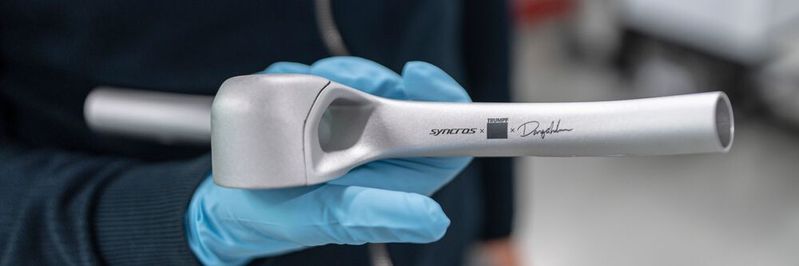
:quality(80)/p7i.vogel.de/wcms/f5/9c/f59c55d8df590e7e16919ad900da54d6/0119786464v1.jpeg "The handlebar is essentially based on a unit with semi-internal channels for the brake cables.(Image: Trumpf)")
:quality(80)/p7i.vogel.de/wcms/a6/f2/a6f2751d2c4f29bd5d6042a4ad8c20c6/0119786466v1.jpeg "Component of the future: Application developer Chris Lengwenat (right) and his colleague Nicolas Haydt, technology expert for additive manufacturing at Trumpf, with the freshly printed Dangerholm handlebar.(Image: Trumpf)")
:quality(80)/p7i.vogel.de/wcms/5c/54/5c54c9585a9eb162e7f1d6e6a3a83cc3/0119786292v1.jpeg "Extreme Bike Tuner Dangerholm(Image: Gustav Gullholm)")
:quality(80)/p7i.vogel.de/wcms/9e/21/9e21d00b072b35291ad6042cdcbd40ee/0119786463v1.jpeg "The components were printed on a Truprint 1000 from Ti64 Gd.23, a special titanium alloy with an exceptionally low oxygen content.(Image: Trumpf)")
:quality(80)/p7i.vogel.de/wcms/e7/f4/e7f483f1ce826406a4392b87cc69923a/0125263540v1.jpeg "The J.Laverack Aston Martin.1R is the world's first boltless bike, with no visible bolts, screws, or fastenings on the headset, seat clamp, or brake calipers. (Image:Renishaw & J. Laverack)")
:quality(80)/p7i.vogel.de/wcms/75/5a/755a7381296cee24f030ee5ed0725379/0124312896v1.jpeg "With this facility, the US company produces a very special titanium powder intended for 3D printing. The German company Trumpf has now examined the suitability and properties of the titanium powder ... (Image:6K Additive)")