European automotive suppliers are in crisis. While a Berylls survey captures the mood, a Deloitte risk analysis provides the hard facts. Both studies reveal the same dilemma.
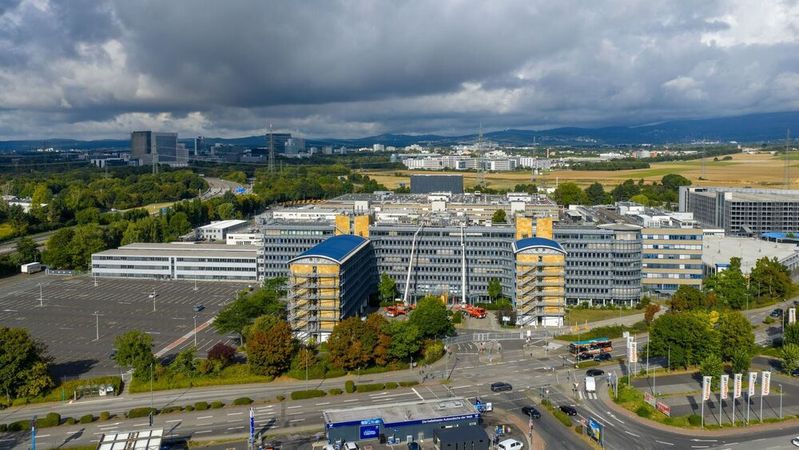
Suppliers from Europe are currently facing a variety of challenges. Pictured: The Aumovio headquarters in Frankfurt am Main.
(Image: Aumovio)
The transformation of the automotive industry is hitting suppliers with full force. Two recent studies - the "E-Mobility Supplier Survey 2025" by Berylls by Alix Partners and the "Supplier Risk Monitor 2025/2026" by Deloitte - paint an alarming picture of the industry. While Berylls captures the sentiment of 49 European suppliers, Deloitte analyzes 776 global companies based on their key financial figures. The results complement each other - and reveal a fundamental paradox.
According to Berylls, only 48% of the suppliers surveyed still rate e-mobility positively - down from 77% in 2023. At the same time, 71% remain heavily dependent on the combustion engine business and generate more than a quarter of their sales with combustion engine components. The Deloitte analysis confirms this imbalance with objective risk figures: All 19 component clusters examined show a higher risk than in 2023, with the minimum value of the so-called risk score rising from 1.0 to 2.25. According to the study, traditional suppliers are particularly affected: seats, frames and combustion engines lead the risk ranking. "The risk scores for frames and seats are 4.63 and 4.61 on a scale up to 5," says the Deloitte report. The combustion engine follows with 4.45.
These clusters are suffering from declining volumes, commoditization and limited opportunities for differentiation.
E-Mobility: Invested, But Not Profitable
The core problem: many suppliers have invested massively in e-mobility, but are generating neither turnover nor profit. According to Berylls, only 50% of the companies surveyed still expect sales growth from e-mobility (2023: 75%). BEV-focused suppliers report EBIT margins of between minus 7.2% and minus 4.6%. By comparison, the top 100 suppliers achieve between 5.2 and 5.9 percent.
Deloitte quantifies the financial imbalance: 15 percent of the companies analyzed are in a critical zone, with EBIT margins below five percent and net debt exceeding three times EBITDA. Only 48% are still considered financially sound (2023: 56%). "Many suppliers no longer have a financial buffer," warns Deloitte. The ability to repay debt is dramatically restricted.
Six Challenges at the Same Time
Deloitte identifies six interrelated challenges that are increasing the pressure on suppliers:
Stagnating production volumes: The global market volume has only been growing at a CAGR of 0.2% since 2023. No significant increase is expected for 2025 and 2026.
Constant forecast cuts: The repeated forecast revisions since 2021 have made financial and capacity planning much more difficult.
Chinese competitive pressure: Chinese OEMs are gaining market share. Their production share will rise to 24 percent by 2026.
E-mobility gap: Chinese and US OEMs increased their BEV share by over 20 percentage points between 2019 and 2024. German manufacturers have reached 11.5 percent - other European OEMs are lagging even further behind.
Europe's locational disadvantages: High energy costs, regulatory complexity and lengthy approval procedures are a burden on competitiveness.
Limited financial resilience: Rising capital costs, inflationary pressure and high investment requirements for e-mobility are putting suppliers under pressure.
Platform Delays Exacerbate the Situation
The Berylls study shows that European OEMs are delaying BEV platforms by an average of 119 to 150 days. Chinese manufacturers, on the other hand, accelerate in some cases - by minus 8 to plus 20 days. These delays have a double impact on suppliers: investments are amortized later, while at the same time the combustion engine business collapses.
The cost structure exacerbates the problem. Battery costs in China are already below 80 dollars per kilowatt hour. In Europe, less than 100 dollars is not expected until 2026. "European suppliers are struggling with structural cost disadvantages," says Deloitte. High energy and labor costs as well as regulatory requirements limit price flexibility.
Consolidation as a Way Out?
Both studies expect a massive market shakeout. According to Berylls, 92% of suppliers expect consolidation - more than half of them in the next two to three years. The main reasons cited by those surveyed are declining production volumes and a slower transition to e-mobility.
Deloitte confirms: M&A activities are concentrated in clusters close to combustion engines. Consolidation dominates there - buyers and target companies come from the same component cluster. In contrast, e-drive suppliers have the highest rate of diversification deals. Investors outside the cluster are specifically buying into these future technologies. The EBIT multiples reflect this difference in attractiveness: Buyers pay a median of 21 times the EBIT for new drivetrain components. For traditional technology, the factor is eight. "The highest valuations are achieved in the e-mobility sector," confirms Deloitte. Strong growth prospects and strategic relevance for electrification justify the premiums.
The Paradox of Overestimating Oneself
The paradox is that despite all the warning signs, 90% of the suppliers surveyed by Berylls consider themselves to be strategically well positioned. This self-assessment is in stark contrast to the objective risk figures.
Deloitte also warns: "Risk scores have risen across the industry. Many companies underestimate the urgency of structural adjustments." The Deloitte analysis distinguishes between four risk quadrants - from "Keep on going" (low internal and external risks) to "Fight the fires" (high risks at both levels). Combustion engines, fuel systems, exhaust systems, axles, seats and frames land in the most critical quadrant. These suppliers must simultaneously remedy internal weaknesses and adapt to external market changes.
Date: 08.12.2025
Naturally, we always handle your personal data responsibly. Any personal data we receive from you is processed in accordance with applicable data protection legislation. For detailed information please see our privacy policy.
Consent to the use of data for promotional purposes
I hereby consent to Vogel Communications Group GmbH & Co. KG, Max-Planck-Str. 7-9, 97082 Würzburg including any affiliated companies according to §§ 15 et seq. AktG (hereafter: Vogel Communications Group) using my e-mail address to send editorial newsletters. A list of all affiliated companies can be found here
Newsletter content may include all products and services of any companies mentioned above, including for example specialist journals and books, events and fairs as well as event-related products and services, print and digital media offers and services such as additional (editorial) newsletters, raffles, lead campaigns, market research both online and offline, specialist webportals and e-learning offers. In case my personal telephone number has also been collected, it may be used for offers of aforementioned products, for services of the companies mentioned above, and market research purposes.
Additionally, my consent also includes the processing of my email address and telephone number for data matching for marketing purposes with select advertising partners such as LinkedIn, Google, and Meta. For this, Vogel Communications Group may transmit said data in hashed form to the advertising partners who then use said data to determine whether I am also a member of the mentioned advertising partner portals. Vogel Communications Group uses this feature for the purposes of re-targeting (up-selling, cross-selling, and customer loyalty), generating so-called look-alike audiences for acquisition of new customers, and as basis for exclusion for on-going advertising campaigns. Further information can be found in section “data matching for marketing purposes”.
In case I access protected data on Internet portals of Vogel Communications Group including any affiliated companies according to §§ 15 et seq. AktG, I need to provide further data in order to register for the access to such content. In return for this free access to editorial content, my data may be used in accordance with this consent for the purposes stated here. This does not apply to data matching for marketing purposes.
Right of revocation
I understand that I can revoke my consent at will. My revocation does not change the lawfulness of data processing that was conducted based on my consent leading up to my revocation. One option to declare my revocation is to use the contact form found at https://contact.vogel.de. In case I no longer wish to receive certain newsletters, I have subscribed to, I can also click on the unsubscribe link included at the end of a newsletter. Further information regarding my right of revocation and the implementation of it as well as the consequences of my revocation can be found in the data protection declaration, section editorial newsletter.
Three-Stage Program Required
Deloitte recommends a graduated package of measures:
Stage 1 - Increasing efficiency: Every supplier must optimize cost structures, reduce working capital and restructure balance sheets. Scenario-based planning helps to counter uncertainties.
Stage 2 - Turnaround: Companies in a critical situation must adjust production footprints, reduce employee capacities and enter into cooperation agreements with other suppliers. Sale and leaseback of non-core assets can create liquidity.
Stage 3 - Restructuring: If there is an acute risk of insolvency, price negotiations with OEMs, alternative sources of financing and, in extreme cases, an orderly market exit are necessary. At the same time, the course must be set: from mass production, system integration and vertical diversification to niche strategies or a controlled exit from shrinking segments.
Europe at Risk of Being Left Behind
The Berylls study shows: Regulatory uncertainty is a massive burden on suppliers. The EU adjustment of December 2025 - 90 instead of 100 percent CO2 reduction by 2035 - came too late and does little to change the fundamental uncertainty. At the same time, the USA is increasing the pressure with tariffs and protective measures.
"Europe must improve the framework conditions if it wants to remain competitive," warns Deloitte. A reduction in bureaucracy, lower energy costs and faster approval procedures are urgently needed. Otherwise there is a risk of production and expertise migrating.
The studies make it clear that European automotive suppliers are facing the biggest transformation in their history. Without decisive action - both at company and political level - many are threatened with extinction. Time is running out for adjustments.
About the Studies
Berylls by Alix Partners "E-Mobility Supplier Survey 2025": Survey of 49 European automotive suppliers on sentiment, strategies and expectations in e-mobility
Deloitte "Supplier Risk Monitor 2025/2026": Analysis of 776 global automotive suppliers based on 25 risk indicators in six categories across 19 component clusters



:quality(80)/p7i.vogel.de/wcms/dd/08/dd086510d9ae7b50181f6070e4463b44/0129363730v1.jpeg "Typical application for ionizing devices: Wrapping films. (Picture: ©Adobe Stock/SMC)")
:quality(80)/p7i.vogel.de/wcms/35/57/3557c819943c53acec41a0ccba87da4f/0130049064v1.jpeg "Researchers at the Fraunhofer IWU in Chemnitz have long known that many typical sheet metal parts can be manufactured more cost-effectively using hollow embossing rollers. Now there is news to report ... (Image:Fraunhofer IWU)")
:quality(80)/p7i.vogel.de/wcms/59/02/590246e3b3f415c65edbee377c14ca77/26-06-pi-fraunhofer-iws-41450-direktplattieren-pic-01-7771x4369v1v1.jpeg "The Fraunhofer IWS has developed the new \"direct laser cladding\" process, which creates a functional layer directly on the base body by applying a strip-shaped metal to rotationally symmetrical components in a spiral and bonding it locally by laser. (Image:Christoph Wilsnack/Fraunhofer IWS)")
:quality(80)/p7i.vogel.de/wcms/73/60/73608418789b1d9c393f5e2fa974eda2/0130209906v1.jpeg "The robots of the X6 generation from b+m enable very high painting quality and are also particularly compact and easy to maintain. (Image:Beckhoff)")
:quality(80)/p7i.vogel.de/wcms/78/e9/78e9188c25a8a94e67c34c9bf8ffe495/visual-agile-20robots-20and-20google-20deepmind-20partner-20to-20bring-20intelligence-20to-20robotics-2500x1406v1v1.jpeg "Together, the partners are developing adaptable, intelligent robots for a wide range of applications (Image:Agile Robots SE)")
:quality(80)/p7i.vogel.de/wcms/e7/66/e7669ecf0260ae8fc54c214e34e4902a/0130316817v1.jpeg "Siemens and Palo Alto Networks offer tested cybersecurity solution for industrial 5G. (Image:Siemens)")
:quality(80)/p7i.vogel.de/wcms/9f/55/9f55324832c4f426958031375124d9de/siemens-20ubtech-20hmnd-1920x1079v1v1.png "Ready for the factory floor: While Ubtech is planning mass production, Siemens is already testing humanoids in real factory applications in Erlangen. (Image:Siemens)")
:quality(80)/p7i.vogel.de/wcms/11/36/113695ed260e29c8c2d9d39dc5f9d869/0130213768v1.jpeg "AI can work cheaply in China and deliver the results rapidly all over the world. (Image:Dall-E / AI-generated)")
:quality(80)/p7i.vogel.de/wcms/62/5f/625f41e87ebfef156a98c8e6393e32fd/0130211654v1.jpeg "Axial flux motors have some advantages over radial flux motor—but their production is currently still expensive. (Image:RWTH Aachen University)")
:quality(80)/p7i.vogel.de/wcms/77/9b/779b0685d010dfe45c9c2cb1cfecd467/0128886425v1.jpeg "The BlueEye is the first \"real\" hyperspectral camera for the UV range and covers the wavelength range from 220 to 380nm. (Image:Inno-spec GmbH)")
:quality(80)/p7i.vogel.de/wcms/e4/51/e451d52ce0182fb0aaa46a5774f832ef/26-04-pi-fraunhofer-iws-21160-bioslide-pic-01-4128x2321v1v1.jpeg "With the BioSlide research project, the Fraunhofer IWS is investigating how sliding systems can be designed to be more sustainable and energy-efficient. New materials can be tested in a particularly application-oriented manner on this plain bearing test stand. (Image:Fraunhofer IWS)")
![Thanks to advanced 3D printing technology, a more efficient use of resources should contribute to lower-emission aviation—this is the goal of ['skai]-lab. (Image:Oleksandr Pashchenko - stock.adobe.com / AI-generated)](https://cdn1.vogel.de/nghHNSbySccfOjG3n1qCA-FVOjQ=/288x162/smart/filters:format(jpg):quality(80)/p7i.vogel.de/wcms/62/64/626424c97a16e69f871bf216c9629c2a/adobestock-1927043193--c2-a9-20oleksandr-20pashchenko-20-e2-80-93-20stock-adobe-com-ki-generiertv1v1.jpeg "Thanks to advanced 3D printing technology, a more efficient use of resources should contribute to lower-emission aviation—this is the goal of ['skai]-lab. (Image:Oleksandr Pashchenko - stock.adobe.com / AI-generated)")
:quality(80)/p7i.vogel.de/wcms/c3/c4/c3c4ce270b083eeac55654148611f064/0130237945v1.jpeg "China is not giving up on hydrogen, but is intensifying its efforts. (Image:freely licensed from Pixabay)")
:quality(80)/p7i.vogel.de/wcms/4e/c0/4ec0bd19390b169edfa23677373dcdf1/0130260089v1.jpeg "Renewable fuels can supply European road traffic, according to a study. (Image:Aral)")
:quality(80)/p7i.vogel.de/wcms/6f/c9/6fc9050301d745cad25585c6780f8f51/0130197341v1.jpeg "Production facilities are a worthwhile target and are therefore at risk. (Image:ABB Robotics)")
:quality(80)/p7i.vogel.de/wcms/b6/62/b662adc2cec8227d8172509bbfb6ee42/25c0207-107-4961x2789v1v1.jpeg "The GLB is the second model based on Mercedes' new MMA platform. Apparently, Geely's platform is better and cheaper, which is why the two companies are negotiating a partnership. (Image:Mercedes-Benz)")
:quality(80)/p7i.vogel.de/wcms/4d/dd/4dddf438e91f394c04a095dbfd109d1c/0130236430v1.jpeg "Measurement modules: The 720301 module in combination with the SL2000 enables RMS and power calculations, among other things. (Image:Yokogawa)")
:quality(80)/p7i.vogel.de/wcms/61/fc/61fcf95f5cca15494ad18343901ae585/0130317237v1.jpeg "With the AGI CPU, Arm says it is taking a \"historic step\": With the processor aimed at AI in data centers, the company is presenting itself for the first time as a provider of its own chips, not just as a pure IP licensor. (Image:Arm)")
:quality(80)/p7i.vogel.de/wcms/82/90/8290dfe3595b6c6b33726ae8b76172c7/0130319587v1.jpeg "The concept image illustrates how the pattern of tiny protrusions and depressions created on the substrate (MgO, bottom) controls the arrangement of atoms in the superconducting material (YBCO, top). At the interface between the two layers, an electronic structure enables superconductivity to occur at higher temperatures than previously possible. (Image:Chalmers University of Technology / Riccardo Arpaia)")
:fill(fff,0)/images.vogel.de/vogelonline/companyimg/76800/76895/65.jpg "FAULHABER_120mm.jpg ()")
:quality(80)/p7i.vogel.de/wcms/c1/ca/c1ca4004b322db66b4d7a4858ce4693b/0129153436v1.jpeg "Apollo Go in China recorded over eleven million journeys between September 2020 and mid-2025. (Image:Baidu)")
:quality(80)/p7i.vogel.de/wcms/18/08/1808907403afe9f5d8ca10c89afdc5ed/0127861992v1.jpeg "Robotaxi from Motional, a joint venture between Hyundai and Aptiv: Chinese global market leader Hesai supplies the short-range lidar sensors for the vehicle based on a Hyundai Ioniq 5. (Image:Hesai)")
:quality(80)/p7i.vogel.de/wcms/b7/2d/b72dfd1458e86652491018914478cb00/0129259253v1.jpeg "The green belt of VW Palmela - including two geothermal fields and a new paint shop. (Image:VW Group)")
:quality(80)/p7i.vogel.de/wcms/5a/40/5a40f9a0f2694fd5ba3fcda47c7efc60/0128999689v1.jpeg "The SOP for the electric Macan (here at the Porsche plant in Leipzig) has been postponed multiple times. This is common for new electric cars in Europe and a problem for local suppliers, according to a recent Berylls study. (Image:Porsche AG)")
:quality(80)/p7i.vogel.de/wcms/2f/5b/2f5ba6a150b52c2b8efada560c5cdafe/0130143442v1.jpeg "Automotive suppliers are facing a severe crisis, which is primarily due to a combination of structural change and economic problems. (Image:freely licensed at Pexels)")