Amid rapid technological change and global connectivity, manufacturing is shifting fast. To meet demand for customization, industries need secure, efficient, scalable production. Here, Nick Dinges, CTO of Replique, explains how stronger IP security enables lock-tight decentralized additive manufacturing while protecting innovation in an increasingly vulnerable digital world.
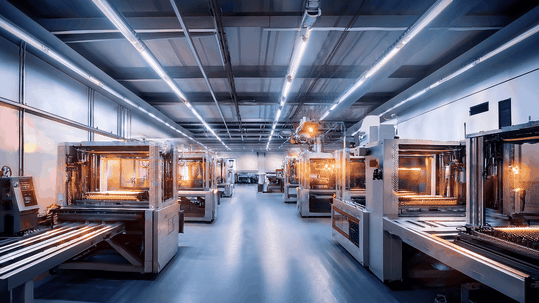
(Source: AI-generated)
Across a wide spectrum of industries – whether it’s ensuring the flawless performance of aerospace components, the precision of 3D-printed medical implants in healthcare or the reliability of custom parts in automotive manufacturing – the demand for zero-defect quality and absolute data integrity is a shared imperative. These examples highlight a universal truth: regardless of the industry, operational success and safety are built on a foundation of secure, flawless processes. As the adoption of decentralized manufacturing continues to rise, the demand for advanced security systems capable of meeting increasingly stringent intellectual property (IP) standards has never been greater.
Innovation in the additive manufacturing sector is advancing at an unprecedented rate, driven by the growing demand for agile, cost-effective, and highly customized production. The global 3D printing market is undergoing a transformative shift, projected to grow from USD 23.41 billion in 2025 to USD 101.74 billion by 2032*. Companies are increasingly moving away from centralized manufacturing, leveraging external service bureaus to deliver products faster and tailor offerings precisely to market demands. However, this rapid evolution introduces a critical vulnerability: the digital design files that power this ecosystem also facilitate its potential misuse. To maintain operational integrity, the industry must address a pressing challenge- protecting intellectual property throughout the digital supply chain.
The High-Stakes Reality of Digital Vulnerability
In the realm of 3D printing, digital model files are the lifeblood of production, encapsulating the exact blueprint required to construct an object layer by layer. The exchange of this sensitive production data across diverse sites – both internally and with external partners – introduces significant security risks.
The stakes are incredibly high. If an unauthorized entity intercepts or gains control of a digital file, they effectively "own" the object, enabling them to 3D-print infinite counterfeit copies. Without rigorous security protocols, these files can be easily copied, altered, or illegally distributed, fundamentally undermining the original designer's ownership. Beyond the monetary and creative losses, a breach in IP security can severely compromise the end-product. Counterfeit components bypass mandatory quality control processes designed to guarantee production consistency, accuracy, and structural integrity. In industries bound by strict regulatory standards, such as aeronautics or medical device manufacturing, a compromised part does not just damage brand reputation – it creates severe safety risks that could lead to life-threatening incidents.
Designers, therefore, systematically need to share their designs for 3D printing securely as a way to produce their creations and ensure the safety of others.
Secure File Streaming: A Transformative Solution
To navigate this world of growing challenges, manufacturers need more than traditional non-disclosure agreements (NDAs) – they need comprehensive, advanced security architectures that encompass access control, end-to-end encryption, absolute traceability, and secure transfer protocols.
The ideal solution to address these challenges must encompass several key components:
Non-Disclosure Agreements (NDAs): Implementing NDAs with all parties involved in the production process ensures legal protection and confidentiality, reducing the risk of intentional or unintentional disclosure of sensitive information.
Access Control: Ensuring that only authorized individuals or entities have access to the design files at each stage of the production process is crucial. This involves stringent authentication measures and permissions management.
Encryption: Transforming production files into unreadable code ensures that even if files are intercepted, they remain useless to unauthorized users.
Traceability: Logging of every interaction with the digital file, from creation to final production, provides a detailed audit trail. This includes recording production parameters to maintain the integrity of the manufacturing process.
Secure Transfer: Encrypted transfer protocols must be used when sending production files between different locations or partners, preventing unauthorized interception and alteration during transit.
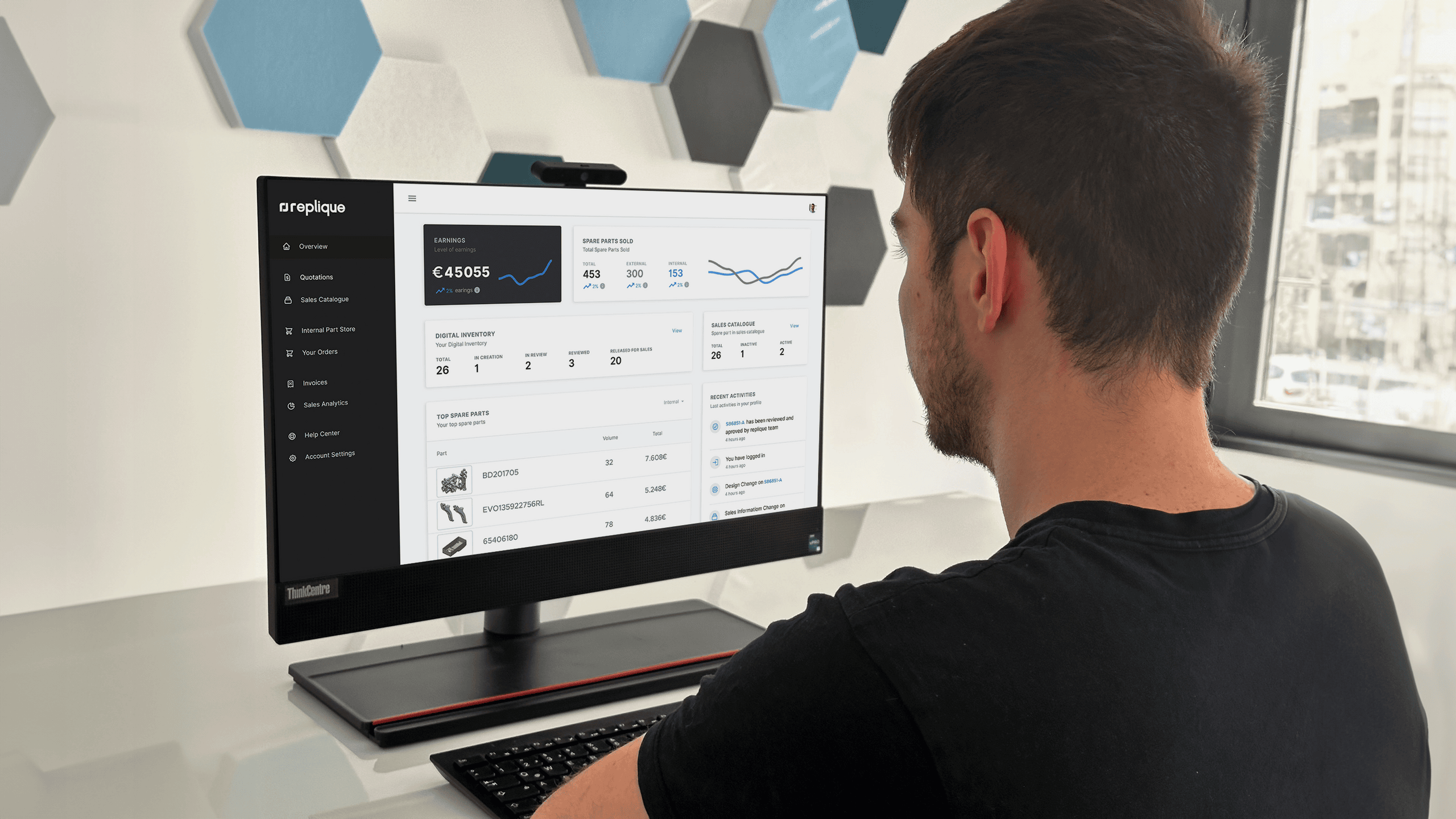
This is where secure digital warehousing platforms have emerged as a transformative solution in the decentralized manufacturing landscape. Operating as a secure digital warehouse, this technology represents a cutting-edge leap in IP protection, offering the advanced security needed to support global 3D printing without compromising production efficiency. Production files are stored within a highly secure, cloud-based digital warehousing system for on-demand production. Besides closing NDAs with all involved parties, they offer a secure digital warehouse that makes processing 3D printing orders as secure as it gets. Every interaction with the file is logged and can be tracked.
(Source: Replique)
Providers of these solutions often hold ISO 27001 certification, underscoring a commitment to high security standards for storing and exchanging sensitive data. Such certification confirms that strict information security requirements are met and that risk management processes are continuously implemented to safeguard confidential data.
Redefining Business Models with Pay-Per-Print Metrology
The benefits of encrypted streaming technology extend beyond basic security to redefine the possibilities in production economics. Encrypting production files and streaming them directly to the printer ensures that the production file cannot be kept or misused.
This method allows for printing only the requested amount, e.g. enabling you to release a part only for one print. Consequently, it unlocks the potential for "pay-per-print" business models. Designers and enterprises can confidently monetize their components as digital assets, sell their parts as digital files, and earn per-print royalties under a license.
Date: 08.12.2025
Naturally, we always handle your personal data responsibly. Any personal data we receive from you is processed in accordance with applicable data protection legislation. For detailed information please see our privacy policy.
Consent to the use of data for promotional purposes
I hereby consent to Vogel Communications Group GmbH & Co. KG, Max-Planck-Str. 7-9, 97082 Würzburg including any affiliated companies according to §§ 15 et seq. AktG (hereafter: Vogel Communications Group) using my e-mail address to send editorial newsletters. A list of all affiliated companies can be found here
Newsletter content may include all products and services of any companies mentioned above, including for example specialist journals and books, events and fairs as well as event-related products and services, print and digital media offers and services such as additional (editorial) newsletters, raffles, lead campaigns, market research both online and offline, specialist webportals and e-learning offers. In case my personal telephone number has also been collected, it may be used for offers of aforementioned products, for services of the companies mentioned above, and market research purposes.
Additionally, my consent also includes the processing of my email address and telephone number for data matching for marketing purposes with select advertising partners such as LinkedIn, Google, and Meta. For this, Vogel Communications Group may transmit said data in hashed form to the advertising partners who then use said data to determine whether I am also a member of the mentioned advertising partner portals. Vogel Communications Group uses this feature for the purposes of re-targeting (up-selling, cross-selling, and customer loyalty), generating so-called look-alike audiences for acquisition of new customers, and as basis for exclusion for on-going advertising campaigns. Further information can be found in section “data matching for marketing purposes”.
In case I access protected data on Internet portals of Vogel Communications Group including any affiliated companies according to §§ 15 et seq. AktG, I need to provide further data in order to register for the access to such content. In return for this free access to editorial content, my data may be used in accordance with this consent for the purposes stated here. This does not apply to data matching for marketing purposes.
Right of revocation
I understand that I can revoke my consent at will. My revocation does not change the lawfulness of data processing that was conducted based on my consent leading up to my revocation. One option to declare my revocation is to use the contact form found at https://contact.vogel.de. In case I no longer wish to receive certain newsletters, I have subscribed to, I can also click on the unsubscribe link included at the end of a newsletter. Further information regarding my right of revocation and the implementation of it as well as the consequences of my revocation can be found in the data protection declaration, section editorial newsletter.
The Race to Future Readiness
As companies increasingly adopt distributed manufacturing models, the need for secure and efficient IP handling becomes paramount. The fusion of smart encryption technology and proactive manufacturing strategies ensures an era where additive manufacturing remains both robust and innovative.
Secure digital warehouse technologies allow companies to confidently share digital files, safe in the knowledge that their intellectual property is protected at every stage. These platforms enable comprehensive tracking of every interaction with the digital file and record all production details, ensuring complete transparency and accountability throughout the production process. This approach secures design data and streamlines the production process, making it more efficient and scalable. Manufacturers can leverage the benefits of 3D printing – such as reduced lead times, cost savings, and customization – without compromising their intellectual property.
*Fortune Business Insights press release – 3D printing market, January 2025.
Nick Dinges is CTO of Replique, which offers an industrial manufacturing platform that enables OEMs to provide parts on-demand anytime and anywhere to their customers through a global, decentralised and secured production network.



:quality(80)/p7i.vogel.de/wcms/23/99/23992bf2dcdc432c9b7209c34a4a7c48/0129733089v1.jpeg "Stork relies on the modular Neoswiss turning system from Iscar to shorten the set-up times for its sliding headstock lathes and work more productively. (Image:Iscar)")
:quality(80)/p7i.vogel.de/wcms/7d/e2/7de2923434b2f1a78ba5482d8d335269/0113143253v1.jpeg "In our China Market Insider we regularly provide you with relevant information directly from China. (Image:© Eisenhans - stock.adobe.com)")
:quality(80)/p7i.vogel.de/wcms/9d/2b/9d2b802f800e5caf17b2831e74228cd3/screenshot-202026-03-03-20103822-609x343v1v1.png "Visual comparison: on the left, a clean, burr-free cut edge; on the right, typical burr formation with oxidation discoloration. This illustrates how strongly parameter control and gas management influence the quality of the result. (CO₂ laser, oxygen cutting gas, sheet thickness approx. 15 mm). (Image:Picture: Rime)")
:quality(80)/p7i.vogel.de/wcms/dd/08/dd086510d9ae7b50181f6070e4463b44/0129363730v1.jpeg "Typical application for ionizing devices: Wrapping films. (Picture: ©Adobe Stock/SMC)")
:quality(80)/p7i.vogel.de/wcms/b7/36/b736dfebc16c42d6901d0d0e1f390493/3d-druck-20factory-20--20ki-20generiert-1920x1079v1.png "(Source: AI-generated)")
:quality(80)/p7i.vogel.de/wcms/79/b2/79b21aad663f4a7bd4472afc1c1afc62/0130433994v1.jpeg "Mission Joyride: The free-flying robot (shown here in the rendering) will relieve the ISS crew of logistics tasks from 2027 with its two mechanical arms. (Image:Icarus Robotics)")
:quality(80)/p7i.vogel.de/wcms/6b/45/6b4546fa6ebf305c3660326909363f32/0130437089v1.jpeg "Industrial AI in action: Rockwell Automation presents practical solutions for self-controlling production systems at the Hannover Messe. (Image:Rainer Jensen, Deutsche Messe)")
:quality(80)/p7i.vogel.de/wcms/78/e9/78e9188c25a8a94e67c34c9bf8ffe495/visual-agile-20robots-20and-20google-20deepmind-20partner-20to-20bring-20intelligence-20to-20robotics-2500x1406v1v1.jpeg "Together, the partners are developing adaptable, intelligent robots for a wide range of applications (Image:Agile Robots SE)")
:quality(80)/p7i.vogel.de/wcms/59/a2/59a2b11f0aa1b700eff02addd5de8703/adobestock-1788280853--c2-a9-20satria-20-e2-80-93-20stock-adobe-com-5081x2860v1v1.jpeg "Quantum computers require extreme cooling to temperatures close to absolute zero in order to keep qubits stable. (Image:satria - stock.adobe.com)")
:quality(80)/p7i.vogel.de/wcms/62/5f/625f41e87ebfef156a98c8e6393e32fd/0130211654v1.jpeg "Axial flux motors have some advantages over radial flux motor—but their production is currently still expensive. (Image:RWTH Aachen University)")
:quality(80)/p7i.vogel.de/wcms/f6/ae/f6aec4f6241b36ed5e3a990ac9176b42/0130429460v1.jpeg "Verne, Pony.ai and Uber want to launch a robotaxi service in Europe. (Image:Verne)")
:quality(80)/p7i.vogel.de/wcms/d7/88/d788699f2974708a332baa4e7a62fa9e/0130438967v1.jpeg "Skoda is withdrawing from China. The brand has produced well over three million vehicles there. (Image:Skoda car)")
:quality(80)/p7i.vogel.de/wcms/b0/43/b043b86899837532aad62d63368a917a/0130371361v1.jpeg "Skoda leaves the chinese market.
(Image:Skoda)")
:quality(80)/p7i.vogel.de/wcms/c3/c4/c3c4ce270b083eeac55654148611f064/0130237945v1.jpeg "China is not giving up on hydrogen, but is intensifying its efforts. (Image:freely licensed from Pixabay)")
:quality(80)/p7i.vogel.de/wcms/10/6c/106cd22de5f68a0f74639d654827228c/0130345302v1.jpeg "Made in India: According to the India Electronics and Semiconductor Association (IESA), the country should be able to produce between 75 and 80 million chips by the beginning of 2027, once the plants currently under construction become operational. (Image:Pixabay (Montage: Sebastian Gerstl))")
:quality(80)/p7i.vogel.de/wcms/a5/ed/a5ed6fda029d362732a293d6b19d74c4/0130444216v1.jpeg "Thirteen executives from the Chinese chip industry have drawn up a plan to achieve an 80% self-sufficiency rate for semiconductors by 2030. (Image:Maxim_Kazmin - stock.adobe.com)")
:quality(80)/p7i.vogel.de/wcms/31/a6/31a646018b34d8e0a44bfc8bf17837f6/0130361632v1.jpeg "For many companies, PFAS are considered indispensable in electronics production. (Image:freely licensed)")
:quality(80)/p7i.vogel.de/wcms/4d/dd/4dddf438e91f394c04a095dbfd109d1c/0130236430v1.jpeg "Measurement modules: The 720301 module in combination with the SL2000 enables RMS and power calculations, among other things. (Image:Yokogawa)")
:fill(fff,0)/p7i.vogel.de/companies/69/88/69882c428938e/tmts2026-ticec-banner-en-2000px.png "tmts2026-ticec-banner-en-2000px (https://www.tmts.tw/en)")
:quality(80)/p7i.vogel.de/wcms/db/01/db0155d9e7ca9fd069bd9bd4161f4d1b/0127315728v1.jpeg "Hackers have become the mafia of the digital age. They block systems, steal sensitive data, and extort money. They no longer operate as individuals in backrooms but as professionally organized groups equipped with top-notch technology. Their targets include both international corporations and medium-sized and small businesses. (Image:Bystronic/Justin Wood)")
:quality(80)/p7i.vogel.de/wcms/02/a6/02a6ca8b3e53c16dca9069f968436829/0123763741v1.jpeg "Public-key cryptography could be broken by quantum computers as early as 2030. (Image:Sergei - stock.adobe.com / AI-generated)")