In Denmark, larva breeding and robot technology combine to create a future-ready solution for global food supply: Enorm Biofactory uses the efficiency of the black soldier fly and the precision of Hygienic-Oil robots from Kuka to produce a climate-friendly protein source.
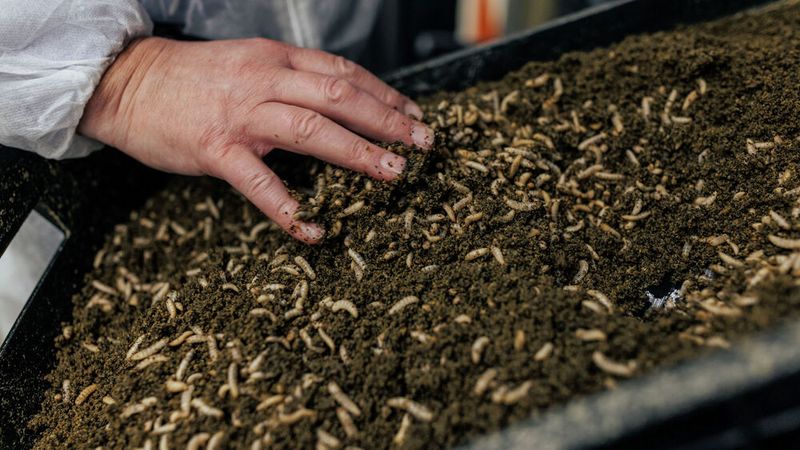
The larvae gain weight so quickly that in just twelve days, 25 kilograms of eggs turn into 100 tons of larvae.
(Image: Kuka)
In a factory hall in the heart of Denmark, 50 kilometers (approx. 31 miles) southwest of Aarhus, a literally moving spectacle can be observed day after day, almost around the clock: Soon millions of fly larvae will devour their food in countless boxes here, while the containers are constantly being moved, stacked, emptied, and filled by quietly humming Kuka robots in the Hygienic Oil (HO) version. Welcome to Enorm Biofactory, Scandinavia's largest and first commercial insect farm!
Perhaps there will soon be factories like this everywhere. After all, many experts believe that insects are the protein source of the future. The United Nations estimates that the world population will grow to about 9.7 billion people by 2050. As average income is expected to rise in many developing countries, a significant increase in meat consumption and thus protein demand is expected.
Faced with climate change and ever scarcer resources, it is clear that an effective circular economy and sustainable food production are more important than ever. The black soldier fly could play a crucial role in this context - and that's what everything at Enorm revolves around.
From 25 kilograms of eggs, 100 tons of larvae are produced
"Only one gram of black soldier fly eggs equals 30,000 larvae," calculates Carsten Lind Pedersen, CEO of Enorm. "And they gain weight so quickly that 25 kilos of eggs become 100 tons of larvae—in just twelve days! No other animal can do that."
Jane Lind Sam, COO of Enorm, also emphasizes the huge potential of the insect for sustainable protein production: "The larvae of the fly can feed on almost all organic substances. That's why we can feed them with waste products from the Danish food industry that would have been disposed of elsewhere—and turn them into high-quality feed protein for animal husbandry."
Specifically, Enorm produces two products from the fast-growing larvae: insect meal as a replacement for highly digestible protein feed—for fish, poultry, pigs and pets—and immune-stimulating insect oil, which can also be used as a food supplement for various animals. "Ingredients based on larvae of the black soldier fly, produced responsibly, have a significantly lower CO2 footprint compared to other animal protein sources," says Pedersen. Thus, insect production is a prime example of a sustainable circular economy that barely burdens the environment and climate: "In further processing, the larvae are simply dried—so the only thing left over here is water." In addition, some of the larvae are used to produce new eggs—a perfect cycle.
Kuka robots don't break a sweat
Sustainability, because of maximum efficiency, also applies to the production process itself, which, according to Pedersen, brings two major challenges: On the one hand, it requires a complex ventilation system in the factory, because the process generates a lot of heat. "Above all, however, we have to fill, empty and stack extremely heavy containers very quickly," says Pedersen.
We knew that Kuka's flexible Hygienic-Oil robots would be perfect for Enorm's insect farm.
Rolf Tange, CTO Sealing System Group
Finding the best solutions for this was the task of Rolf Tange and his team. Tange is CTO of the Sealing System Group, one of the leading providers of packaging and palletizing solutions, and has relied on Kuka technologies for decades. "We knew that Kuka's flexible Hygienic Oil robots would be perfect for Enorm's insect farm," says Tange. "In the first stage, the larvae grow in smaller, 30 to 40 centimeter boxes," he describes the process. After seven days, they are then transferred to larger boxes, measuring more than one square meter. And at least with these, the robots are indispensable help to any human: "There are 50 kilos of liquid food in there, then 70,000 larvae are tipped on top," Tange says. "Even the fittest worker couldn't handle that weight!"
No problem, however, for the six KR Quantec PA HO from Kuka: every seven seconds they fill a new box, that is 500 per hour—and that 20 hours a day. The facility is cleaned in the remaining four hours. "Without the robots from Kuka, our production would not be possible," says Carsten Pedersen. Especially since he has to rely on them one hundred percent, because the entire process is programmed down to the minute: "If there was a problem with one of the robots, we would only have two to three minutes to solve it - otherwise the entire process would stop. But luckily this hasn't happened yet."
Date: 08.12.2025
Naturally, we always handle your personal data responsibly. Any personal data we receive from you is processed in accordance with applicable data protection legislation. For detailed information please see our privacy policy.
Consent to the use of data for promotional purposes
I hereby consent to Vogel Communications Group GmbH & Co. KG, Max-Planck-Str. 7-9, 97082 Würzburg including any affiliated companies according to §§ 15 et seq. AktG (hereafter: Vogel Communications Group) using my e-mail address to send editorial newsletters. A list of all affiliated companies can be found here
Newsletter content may include all products and services of any companies mentioned above, including for example specialist journals and books, events and fairs as well as event-related products and services, print and digital media offers and services such as additional (editorial) newsletters, raffles, lead campaigns, market research both online and offline, specialist webportals and e-learning offers. In case my personal telephone number has also been collected, it may be used for offers of aforementioned products, for services of the companies mentioned above, and market research purposes.
Additionally, my consent also includes the processing of my email address and telephone number for data matching for marketing purposes with select advertising partners such as LinkedIn, Google, and Meta. For this, Vogel Communications Group may transmit said data in hashed form to the advertising partners who then use said data to determine whether I am also a member of the mentioned advertising partner portals. Vogel Communications Group uses this feature for the purposes of re-targeting (up-selling, cross-selling, and customer loyalty), generating so-called look-alike audiences for acquisition of new customers, and as basis for exclusion for on-going advertising campaigns. Further information can be found in section “data matching for marketing purposes”.
In case I access protected data on Internet portals of Vogel Communications Group including any affiliated companies according to §§ 15 et seq. AktG, I need to provide further data in order to register for the access to such content. In return for this free access to editorial content, my data may be used in accordance with this consent for the purposes stated here. This does not apply to data matching for marketing purposes.
Right of revocation
I understand that I can revoke my consent at will. My revocation does not change the lawfulness of data processing that was conducted based on my consent leading up to my revocation. One option to declare my revocation is to use the contact form found at https://contact.vogel.de. In case I no longer wish to receive certain newsletters, I have subscribed to, I can also click on the unsubscribe link included at the end of a newsletter. Further information regarding my right of revocation and the implementation of it as well as the consequences of my revocation can be found in the data protection declaration, section editorial newsletter.
Fully automated plant runs by itself
In principle, the plant runs by itself, Pedersen explains, because the entire process is completely automated: "In fact, we only need two employees to control everything." Their task is largely limited to checking the systems.
The fact that the facility runs so reliably is also due to the good work of the system partner Sealing System. "We have often and successfully worked with Kuka technologies for the food industry," says Kim Kildahl Poulsen, Sales Manager at XIO—Intelligent Farming, Sealing System Group. He particularly appreciates Kuka's extensive portfolio in the Hygienic-Oil robot segment. With their special H1 lubricants in all axes, they meet the high requirements of the food industry along the entire process chain. If the lubricants come into contact with food, this is absolutely safe for humans and animals—as is the case with Enorm.
Despite the vast experience in the food industry, the construction of the facility at Enorm was also somewhat new territory for Sealing System, as Poulsen admits: "In an insect farm, we are dealing with living matter. We had not seen that before." Since the larvae's food consists of 70 percent water, for example, they have to deal with an extremely humid environment in the factory—no problem for the specially designed robots from Kuka.
Software from Visual Components assisted in design and planning
The fact that everything would work so well in the end did not come as a surprise to Poulsen. After all, he and his team were able to test important processes in advance—with Visual Components. The Finnish company, acquired by Kuka, specializes in software solutions for 3D simulation in factory planning. "With the software from Visual Components, we were able to simulate the speed and rhythm at which the robots and conveyor systems need to move. That helped a lot." The programming concept Kuka-App-Tech, which enables efficient and simple robot programming in the shortest possible time, proved to be just as practical.
And so, the larvae and robot work diligently and reliably day in and day out in the heart of Denmark—and with the help of Kuka's innovative technology, they contribute to more sustainable food production.
*Sandra Hirsch is the Global Content Marketing Manager at Kuka. The article was first published on our sisterbrand 'elektrotechnik AUTOMATISIERUNG' (German Edition), Vogel Communications Group GmbH & Co. KG



:quality(80)/p7i.vogel.de/wcms/23/99/23992bf2dcdc432c9b7209c34a4a7c48/0129733089v1.jpeg "Stork relies on the modular Neoswiss turning system from Iscar to shorten the set-up times for its sliding headstock lathes and work more productively. (Image:Iscar)")
:quality(80)/p7i.vogel.de/wcms/7d/e2/7de2923434b2f1a78ba5482d8d335269/0113143253v1.jpeg "In our China Market Insider we regularly provide you with relevant information directly from China. (Image:© Eisenhans - stock.adobe.com)")
:quality(80)/p7i.vogel.de/wcms/9d/2b/9d2b802f800e5caf17b2831e74228cd3/screenshot-202026-03-03-20103822-609x343v1v1.png "Visual comparison: on the left, a clean, burr-free cut edge; on the right, typical burr formation with oxidation discoloration. This illustrates how strongly parameter control and gas management influence the quality of the result. (CO₂ laser, oxygen cutting gas, sheet thickness approx. 15 mm). (Image:Picture: Rime)")
:quality(80)/p7i.vogel.de/wcms/dd/08/dd086510d9ae7b50181f6070e4463b44/0129363730v1.jpeg "Typical application for ionizing devices: Wrapping films. (Picture: ©Adobe Stock/SMC)")
:quality(80)/p7i.vogel.de/wcms/b7/36/b736dfebc16c42d6901d0d0e1f390493/3d-druck-20factory-20--20ki-20generiert-1920x1079v1.png "(Source: AI-generated)")
:quality(80)/p7i.vogel.de/wcms/79/b2/79b21aad663f4a7bd4472afc1c1afc62/0130433994v1.jpeg "Mission Joyride: The free-flying robot (shown here in the rendering) will relieve the ISS crew of logistics tasks from 2027 with its two mechanical arms. (Image:Icarus Robotics)")
:quality(80)/p7i.vogel.de/wcms/6b/45/6b4546fa6ebf305c3660326909363f32/0130437089v1.jpeg "Industrial AI in action: Rockwell Automation presents practical solutions for self-controlling production systems at the Hannover Messe. (Image:Rainer Jensen, Deutsche Messe)")
:quality(80)/p7i.vogel.de/wcms/78/e9/78e9188c25a8a94e67c34c9bf8ffe495/visual-agile-20robots-20and-20google-20deepmind-20partner-20to-20bring-20intelligence-20to-20robotics-2500x1406v1v1.jpeg "Together, the partners are developing adaptable, intelligent robots for a wide range of applications (Image:Agile Robots SE)")
:quality(80)/p7i.vogel.de/wcms/59/a2/59a2b11f0aa1b700eff02addd5de8703/adobestock-1788280853--c2-a9-20satria-20-e2-80-93-20stock-adobe-com-5081x2860v1v1.jpeg "Quantum computers require extreme cooling to temperatures close to absolute zero in order to keep qubits stable. (Image:satria - stock.adobe.com)")
:quality(80)/p7i.vogel.de/wcms/62/5f/625f41e87ebfef156a98c8e6393e32fd/0130211654v1.jpeg "Axial flux motors have some advantages over radial flux motor—but their production is currently still expensive. (Image:RWTH Aachen University)")
:quality(80)/p7i.vogel.de/wcms/f6/ae/f6aec4f6241b36ed5e3a990ac9176b42/0130429460v1.jpeg "Verne, Pony.ai and Uber want to launch a robotaxi service in Europe. (Image:Verne)")
:quality(80)/p7i.vogel.de/wcms/d7/88/d788699f2974708a332baa4e7a62fa9e/0130438967v1.jpeg "Skoda is withdrawing from China. The brand has produced well over three million vehicles there. (Image:Skoda car)")
:quality(80)/p7i.vogel.de/wcms/b0/43/b043b86899837532aad62d63368a917a/0130371361v1.jpeg "Skoda leaves the chinese market.
(Image:Skoda)")
:quality(80)/p7i.vogel.de/wcms/c3/c4/c3c4ce270b083eeac55654148611f064/0130237945v1.jpeg "China is not giving up on hydrogen, but is intensifying its efforts. (Image:freely licensed from Pixabay)")
:quality(80)/p7i.vogel.de/wcms/10/6c/106cd22de5f68a0f74639d654827228c/0130345302v1.jpeg "Made in India: According to the India Electronics and Semiconductor Association (IESA), the country should be able to produce between 75 and 80 million chips by the beginning of 2027, once the plants currently under construction become operational. (Image:Pixabay (Montage: Sebastian Gerstl))")
:quality(80)/p7i.vogel.de/wcms/a5/ed/a5ed6fda029d362732a293d6b19d74c4/0130444216v1.jpeg "Thirteen executives from the Chinese chip industry have drawn up a plan to achieve an 80% self-sufficiency rate for semiconductors by 2030. (Image:Maxim_Kazmin - stock.adobe.com)")
:quality(80)/p7i.vogel.de/wcms/31/a6/31a646018b34d8e0a44bfc8bf17837f6/0130361632v1.jpeg "For many companies, PFAS are considered indispensable in electronics production. (Image:freely licensed)")
:quality(80)/p7i.vogel.de/wcms/4d/dd/4dddf438e91f394c04a095dbfd109d1c/0130236430v1.jpeg "Measurement modules: The 720301 module in combination with the SL2000 enables RMS and power calculations, among other things. (Image:Yokogawa)")
:fill(fff,0)/images.vogel.de/vogelonline/companyimg/76800/76895/65.jpg "FAULHABER_120mm.jpg ()")
:quality(80)/p7i.vogel.de/wcms/10/7a/107adbae34fbd2682b7e41291bdaab59/0118955864v1.jpeg "Every seven seconds, the KR Quantec PA HO fills a new box, 500 per hour - and that for 20 hours a day.(Image: Kuka)")
:quality(80)/p7i.vogel.de/wcms/ce/24/ce2412c5d9a93a334a7563f9e4de2e3f/0118955865v1.jpeg "Rolf Tange, Carsten Pedersen and Kim Poulsen (from left to right) discuss how larva farming and robot technology can contribute to a sustainable solution for global food supply.(Image: Kuka)")
:quality(80)/p7i.vogel.de/wcms/49/fb/49fb74c11c5950e5ccf467401fa03654/0118955653v1.jpeg "Enorm Biofactory in Denmark uses the efficiency of the Black Soldier Fly and the precision of Kuka's Hygienic-Oil Robots.(Image: Kuka)")
:quality(80)/p7i.vogel.de/wcms/aa/d1/aad1418202bab8a7eb732a868f651a0f/0118955855v1.jpeg "With their special H1 lubricants in all axes, the HO robots from Kuka meet the high requirements of the food industry along the entire process chain.(Image: Kuka)")
:quality(80)/p7i.vogel.de/wcms/d9/bd/d9bd1bfa7d02f586e092f06c61ee3d9a/0129464423v1.jpeg "This is what the Black Soldier Fly (BSF) looks like. The first impression is of a common two-winged insect. But appearances are deceptive, because its larvae are true protein reactors, whose industriousness is now to be exploited for food ... (Image:Fly Friends)")
:quality(80)/p7i.vogel.de/wcms/28/ac/28acc920f0ac0a2a05e4ffe4fb4dff30/0127136020v1.jpeg "Big Dutchman equips solar systems for agricultural enterprises with Helukabel connection technology. (Image:Big Dutchman)")