There is potential in packaging machines—and not just for handling and packaging various consumer goods. They also offer a wealth of levers for energy-saving production.
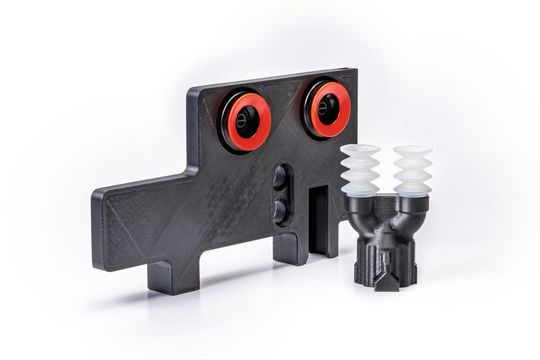
3D-printed tools and other components contribute to energy-saving, precise processes.
(Image: Gerhard Schubert GmbH)
It doesn't always have to be the materials: It is true that EU regulations such as the Packaging & Packaging Waste Regulation (PPWR) lead directly to packaging materials, for which there is now a wealth of recyclable options. However, the PPWR also indirectly exerts pressure on manufacturers to save resources and produce less waste. Truly sustainable production therefore also means using energy as sparingly as possible—whether in gluing or transport systems, robot tools or sealing units. With appropriate modifications, considerable energy and process-related potential can be exploited.
Without pressure, temperature and time, numerous packaging processes would come to a standstill. Compressed air, for example, drives pneumatic cylinders that perform movements such as gripping, pushing or lifting, and supports transportation and handling. Empty bottles or bags can be brought into position with blasts of air, while suction pads enable gentle pick-and-place with the help of negative pressure.
Gallery
As indispensable as compressed air is in many places, its share of the plant's power consumption can be just as high: To generate compressed air, systems require compressors and sufficient electricity to reliably produce the medium for the entire duration of production. In industry, compressed air accounts for around ten percent of electricity consumption (EU-wide > 80 terawatt hours/year). In packaging-intensive areas, it can be significantly higher: Case studies in the pharmaceutical industry determined shares of between 30 and 40 percent . Weak points can quickly become cost drivers: Insufficient system pressure, leaks or inefficient piping systems can quickly lead to additional costs that can be avoided by making targeted adjustments.
Components from the 3D Printer
In vacuum systems, for example, the shape and length of the media-carrying pipes or hoses determine how efficiently the devices work. Right-angled pipes mean more air resistance; the pumps required to generate the vacuum have to deliver correspondingly more power. If the pipe geometry is altered, the air resistance is reduced: flatter angles enable a much more energy-efficient vacuum generation. Electric vacuum ejectors allow even more energy-saving operation: The compact systems, which are positioned close to the product, are only in operation when a vacuum is required; their demand-dependent use helps to reduce electricity consumption.
The same applies to tube lengths: In robots with several grippers, for example, the air is extracted via several hoses. If these are of different lengths, vacuum generation can take different amounts of time. The disadvantage: the suction cups work unevenly and, in the worst case, place objects inaccurately—with undesirable consequences, not only for the products themselves. To compensate for the suction power, the systems have to take countermeasures, which increases electricity and compressed air consumption.
Additive manufacturing provides a remedy: Using 3D printing, pipes, hoses and suction tools can be designed in advance so that they have the necessary internal or external geometry for clean, reproducible vacuum generation. Flat angles, hoses with a uniform length: the use of modern processes such as 3D printing offers advantages that go beyond power consumption. While the path of a part through the factory is often long and complex in traditional production processes, 3D printing eliminates many of these intermediate steps. This not only saves manufacturers time, but also material, energy and transportation costs—a clear benefit in terms of efficiency and environmental compatibility.
Tight or Not?
Correctly placed products are ready for initial packaging. Tubular bags are often used in the food and pharmaceutical industries as they can be produced quickly, cost-effectively and hermetically sealed. Depending on the packaging material, manufacturers have different sealing processes at their disposal, from hot to cold to ultrasonic sealing. Regardless of the method, the focus is on tight sealing seams and as few rejects as possible.
Innovative heat sealing systems can determine the energy input during the sealing process and thus provide indirect information on whether a seam is sealed or not. If there is no feedback from the sealing system, this means that no energy has been transferred from the sealing element to the film and no heating has taken place—in this case, the seal has not been applied. There is a similar check for ultrasonic sealing: here, the systems measure whether energy has actually been transferred from the sonotrode to the anvil. If this feedback is not received, a tight seal has not been achieved here either. The advantage: this indirect product control does not require any destructive processes and reduces material wear.
Date: 08.12.2025
Naturally, we always handle your personal data responsibly. Any personal data we receive from you is processed in accordance with applicable data protection legislation. For detailed information please see our privacy policy.
Consent to the use of data for promotional purposes
I hereby consent to Vogel Communications Group GmbH & Co. KG, Max-Planck-Str. 7-9, 97082 Würzburg including any affiliated companies according to §§ 15 et seq. AktG (hereafter: Vogel Communications Group) using my e-mail address to send editorial newsletters. A list of all affiliated companies can be found here
Newsletter content may include all products and services of any companies mentioned above, including for example specialist journals and books, events and fairs as well as event-related products and services, print and digital media offers and services such as additional (editorial) newsletters, raffles, lead campaigns, market research both online and offline, specialist webportals and e-learning offers. In case my personal telephone number has also been collected, it may be used for offers of aforementioned products, for services of the companies mentioned above, and market research purposes.
Additionally, my consent also includes the processing of my email address and telephone number for data matching for marketing purposes with select advertising partners such as LinkedIn, Google, and Meta. For this, Vogel Communications Group may transmit said data in hashed form to the advertising partners who then use said data to determine whether I am also a member of the mentioned advertising partner portals. Vogel Communications Group uses this feature for the purposes of re-targeting (up-selling, cross-selling, and customer loyalty), generating so-called look-alike audiences for acquisition of new customers, and as basis for exclusion for on-going advertising campaigns. Further information can be found in section “data matching for marketing purposes”.
In case I access protected data on Internet portals of Vogel Communications Group including any affiliated companies according to §§ 15 et seq. AktG, I need to provide further data in order to register for the access to such content. In return for this free access to editorial content, my data may be used in accordance with this consent for the purposes stated here. This does not apply to data matching for marketing purposes.
Right of revocation
I understand that I can revoke my consent at will. My revocation does not change the lawfulness of data processing that was conducted based on my consent leading up to my revocation. One option to declare my revocation is to use the contact form found at https://contact.vogel.de. In case I no longer wish to receive certain newsletters, I have subscribed to, I can also click on the unsubscribe link included at the end of a newsletter. Further information regarding my right of revocation and the implementation of it as well as the consequences of my revocation can be found in the data protection declaration, section editorial newsletter.
This allows manufacturers to significantly reduce their sampling rates: Instead of testing every thousandth product, as was previously the case, it may now only be necessary to sample every ten thousandth product. As sampling is always accompanied by the destruction of the product—for example when immersed in water—the reduced test frequency through indirect leakage measurement promotes the careful use of resources. The latter is also reflected in the energy consumption of the sealing systems: Because heat is only generated at certain points instead of over a large area and no sealing jaws need to be brought up to temperature in advance, the consumption of ultrasonic sealing systems in standby mode is reduced by a factor of 3.5 compared to the heat-sealing variant. During operation, the savings amount to 40 percent, as measurements by Gerhard Schubert GmbH have shown.
As Much Glue As Necessary
For tubular bags or other primary packaging, the process rarely ends without further protection. To ensure that secondary packaging such as boxes or transport cartons remain stable, packaging machines apply hot melt to pre-defined points on the blanks. Glueless approaches now also exist, such as the Dotlock technology developed by Schubert, which guarantees maximum stability even for heavy products. However, hot melt is likely to remain in use, as it enables hermetically sealed and robust packaging that offers optimum protection in demanding environments such as damp rooms.
Nevertheless, the direct requirements of the PPWR—particularly those for recyclable, lightweight and minimalist packaging—may mean that manufacturers have to adapt their packaging technology, retrofit machines or reconfigure them. If packaging machines are to process cartons with minimal wall thicknesses or with new gluing techniques in the future, they will have to enable special cycle times or adhesive applications—and have modified gluing systems if required. Manufacturers should take an ecological approach to glue application in particular, as melting the glue granulate and storing the glue mass requires a certain core temperature—with corresponding energy consumption.
The amount of hot melt itself is a key factor: Instead of using a blanket application of the binding agent, manufacturers of consumer goods can fall back on systems that apply glue as required and thus work in a more material-saving and cost-efficient manner. Corresponding glue systems are based on known production values in order to calculate consumption precisely: Using the number of cycles per minute as well as robot paths and speeds, machine manufacturers can determine the exact amount of glue required per hour in advance and transmit this to the system control.
This also regulates the glue application. This means that the glue system processes exactly the amount of glue that the cartons require. This has a decisive advantage: designers can reduce the size of the glue tank in advance, which in turn requires significantly less energy to heat up and maintain the temperature. Gone are the days when the glue unit had to be re-parameterized or glue nozzles had to be changed every time the program was changed.
Save With Compact Technology
The transport systems within packaging lines can also be designed according to requirements. Transport robots such as the Transmodul from Schubert perform an important, highly flexible function within lines: they transport primary-packed products to cartoners or already filled cartons to other stations in the process. For format changes, only the format plates or transport tools on the Transmodul need to be exchanged. A vacuum blower holds the cartons or products securely in place.
This is precisely where there is potential for savings: powerful, compact vacuum ejectors save a significant amount of space and energy compared to conventional ejectors or pumps. Modern solutions enable significantly higher vacuum flows than standard systems, which means they not only achieve faster cycles, but also reduce their energy consumption. The high efficiency is maintained.
The solutions also stand out in other ways: as they are small and lightweight, they can also be used inside machines, in end-of-arm tools such as robot grippers or directly on transport robots. This eliminates the need for bulky central vacuum pumps in the production environment. If there is no need for vacuum systems—for example for bags with liquid that are also labeled—the ejector can simply be switched off or removed.
However, there is potential for greater sustainability far beyond the examples mentioned: whether in the path calculation of robots, more ecological packaging materials, new recycling streams or innovative production methods—the process offers manufacturers further opportunities to make their production more sustainable. In view of tight regulatory deadlines and ambitious climate targets, it is important to seize these opportunities as soon as possible.



:quality(80)/p7i.vogel.de/wcms/40/c5/40c5051cebdb10fdee9a283303434d9d/0129881741v1.jpeg "3D-printed tools and other components contribute to energy-saving, precise processes. (Image:Gerhard Schubert GmbH)")
:quality(80)/p7i.vogel.de/wcms/e5/fa/e5fa9fa2e3b44ee1894fdf95bbe828fe/0129904146v1.jpeg "Airports and other critical infrastructure in Europe are to be better protected against drones. (Picture: ©assetseller - stock.adobe.com)")
:quality(80)/p7i.vogel.de/wcms/ae/bd/aebda515c684825e97579175874ea6bd/0129920231v1.jpeg "Hensoldt, a sensor specialist for critical defense applications among other things, now has a strategic milestone ahead of it. The company is planning to acquire Nedinsco, an optronics company from Venlo in the Netherlands. Here's what's to come ... (Image:Hensoldt)")
:quality(80)/p7i.vogel.de/wcms/c3/6f/c36f031df46d22615d941d077d32313c/0129800025v1.jpeg "The laser-assisted process is intended to make wafer cutting significantly more productive. (Image:Trumpf)")
:quality(80)/p7i.vogel.de/wcms/e8/dc/e8dc27a8d9fba8fbd081987400bf6848/0127426198v1.jpeg "3D FEM models are detailed, large and computationally intensive. Thanks to ROM and the support of Cadfem, Wago has succeeded in setting up an e-shop for thermal simulation. (Image:WAGO)")
:quality(80)/p7i.vogel.de/wcms/9c/ac/9cac6246660e746c5a3989399ac4d250/0128561645v1.jpeg "Artificial intelligence can drive efficiency in smart factories through centralized data management and predictive maintenance. (Picture: ©Fardived - stock.adobe.com)")
:quality(80)/p7i.vogel.de/wcms/6b/e2/6be235b5ad8a442ccd9d164b0b300d8b/0129763992v1.jpeg "As early as 2020, the Zimmer Group announced that it would convert its production to be sustainably CO2-neutral. (Image:Zimmer Group)")
:quality(80)/p7i.vogel.de/wcms/d4/ba/d4bab9481e66f8570f40eb8ef2a90198/0129795613v1.jpeg "A camera inspection during removal ensures that the components are placed correctly in the KLTs. (Image:Yaskawa Europe)")
:quality(80)/p7i.vogel.de/wcms/76/81/7681b6450512b2cce1e453cd3d732543/0129479309v1.jpeg "Symbolic image: Model-based design combines virtual system models with real machines and systems in order to simulate, validate and coordinate functions, control and software early on in the development process. (Image:Dall-E / AI-generated)")
:quality(80)/p7i.vogel.de/wcms/5c/0f/5c0fee074c4b6c8e8c0993f3217c2f5a/0129773718v1.jpeg "The General Fusion demonstration reactor. (Image:General Fusion)")
:quality(80)/p7i.vogel.de/wcms/b5/5e/b55ed9355e0395ec0caf111d6af6b494/adobestock-495980372--c2-a9-20natali-mis-20-e2-80-93-20stock-adobe-com-6720x3778v1v1.jpeg "Which engineering skills will be in vogue in 2026? (Image:natali_mis - stock.adobe.com)")
:quality(80)/p7i.vogel.de/wcms/bf/a5/bfa5d882e93f159ce93e933742272b00/nord-vibn-cmyk-2196x1235v1v1.jpeg "With digital twins for virtual commissioning, Nord supports customers in ensuring that systems are available more quickly, even with complex drive systems. (Image:Nord Drivesystems)")
:quality(80)/p7i.vogel.de/wcms/e4/01/e40186c9a7d04cbecb20fab20ff79094/0129886097v1.jpeg "Skoda has inaugurated a new battery plant in Mlada Boleslav to meet rising demand, but also to reduce battery costs by 30 percent. (Image:Skoda)")
:quality(80)/p7i.vogel.de/wcms/74/7b/747b6bc4d758c5dd4b5c24a763ae493d/0129897614v1.jpeg "Huawei Intelligent Automotive Solutions has presented a lidar with a resolution of 896 lines. (Image:HIMA via ChinaEVHome)")
:quality(80)/p7i.vogel.de/wcms/ba/b7/bab7bfd052f35da3c39388508faa350e/0129851977v1.jpeg "The third generation of the Mazda CX-5 scores above all with its inner values. (Image:Mauritz - VCG)")
:quality(80)/p7i.vogel.de/wcms/81/24/8124e33f53ec73fa99374f407cc11b61/0129727992-541x304v1v1.jpeg "The development of control elements and HMI systems for commercial vehicles can lead to interactions. (Image:Preh / AI-generated)")
:quality(80)/p7i.vogel.de/wcms/8b/46/8b46730ba87a86f16d696f043cf0e3d1/0129887022v1.jpeg "Linyi Yunchuan's S2000 platform has risen to a height of two kilometers and fed the energy generated into the grid. (Image:Linyi Yunchuan)")
:quality(80)/p7i.vogel.de/wcms/92/f8/92f8bf81914500bcda78f63dab8da720/0129926751v1.jpeg "Only recently, the US government allowed high-end chips for AI such as Nvidia's H200 series (pictured) to be exported to China under certain conditions. But now the tax is being pulled back all the harder: An eDraft envisages tighter controls on the export of hardware for AI technologies worldwide. Even allies would be affected. (Image:Nvidia)")
:quality(80)/p7i.vogel.de/wcms/84/cc/84cc506003388ecffaab464677c7afa6/0129843694v1.jpeg "Launched last year, ASML's TWINSCAN XT:260 is an i-line scanner with a throughput of 270 wafers per hour. With a focus on the increased demands of AI chips, ASML wants to shift its focus away from pure front-end tools for chip production in the next ten to fifteen years with packaging and bonding technologies. (Image:ASML)")
:quality(80)/p7i.vogel.de/wcms/8f/48/8f48b0ed0d6c5c4f299b1310a7b577e9/0129830738v1.jpeg "Data centers in orbit are indeed dreams of the future, while data centers under water are already being tested. (Image:Dall-E / AI-generated)")
:fill(fff,0)/p7i.vogel.de/companies/69/88/69882c428938e/tmts2026-ticec-banner-en-2000px.png "tmts2026-ticec-banner-en-2000px (https://www.tmts.tw/en)")
:quality(80)/p7i.vogel.de/wcms/1b/9c/1b9c9ec6edcd7c9e93ceacd49f9c6660/0129881735v1.jpeg "Precisely controlled glue application helps to save resources.(Image: Gerhard Schubert GmbH)")
:quality(80)/p7i.vogel.de/wcms/cc/bd/ccbd189c26b4b84d9ddf8b5ab91684b8/0129881744v1.jpeg "Transport robots such as the Transmodul from Schubert use plates or vacuum technology as required to fix products in place.(Image: Gerhard Schubert GmbH)")
:quality(80)/p7i.vogel.de/wcms/9e/26/9e26a6992e302c7ba41b1271d5e51442/0129881739v1.jpeg "Easily interchangeable formats - here on a flow-wrapping machine - enable the use of energy-saving sealing technologies.(Image: Gerhard Schubert GmbH)")
:quality(80):fill(efefef,0)/p7i.vogel.de/wcms/67/ad/67adf92d254d2/elatec-wp-smart-factory.png "Elatec WP Smart Factory")
:quality(80)/p7i.vogel.de/wcms/fb/a0/fba0d7559dab6fbdde49cbd32b968636/0126113524v1.jpeg "For the energy transition to succeed, machines and systems must operate energy-efficiently. (Image: ©OlegDoroshin - stock.adobe.com)")
:quality(80)/p7i.vogel.de/wcms/20/48/2048d7a876ec38da1df64a5c3c12d1ba/0129069977v1.jpeg "0129069977v1 (Image:AI-generated)")