The embedded world starts on March 10 in Nuremberg. The trade fair showcases the entire spectrum of embedded systems, from hardware and software to services and tools. Especially for the automotive industry.
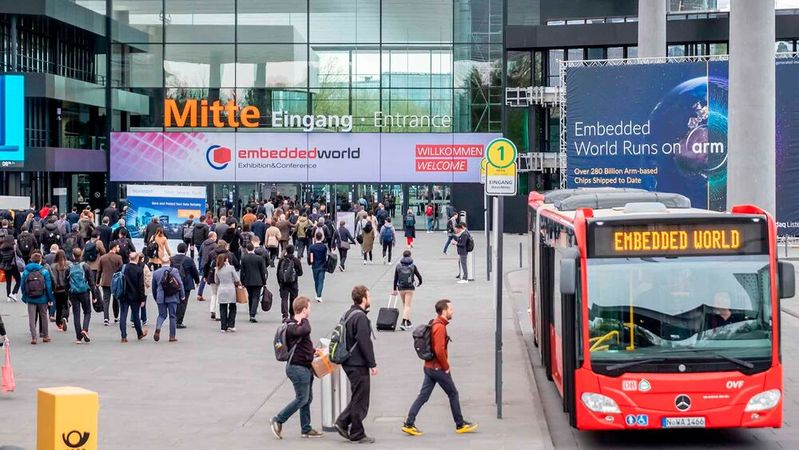
From March 10 to 12, 2026, everything in Nuremberg will once again revolve around embedded systems when Embedded World opens its doors.
(Image: NürnbergMesse | Thomas Geiger)
"The dynamism and innovative strength of the embedded industry was palpable in every hall," said Benedikt Weyerer, Executive Director of Embedded World last year. The data confirms his feeling: around 32,000 visitors from 80 countries came to the trade fair to find out about new products and services from almost 1,200 exhibitors from 46 countries. Now embedded world 2026 is approaching and the manufacturers have prepared themselves with interesting innovations.
Safety and Security
ETAS focuses on three subject areas:
the use of artificial intelligence (AI) in safety-critical applications,
the professionally managed use of open source in vehicle software platforms
and regulatory requirements for cybersecurity in the context of the EU Cyber Resilience Act (CRA).
Under the motto "Artificial intelligence meets functional safety", ETAS will show how AI functionalities can be brought together with the requirements of safety-critical embedded systems. The second topic addresses the growing importance of open, yet robustly secured software stacks in the automotive industry. ETAS will present a production-ready, S-Core based distribution as part of the ETAS Vehicle Platform Suite - geared to the current requirements of automotive software developers for industrial quality, integration capability and long-term maintainability.
Another focus is on cybersecurity decisions under regulatory time pressure. The Cyber Resilience Act (CRA) defines binding requirements for the cybersecurity of networked hardware and software products; it will apply from December 11, 2027, while reporting obligations for vulnerabilities will take effect from September 11, 2026. ETAS will be offering advice on this at the trade fair in order to assess the impact at an early stage and derive suitable measures.
Because cyber security and regulatory compliance are increasingly becoming the focus of every embedded roadmap, Sysgo is also focusing on the CRA alongside ETAS. The provider's software stack supports security-by-design architectures, long-term maintainability, deterministic system behavior, certification capability (safety & security) and vulnerability management over the entire lifecycle. By combining PikeOS, ELinOS and proven security services, the company offers the opportunity to efficiently fulfill CRA requirements - without having to redevelop an entire platform.
How Do You Test Cybersecurity?
With "HydraVision" - a scalable cybersecurity test framework for the development of control units - dSpace is also demonstrating its commitment to cybersecurity. HydraVision enables the efficient integration of cybersecurity tests into the development process so that potential vulnerabilities can be identified and assessed at an early stage and the consequences minimized.
The Paderborn-based company will also be showcasing its entry-level solution for hardware-in-the-loop testing, Scalexio Essential. This is a HiL system that was developed for testing and validating classic control units in the automotive sector. The system is available with a fully-fledged software package and offers all the essential functions for basic hardware-in-the-loop applications.
Hitex has its Safety and Security Suite for qualified development, "SafeTpal" for short, in its luggage. SafeTpal was developed to facilitate and accelerate the development of functional safety and cybersecurity for embedded systems and applications. The company has already developed the suite for the new Infineon RISC-V automotive controller.
Programming Languages
Due to its security features, the Rust programming language is increasingly finding its way into embedded development. However, barriers between components from different languages can become a security risk.
Against this background, Perforce Software presents its latest product innovations. With native Rust support, Perforce enables standardized analysis and testing processes across projects with combined C, C++ and Rust elements. In addition, new AI tools support developers during the coding process and help to optimize quality and efficiency in equal measure. Through integration with the Siemens "Solido IP Validation Suite", Perforce and Siemens want to take a first joint step towards a centralized ecosystem that transforms the development of smart, connected products.
HighTec EDV-Systeme announces a new release of its Arm development platform "HighTec Rust" and C/C++. Version v10.0.0 extends processor support, integrates LLVM 19 for improved performance, supports memory-safe Rust for hybrid development with legacy C/C++ code and includes qualification kits for faster safety and security certification. HighTec's compilers are based on the proven open source technology LLVM. Existing automotive software such as MCAL and Autosar can be reused without modification, and Rust software components can be used at application level.
Date: 08.12.2025
Naturally, we always handle your personal data responsibly. Any personal data we receive from you is processed in accordance with applicable data protection legislation. For detailed information please see our privacy policy.
Consent to the use of data for promotional purposes
I hereby consent to Vogel Communications Group GmbH & Co. KG, Max-Planck-Str. 7-9, 97082 Würzburg including any affiliated companies according to §§ 15 et seq. AktG (hereafter: Vogel Communications Group) using my e-mail address to send editorial newsletters. A list of all affiliated companies can be found here
Newsletter content may include all products and services of any companies mentioned above, including for example specialist journals and books, events and fairs as well as event-related products and services, print and digital media offers and services such as additional (editorial) newsletters, raffles, lead campaigns, market research both online and offline, specialist webportals and e-learning offers. In case my personal telephone number has also been collected, it may be used for offers of aforementioned products, for services of the companies mentioned above, and market research purposes.
Additionally, my consent also includes the processing of my email address and telephone number for data matching for marketing purposes with select advertising partners such as LinkedIn, Google, and Meta. For this, Vogel Communications Group may transmit said data in hashed form to the advertising partners who then use said data to determine whether I am also a member of the mentioned advertising partner portals. Vogel Communications Group uses this feature for the purposes of re-targeting (up-selling, cross-selling, and customer loyalty), generating so-called look-alike audiences for acquisition of new customers, and as basis for exclusion for on-going advertising campaigns. Further information can be found in section “data matching for marketing purposes”.
In case I access protected data on Internet portals of Vogel Communications Group including any affiliated companies according to §§ 15 et seq. AktG, I need to provide further data in order to register for the access to such content. In return for this free access to editorial content, my data may be used in accordance with this consent for the purposes stated here. This does not apply to data matching for marketing purposes.
Right of revocation
I understand that I can revoke my consent at will. My revocation does not change the lawfulness of data processing that was conducted based on my consent leading up to my revocation. One option to declare my revocation is to use the contact form found at https://contact.vogel.de. In case I no longer wish to receive certain newsletters, I have subscribed to, I can also click on the unsubscribe link included at the end of a newsletter. Further information regarding my right of revocation and the implementation of it as well as the consequences of my revocation can be found in the data protection declaration, section editorial newsletter.
New Debug Features
The new major release UDE 2026 from PLS offers a whole range of new functions that make debugging and trace-based analysis of complex microcontroller applications easier for developers. At the same time, the portfolio of supported high-end microcontrollers and embedded processors has been expanded.
In order to provide an easy-to-use and efficient tool for debugging, tracing and testing embedded software on microcontrollers and embedded processors, PLS has extended the CPU utilization function in its UDE 2026 release for the runtime analysis of RTOS and Autosar-based applications, among other things. From now on, the data for the calculation can not only be determined by the trace system of the respective microcontroller, but alternatively also by sampling via the debug interface.
Although this method is statistically somewhat less accurate, it offers the advantage that the CPU utilization can also be determined for MCUs without trace support. Additional operating system hooks, which are defined in the Autosar Runtime Interfaces (ARTI), enable an even more detailed visualization of the runtime behaviour of Autosar applications.
Python in UDE 2026
In order to facilitate the development of scripts for the automation of debugging tasks and software tests using the Python scripting language, the new release now offers a dedicated script debugger within the integrated Python console. This allows breakpoints and single-stepping in Python code as well as the display of Python variables via a separate watch window. The UDE 2026 also includes special extensions and adaptations for individual MCU families and components such as the Infineon Aurix TC4Dx, the first member of the TC4x family. For example, trace support has been extended for the runtime monitoring of virtualized applications, which means that the virtual machines managed by the TC4x hardware hypervisor are now also visible in the trace recordings.
On the Way to the Software-Defined Vehicle
At Embedded World, Infineon will be showing various demos for software-defined vehicles, such as the Traveo SDV Zonal Demo. This demonstrates how automotive MCUs support zonal E/E architectures, OTA updates and software-driven innovations. The company will also showcase automotive and SDV sensor use cases that demonstrate how radar, magnetic and current sensors support perception, monitoring and zonal architectures in vehicles.
As part of their recently announced partnership, ZF and Qualcomm are working together to develop scalable assistance systems that combine computing and perception capabilities based on artificial intelligence. The solution is based on Qualcomm's Snapdragon Ride System-on-Chips and provides a powerful and flexible platform for automated driving. ZF's ProAI supercomputer also integrates Snapdragon Ride Pilot and Vision Stack for a fast time-to-market and provides turnkey systems for car manufacturers.
With "oToSLAM", Otobrite combines vision AI-based deep learning with an automotive-grade ECU in accordance with IATF 16949 certification and four SerDes camera modules. This enables real-time and loss-free data transmission over a distance of up to 15 meters (approx. 49 ft), which allows for high-precision localization and mapping of unmanned vehicles.
oToSlam does not require HD maps or lidar, but still offers precise localization and 3D environment perception. The system is suitable for both indoor and outdoor environments and ensures stable navigation. In addition, oToSlam integrates object classification and segmentation of drivable areas to reliably detect obstacles.
Electric Drive Train
In collaboration with ST Microelectronics, Dukosi will present a battery pass-enabled proof-of-concept (PoC) that provides an end-to-end solution for battery data management from the cell to the cloud, utilizing DKCMS and STSAFE-A, a turnkey security concept for battery authentication, data encryption and secure connectivity. This reference design has been developed to achieve a new level of cell data security, battery safety and serviceability.
The PoC represents a comprehensive solution comprising 16 cells, which is the standard for battery module configurations such as those used in hybrid and electric vehicles. Utilizing Dukosi's chip-on-cell technology with proprietary C-SynQ communication with ST's BMS solution and hardware encryption technology, the design demonstrates the potential of authenticated cell-to-cloud data throughout the lifecycle and tamper-proof battery passport IDs for building supply chain trust, improving repairability and extending the battery lifecycle through safer reuse and recycling.
Live demonstrations include a 54-channel BESS container demo and a 16-channel automotive demo modeled after a vehicle chassis, highlighting the adaptability of DKCMS for battery energy storage systems (BESS) and various electric vehicle (xEV) applications.



:quality(80)/p7i.vogel.de/wcms/c3/6f/c36f031df46d22615d941d077d32313c/0129800025v1.jpeg "The laser-assisted process is intended to make wafer cutting significantly more productive. (Image:Trumpf)")
:quality(80)/p7i.vogel.de/wcms/ef/1e/ef1e248f58a3697ec1384f6849762d5a/0129842086v1.jpeg "Bodo will soon be hitting it off smart! Signing the memorandum of understanding in Las Vegas: Steffen Haack, Member of the Board of Bosch Rexroth, and Yoshimoto Matsuda, Managing Director of Precision Machinery & Robot Company, Kawasaki Heavy Industries. Here's what it's all about ... (Image:Bosch Rexroth)")
:quality(80)/p7i.vogel.de/wcms/40/b3/40b38efc9eae25e69d644512a2dc4b7c/0129806862v1.jpeg "This is one of the new MDA power clamping nuts from Jakob Antriebstechnik from various angles. It is described as particularly durable and powerful. Here are a few specific data ... (Image:Jakob Drive Technology)")
:quality(80)/p7i.vogel.de/wcms/f5/61/f561ad7c72ed41fd7a67ad9c481cb15d/0129799343v1.jpeg "Engine-generator units (MGU) from Steyr Motors are at work in the Leopard 2 main battle tank and the Leguan bridge vehicle (pictured). An extended contract is now to secure at least 500 more systems of this type for the Bundeswehr ... (Image:German Armed Forces)")
:quality(80)/p7i.vogel.de/wcms/9c/ac/9cac6246660e746c5a3989399ac4d250/0128561645v1.jpeg "Artificial intelligence can drive efficiency in smart factories through centralized data management and predictive maintenance. (Picture: ©Fardived - stock.adobe.com)")
:quality(80)/p7i.vogel.de/wcms/6b/e2/6be235b5ad8a442ccd9d164b0b300d8b/0129763992v1.jpeg "As early as 2020, the Zimmer Group announced that it would convert its production to be sustainably CO2-neutral. (Image:Zimmer Group)")
:quality(80)/p7i.vogel.de/wcms/d4/ba/d4bab9481e66f8570f40eb8ef2a90198/0129795613v1.jpeg "A camera inspection during removal ensures that the components are placed correctly in the KLTs. (Image:Yaskawa Europe)")
:quality(80)/p7i.vogel.de/wcms/cb/56/cb56e42b01638b618e8d1b9b38f32faa/0129810132v1.jpeg "From summer 2026, \"AEON\" will support people at the BMW plant in Leipzig. (Image:diephotodesigner.de/BMW)")
:quality(80)/p7i.vogel.de/wcms/76/81/7681b6450512b2cce1e453cd3d732543/0129479309v1.jpeg "Symbolic image: Model-based design combines virtual system models with real machines and systems in order to simulate, validate and coordinate functions, control and software early on in the development process. (Image:Dall-E / AI-generated)")
:quality(80)/p7i.vogel.de/wcms/5c/0f/5c0fee074c4b6c8e8c0993f3217c2f5a/0129773718v1.jpeg "The General Fusion demonstration reactor. (Image:General Fusion)")
:quality(80)/p7i.vogel.de/wcms/b5/5e/b55ed9355e0395ec0caf111d6af6b494/adobestock-495980372--c2-a9-20natali-mis-20-e2-80-93-20stock-adobe-com-6720x3778v1v1.jpeg "Which engineering skills will be in vogue in 2026? (Image:natali_mis - stock.adobe.com)")
:quality(80)/p7i.vogel.de/wcms/bf/a5/bfa5d882e93f159ce93e933742272b00/nord-vibn-cmyk-2196x1235v1v1.jpeg "With digital twins for virtual commissioning, Nord supports customers in ensuring that systems are available more quickly, even with complex drive systems. (Image:Nord Drivesystems)")
:quality(80)/p7i.vogel.de/wcms/2c/7d/2c7dd82cd4ab194a509126bc75b34fcd/0129849981v1.jpeg "From March 10 to 12, 2026, everything in Nuremberg will once again revolve around embedded systems when Embedded World opens its doors. (Image:NürnbergMesse | Thomas Geiger)")
:quality(80)/p7i.vogel.de/wcms/29/3a/293a6a8483f59bc2fa65a7e1a4d9a703/0129822140v1.jpeg "The Fraunhofer IDMT, Mercedes-Benz and Burmester have developed the 3D audio technology \"Audiofields\". (Image:Thomas Günnel - Automotive Industry)")
:quality(80)/p7i.vogel.de/wcms/cb/23/cb23acd8e9de969d52522692b62b1892/0129680605v1.jpeg "The Z22198 is an extremely compact, three-axis IEPE acceleration sensor for measuring oscillations (vibrations) and shocks in demanding applications. With an edge length of just 0.24 inches and a weight of 0.03 ounces, it is ideal for lightweight structures and confined spaces. (Image:Copyright 2020 ScROGERS,All Rights Reserved)")
:quality(80)/p7i.vogel.de/wcms/c4/40/c44043c61f9dd99b80ccca398c284018/0129795093v1.jpeg "Subaru manufactures the E-Outback at its Yajima plant, marking the first time it has produced an electric vehicle in-house. (Image:Subaru)")
:quality(80)/p7i.vogel.de/wcms/84/cc/84cc506003388ecffaab464677c7afa6/0129843694v1.jpeg "Launched last year, ASML's TWINSCAN XT:260 is an i-line scanner with a throughput of 270 wafers per hour. With a focus on the increased demands of AI chips, ASML wants to shift its focus away from pure front-end tools for chip production in the next ten to fifteen years with packaging and bonding technologies. (Image:ASML)")
:quality(80)/p7i.vogel.de/wcms/8f/48/8f48b0ed0d6c5c4f299b1310a7b577e9/0129830738v1.jpeg "Data centers in orbit are indeed dreams of the future, while data centers under water are already being tested. (Image:Dall-E / AI-generated)")
:quality(80)/p7i.vogel.de/wcms/36/ec/36ec46b311c3fb2cf9759ba4843047c5/0129831604v1.jpeg "Keysight and Ericsson enable validation of pre-6G interoperability with real network infrastructure and devices. (Image:Keysight)")
:quality(80)/p7i.vogel.de/wcms/c5/7a/c57ab05221defbbcaf6bddc346d21464/0129752421v1.jpeg "(Image:concept electronic GmbH)")
:fill(fff,0)/p7i.vogel.de/companies/67/eb/67eba621ef6ea/logo2.png "logo2 (Wuxi InfiMotion)")
:quality(80)/p7i.vogel.de/wcms/53/6b/536be1966f279ef2cd99509d00e79fca/0129693994v1.jpeg "Elektrobit is working on a new architecture for cockpit systems. (Image:Electrobit)")
:quality(80)/p7i.vogel.de/wcms/3b/9a/3b9a074df22f04e58ee637042e619027/0123387761v1.jpeg "Embedded World opens its doors from March 11 to 13, 2025. (Image:NürnbergMesse / Thomas Geiger)")
:quality(80)/p7i.vogel.de/wcms/88/c0/88c0efef674e9a92a9438c4ca87232b4/0127890201v1.jpeg "A large number of different programming languages are used in the development of software for the automotive sector. But which language is best suited to meet the stringent requirements of cybersecurity? (Image:freely licensed)")