


:quality(80)/p7i.vogel.de/wcms/31/1f/311fb5b8aa1683b31cca284c8d33f443/0130073373v1.jpeg "Ceratizit has forged a very stable supply chain through a sophisticated and comprehensive recycling concept as well as through its holdings in tungsten mines. Here are some details ... (Image:Ceratite)")
:quality(80)/p7i.vogel.de/wcms/4c/49/4c49ab206af08de47d42c35bacc89c1d/0129539746v1.jpeg "With CPQ software, sales staff can create quotes for complex heavy-duty vehicles in minutes. (Image:TII Scheuerle)")
:quality(80)/p7i.vogel.de/wcms/bc/29/bc29ee18ce776b1915e10e07c1525f3a/0129766196v1.jpeg "The control cabinet is integrated into the rear of the press frame and offers accessibility with a small overhang thanks to the variable door opening. (Image:Tox)")
:quality(80)/p7i.vogel.de/wcms/fe/8a/fe8af1b829b085210fef4c1fa8abddb5/0129784389v1.jpeg "As an integral part of Koch Pac-Systeme's Predictive Pack digital service product, the gearboxes with Cynapse and Wittenstein's Smart Services make it possible to detect damage risks in the packaging specialist's machines at an early stage. (Image:Koch Pac systems)")
:quality(80)/p7i.vogel.de/wcms/b5/34/b534e64b2db218cdb5ad938898cbed56/0130044810v1.jpeg "The magnet of the torus-shaped tokamak reactor will generate magnetic pulses lasting up to 500 seconds and heat the enclosed plasma to a temperature of 150 million degrees. (Image:Iter)")
:quality(80)/p7i.vogel.de/wcms/97/28/9728e560d751dd54acd8b88a82ff7330/0129610882v1.jpeg "Temperature measuring devices are essential for monitoring industrial processes and thus ensuring high product quality. (Image:Micro-Epsilon)")
:quality(80)/p7i.vogel.de/wcms/6b/0d/6b0d694b060190016a4db18401fa55eb/0129937458v1.jpeg "(Picture: ©AI-generated)")
:quality(80)/p7i.vogel.de/wcms/db/68/db689490e348201603dd30447711ea2b/0129578734v1.jpeg "With three-axis vibration measurement (X, Y and Z axes) and temperature detection, the CMSVT38 condition monitoring sensor provides detailed status information that helps to detect machine damage at an early stage. (Image:Kübler)")
:quality(80)/p7i.vogel.de/wcms/48/8a/488afa7c9416394023a5ea1095f4ee4b/rfc4800-1-787x443v1v1.jpeg "Precise, intelligent and robust sensors will play a key role in an increasingly automated and data-driven world. (Image:Novotechnology)")
:quality(80)/p7i.vogel.de/wcms/08/70/087062e2e1a9b9add5777410dd746ee9/adobestock-1923991605-5607x3156v1v1.jpeg "A new type of tactile sensor, inspired by human skin, even recognizes grains of sand. (Image:Curioso.Photography - stock.adobe.com)")
:quality(80)/p7i.vogel.de/wcms/7f/08/7f087d7013424d123ab7275cd2e3fe55/adobestock-809456218--c2-a9-20degimages-20-e2-80-93-20stock-adobe-com-ki-generiert-4179x2351v1v1.jpeg "The digital upgrading of existing machines conserves resources, saves energy and reduces the need for new production. (Image:Degimages - stock.adobe.com/AI-generated)")
:quality(80)/p7i.vogel.de/wcms/dd/ce/ddcef80b290218276bf857cdb64a45e1/finkel-stephan-4162x2341v1.jpeg "Stephan Finkel, Partner and Industry Lead Defence & Security at 3DSE (Source: 3DSE)")
:quality(80)/p7i.vogel.de/wcms/34/e2/34e2a9e46e59eb28f09f9a5fdf41ff9a/0130091813v1.jpeg "Electrical drive trains require a multidimensional concept of performance characterization. Rohde & Schwarz has developed the MXO 3 oscilloscope series for this purpose. (Image:Rohde & Schwarz)")
:quality(80)/p7i.vogel.de/wcms/c9/2a/c92af18e41b077a518994a2ba60eb09f/0130037726v1.jpeg "The Renault subsidiary has presented a new brand strategy (Image:Alpine)")
:quality(80)/p7i.vogel.de/wcms/d8/fc/d8fc13ba0ae6e2180b3954cb1f1bd34c/0130060162v1.jpeg "Volkswagen has started series production of the ID Unyx 08. The model was developed in collaboration with Xpeng. (Image:Volkswagen)")
:quality(80)/p7i.vogel.de/wcms/f5/80/f5809e877017e40b413b48fcd8452246/cefmof-hydrogen-station-29-2048x1366-2048x1152v1v1.jpeg "The hydrogen filling station in Jyväskylä. The electrolyzer is installed in the fenced area at the top right. (Image:Cefmof Hydrogen)")
:quality(80)/p7i.vogel.de/wcms/3d/f2/3df286b8c62e72218e4ea42dcd959ee1/0130050208v1.jpeg "The Heracles chip from Intel calculates fully encrypted data without decrypting it. According to the company, the chip is 1,074 to 1,547 times faster than an Intel Xeon with 24 cores in FHE (Fully Homomorphic Encryption) computing operations. (Image:Intel)")
:quality(80)/p7i.vogel.de/wcms/f6/a5/f6a587801c676040f1e6413a7d305e33/0130062380v1.jpeg "Nvidia is investing 4 billion US dollars in silicon photonics. The aim is to avoid an impending bottleneck in the AI infrastructure. (Image:freely licensed)")
:quality(80)/p7i.vogel.de/wcms/02/36/02364f083b3023cee3b3f0893ea3f859/0129857003v1.jpeg "AI will continue to drive growth in the semiconductor market in 2026. (Image:Dall-E / AI-generated)")
:quality(80)/p7i.vogel.de/wcms/61/8f/618f16f8fa95ec6cc838ca9bfb5dbaf1/0130027046v1.jpeg "The Belgian Research Institute has set up a European university consortium on the subject of CMOS 2.0. It brings together 26 university groups to research chip technologies that go beyond conventional transistor scaling. (Image:Imec)")
:fill(fff,0)/p7i.vogel.de/companies/68/a4/68a47beec75ce/logo-cmyk-de.jpeg "logo-cmyk-de (https://www.datatec.eu/)")
:fill(fff,0)/p7i.vogel.de/companies/69/88/69882c428938e/tmts2026-ticec-banner-en-2000px.png "tmts2026-ticec-banner-en-2000px (https://www.tmts.tw/en)")
:fill(fff,0)/p7i.vogel.de/companies/67/eb/67eba621ef6ea/logo2.png "logo2 (Wuxi InfiMotion)")
:quality(80):fill(efefef,0)/p7i.vogel.de/wcms/67/ae/67ae0b9ac31f8/elatec-wp-universal-reader.png "Elatec WP Universal Reader")
Date: 08.12.2025
Naturally, we always handle your personal data responsibly. Any personal data we receive from you is processed in accordance with applicable data protection legislation. For detailed information please see our privacy policy.
Consent to the use of data for promotional purposes
I hereby consent to Vogel Communications Group GmbH & Co. KG, Max-Planck-Str. 7-9, 97082 Würzburg including any affiliated companies according to §§ 15 et seq. AktG (hereafter: Vogel Communications Group) using my e-mail address to send editorial newsletters. A list of all affiliated companies can be found here
Newsletter content may include all products and services of any companies mentioned above, including for example specialist journals and books, events and fairs as well as event-related products and services, print and digital media offers and services such as additional (editorial) newsletters, raffles, lead campaigns, market research both online and offline, specialist webportals and e-learning offers. In case my personal telephone number has also been collected, it may be used for offers of aforementioned products, for services of the companies mentioned above, and market research purposes.
Additionally, my consent also includes the processing of my email address and telephone number for data matching for marketing purposes with select advertising partners such as LinkedIn, Google, and Meta. For this, Vogel Communications Group may transmit said data in hashed form to the advertising partners who then use said data to determine whether I am also a member of the mentioned advertising partner portals. Vogel Communications Group uses this feature for the purposes of re-targeting (up-selling, cross-selling, and customer loyalty), generating so-called look-alike audiences for acquisition of new customers, and as basis for exclusion for on-going advertising campaigns. Further information can be found in section “data matching for marketing purposes”.
In case I access protected data on Internet portals of Vogel Communications Group including any affiliated companies according to §§ 15 et seq. AktG, I need to provide further data in order to register for the access to such content. In return for this free access to editorial content, my data may be used in accordance with this consent for the purposes stated here. This does not apply to data matching for marketing purposes.
Right of revocation
I understand that I can revoke my consent at will. My revocation does not change the lawfulness of data processing that was conducted based on my consent leading up to my revocation. One option to declare my revocation is to use the contact form found at https://contact.vogel.de. In case I no longer wish to receive certain newsletters, I have subscribed to, I can also click on the unsubscribe link included at the end of a newsletter. Further information regarding my right of revocation and the implementation of it as well as the consequences of my revocation can be found in the data protection declaration, section editorial newsletter.
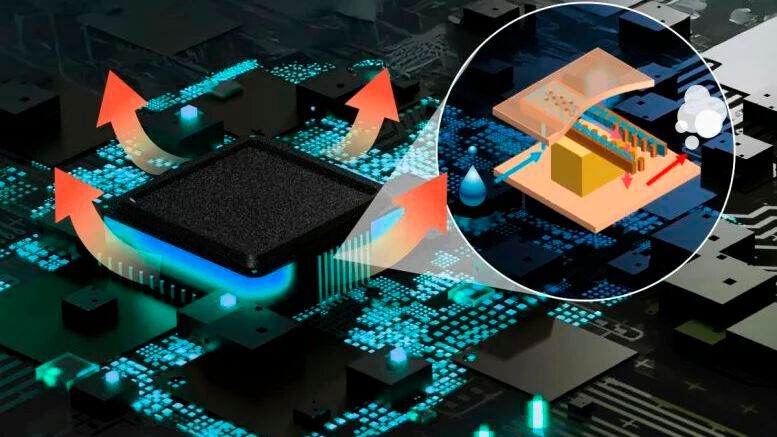
:quality(80)/p7i.vogel.de/wcms/21/b2/21b23691dac3d7198ddffbbdfc540e76/0127003520v1.jpeg "Microfluidics in the chip: Channels are etched into the silicon, allowing coolant to flow directly onto the chip and dissipate heat more efficiently. (Image:Dan DeLong for Microsoft)")
:quality(80)/p7i.vogel.de/wcms/a4/ac/a4acf660e61bc147f78d212fe5132128/0125683183v1.jpeg "Battery cell connection platform Infinicell: Fewer short circuits during module assembly and welding. (Image:Mersen)")