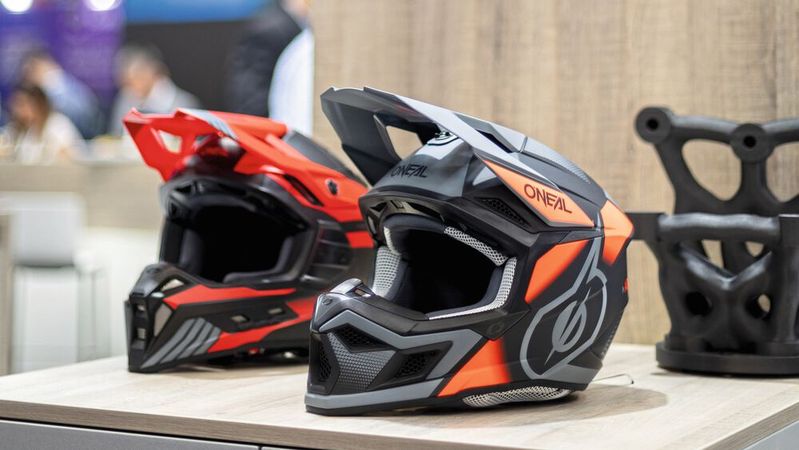
To make motorcycle and mountain bike rides safer, O'Neal, in collaboration with Quintessential Design, developed a smart helmet. They mastered the challenge of managing the development process with multiple parties using a shared digital platform—and reduced the development time by fourfold.
Teamwork: O'Neal and Quintessential Design collaboratively and across distributed locations developed a helmet that, thanks to a sensor, ensures greater safety for the rider.
(Image: O'Neal)
When thinking about motorcycle or mountain bike excursions, freedom, mud, gravel, tight curves, and endless roads probably come to mind first: pure adventure. However, both sports pose risks that should not be underestimated. To avoid serious injuries, the market today offers a range of sophisticated technical equipment. A new addition includes a helmet from the Baden-Württemberg manufacturer O'Neal and the American company Quintessential Design.
The helmet is equipped with an integrated sensor that fits modularly into the base of the helmet and connects to an app on the rider's mobile phone. This gadget can detect an impact and ensure that the rider receives the necessary help as quickly as possible after an accident—even if they are unable to call for help themselves.
Increased Safety: Sensor Detects Impacts
Both companies were driven by personal experiences that showed the severe consequences of accidents during mountain biking and motorcycle tours—especially when riders were not medically attended to in a timely manner. Against this backdrop, both companies aimed to develop solutions that ensure greater safety for mountain bikers and motorcyclists. O'Neal, a manufacturer of protective clothing and accessories, focused on physical safety through sophisticated helmet design. Quintessential Design, an IT and electronics system developer, created technology for sensors that detect impacts and for GPS tracking.
Quintessential Design's sensor is currently the only system in the world that captures and aggregates gyroscope data, magnetometer data, and acceleration data in compliance with data protection regulations. Using these data, a specially programmed algorithm determines whether a helmet hits the ground, the force and speed of the impact, and the angle of impact— all crucial information for enhancing the safety of the rider.
Global Teams, Multiple Trades: Agile Development with Digital Tools
The special challenge lay not only in developing a design that is modular for all six different helmet models from O'Neal but also in coordinating the project: Both companies work in teams distributed across the globe. Coordinating the distribution and execution of tasks across multiple locations can quickly become complex and time-consuming.
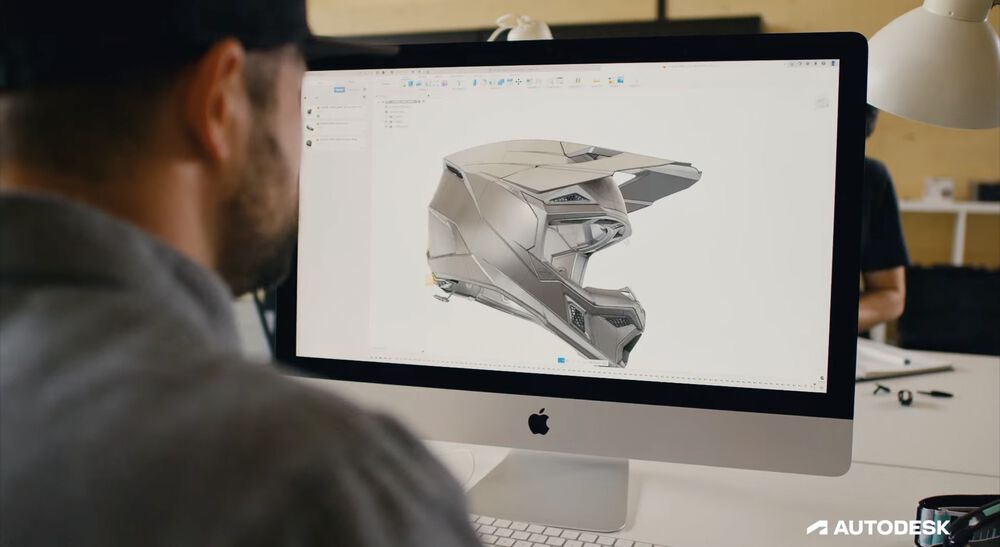
During the development, Autodesk Fusion software was used, enabling work on a shared digital model.
(Image:O'Neal)
The challenges of working across different time zones and the fragmented nature of tasks when different teams work on various parts of a product often lead to increased administrative effort. Issues such as quality control, integration of work results, and comprehensive testing can be more difficult with distributed teams. Especially, distributed teams need to be flexible and quickly adaptable to changes. The solution for Quintessential Design and O’Neal lay in the implementation of agile methodologies and the joint use of suitable digital tools. This approach allowed for better synchronization of tasks, improved communication, and more efficient problem-solving, ensuring continuity and consistency throughout the project. Agile practices, such as regular stand-ups, sprints, and retrospectives, also helped to maintain a clear focus and foster a collaborative environment despite the geographical dispersion of their teams.
From Concept to Helmet: Effortless Design Process Thanks to Digital Software
Autodesk Fusion was chosen as the digital tool for developing the helmet. Both companies had previous experience with the solution. This allowed the teams to efficiently represent all necessary steps of product development within one solution and to work together on a design without significant delays.
Autodesk Fusion combines CAD, CAM, and CAE functions in an integrated cloud software platform. It includes all the tools needed to seamlessly execute all processes from design to manufacturing.
The entire preliminary development was handled via the software, including across different trades. Relevant files were exchanged directly in the same file format, and necessary changes and adjustments could be made quickly. This led to a fourfold reduction in development time.
Only after all design decisions were made and the helmet model was finalized, were the files sent to the manufacturing companies, primarily located in Asia. This seamless transmission allowed Quintessential Design and O'Neal to move from concept to finished helmet in record time. This case highlights how companies like O'Neal and Quintessential Design streamline their processes using digital tools—a strategy confirmed by 60 percent of the executives, researchers, and professionals from architecture, engineering, construction, product development, manufacturing, as well as media and entertainment surveyed for the State of Design and Make Report 2024 by Autodesk. This approach not only enhances efficiency but also improves accuracy and speed in bringing new products to market.
This case illustrates how companies like O'Neal and Quintessential Design streamline their processes using digital tools—a strategy that is confirmed by 60 percent of the executives, researchers, and professionals from architecture, engineering, construction, product development, manufacturing, as well as media and entertainment who were surveyed for the State of Design and Make Report 2024 by Autodesk. This widespread adoption underscores the critical role digital technologies play in improving efficiency, reducing time to market, and enhancing collaboration across diverse geographical locations.
More Than Just Design: Keeping the Entire Lifecycle in View
In addition to streamlined processes and efficient communication, working with a shared digital model brought further benefits, as reported by Anirudha Surabhi, CEO and founder of Quintessential Design. Utilizing tools available through Fusion allowed the entire lifecycle of the product to be examined. Thus, the partners also gained insights into the prerequisites for the helmets' recyclability and could incorporate sustainability considerations into their design from the early stages. This enabled them to adopt a holistic view of their product and factor in all aspects that were particularly important to them. This approach not only enhances product design from an environmental perspective but also aligns with increasing consumer and regulatory demands for sustainable products.
Date: 08.12.2025
Naturally, we always handle your personal data responsibly. Any personal data we receive from you is processed in accordance with applicable data protection legislation. For detailed information please see our privacy policy.
Consent to the use of data for promotional purposes
I hereby consent to Vogel Communications Group GmbH & Co. KG, Max-Planck-Str. 7-9, 97082 Würzburg including any affiliated companies according to §§ 15 et seq. AktG (hereafter: Vogel Communications Group) using my e-mail address to send editorial newsletters. A list of all affiliated companies can be found here
Newsletter content may include all products and services of any companies mentioned above, including for example specialist journals and books, events and fairs as well as event-related products and services, print and digital media offers and services such as additional (editorial) newsletters, raffles, lead campaigns, market research both online and offline, specialist webportals and e-learning offers. In case my personal telephone number has also been collected, it may be used for offers of aforementioned products, for services of the companies mentioned above, and market research purposes.
Additionally, my consent also includes the processing of my email address and telephone number for data matching for marketing purposes with select advertising partners such as LinkedIn, Google, and Meta. For this, Vogel Communications Group may transmit said data in hashed form to the advertising partners who then use said data to determine whether I am also a member of the mentioned advertising partner portals. Vogel Communications Group uses this feature for the purposes of re-targeting (up-selling, cross-selling, and customer loyalty), generating so-called look-alike audiences for acquisition of new customers, and as basis for exclusion for on-going advertising campaigns. Further information can be found in section “data matching for marketing purposes”.
In case I access protected data on Internet portals of Vogel Communications Group including any affiliated companies according to §§ 15 et seq. AktG, I need to provide further data in order to register for the access to such content. In return for this free access to editorial content, my data may be used in accordance with this consent for the purposes stated here. This does not apply to data matching for marketing purposes.
Right of revocation
I understand that I can revoke my consent at will. My revocation does not change the lawfulness of data processing that was conducted based on my consent leading up to my revocation. One option to declare my revocation is to use the contact form found at https://contact.vogel.de. In case I no longer wish to receive certain newsletters, I have subscribed to, I can also click on the unsubscribe link included at the end of a newsletter. Further information regarding my right of revocation and the implementation of it as well as the consequences of my revocation can be found in the data protection declaration, section editorial newsletter.
For O'Neal, alongside the safety aspects brought by the integration of Quin's device, the future-proof nature of the solution also played a crucial role. Ride Analytics, supported by Artificial Intelligence, and gamification are becoming increasingly popular and will play a significant role in the future motor and mountain bike market. By engaging in this partnership, O'Neal is investing in its future, creating opportunities to flexibly adapt its offerings. Thanks to a modular system, the technology can potentially be implemented in all O'Neal helmets, allowing the company to stay ahead in the market by integrating cutting-edge technology that aligns with emerging consumer trends and technological advancements.



:quality(80)/p7i.vogel.de/wcms/dd/08/dd086510d9ae7b50181f6070e4463b44/0129363730v1.jpeg "Typical application for ionizing devices: Wrapping films. (Picture: ©Adobe Stock/SMC)")
:quality(80)/p7i.vogel.de/wcms/35/57/3557c819943c53acec41a0ccba87da4f/0130049064v1.jpeg "Researchers at the Fraunhofer IWU in Chemnitz have long known that many typical sheet metal parts can be manufactured more cost-effectively using hollow embossing rollers. Now there is news to report ... (Image:Fraunhofer IWU)")
:quality(80)/p7i.vogel.de/wcms/59/02/590246e3b3f415c65edbee377c14ca77/26-06-pi-fraunhofer-iws-41450-direktplattieren-pic-01-7771x4369v1v1.jpeg "The Fraunhofer IWS has developed the new \"direct laser cladding\" process, which creates a functional layer directly on the base body by applying a strip-shaped metal to rotationally symmetrical components in a spiral and bonding it locally by laser. (Image:Christoph Wilsnack/Fraunhofer IWS)")
:quality(80)/p7i.vogel.de/wcms/73/60/73608418789b1d9c393f5e2fa974eda2/0130209906v1.jpeg "The robots of the X6 generation from b+m enable very high painting quality and are also particularly compact and easy to maintain. (Image:Beckhoff)")
:quality(80)/p7i.vogel.de/wcms/78/e9/78e9188c25a8a94e67c34c9bf8ffe495/visual-agile-20robots-20and-20google-20deepmind-20partner-20to-20bring-20intelligence-20to-20robotics-2500x1406v1v1.jpeg "Together, the partners are developing adaptable, intelligent robots for a wide range of applications (Image:Agile Robots SE)")
:quality(80)/p7i.vogel.de/wcms/e7/66/e7669ecf0260ae8fc54c214e34e4902a/0130316817v1.jpeg "Siemens and Palo Alto Networks offer tested cybersecurity solution for industrial 5G. (Image:Siemens)")
:quality(80)/p7i.vogel.de/wcms/9f/55/9f55324832c4f426958031375124d9de/siemens-20ubtech-20hmnd-1920x1079v1v1.png "Ready for the factory floor: While Ubtech is planning mass production, Siemens is already testing humanoids in real factory applications in Erlangen. (Image:Siemens)")
:quality(80)/p7i.vogel.de/wcms/11/36/113695ed260e29c8c2d9d39dc5f9d869/0130213768v1.jpeg "AI can work cheaply in China and deliver the results rapidly all over the world. (Image:Dall-E / AI-generated)")
:quality(80)/p7i.vogel.de/wcms/62/5f/625f41e87ebfef156a98c8e6393e32fd/0130211654v1.jpeg "Axial flux motors have some advantages over radial flux motor—but their production is currently still expensive. (Image:RWTH Aachen University)")
:quality(80)/p7i.vogel.de/wcms/77/9b/779b0685d010dfe45c9c2cb1cfecd467/0128886425v1.jpeg "The BlueEye is the first \"real\" hyperspectral camera for the UV range and covers the wavelength range from 220 to 380nm. (Image:Inno-spec GmbH)")
:quality(80)/p7i.vogel.de/wcms/e4/51/e451d52ce0182fb0aaa46a5774f832ef/26-04-pi-fraunhofer-iws-21160-bioslide-pic-01-4128x2321v1v1.jpeg "With the BioSlide research project, the Fraunhofer IWS is investigating how sliding systems can be designed to be more sustainable and energy-efficient. New materials can be tested in a particularly application-oriented manner on this plain bearing test stand. (Image:Fraunhofer IWS)")
![Thanks to advanced 3D printing technology, a more efficient use of resources should contribute to lower-emission aviation—this is the goal of ['skai]-lab. (Image:Oleksandr Pashchenko - stock.adobe.com / AI-generated)](https://cdn1.vogel.de/nghHNSbySccfOjG3n1qCA-FVOjQ=/288x162/smart/filters:format(jpg):quality(80)/p7i.vogel.de/wcms/62/64/626424c97a16e69f871bf216c9629c2a/adobestock-1927043193--c2-a9-20oleksandr-20pashchenko-20-e2-80-93-20stock-adobe-com-ki-generiertv1v1.jpeg "Thanks to advanced 3D printing technology, a more efficient use of resources should contribute to lower-emission aviation—this is the goal of ['skai]-lab. (Image:Oleksandr Pashchenko - stock.adobe.com / AI-generated)")
:quality(80)/p7i.vogel.de/wcms/c3/c4/c3c4ce270b083eeac55654148611f064/0130237945v1.jpeg "China is not giving up on hydrogen, but is intensifying its efforts. (Image:freely licensed from Pixabay)")
:quality(80)/p7i.vogel.de/wcms/4e/c0/4ec0bd19390b169edfa23677373dcdf1/0130260089v1.jpeg "Renewable fuels can supply European road traffic, according to a study. (Image:Aral)")
:quality(80)/p7i.vogel.de/wcms/6f/c9/6fc9050301d745cad25585c6780f8f51/0130197341v1.jpeg "Production facilities are a worthwhile target and are therefore at risk. (Image:ABB Robotics)")
:quality(80)/p7i.vogel.de/wcms/b6/62/b662adc2cec8227d8172509bbfb6ee42/25c0207-107-4961x2789v1v1.jpeg "The GLB is the second model based on Mercedes' new MMA platform. Apparently, Geely's platform is better and cheaper, which is why the two companies are negotiating a partnership. (Image:Mercedes-Benz)")
:quality(80)/p7i.vogel.de/wcms/4d/dd/4dddf438e91f394c04a095dbfd109d1c/0130236430v1.jpeg "Measurement modules: The 720301 module in combination with the SL2000 enables RMS and power calculations, among other things. (Image:Yokogawa)")
:quality(80)/p7i.vogel.de/wcms/61/fc/61fcf95f5cca15494ad18343901ae585/0130317237v1.jpeg "With the AGI CPU, Arm says it is taking a \"historic step\": With the processor aimed at AI in data centers, the company is presenting itself for the first time as a provider of its own chips, not just as a pure IP licensor. (Image:Arm)")
:quality(80)/p7i.vogel.de/wcms/82/90/8290dfe3595b6c6b33726ae8b76172c7/0130319587v1.jpeg "The concept image illustrates how the pattern of tiny protrusions and depressions created on the substrate (MgO, bottom) controls the arrangement of atoms in the superconducting material (YBCO, top). At the interface between the two layers, an electronic structure enables superconductivity to occur at higher temperatures than previously possible. (Image:Chalmers University of Technology / Riccardo Arpaia)")
:fill(fff,0)/p7i.vogel.de/companies/68/a4/68a47beec75ce/logo-cmyk-de.jpeg "logo-cmyk-de (https://www.datatec.eu/)")
:fill(fff,0)/p7i.vogel.de/companies/69/88/69882c428938e/tmts2026-ticec-banner-en-2000px.png "tmts2026-ticec-banner-en-2000px (https://www.tmts.tw/en)")
:fill(fff,0)/p7i.vogel.de/companies/67/eb/67eba621ef6ea/logo2.png "logo2 (Wuxi InfiMotion)")
:quality(80)/p7i.vogel.de/wcms/a4/03/a403f2ebe7f3bf99c9db3f5c051888c7/0125808791v1.jpeg "For a comfortable riding experience, motorcycles are increasingly being equipped with advanced technologies, the operation of which, however, poses risks during the ride. TH Köln and the Brehmergroup are working on an alternative control system via the motorcycle handles. (Image:freely licensed)")
:quality(80)/p7i.vogel.de/wcms/fa/e4/fae41f887d3922f4eb6693d95448499c/0126796995v1.jpeg "Autodesk University will take place this year from September 16 to 18, 2025. Participants can look forward to a diverse program focused on design and manufacturing. (Image:Autodesk)")