How a vehicle should communicate with its occupants depending on the degree of automation is the goal of the "Karli" research project. This should reduce motion sickness, for example.
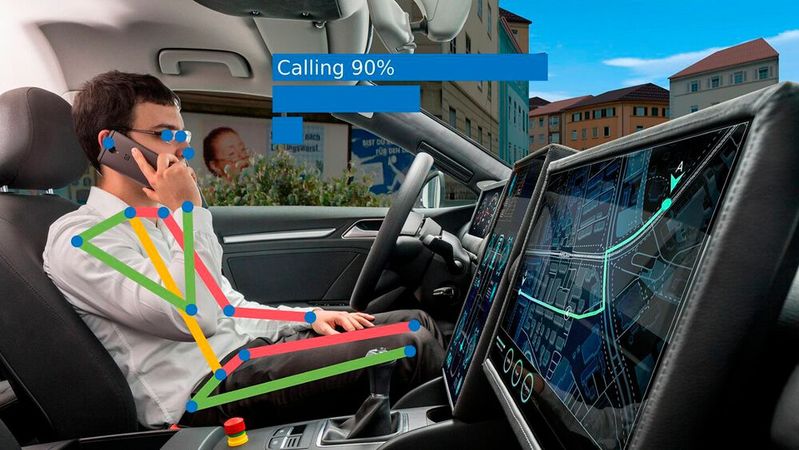
Researchers are working on extracting relevant information from passenger monitoring and providing it as context for various vehicle functions, such as AI assistants and safety systems.
(Image: Fraunhofer IOSB/Zensch)
"Caution, if you continue reading now, you may feel sick on the winding road. We'll be on the highway in five minutes, then it'll be better." Or: "It's about to rain and we'll have to stop the automatic driving. Please prepare to drive a bit yourself. I'm sorry you'll have to securely stow your laptop now. Safety comes first."
This is how cars could communicate with their drivers in a few years. As vehicles become increasingly automated, the interaction with people also needs to be rethought. This task was undertaken by a research team from the Fraunhofer Institutes for Optronics, System Technology and Image Evaluation IOSB and for Labor Economics and Organization IAO, together with ten partners, including Continental, Ford and Audi, as well as a number of small and medium-sized enterprises and universities in the "KARLI" project. Karli stands for Artificial Intelligence (AI) for Adaptive, Responsive and Level-Conform Interaction in the vehicle of the future.
Depending on the level of automation, the drivers need to focus on the road or can engage in other activities. They have ten seconds to take over the wheel again, or in some cases, they don't need to intervene at all. These different requirements for users and the ability to switch between various stages depending on the road situation make it a complex task to define and design appropriate interactions for each level. Furthermore, interaction and design must ensure that drivers are always aware of the current level of automation, so they can fulfill their role in it.
The applications developed in the Karli project have three main focuses:
Warnings and indications are intended to promote behavior adapted to the level of automation. For example, they should prevent the driver from being distracted at a moment that requires attention to the road. The user address is adapted to the respective level—visually, acoustically, haptically or a combination of these possibilities. The interaction is controlled by AI agents, whose performance and reliability the partners evaluate.
Predicting and minimizing the occurrence of motion sickness—one of the biggest problems with passive driving. Between 20 and 50 percent of people suffer from this so-called motion sickness. Depending on expected accelerations on winding routes, the occupants should be given tips related to their current activities at the right time.
Generated User Interfaces, or "GenUIn" for short, are the third focus in the Karli project. GenUIn creates personalized addresses and gives tips on how to reduce nausea, should it still occur. These tips can relate to the current activity, which is detected by sensors, but also take into account what options are available in the current context. By expressing their wishes, users also have the opportunity to gradually personalize and adapt the entire interaction in the vehicle to their needs. The automation level is always taken into account in the interaction: the hints can be short and purely verbal if the driver is concentrating on the road, or detailed and through visual channels if the vehicle is currently performing the driving task.
Artificial Intelligence and Vision Language Model
Various sensors are used to capture activities in the car, with optical sensors from interior cameras playing a central role. These are mandatory anyway under current legislation on automated driving to ensure the driving ability of the drivers. The researchers then combine the visual data from the cameras with large language models to create so-called Vision-Language Models (VLM). These form the basis for modern assistance systems in (semi-) autonomous vehicles to semantically capture situations in the interior and react to them. Diederichs compares the interaction in the vehicle of the future to a butler who keeps in the background but knows the context and offers the occupants the best possible support.
"Decisive factors for the acceptance of such systems are trust in the service provider, data security and a direct benefit for the drivers," says Frederik Diederichs. Therefore, the best possible anonymization and data security as well as a transparent and explainable collection of data are essential. "Not everything that is in the field of vision of a camera is evaluated. It must be transparent what information a sensor collects and what it is used for." In another project (Anymos), the Fraunhofer researchers are working on anonymizing camera data, processing it in a data-efficient way, and effectively protecting it.
Series use from 2026
Another topic of the research project, which is funded by the Federal Ministry for Economic Affairs and Climate Protection, is data efficiency. The project participants have chosen an approach, which, according to their own information, requires only a few, high-quality AI training data. These are collected empirically and synthetically generated. Based on this database, automobile manufacturers can decide which data they need to collect later in series operation in order to be able to use the system. "This keeps the data effort manageable and makes the project results scalable", explains Diederichs.
Date: 08.12.2025
Naturally, we always handle your personal data responsibly. Any personal data we receive from you is processed in accordance with applicable data protection legislation. For detailed information please see our privacy policy.
Consent to the use of data for promotional purposes
I hereby consent to Vogel Communications Group GmbH & Co. KG, Max-Planck-Str. 7-9, 97082 Würzburg including any affiliated companies according to §§ 15 et seq. AktG (hereafter: Vogel Communications Group) using my e-mail address to send editorial newsletters. A list of all affiliated companies can be found here
Newsletter content may include all products and services of any companies mentioned above, including for example specialist journals and books, events and fairs as well as event-related products and services, print and digital media offers and services such as additional (editorial) newsletters, raffles, lead campaigns, market research both online and offline, specialist webportals and e-learning offers. In case my personal telephone number has also been collected, it may be used for offers of aforementioned products, for services of the companies mentioned above, and market research purposes.
Additionally, my consent also includes the processing of my email address and telephone number for data matching for marketing purposes with select advertising partners such as LinkedIn, Google, and Meta. For this, Vogel Communications Group may transmit said data in hashed form to the advertising partners who then use said data to determine whether I am also a member of the mentioned advertising partner portals. Vogel Communications Group uses this feature for the purposes of re-targeting (up-selling, cross-selling, and customer loyalty), generating so-called look-alike audiences for acquisition of new customers, and as basis for exclusion for on-going advertising campaigns. Further information can be found in section “data matching for marketing purposes”.
In case I access protected data on Internet portals of Vogel Communications Group including any affiliated companies according to §§ 15 et seq. AktG, I need to provide further data in order to register for the access to such content. In return for this free access to editorial content, my data may be used in accordance with this consent for the purposes stated here. This does not apply to data matching for marketing purposes.
Right of revocation
I understand that I can revoke my consent at will. My revocation does not change the lawfulness of data processing that was conducted based on my consent leading up to my revocation. One option to declare my revocation is to use the contact form found at https://contact.vogel.de. In case I no longer wish to receive certain newsletters, I have subscribed to, I can also click on the unsubscribe link included at the end of a newsletter. Further information regarding my right of revocation and the implementation of it as well as the consequences of my revocation can be found in the data protection declaration, section editorial newsletter.
Just recently, Diederichs and his team put a mobile research laboratory based on a Mercedes EQS into operation to research user needs in automated Level 3 driving on the road. There, the findings from the Karli project are tested and evaluated in practice. Thus, the first functions could be available in production vehicles from 2026. Diederichs sees a significant competitive advantage in a positive user experience with automated driving when car manufacturers "respond to user requirements with AI and individualize the interaction".



:quality(80)/p7i.vogel.de/wcms/a0/47/a04725ef9bd09fb6c9341a1bea1b5d93/0130443083v1.jpeg "Here, a type of plastic pallet is produced by thermoforming (vacuum forming or deep drawing) at the corresponding division of New England Plastics in the USA. This division, which specializes in so-called liners, is now part of Ringmetall ... (Image:New England Plastics)")
:quality(80)/p7i.vogel.de/wcms/e3/42/e342b3c593ea92d56604d3be969e9c9a/0130437231v1.jpeg "Daimler Truck will be building even more trucks at its Czech plant in Cheb in the future. This is because it is now being expanded for strategic cost-saving reasons ... (Image:Daimler Truck)")
:quality(80)/p7i.vogel.de/wcms/23/99/23992bf2dcdc432c9b7209c34a4a7c48/0129733089v1.jpeg "Stork relies on the modular Neoswiss turning system from Iscar to shorten the set-up times for its sliding headstock lathes and work more productively. (Image:Iscar)")
:quality(80)/p7i.vogel.de/wcms/7d/e2/7de2923434b2f1a78ba5482d8d335269/0113143253v1.jpeg "In our China Market Insider we regularly provide you with relevant information directly from China. (Image:© Eisenhans - stock.adobe.com)")
:quality(80)/p7i.vogel.de/wcms/b7/36/b736dfebc16c42d6901d0d0e1f390493/3d-druck-20factory-20--20ki-20generiert-1920x1079v1.png "(Source: AI-generated)")
:quality(80)/p7i.vogel.de/wcms/79/b2/79b21aad663f4a7bd4472afc1c1afc62/0130433994v1.jpeg "Mission Joyride: The free-flying robot (shown here in the rendering) will relieve the ISS crew of logistics tasks from 2027 with its two mechanical arms. (Image:Icarus Robotics)")
:quality(80)/p7i.vogel.de/wcms/6b/45/6b4546fa6ebf305c3660326909363f32/0130437089v1.jpeg "Industrial AI in action: Rockwell Automation presents practical solutions for self-controlling production systems at the Hannover Messe. (Image:Rainer Jensen, Deutsche Messe)")
:quality(80)/p7i.vogel.de/wcms/78/e9/78e9188c25a8a94e67c34c9bf8ffe495/visual-agile-20robots-20and-20google-20deepmind-20partner-20to-20bring-20intelligence-20to-20robotics-2500x1406v1v1.jpeg "Together, the partners are developing adaptable, intelligent robots for a wide range of applications (Image:Agile Robots SE)")
:quality(80)/p7i.vogel.de/wcms/59/a2/59a2b11f0aa1b700eff02addd5de8703/adobestock-1788280853--c2-a9-20satria-20-e2-80-93-20stock-adobe-com-5081x2860v1v1.jpeg "Quantum computers require extreme cooling to temperatures close to absolute zero in order to keep qubits stable. (Image:satria - stock.adobe.com)")
:quality(80)/p7i.vogel.de/wcms/62/5f/625f41e87ebfef156a98c8e6393e32fd/0130211654v1.jpeg "Axial flux motors have some advantages over radial flux motor—but their production is currently still expensive. (Image:RWTH Aachen University)")
:quality(80)/p7i.vogel.de/wcms/f6/ae/f6aec4f6241b36ed5e3a990ac9176b42/0130429460v1.jpeg "Verne, Pony.ai and Uber want to launch a robotaxi service in Europe. (Image:Verne)")
:quality(80)/p7i.vogel.de/wcms/d7/88/d788699f2974708a332baa4e7a62fa9e/0130438967v1.jpeg "Skoda is withdrawing from China. The brand has produced well over three million vehicles there. (Image:Skoda car)")
:quality(80)/p7i.vogel.de/wcms/b0/43/b043b86899837532aad62d63368a917a/0130371361v1.jpeg "Skoda leaves the chinese market.
(Image:Skoda)")
:quality(80)/p7i.vogel.de/wcms/c3/c4/c3c4ce270b083eeac55654148611f064/0130237945v1.jpeg "China is not giving up on hydrogen, but is intensifying its efforts. (Image:freely licensed from Pixabay)")
:quality(80)/p7i.vogel.de/wcms/ee/09/ee09acbd6dc896df25affaa9e871e6e5/0130440053v1.jpeg "IMS chip module for simple system integration into an ion mobility spectrometer. (Image:Fraunhofer IPMS)")
:quality(80)/p7i.vogel.de/wcms/10/6c/106cd22de5f68a0f74639d654827228c/0130345302v1.jpeg "Made in India: According to the India Electronics and Semiconductor Association (IESA), the country should be able to produce between 75 and 80 million chips by the beginning of 2027, once the plants currently under construction become operational. (Image:Pixabay (Montage: Sebastian Gerstl))")
:quality(80)/p7i.vogel.de/wcms/a5/ed/a5ed6fda029d362732a293d6b19d74c4/0130444216v1.jpeg "Thirteen executives from the Chinese chip industry have drawn up a plan to achieve an 80% self-sufficiency rate for semiconductors by 2030. (Image:Maxim_Kazmin - stock.adobe.com)")
:quality(80)/p7i.vogel.de/wcms/31/a6/31a646018b34d8e0a44bfc8bf17837f6/0130361632v1.jpeg "For many companies, PFAS are considered indispensable in electronics production. (Image:freely licensed)")
:fill(fff,0)/images.vogel.de/vogelonline/companyimg/76800/76895/65.jpg "FAULHABER_120mm.jpg ()")
:fill(fff,0)/p7i.vogel.de/companies/69/88/69882c428938e/tmts2026-ticec-banner-en-2000px.png "tmts2026-ticec-banner-en-2000px (https://www.tmts.tw/en)")
:quality(80)/p7i.vogel.de/wcms/27/e0/27e05962c118327dedaae156763d6d99/0119696950v1.jpeg "Microsar Classic Safe meets the requirements of ISO 26262 up to ASIL D and is suitable for use in safety-related applications up to autonomous driving. (Image:Vector Informatik)")
:quality(80)/p7i.vogel.de/wcms/cd/70/cd7019c485b4beb6cf0da564d52b9150/0119189608v1.jpeg "Tesla has received the first testing license for its FSD Autopilot in China. (Image:Tesla)")
:quality(80)/p7i.vogel.de/wcms/a8/d7/a8d748a29612695eec22e0fad4cbf61a/0128735143v1.jpeg "The CES takes place in Las Vegas from January 6 to 9, 2026. (Image:Consumer Technology Association (CTA))")
:quality(80)/p7i.vogel.de/wcms/71/e6/71e60d3ea572c63e998ef48ba729cc9f/0126126157v1.jpeg "The automated driving functions developed by Bosch and Cariad will be implemented in the software-defined vehicle architecture within the Volkswagen Group. (Image:Cariad)")