In production and intralogistics, autonomous mobile robots (AMR) or Automated Guided Vehicles (AGVs) can become efficiency-enhancing helpers. A robot learning platform now makes it easier for users to get started. The motors used there, with highly accurate gearboxes and encoders, come from Faulhaber.
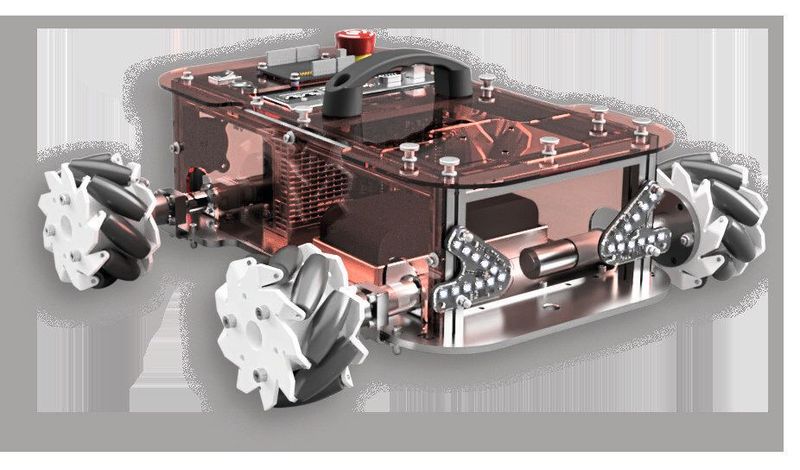
Eduard is a teaching and prototyping platform that can be used for the training and further education of employees in handling mobile robotics.
(Image: Faulhaber/ EduArt)
Upon request from an industrial company, Eduart Robotik GmbH Neunkirchen a. Sand developed a teaching and prototyping platform that can be used for training and further education of employees in handling mobile robotics. In addition to the robot learning platform, the company offers a teaching and service package for testing and optimizing.
Expandable robot learning platform
The resulting robot learning platform is named Eduard, and it measures approximately 40 x 40 x 15 cm and weighs just under 8 kg. A sensor concept including distance and inertial measuring devices is integrated into it, as well as a battery management system. Access is possible via open interfaces. The mobile robot's motion is either powered by simple rubber tires or by Mecanum wheels.
These allow the robot to turn on the spot as well as move sideways or diagonally. Even in very tight spaces, this makes it possible to navigate and position precisely. Faulhaber motors are used in both wheel variants. "These high-quality drives have proven to be optimal for our applications," confirms Markus Fenn, Managing Director of Eduart Robotik GmbH.
Depending on the required speed or torque, gearboxes with a ratio of 72:1 or 89:1 are available for the drive. The basic equipment of the robotic learning platform can be expanded by the user or adapted by EduArt according to individual needs. This makes it possible to cost-effectively test new concepts, such as a different sensor system.
Flexible drive technology
When selecting the drive systems used, it was important to ensure that they would also meet future requirements of AGV (Automated Guided Vehicle) and AMR (Autonomous Mobile Robot) concepts. Therefore, the choice was made for DC micromotors with precious metal commutation from Faulhaber. Despite their small dimensions, these deliver a high torque and impress with their high power density. Moreover, they can be precisely controlled and are suitable for highly accurate control loops. For larger platforms, the robot builders used large DC motors from the same manufacturer. Alternatively, depending on the application, these drives can also be replaced with maintenance-free and long-lasting brushless DC motors.
With the trend towards decreasing batch sizes and increasing variety of variants, more robots will be needed for smaller loads in the future, i.e., smaller robots with smaller but more powerful drives. Such autonomous floor conveyance vehicles have reduced electronic effort and smaller batteries, which means less weight and lower energy consumption. For this too, suitable solutions can be found in the wide range of drive experts from Schönaich. When higher loads are required again, scaling up and working in combination is also no problem.
Easily develop and test software
In AGV (Automated Guided Vehicle) and AMR (Autonomous Mobile Robot) solutions, the complexity usually lies not in the hardware but rather in the software. For instance, good planning on the software side is important so that all mobile robots can work together without problems or reliable fleet management becomes possible. Robots must be able to "think" for themselves, exchange information via standard interfaces, and cooperate if necessary. The software only needs to know little about the particular mobile robot but rather calculate where the robot is located on the hall plan. The navigation, one of the few components that knows the dimensions of the robot, then searches for the suitable path. To achieve the required speed, the motor controller calculates how many wheel revolutions are necessary. Even to adjust this, only a few lines in the program code or a configuration file are needed. Faulhaber provides motors with highly precise gearboxes and encoders for exact positioning, which together bring optimal performance and safety. "The corresponding communication interfaces were also important so that the drives can "exchange" information with the rest of the system accordingly," says Fenn.
Safety is important for mobile robots
Safety is also an important issue when deploying mobile robots, in terms of both security and safety. The latter, for instance, is achieved by the motor controller detecting when one of the motors fails and immediately stopping the journey. If a person steps into the travel area, they are detected by the laser scanner, and the system brakes. Safety is an interesting topic insofar as the individual mobile robots communicate with each other over communication networks such as WiFi or 5G. Appropriate protection mechanisms have been put in place for this as well. Should there still be a hacker attack, it's important that no dangerous movements can be triggered on the robot. For this purpose, robots are equipped with a safety scanner with a distance sensor, for example, to prevent them from crashing into a wall.
Date: 08.12.2025
Naturally, we always handle your personal data responsibly. Any personal data we receive from you is processed in accordance with applicable data protection legislation. For detailed information please see our privacy policy.
Consent to the use of data for promotional purposes
I hereby consent to Vogel Communications Group GmbH & Co. KG, Max-Planck-Str. 7-9, 97082 Würzburg including any affiliated companies according to §§ 15 et seq. AktG (hereafter: Vogel Communications Group) using my e-mail address to send editorial newsletters. A list of all affiliated companies can be found here
Newsletter content may include all products and services of any companies mentioned above, including for example specialist journals and books, events and fairs as well as event-related products and services, print and digital media offers and services such as additional (editorial) newsletters, raffles, lead campaigns, market research both online and offline, specialist webportals and e-learning offers. In case my personal telephone number has also been collected, it may be used for offers of aforementioned products, for services of the companies mentioned above, and market research purposes.
Additionally, my consent also includes the processing of my email address and telephone number for data matching for marketing purposes with select advertising partners such as LinkedIn, Google, and Meta. For this, Vogel Communications Group may transmit said data in hashed form to the advertising partners who then use said data to determine whether I am also a member of the mentioned advertising partner portals. Vogel Communications Group uses this feature for the purposes of re-targeting (up-selling, cross-selling, and customer loyalty), generating so-called look-alike audiences for acquisition of new customers, and as basis for exclusion for on-going advertising campaigns. Further information can be found in section “data matching for marketing purposes”.
In case I access protected data on Internet portals of Vogel Communications Group including any affiliated companies according to §§ 15 et seq. AktG, I need to provide further data in order to register for the access to such content. In return for this free access to editorial content, my data may be used in accordance with this consent for the purposes stated here. This does not apply to data matching for marketing purposes.
Right of revocation
I understand that I can revoke my consent at will. My revocation does not change the lawfulness of data processing that was conducted based on my consent leading up to my revocation. One option to declare my revocation is to use the contact form found at https://contact.vogel.de. In case I no longer wish to receive certain newsletters, I have subscribed to, I can also click on the unsubscribe link included at the end of a newsletter. Further information regarding my right of revocation and the implementation of it as well as the consequences of my revocation can be found in the data protection declaration, section editorial newsletter.
A look into the future
In the field of mobile robotics, there will be a lot of developments in the coming years, e.g., in terms of networking. Where, for example, four smaller robots instead of one large one work together on a transport task, small motors are needed that work absolutely precisely. Otherwise, the robot swarm will stumble or get out of sync. To improve fail-safety, encoders must be completely interference-resistant so that the robot is not affected by external disturbances. That's why Faulhaber sometimes uses two encoders per motor. With the further development of mobile robots, the requirements for the drives used will also continually change. Here, it is advantageous that the components of the modularly structured range from the drive experts can be flexibly combined. Theoretically, from the combination of the offered gearboxes, encoders, controllers, etc., 25 million variants are possible, a considerable portion of which has already been implemented in practice. No matter how mobile robotics continues to evolve, an optimal drive can be found for almost every existing as well as future application.
About the company
Faulhaber specializes in the development, production, and application of high-precision small and micro drive systems, servo components, and controls up to 200 watts of output power. This includes the realization of customer-specific complete solutions as well as a comprehensive program of standard products such as brushless motors, micro DC motors, encoders, and motion controllers.
From the powerful DC motor with 200 mNm continuous torque to the delicate micro drive with a 1.9 mm outer diameter, the standard portfolio includes more than 25 million possibilities for assembling an optimal drive system for an application.



:quality(80)/p7i.vogel.de/wcms/53/f7/53f7dadbe4d656a3fd4f4077445f29f6/0129828707v1.jpeg "Thanks to its compact design and drilling/unscrewing function, the Fire Birdie is suitable for applications with limited installation space and frequent tool changes. (Image:Marcel Kraibühler)")
:quality(80)/p7i.vogel.de/wcms/da/4d/da4da8d34671dc6bce80e496212de877/0129850788v1.jpeg "Mate-XT Go supports the arms and shoulders during overhead work and repetitive tasks and is designed to significantly reduce muscle strain in everyday working life. (Image:Comau)")
:quality(80)/p7i.vogel.de/wcms/95/97/95976dbaac68b249eb65e74c5aad5300/0129651893v1.jpeg "The C2.0 centric clamps, the S2 fixed jaw clamps and the \"gredoc\" zero-point clamping systems are used for machining the raw parts. Fastening is carried out with width across flats 27. (Image:Gressel)")
:quality(80)/p7i.vogel.de/wcms/57/1b/571b8895efb299d70846bbdbd7af2338/0130043886v1.jpeg "Servo hydraulics independent of the control system: The servo hydraulics software module is integrated directly into the b Maxx 5500 servo drive (pictured: Mehmet Sari, Export Sales Manager at Hürsan Pres (left), Özgür Deniz Demirbaş, Country Manager at Baumüller Turkey) (Image:Baumüller)")
:quality(80)/p7i.vogel.de/wcms/3b/27/3b27f6c5848be73acecb04054bf0a146/0130115209v1.jpeg "Spectroscopic glucose measurement with infrared spectroscopy enables more regular measurements without physical strain. (Image:Endrich)")
:quality(80)/p7i.vogel.de/wcms/3f/cc/3fccb748b0fe16f1f61249d94c72f126/0130149439v1.jpeg "Requirements for integrated power supply systems: Precise AC and DC power supply systems that not only provide energy, but also reliably combine measurement, analysis and system integration. (Image:Schulz Electronic)")
:quality(80)/p7i.vogel.de/wcms/fd/93/fd93e01c16f5a4709278499d981a459c/0130061090v1.jpeg "Revealed: These servo drives are assembled at Aerotech in Fürth. (Image:Aerotech)")
:quality(80)/p7i.vogel.de/wcms/cb/8a/cb8ae7f5205365efce3e7285154fc3cf/0130132198v1.jpeg "Markus Huber (left) and Nicolai Friis from TU Wien know how to make quantum computers multidimensional in order to perform computing operations even better. (Image:TU Vienna / A. Rommel)")
:quality(80)/p7i.vogel.de/wcms/63/21/6321beb732bf7d92640df46d7aa77573/0130125122v1.jpeg "As part of the Carbon Lab Factory Lausitz, a pilot plant for the production of sustainable, cost-effective and competitive carbon fibers will be built at the Guben site. (Image:Fraunhofer IAP / Kristin Stein)")
:quality(80)/p7i.vogel.de/wcms/53/4f/534fe0f168f6ee070ded4a48faca4cef/business-wire-main-image-1103x620v1.jpeg "The new UR AI Trainer, developed by Universal Robots and Scale AI, is the first direct lab-to-factory solution for AI model training.
(Source: Universal Robots)")
:quality(80)/p7i.vogel.de/wcms/08/70/087062e2e1a9b9add5777410dd746ee9/adobestock-1923991605-5607x3156v1v1.jpeg "A new type of tactile sensor, inspired by human skin, even recognizes grains of sand. (Image:Curioso.Photography - stock.adobe.com)")
:quality(80)/p7i.vogel.de/wcms/7f/08/7f087d7013424d123ab7275cd2e3fe55/adobestock-809456218--c2-a9-20degimages-20-e2-80-93-20stock-adobe-com-ki-generiert-4179x2351v1v1.jpeg "The digital upgrading of existing machines conserves resources, saves energy and reduces the need for new production. (Image:Degimages - stock.adobe.com/AI-generated)")
:quality(80)/p7i.vogel.de/wcms/90/db/90db3087d3af0560fcdb4dbc42443ce1/0130157448v1.jpeg "The switch to SDV is the most complex transformation the industry has ever had to master. The end consumer gets a vehicle that gains rather than loses value over its lifetime. (Image:Sonatus)")
:quality(80)/p7i.vogel.de/wcms/73/f0/73f00bb99a23197db05bb584fe78f20f/0130080581v1.jpeg "The \"China Speed\" analysis by Roland Berger shows that the speed of development has only a limited connection with labor costs. (Image:freely licensed at Pexels)")
:quality(80)/p7i.vogel.de/wcms/2f/5b/2f5ba6a150b52c2b8efada560c5cdafe/0130143442v1.jpeg "Automotive suppliers are facing a severe crisis, which is primarily due to a combination of structural change and economic problems. (Image:freely licensed at Pexels)")
:quality(80)/p7i.vogel.de/wcms/22/d0/22d03cd48e992435338b59464c428d41/0129739814v1.jpeg "More electric vehicles on the roads mean a higher demand for electricity - which should ideally be covered by renewable energies. (Image:BMW)")
:quality(80)/p7i.vogel.de/wcms/94/7a/947ac066b98cbcd3470e83ff9da3e25f/0130096114v1.jpeg "The use of amorphous steels in the stator enables a significant reduction in losses and increases the efficiency of modern electric motors in vehicle drives. (Image:Horse Powertrain)")
:quality(80)/p7i.vogel.de/wcms/e5/f1/e5f171d3d7ae021332cc0aeae4d6e299/0130127049v1.jpeg "In collaboration with Shanghai Jiao Tong University, Lenovo has presented a silicon anode battery under the name \"ED1000\" as a proof of concept for mobile workstations. (Image:Lenovo)")
:quality(80)/p7i.vogel.de/wcms/fa/69/fa696e59706b96fff02283dd74cc2398/0130129635v1.jpeg "Samsung Co-CEO Jun Young-hyun wants to respond to the AI-driven boom in demand in the memory market with contracts for up to five years. This should provide more planning security in the traditionally volatile storage business. At the same time, however, this is likely to increase the pressure on customers to secure precise long-term requirements, prices and supply chains. (Image:Samsung)")
:quality(80)/p7i.vogel.de/wcms/31/a8/31a883a47b86634c382923e78fd9a4c9/0130133225v1.jpeg "Figure 1: GMSL-capable point-to-point connection. (Image:ADI)")
:fill(fff,0)/images.vogel.de/vogelonline/companyimg/76800/76895/65.jpg "FAULHABER_120mm.jpg ()")
:fill(fff,0)/p7i.vogel.de/companies/67/eb/67eba621ef6ea/logo2.png "logo2 (Wuxi InfiMotion)")
:quality(80)/p7i.vogel.de/wcms/64/0f/640fa361df5628a518a598ad4f9aaeb7/0116013156v1.jpeg "Eduard ist eine Lehr- und Prototyping-Plattform, die für die Aus- und Weiterbildung von Mitarbeitern im Umgang mit mobiler Robotik genutzt werden kann.(Bild: Faulhaber/ EduArt)")
:quality(80)/p7i.vogel.de/wcms/59/d8/59d8d76c54c019a4b6ee56e7ba62194f/0115940161v1.jpeg "Eduard wird von DC-Kleinstmotoren mit Edelmetallkommutierung von Faulhaber angetrieben. Sie liefern trotz ihrer geringen Abmessungen ein großes Drehmoment und überzeugen durch ihre hohe Leistungsdichte. Zudem lassen sie sich einfach ansteuern und eignen sich für hochgenaue Regelkreise.(Bild: Faulhaber)")
:quality(80)/p7i.vogel.de/wcms/63/13/631316b9792ef36cd92b29ecbfa1ef16/0115940157v1.jpeg "Die Variante mit Mecanum-Rädern ermöglicht es dem Roboter, auf der Stelle zu drehen sowie seitlich oder diagonal zu fahren.(Bild: Faulhaber/ EduArt)")
:quality(80)/p7i.vogel.de/wcms/46/80/46805ca5713f8beada61857a60f6834c/0115939751v1.jpeg "In beiden Rädervarianten (Gummireifen oder Mecanum-Räder) der Lehr- und Prototyping-Plattform Eduard kommen Faulhaber-Motoren zum Einsatz.(Bild: Faulhaber/ EduArt)")
:quality(80)/p7i.vogel.de/wcms/62/93/62934fd6900b930a0db9493be3d931ba/0127310246v1.jpeg "Servomotors without housings can be used very efficiently in confined spaces. (Image:TQ-Robotics)")
:quality(80)/p7i.vogel.de/wcms/d1/20/d1200ea644f9fabf17c2a919b5ada720/0127928583v1.jpeg "The i650 Motec frequency inverter, combined with the m550/m650 synchronous motor, offers a powerful and energy-efficient solution. (Image:Lenze)")