How can new bio-based and biohybrid materials with improved functionality be developed more quickly? This question is being addressed jointly by six Fraunhofer Institutes in the flagship project SUBI²MA. A bio-based polyamide developed by Fraunhofer researchers serves as a model.
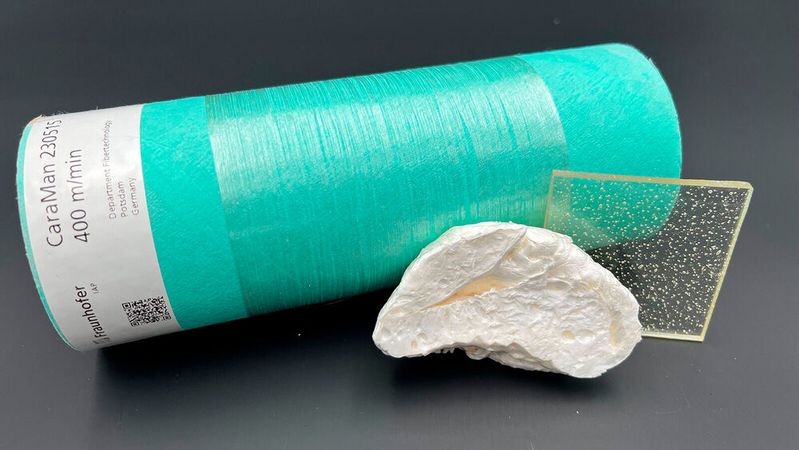
The bio-based polymer Caramid is derived from 3-Caren, a terpene that occurs as a by-product in large quantities during cellulose production. Terpenes are natural organic compounds found in many plant parts such as leaves, flowers, and roots, and are the main components of resins and essential oils.
(Image: Fraunhofer IGB)
The plastics industry is undergoing a transformation: petroleum-based materials are increasingly being replaced by sustainable alternatives. However, sustainability alone is not enough—bio-based plastics need to deliver more. In the flagship project SUBI²MA, Fraunhofer Institutes are working on accelerating the development of new materials that are not only environmentally friendly but also functionally superior. They are focusing on three main objectives: advancing new bio-based materials, creating new biohybrid materials, and implementing digital fast-track development.
In the SUBI2MA project, the combined expertise of six institutes has now enabled us to think in new ways, scale the caranlactams, optimize the caramides, and develop them even more specifically for certain applications.
Dr. Paul Stockmann
At the center of the bio-based materials development is Caramid, a bio-based high-performance polyamide. It is derived from 3-Caren, a terpene that occurs as a by-product in large quantities during cellulose production. Terpenes are natural organic compounds found in many plant parts such as leaves, flowers, and roots, and are the main components of resins and essential oils.
Researchers at the Straubing branch of the Fraunhofer Institute for Interfacial Engineering and Biotechnology IGB developed the monomers 3S- and 3R-Caranlactam, as well as the Caramides derived from them, from 3-Caren about ten years ago. "In the SUBI2MA project, the combined expertise of six institutes has now enabled us to think in new ways, scale the Caranlactams, optimize the Caramides, and develop them even more specifically for certain applications," says Dr. Paul Stockmann from Fraunhofer IGB.
Bio-Based Building Blocks Integrated into High-Performance Polymers
Caramides have exceptional thermal properties due to their chemical structure, making them attractive for numerous applications: from gears in mechanical engineering to safety glass, lightweight panels, foams, protective textiles, and even surgical sutures. Monofilaments, foams, and plastic glasses have already been manufactured from the new polyamide, which, in addition to its high-temperature stability, demonstrates great versatility. "During the project, it became apparent that the two Caranlactam monomers lead to different Caramides that vary significantly in their properties," the researcher explains. "For example, Caramide-S, due to its partial crystallinity, is suitable for fibers, while Caramide-R, because of its so-called amorphous or irregular structure, is ideal for foams."
By integrating bio-based building blocks into high-performance polymers, a functional advantage is achieved. Caramids are therefore not only bio-based but also exhibit better performance than fossil-based materials.
Dr. Paul Stockmann
Another property is the so-called chirality, a spatial characteristic of molecules where two structural variants exist that are mirror images but not superimposable. This can influence the physical, chemical, or biological functions of a material. As a result, Caramide's material properties can be more finely tuned, for example, for specialized applications in medical technology or sensor systems. "By integrating bio-based components into high-performance polymers, a functional advantage is achieved. Caramides are therefore not only bio-based but also show better performance than fossil-based materials," concludes Stockmann.
Biomolecules Give Well-Known Materials New Properties
The second objective involves the development of new biohybrid materials. The integration of functional biomolecules imparts new functions to well-established materials. The areas of application are diverse, ranging from bio-based flame retardants for materials to additives or enzymes that accelerate the decomposition of petroleum-based PET. Fiber-reinforced composites incorporating biomaterials and diagnostic tools such as innovative biosensors are additional fields of application.
"An important function enabled by the integration of specific proteins is the hydrophobization of materials, meaning the targeted modification of a material's surface to make it water-repellent," explains Ruben Rosencrantz, a scientist at the Fraunhofer Institute for Applied Polymer Research IAP. Such water-repellent materials are used, for example, in protective workwear and outdoor textiles or medical applications and could potentially replace environmentally harmful substances like PFAS in the long term.
Digitalization As A Turbo for Material Development
Based on their own experience, the researchers know: material development and substitution still take a long time, and it is often entirely uncertain which specific applications a material will be best suited for. The scientists aim to change this with their third goal, Fast-Track Development. To do this, they are digitizing material development: "We are creating a comprehensive, structured, and digitized data foundation in the lab using simulations," says Frank Huberth from the Fraunhofer Institute for Mechanics of Materials IWM. "In this digital value chain, property profiles and sustainability can be estimated earlier in the future through the combination with data-driven methods and simulations, significantly accelerating development times for materials and products."
Date: 08.12.2025
Naturally, we always handle your personal data responsibly. Any personal data we receive from you is processed in accordance with applicable data protection legislation. For detailed information please see our privacy policy.
Consent to the use of data for promotional purposes
I hereby consent to Vogel Communications Group GmbH & Co. KG, Max-Planck-Str. 7-9, 97082 Würzburg including any affiliated companies according to §§ 15 et seq. AktG (hereafter: Vogel Communications Group) using my e-mail address to send editorial newsletters. A list of all affiliated companies can be found here
Newsletter content may include all products and services of any companies mentioned above, including for example specialist journals and books, events and fairs as well as event-related products and services, print and digital media offers and services such as additional (editorial) newsletters, raffles, lead campaigns, market research both online and offline, specialist webportals and e-learning offers. In case my personal telephone number has also been collected, it may be used for offers of aforementioned products, for services of the companies mentioned above, and market research purposes.
Additionally, my consent also includes the processing of my email address and telephone number for data matching for marketing purposes with select advertising partners such as LinkedIn, Google, and Meta. For this, Vogel Communications Group may transmit said data in hashed form to the advertising partners who then use said data to determine whether I am also a member of the mentioned advertising partner portals. Vogel Communications Group uses this feature for the purposes of re-targeting (up-selling, cross-selling, and customer loyalty), generating so-called look-alike audiences for acquisition of new customers, and as basis for exclusion for on-going advertising campaigns. Further information can be found in section “data matching for marketing purposes”.
In case I access protected data on Internet portals of Vogel Communications Group including any affiliated companies according to §§ 15 et seq. AktG, I need to provide further data in order to register for the access to such content. In return for this free access to editorial content, my data may be used in accordance with this consent for the purposes stated here. This does not apply to data matching for marketing purposes.
Right of revocation
I understand that I can revoke my consent at will. My revocation does not change the lawfulness of data processing that was conducted based on my consent leading up to my revocation. One option to declare my revocation is to use the contact form found at https://contact.vogel.de. In case I no longer wish to receive certain newsletters, I have subscribed to, I can also click on the unsubscribe link included at the end of a newsletter. Further information regarding my right of revocation and the implementation of it as well as the consequences of my revocation can be found in the data protection declaration, section editorial newsletter.
Konrad Steiner from the Fraunhofer Institute for Industrial Mathematics ITWM adds: "With the help of digital demonstrators, for example for protective textiles and tires, we can save development steps and evaluate the effects and performance of the new Caramid fibers early on without laboriously producing and testing a textile or a complete tire."
Outlook: From Laboratory to Application
An important driving force in the concept development was the strong interdisciplinary collaboration between the six institutes—Fraunhofer IGB, IAP, IWM, ITWM, LBF, and ICT—and an external subcontractor within the project. For instance, a major hurdle, the scaling of synthesis processes, was tackled collaboratively. The two monomers can now be produced on a kilogram scale. An increase in funding for the flagship project now makes it possible to test additional, industrially viable demonstrators, partially in direct cooperation with industry. The monomers are soon to be made available to an associated industry partner, who will process the raw material on their systems for a specific application.
Secure and Compliant Authentication in Laboratories



:quality(80)/p7i.vogel.de/wcms/dd/08/dd086510d9ae7b50181f6070e4463b44/0129363730v1.jpeg "Typical application for ionizing devices: Wrapping films. (Picture: ©Adobe Stock/SMC)")
:quality(80)/p7i.vogel.de/wcms/35/57/3557c819943c53acec41a0ccba87da4f/0130049064v1.jpeg "Researchers at the Fraunhofer IWU in Chemnitz have long known that many typical sheet metal parts can be manufactured more cost-effectively using hollow embossing rollers. Now there is news to report ... (Image:Fraunhofer IWU)")
:quality(80)/p7i.vogel.de/wcms/59/02/590246e3b3f415c65edbee377c14ca77/26-06-pi-fraunhofer-iws-41450-direktplattieren-pic-01-7771x4369v1v1.jpeg "The Fraunhofer IWS has developed the new \"direct laser cladding\" process, which creates a functional layer directly on the base body by applying a strip-shaped metal to rotationally symmetrical components in a spiral and bonding it locally by laser. (Image:Christoph Wilsnack/Fraunhofer IWS)")
:quality(80)/p7i.vogel.de/wcms/73/60/73608418789b1d9c393f5e2fa974eda2/0130209906v1.jpeg "The robots of the X6 generation from b+m enable very high painting quality and are also particularly compact and easy to maintain. (Image:Beckhoff)")
:quality(80)/p7i.vogel.de/wcms/78/e9/78e9188c25a8a94e67c34c9bf8ffe495/visual-agile-20robots-20and-20google-20deepmind-20partner-20to-20bring-20intelligence-20to-20robotics-2500x1406v1v1.jpeg "Together, the partners are developing adaptable, intelligent robots for a wide range of applications (Image:Agile Robots SE)")
:quality(80)/p7i.vogel.de/wcms/e7/66/e7669ecf0260ae8fc54c214e34e4902a/0130316817v1.jpeg "Siemens and Palo Alto Networks offer tested cybersecurity solution for industrial 5G. (Image:Siemens)")
:quality(80)/p7i.vogel.de/wcms/9f/55/9f55324832c4f426958031375124d9de/siemens-20ubtech-20hmnd-1920x1079v1v1.png "Ready for the factory floor: While Ubtech is planning mass production, Siemens is already testing humanoids in real factory applications in Erlangen. (Image:Siemens)")
:quality(80)/p7i.vogel.de/wcms/11/36/113695ed260e29c8c2d9d39dc5f9d869/0130213768v1.jpeg "AI can work cheaply in China and deliver the results rapidly all over the world. (Image:Dall-E / AI-generated)")
:quality(80)/p7i.vogel.de/wcms/62/5f/625f41e87ebfef156a98c8e6393e32fd/0130211654v1.jpeg "Axial flux motors have some advantages over radial flux motor—but their production is currently still expensive. (Image:RWTH Aachen University)")
:quality(80)/p7i.vogel.de/wcms/77/9b/779b0685d010dfe45c9c2cb1cfecd467/0128886425v1.jpeg "The BlueEye is the first \"real\" hyperspectral camera for the UV range and covers the wavelength range from 220 to 380nm. (Image:Inno-spec GmbH)")
:quality(80)/p7i.vogel.de/wcms/e4/51/e451d52ce0182fb0aaa46a5774f832ef/26-04-pi-fraunhofer-iws-21160-bioslide-pic-01-4128x2321v1v1.jpeg "With the BioSlide research project, the Fraunhofer IWS is investigating how sliding systems can be designed to be more sustainable and energy-efficient. New materials can be tested in a particularly application-oriented manner on this plain bearing test stand. (Image:Fraunhofer IWS)")
![Thanks to advanced 3D printing technology, a more efficient use of resources should contribute to lower-emission aviation—this is the goal of ['skai]-lab. (Image:Oleksandr Pashchenko - stock.adobe.com / AI-generated)](https://cdn1.vogel.de/nghHNSbySccfOjG3n1qCA-FVOjQ=/288x162/smart/filters:format(jpg):quality(80)/p7i.vogel.de/wcms/62/64/626424c97a16e69f871bf216c9629c2a/adobestock-1927043193--c2-a9-20oleksandr-20pashchenko-20-e2-80-93-20stock-adobe-com-ki-generiertv1v1.jpeg "Thanks to advanced 3D printing technology, a more efficient use of resources should contribute to lower-emission aviation—this is the goal of ['skai]-lab. (Image:Oleksandr Pashchenko - stock.adobe.com / AI-generated)")
:quality(80)/p7i.vogel.de/wcms/c3/c4/c3c4ce270b083eeac55654148611f064/0130237945v1.jpeg "China is not giving up on hydrogen, but is intensifying its efforts. (Image:freely licensed from Pixabay)")
:quality(80)/p7i.vogel.de/wcms/4e/c0/4ec0bd19390b169edfa23677373dcdf1/0130260089v1.jpeg "Renewable fuels can supply European road traffic, according to a study. (Image:Aral)")
:quality(80)/p7i.vogel.de/wcms/6f/c9/6fc9050301d745cad25585c6780f8f51/0130197341v1.jpeg "Production facilities are a worthwhile target and are therefore at risk. (Image:ABB Robotics)")
:quality(80)/p7i.vogel.de/wcms/b6/62/b662adc2cec8227d8172509bbfb6ee42/25c0207-107-4961x2789v1v1.jpeg "The GLB is the second model based on Mercedes' new MMA platform. Apparently, Geely's platform is better and cheaper, which is why the two companies are negotiating a partnership. (Image:Mercedes-Benz)")
:quality(80)/p7i.vogel.de/wcms/4d/dd/4dddf438e91f394c04a095dbfd109d1c/0130236430v1.jpeg "Measurement modules: The 720301 module in combination with the SL2000 enables RMS and power calculations, among other things. (Image:Yokogawa)")
:quality(80)/p7i.vogel.de/wcms/61/fc/61fcf95f5cca15494ad18343901ae585/0130317237v1.jpeg "With the AGI CPU, Arm says it is taking a \"historic step\": With the processor aimed at AI in data centers, the company is presenting itself for the first time as a provider of its own chips, not just as a pure IP licensor. (Image:Arm)")
:quality(80)/p7i.vogel.de/wcms/82/90/8290dfe3595b6c6b33726ae8b76172c7/0130319587v1.jpeg "The concept image illustrates how the pattern of tiny protrusions and depressions created on the substrate (MgO, bottom) controls the arrangement of atoms in the superconducting material (YBCO, top). At the interface between the two layers, an electronic structure enables superconductivity to occur at higher temperatures than previously possible. (Image:Chalmers University of Technology / Riccardo Arpaia)")
:fill(fff,0)/images.vogel.de/vogelonline/companyimg/76800/76895/65.jpg "FAULHABER_120mm.jpg ()")
:fill(fff,0)/p7i.vogel.de/companies/67/eb/67eba621ef6ea/logo2.png "logo2 (Wuxi InfiMotion)")
:quality(80):fill(efefef,0)/p7i.vogel.de/wcms/67/ac/67acb931a438c/elatec-wp-gmp.png "Elatec WP GMP")
:quality(80)/p7i.vogel.de/wcms/63/21/6321beb732bf7d92640df46d7aa77573/0130125122v1.jpeg "As part of the Carbon Lab Factory Lausitz, a pilot plant for the production of sustainable, cost-effective and competitive carbon fibers will be built at the Guben site. (Image:Fraunhofer IAP / Kristin Stein)")
:quality(80)/p7i.vogel.de/wcms/e0/7a/e07a70a5de6fe6a6be7109780e597b58/0125413765v1.jpeg "Electrocaloric polymer film with a thin layer for the construction of heating and cooling elements. (Image:Fraunhofer IAP)")