Those who understand the lifecycle of an industrial machine as a data-driven cycle can use resources more efficiently, preserve expertise, and drive innovations in a well-founded manner. Openness, interface compatibility, and a focus on value creation turn digital twins into active decision-making partners.
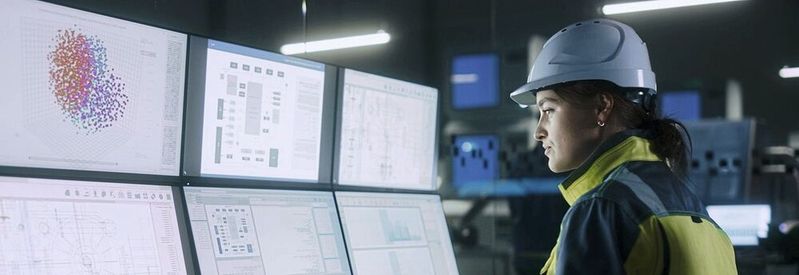
During ongoing operations, the digital twin becomes the central "hub" for process understanding.
(Image: Hexagon)
The lifecycle of a machine begins already in the early project planning phase—and countless pieces of information are generated: CAD models, CAE data from FEM simulations, layout studies, and feasibility analyses. Additionally, there is structured information from project planning tools and ERP systems—such as budget constraints, supply chains, or resource availability. Investment and amortization calculations are also part of this phase.
Here lies a often untapped data treasure. To systematically unlock it, a consistent digital architecture is needed, along which information from different disciplines can be consolidated and flow through standardized interfaces. Platforms like Hexagon's Smart Digital Reality provide a framework in this phase to merge CAD, simulation, and project information into an initial Project Twin.
Gallery
Simulate Instead of Speculate
As a connected single source of truth, the digital twin links planning data, information from MES and ERP systems, current operating states, maintenance histories, and sensor data from ongoing production using open APIs. This creates a holistic, dynamically growing model that does more than merely reflect the status quo: it makes concrete risks, weaknesses, and improvement potentials transparent and serves as the basis for technical and economic decisions.
Simulations thus become an interactive planning tool. From thermal stress analyses and vibration simulations to resource planning, "what-if" scenarios can be explored in granular detail. For example: How does the cycle time change with the introduction of a collaborative robot? How do tool change cycles affect output? Such considerations can be quantified before commissioning using integrated simulation solutions, for instance with MSC Software or Simufact—delivering significant time and cost savings compared to traditional trial-and-error planning.
Clean Start, Clean Operation
With the transition to physical reality, the digital twin gains a new dimension: reality capture technologies such as high-resolution 3D laser scans or photogrammetry models document the actual installed system. The comparison with its virtual model reveals deviations—for example, due to adjustments during assembly, tolerance deviations, or subsequent modifications. This data flows back into the twin and completes it into a precise "as-built" model.
In addition, modern twins link real components with semantic depth: When was which component installed? What is its lifespan? Which material batch was used? Information of this kind can be automatically recorded and versioned through solutions like HxGN EAM (Enterprise Asset Management)—which proves beneficial later when it comes to maintenance, traceability, or deconstruction.
During ongoing operations, the digital twin becomes the central "hub" for process understanding. Real-time data from controllers, for example via OPC UA, management systems (MES), energy management, condition monitoring, or even air quality and climate sensors, flows into the model in real time. This data transforms the twin into a continuously updated representation of reality—a so-called live twin. Based on this, production managers gain reliable insights into performance: Does the system performance systematically deviate from the design value? Are there fluctuations in energy consumption? Which environmental conditions affect process performance?
Reliable Foundation Instead of Gut Feeling
Maintenance processes have long been heavily experience-driven. With the digital twin, data-driven methods are now being introduced. Especially for younger specialists who cannot draw on decades of their own experience, the digital twin provides an objective basis for decision-making. Systems like HxGN Predictive Maintenance analyze sensor patterns and machine logs, compare them with historical reference data, and suggest preventive measures—before costly failures occur.
Beyond mere maintenance and repair, continuously maintained digital twins provide the data foundation for investments in automation. Which processes can be implemented using robots? Where does retrofitting make economic sense? How can personnel resources be optimally combined with existing systems? Using simulation-based feasibility studies—for example in conjunction with HxGN Virtual Commissioning—scenarios such as the introduction of AMR (Autonomous Mobile Robots) or CNC retrofitting can be tested in advance on the digital shop floor. This provides companies with reliable decision-making foundations, such as for prioritizing CAPEX measures or assessing ROI potential.
Date: 08.12.2025
Naturally, we always handle your personal data responsibly. Any personal data we receive from you is processed in accordance with applicable data protection legislation. For detailed information please see our privacy policy.
Consent to the use of data for promotional purposes
I hereby consent to Vogel Communications Group GmbH & Co. KG, Max-Planck-Str. 7-9, 97082 Würzburg including any affiliated companies according to §§ 15 et seq. AktG (hereafter: Vogel Communications Group) using my e-mail address to send editorial newsletters. A list of all affiliated companies can be found here
Newsletter content may include all products and services of any companies mentioned above, including for example specialist journals and books, events and fairs as well as event-related products and services, print and digital media offers and services such as additional (editorial) newsletters, raffles, lead campaigns, market research both online and offline, specialist webportals and e-learning offers. In case my personal telephone number has also been collected, it may be used for offers of aforementioned products, for services of the companies mentioned above, and market research purposes.
Additionally, my consent also includes the processing of my email address and telephone number for data matching for marketing purposes with select advertising partners such as LinkedIn, Google, and Meta. For this, Vogel Communications Group may transmit said data in hashed form to the advertising partners who then use said data to determine whether I am also a member of the mentioned advertising partner portals. Vogel Communications Group uses this feature for the purposes of re-targeting (up-selling, cross-selling, and customer loyalty), generating so-called look-alike audiences for acquisition of new customers, and as basis for exclusion for on-going advertising campaigns. Further information can be found in section “data matching for marketing purposes”.
In case I access protected data on Internet portals of Vogel Communications Group including any affiliated companies according to §§ 15 et seq. AktG, I need to provide further data in order to register for the access to such content. In return for this free access to editorial content, my data may be used in accordance with this consent for the purposes stated here. This does not apply to data matching for marketing purposes.
Right of revocation
I understand that I can revoke my consent at will. My revocation does not change the lawfulness of data processing that was conducted based on my consent leading up to my revocation. One option to declare my revocation is to use the contact form found at https://contact.vogel.de. In case I no longer wish to receive certain newsletters, I have subscribed to, I can also click on the unsubscribe link included at the end of a newsletter. Further information regarding my right of revocation and the implementation of it as well as the consequences of my revocation can be found in the data protection declaration, section editorial newsletter.
The end of a machine's lifecycle is also part of the cycle. The digital twin documents all modifications, spare parts, material information, and maintenance histories—thus providing the foundation for an orderly dismantling or resource-efficient recycling in line with the ESG goals of the respective manufacturing company. Which components can be recycled, which can be safely dismantled, and which machines can be repurposed for other uses?
Digital Twin As A Change Companion in Demographic Transition
As experienced professionals retire, knowledge becomes a scarce resource. Younger industrial specialists see themselves as connected workers and expect digitized, agile workflows. In addition, comprehensive knowledge management is essential to preserve specialized expertise across generations.
In this context, the digital twin becomes an interactive knowledge keeper: 3D models of machines can be integrated into augmented or virtual reality environments. New employees can then virtually explore the system, test functions, or simulate maintenance processes—long before working on the actual machine. The benefit: reduced onboarding time, standardized training levels, and more reliable overall knowledge transfer. Especially in industries with high demand for skilled personnel— such as energy, chemistry, or pharmaceuticals—this creates a sustainable knowledge ecosystem.
With demographic change, the question of how to optimally utilize existing skilled workers is becoming increasingly urgent. Automated processes and AI-driven decisions are an important lever in this context. On a meta-level, for example, artificial intelligence could analyze existing processes within a facility and provide recommendations on where the use of robots would be most economically viable.
Digital twins embody the transition from isolated digitalization initiatives to a systemic understanding of industrial processes as lifecycles—data-driven, interconnected, and future-oriented. They realize their full potential when data silos are eliminated and a seamless data flow across planning, operation, and optimization is achieved. Thus, the technology is not an end in itself. What matters is its integration into everyday manufacturing. Technology partners like Hexagon, which combine CAD, metrology, simulation, and IoT expertise under one roof, provide the necessary combination of detailed insight and holistic perspective.
Secure and Compliant Authentication in Laboratories



:quality(80)/p7i.vogel.de/wcms/40/c5/40c5051cebdb10fdee9a283303434d9d/0129881741v1.jpeg "3D-printed tools and other components contribute to energy-saving, precise processes. (Image:Gerhard Schubert GmbH)")
:quality(80)/p7i.vogel.de/wcms/e5/fa/e5fa9fa2e3b44ee1894fdf95bbe828fe/0129904146v1.jpeg "Airports and other critical infrastructure in Europe are to be better protected against drones. (Picture: ©assetseller - stock.adobe.com)")
:quality(80)/p7i.vogel.de/wcms/ae/bd/aebda515c684825e97579175874ea6bd/0129920231v1.jpeg "Hensoldt, a sensor specialist for critical defense applications among other things, now has a strategic milestone ahead of it. The company is planning to acquire Nedinsco, an optronics company from Venlo in the Netherlands. Here's what's to come ... (Image:Hensoldt)")
:quality(80)/p7i.vogel.de/wcms/c3/6f/c36f031df46d22615d941d077d32313c/0129800025v1.jpeg "The laser-assisted process is intended to make wafer cutting significantly more productive. (Image:Trumpf)")
:quality(80)/p7i.vogel.de/wcms/e8/dc/e8dc27a8d9fba8fbd081987400bf6848/0127426198v1.jpeg "3D FEM models are detailed, large and computationally intensive. Thanks to ROM and the support of Cadfem, Wago has succeeded in setting up an e-shop for thermal simulation. (Image:WAGO)")
:quality(80)/p7i.vogel.de/wcms/9c/ac/9cac6246660e746c5a3989399ac4d250/0128561645v1.jpeg "Artificial intelligence can drive efficiency in smart factories through centralized data management and predictive maintenance. (Picture: ©Fardived - stock.adobe.com)")
:quality(80)/p7i.vogel.de/wcms/6b/e2/6be235b5ad8a442ccd9d164b0b300d8b/0129763992v1.jpeg "As early as 2020, the Zimmer Group announced that it would convert its production to be sustainably CO2-neutral. (Image:Zimmer Group)")
:quality(80)/p7i.vogel.de/wcms/d4/ba/d4bab9481e66f8570f40eb8ef2a90198/0129795613v1.jpeg "A camera inspection during removal ensures that the components are placed correctly in the KLTs. (Image:Yaskawa Europe)")
:quality(80)/p7i.vogel.de/wcms/76/81/7681b6450512b2cce1e453cd3d732543/0129479309v1.jpeg "Symbolic image: Model-based design combines virtual system models with real machines and systems in order to simulate, validate and coordinate functions, control and software early on in the development process. (Image:Dall-E / AI-generated)")
:quality(80)/p7i.vogel.de/wcms/5c/0f/5c0fee074c4b6c8e8c0993f3217c2f5a/0129773718v1.jpeg "The General Fusion demonstration reactor. (Image:General Fusion)")
:quality(80)/p7i.vogel.de/wcms/b5/5e/b55ed9355e0395ec0caf111d6af6b494/adobestock-495980372--c2-a9-20natali-mis-20-e2-80-93-20stock-adobe-com-6720x3778v1v1.jpeg "Which engineering skills will be in vogue in 2026? (Image:natali_mis - stock.adobe.com)")
:quality(80)/p7i.vogel.de/wcms/bf/a5/bfa5d882e93f159ce93e933742272b00/nord-vibn-cmyk-2196x1235v1v1.jpeg "With digital twins for virtual commissioning, Nord supports customers in ensuring that systems are available more quickly, even with complex drive systems. (Image:Nord Drivesystems)")
:quality(80)/p7i.vogel.de/wcms/e4/01/e40186c9a7d04cbecb20fab20ff79094/0129886097v1.jpeg "Skoda has inaugurated a new battery plant in Mlada Boleslav to meet rising demand, but also to reduce battery costs by 30 percent. (Image:Skoda)")
:quality(80)/p7i.vogel.de/wcms/74/7b/747b6bc4d758c5dd4b5c24a763ae493d/0129897614v1.jpeg "Huawei Intelligent Automotive Solutions has presented a lidar with a resolution of 896 lines. (Image:HIMA via ChinaEVHome)")
:quality(80)/p7i.vogel.de/wcms/ba/b7/bab7bfd052f35da3c39388508faa350e/0129851977v1.jpeg "The third generation of the Mazda CX-5 scores above all with its inner values. (Image:Mauritz - VCG)")
:quality(80)/p7i.vogel.de/wcms/81/24/8124e33f53ec73fa99374f407cc11b61/0129727992-541x304v1v1.jpeg "The development of control elements and HMI systems for commercial vehicles can lead to interactions. (Image:Preh / AI-generated)")
:quality(80)/p7i.vogel.de/wcms/8b/46/8b46730ba87a86f16d696f043cf0e3d1/0129887022v1.jpeg "Linyi Yunchuan's S2000 platform has risen to a height of two kilometers and fed the energy generated into the grid. (Image:Linyi Yunchuan)")
:quality(80)/p7i.vogel.de/wcms/92/f8/92f8bf81914500bcda78f63dab8da720/0129926751v1.jpeg "Only recently, the US government allowed high-end chips for AI such as Nvidia's H200 series (pictured) to be exported to China under certain conditions. But now the tax is being pulled back all the harder: An eDraft envisages tighter controls on the export of hardware for AI technologies worldwide. Even allies would be affected. (Image:Nvidia)")
:quality(80)/p7i.vogel.de/wcms/84/cc/84cc506003388ecffaab464677c7afa6/0129843694v1.jpeg "Launched last year, ASML's TWINSCAN XT:260 is an i-line scanner with a throughput of 270 wafers per hour. With a focus on the increased demands of AI chips, ASML wants to shift its focus away from pure front-end tools for chip production in the next ten to fifteen years with packaging and bonding technologies. (Image:ASML)")
:quality(80)/p7i.vogel.de/wcms/8f/48/8f48b0ed0d6c5c4f299b1310a7b577e9/0129830738v1.jpeg "Data centers in orbit are indeed dreams of the future, while data centers under water are already being tested. (Image:Dall-E / AI-generated)")
:fill(fff,0)/images.vogel.de/vogelonline/companyimg/76800/76895/65.jpg "FAULHABER_120mm.jpg ()")
:fill(fff,0)/p7i.vogel.de/companies/69/88/69882c428938e/tmts2026-ticec-banner-en-2000px.png "tmts2026-ticec-banner-en-2000px (https://www.tmts.tw/en)")
:fill(fff,0)/p7i.vogel.de/companies/67/eb/67eba621ef6ea/logo2.png "logo2 (Wuxi InfiMotion)")
:quality(80)/p7i.vogel.de/wcms/3d/fb/3dfb791230da7f0aceeb0641673b4f63/0127926775v1.jpeg "The digital twin provides valuable information for young employees without years of experience.(Image: Hexagon)")
:quality(80)/p7i.vogel.de/wcms/ce/c7/cec7c48b52d1ce53df9f21814e224b43/0127926767v1.jpeg "Reality capture technologies such as high-resolution 3D laser scans or photogrammetry models document the actually installed facility.(Image: Hexagon)")
:quality(80)/p7i.vogel.de/wcms/99/1a/991a217389ce660734e478b65a11a424/0127926773v1.jpeg "Maurizio Granata is Executive Industry Consultant at the Hexagon Asset Lifecycle Intelligence Division.(Image: Hexagon)")
:quality(80):fill(efefef,0)/p7i.vogel.de/wcms/67/ac/67acb931a438c/elatec-wp-gmp.png "Elatec WP GMP")
:quality(80)/p7i.vogel.de/wcms/4d/74/4d745446555110ca9797db1eabb7c9d3/0129551585v1.jpeg "Jochen Gemeinhardt is responsible for NTT Data's AI business in the DACH region as Head of Production & Supply Chain and Head of Industry Line Global Business. (Image:NTT Data)")
:quality(80)/p7i.vogel.de/wcms/dd/6a/dd6a13b14d04147bd3c8f78d4cf0f35e/0125267489v1.jpeg "Product Lifecycle Management (PLM) can make a crucial contribution to ensuring the conscientious use of AI and robotics. (Image: ©ImageFlow - stock.adobe.com)")