Liquid hydrogenMercedes-Benz GenH2: The first customers are rolling out
From
Thomas Günnel
| Translated by AI
4 min Reading Time
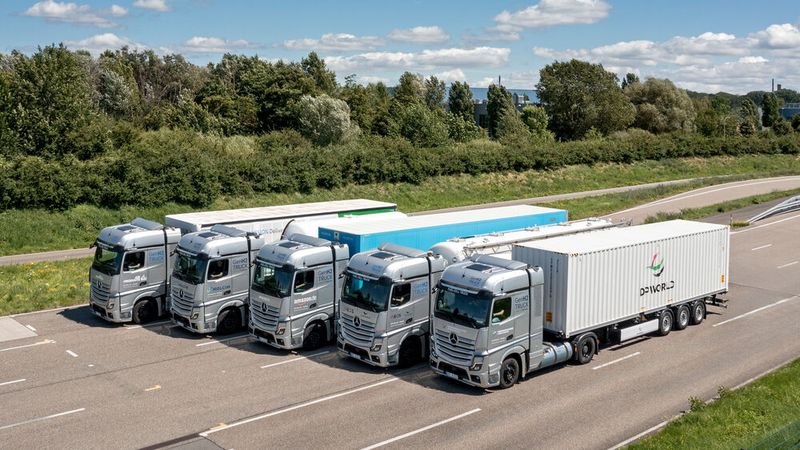
Daimler Truck has delivered the first "GenH2" fuel cell trucks to customers. Five companies are now testing the trucks daily in their fleets.
Five fuel cell trucks are on the road in customer operation for a year.
(Image: Daimler Truck AG)
Daimler Truck has handed over the first "GenH2" fuel cell trucks to customers. Five companies are now testing the hydrogen-powered tractor units for a year in daily long-distance transport. Amazon will use the truck in its logistics network in Germany, Air Products for the transport of bottled gases, Wiedmann & Winz for sea containers, Holcim for construction logistics, and Vervaeke, the logistics company of Ineos, for PVC and vinyl transport.
The five trucks are on specific routes—due to the still limited availability of appropriate filling stations. Around 1,000 kilometers of range with a tank filling of just over 80 kilograms of liquid hydrogen still allow flexibility. And: All the companies involved can literally find out whether the drive technology can withstand everyday logistics.
"We will gradually stress-test the possible range," announced Benoit Robinot-Bertrand, who is responsible for transport at Amazon in Europe. The development team at Daimler Truck is looking forward to the insights from these stress tests. They will be incorporated into the series development of the trucks, which the truck manufacturer wants to complete by the end of this decade.
Test for trucks and filling stations
At the same time, the test phase will show whether the filling stations can meet the requirements. Only two should be sufficient for testing. The first was put into operation by Daimler Truck and Linde Engineering at the beginning of February in Wörth am Rhein (Germany). There, liquid, cryogenically cooled hydrogen enters the tanks of the trucks. "Liquid hydrogen has a significantly higher volumetric energy density," explained Rainer Müller-Finkeldei, Head of Product Development at Mercedes-Benz Trucks, the decision.
This means: More hydrogen fits into the tanks per volume, the truck can drive further. Daimler Truck managed 1,047 kilometers (approx. 650 miles) with a prototype of the GenH2—in one piece and with the full 40 tons. The biggest advantage for the operators of the trucks: Refueling takes a maximum of 15 minutes—just as long as with a diesel tank. The second hydrogen filling station is currently being built in the Duisburg area.
Liquid hydrogen easier to handle
The hydrogen is stored in the truck tanks at minus 253 degrees Celsius (-423.4°F); and at a maximum pressure of 16.5 bar. It is 71 kilograms (156.53 lb) per cubic meter in this state. Gaseous hydrogen reaches 42 kg/m3 at 700 bar. For the transport of hydrogen, the liquid state is ideal compared to the alternatives.
"In the long run, liquid hydrogen is the right way—we are convinced of that," explained Rainer Müller-Finkeldei. The tanks are lighter and cost less than pressure tanks for gaseous hydrogen. The hydrogen stored in liquid form at the filling stations can be converted into gaseous form. Assuming the appropriate technology, trucks with gas pressure tanks can also refuel here.
Daum and Müller demand commitment for infrastructure
Whether gaseous or liquid hydrogen: "CO2-neutral vehicles alone will not be sufficient to make sustainable transport a success. This also requires an appropriate charging and refuelling infrastructure, as well as cost parity with conventional vehicles," said Daimler Truck CEO Martin Daum at the project start. "Politics and energy companies are already active here, but we urgently need even more momentum, and on a Europe-wide scale!"
VDA President Hildegard Müller shared his opinion. "The manufacturers have the corresponding models in development and production, now the political framework conditions must finally be created," she said in Wörth am Rhein. "An urgent need is to build a network of hydrogen filling stations and the associated infrastructure that meets demand. There is an urgent need for action here for politicians, the Federal Network Agency and the energy industry."
At least: The long-distance pipeline operators have recently submitted their application for the hydrogen core network to the Federal Network Agency. The core network is the basis for a nationwide hydrogen infrastructure—and is to be gradually put into operation by 2032. A total of 9,666 kilometers (6,006 miles)of pipelines are planned, 60 of which already exist and are being converted to hydrogen. The Federal Network Agency intends to approve the application within two months.
Technical data of the GenH2 hydrogen truck
The GenH2 is comparable to a diesel counterpart in terms of pulling power, range and performance. Around 25 tons of payload are possible, with a total tractor weight of 40 tons. The fuel cell system—a development of the Daimler-Volvo joint venture Cellcentric—delivers twice 150 kilowatts.
Date: 08.12.2025
Naturally, we always handle your personal data responsibly. Any personal data we receive from you is processed in accordance with applicable data protection legislation. For detailed information please see our privacy policy.
Consent to the use of data for promotional purposes
I hereby consent to Vogel Communications Group GmbH & Co. KG, Max-Planck-Str. 7-9, 97082 Würzburg including any affiliated companies according to §§ 15 et seq. AktG (hereafter: Vogel Communications Group) using my e-mail address to send editorial newsletters. A list of all affiliated companies can be found here
Newsletter content may include all products and services of any companies mentioned above, including for example specialist journals and books, events and fairs as well as event-related products and services, print and digital media offers and services such as additional (editorial) newsletters, raffles, lead campaigns, market research both online and offline, specialist webportals and e-learning offers. In case my personal telephone number has also been collected, it may be used for offers of aforementioned products, for services of the companies mentioned above, and market research purposes.
Additionally, my consent also includes the processing of my email address and telephone number for data matching for marketing purposes with select advertising partners such as LinkedIn, Google, and Meta. For this, Vogel Communications Group may transmit said data in hashed form to the advertising partners who then use said data to determine whether I am also a member of the mentioned advertising partner portals. Vogel Communications Group uses this feature for the purposes of re-targeting (up-selling, cross-selling, and customer loyalty), generating so-called look-alike audiences for acquisition of new customers, and as basis for exclusion for on-going advertising campaigns. Further information can be found in section “data matching for marketing purposes”.
In case I access protected data on Internet portals of Vogel Communications Group including any affiliated companies according to §§ 15 et seq. AktG, I need to provide further data in order to register for the access to such content. In return for this free access to editorial content, my data may be used in accordance with this consent for the purposes stated here. This does not apply to data matching for marketing purposes.
Right of revocation
I understand that I can revoke my consent at will. My revocation does not change the lawfulness of data processing that was conducted based on my consent leading up to my revocation. One option to declare my revocation is to use the contact form found at https://contact.vogel.de. In case I no longer wish to receive certain newsletters, I have subscribed to, I can also click on the unsubscribe link included at the end of a newsletter. Further information regarding my right of revocation and the implementation of it as well as the consequences of my revocation can be found in the data protection declaration, section editorial newsletter.
In the series version, a combined system is conceivable. For the tests, there are two: Should one fail, the truck remains mobile. The buffer battery with a capacity of 70 kilowatt hours and temporarily up to 400 kilowatts of power, would be enough for 20km (12,4 miles) to 30 km (18.6 miles) on its own. The battery is charged during coasting by means of recuperation—with plenty of potential: "When we arrived at the top of the mountain during the altitude test, the battery was almost empty," described a developer involved in the test drives. "At the bottom of the mountain, the battery was full again."
The two electric motors deliver twice 230 kilowatts in continuous operation and twice 330 kilowatts at maximum in the pre-series version. The torque is twice 1,577 Newton meters or twice 2,071 Newton meters.
The two liquid hydrogen stainless steel tanks each hold 44 kilograms. The stainless steel tank system consists of two interlocking tubes. They are connected and vacuum insulated. How well this works is shown by the fact that the hydrogen maintains its state without active cooling and despite the low temperatures in the tanks. "Evaporating hydrogen only becomes noticeable after a week of standing," described Rainer Müller-Finkeldei. "A weekend is not a problem depending on the fill level."
No problems: This is also what Martin Daum expects. When asked about a detail of the testing that he was not familiar with, which is more likely to be located in the development team, the CEO confidently replied: "As CEO, I assume that my team solves the problems." The coming weeks and months will show whether this has been achieved.



:quality(80)/p7i.vogel.de/wcms/a0/47/a04725ef9bd09fb6c9341a1bea1b5d93/0130443083v1.jpeg "Here, a type of plastic pallet is produced by thermoforming (vacuum forming or deep drawing) at the corresponding division of New England Plastics in the USA. This division, which specializes in so-called liners, is now part of Ringmetall ... (Image:New England Plastics)")
:quality(80)/p7i.vogel.de/wcms/23/99/23992bf2dcdc432c9b7209c34a4a7c48/0129733089v1.jpeg "Stork relies on the modular Neoswiss turning system from Iscar to shorten the set-up times for its sliding headstock lathes and work more productively. (Image:Iscar)")
:quality(80)/p7i.vogel.de/wcms/7d/e2/7de2923434b2f1a78ba5482d8d335269/0113143253v1.jpeg "In our China Market Insider we regularly provide you with relevant information directly from China. (Image:© Eisenhans - stock.adobe.com)")
:quality(80)/p7i.vogel.de/wcms/9d/2b/9d2b802f800e5caf17b2831e74228cd3/screenshot-202026-03-03-20103822-609x343v1v1.png "Visual comparison: on the left, a clean, burr-free cut edge; on the right, typical burr formation with oxidation discoloration. This illustrates how strongly parameter control and gas management influence the quality of the result. (CO₂ laser, oxygen cutting gas, sheet thickness approx. 15 mm). (Image:Picture: Rime)")
:quality(80)/p7i.vogel.de/wcms/b7/36/b736dfebc16c42d6901d0d0e1f390493/3d-druck-20factory-20--20ki-20generiert-1920x1079v1.png "(Source: AI-generated)")
:quality(80)/p7i.vogel.de/wcms/79/b2/79b21aad663f4a7bd4472afc1c1afc62/0130433994v1.jpeg "Mission Joyride: The free-flying robot (shown here in the rendering) will relieve the ISS crew of logistics tasks from 2027 with its two mechanical arms. (Image:Icarus Robotics)")
:quality(80)/p7i.vogel.de/wcms/6b/45/6b4546fa6ebf305c3660326909363f32/0130437089v1.jpeg "Industrial AI in action: Rockwell Automation presents practical solutions for self-controlling production systems at the Hannover Messe. (Image:Rainer Jensen, Deutsche Messe)")
:quality(80)/p7i.vogel.de/wcms/78/e9/78e9188c25a8a94e67c34c9bf8ffe495/visual-agile-20robots-20and-20google-20deepmind-20partner-20to-20bring-20intelligence-20to-20robotics-2500x1406v1v1.jpeg "Together, the partners are developing adaptable, intelligent robots for a wide range of applications (Image:Agile Robots SE)")
:quality(80)/p7i.vogel.de/wcms/59/a2/59a2b11f0aa1b700eff02addd5de8703/adobestock-1788280853--c2-a9-20satria-20-e2-80-93-20stock-adobe-com-5081x2860v1v1.jpeg "Quantum computers require extreme cooling to temperatures close to absolute zero in order to keep qubits stable. (Image:satria - stock.adobe.com)")
:quality(80)/p7i.vogel.de/wcms/49/38/493876a248943456b7e4a6db6edfc454/0130230765v1.jpeg "Safe and reliable in aircraft construction: light-curing adhesive bond combined with universal fastening elements. (Source: Delo)")
:quality(80)/p7i.vogel.de/wcms/b5/c7/b5c749d16c8a2e789c1469c2c8c1c387/0130452780v1.jpeg "Volvo Trucks completes road tests with its new hydrogen-powered trucks. (Image:Volvo Trucks)")
:quality(80)/p7i.vogel.de/wcms/ba/69/ba6975f417a85147084f38dc2cd209e2/0130451386v1.jpeg "Together with Nvidia, Hyundai wants to develop an architecture that will be used for level 4 robotaxis (image) as well as for level 2 customer vehicles. (Image:Hyundai)")
:quality(80)/p7i.vogel.de/wcms/93/4d/934de334b47abaa526c78cba1417d7af/0130343495v1.jpeg "The new SU7 is available in three price categories, \"Standard\", \"Pro\" and \"Max\" (Image:Xiaomi)")
:quality(80)/p7i.vogel.de/wcms/df/a0/dfa048434bb94f1b7d030e346b25b3ae/0130373541v1.jpeg "From August, BMW will be producing the i3 at its main plant in Munich - which the car manufacturer has extensively rebuilt for this purpose. (Image:Rainer Haeckl)")
:quality(80)/p7i.vogel.de/wcms/ee/09/ee09acbd6dc896df25affaa9e871e6e5/0130440053v1.jpeg "IMS chip module for simple system integration into an ion mobility spectrometer. (Image:Fraunhofer IPMS)")
:quality(80)/p7i.vogel.de/wcms/10/6c/106cd22de5f68a0f74639d654827228c/0130345302v1.jpeg "Made in India: According to the India Electronics and Semiconductor Association (IESA), the country should be able to produce between 75 and 80 million chips by the beginning of 2027, once the plants currently under construction become operational. (Image:Pixabay (Montage: Sebastian Gerstl))")
:quality(80)/p7i.vogel.de/wcms/a5/ed/a5ed6fda029d362732a293d6b19d74c4/0130444216v1.jpeg "Thirteen executives from the Chinese chip industry have drawn up a plan to achieve an 80% self-sufficiency rate for semiconductors by 2030. (Image:Maxim_Kazmin - stock.adobe.com)")
:quality(80)/p7i.vogel.de/wcms/31/a6/31a646018b34d8e0a44bfc8bf17837f6/0130361632v1.jpeg "For many companies, PFAS are considered indispensable in electronics production. (Image:freely licensed)")
:quality(80)/p7i.vogel.de/wcms/b2/fa/b2faabaa252c361d3febb80ee17f1e5b/0119709404v1.jpeg "Each of the vacuum-insulated hydrogen tanks can hold 44 kilograms of hydrogen.(Image: Thomas Günnel - Vogel Communications Group)")
:quality(80)/p7i.vogel.de/wcms/fd/e2/fde279b7e1b79fc7f3726a30c3cfabc7/0119709454v1.jpeg "The \"fuel nozzle\" is somewhat more complex than that for diesel tanks.(Image: Thomas Günnel - Vogel Communications Group)")
:quality(80)/p7i.vogel.de/wcms/7a/10/7a10a77f9d202d1027bde6c555d59136/0119714735v1.jpeg "Vervaeke, the logistics company of Ineos, transports PVC and vinyl in the tank trailer.(Image: Daimler Truck AG)")
:quality(80)/p7i.vogel.de/wcms/8a/36/8a368c302a6eb837e7c8b9d94d3533a1/0119714727v1.jpeg "Holcim uses a silo trailer for building material logistics.(Image: Daimler Truck AG)")
:quality(80)/p7i.vogel.de/wcms/0f/68/0f6882f56904b8e0d0bc84273b48abd7/0127977063v1.jpeg "The testing of the GenH2 Truck enters its second phase. (Image:Daimler Truck)")
:quality(80)/p7i.vogel.de/wcms/5a/2a/5a2aa458291a73b90623e67ebec60f7a/0129089498v1.jpeg "Daimler Truck has presented the next version of the GenH2 truck. It is to be produced in a small series. (Image:Daimler Truck)")