Commercial vehiclesDaimler is testing hydrogen propulsion
Source:
sp-x
7 min Reading Time
Fuel cell? Battery? Or both? Where the journey goes with the truck is not yet clear. That's why everything is being tested. Also at the Brenner Pass.
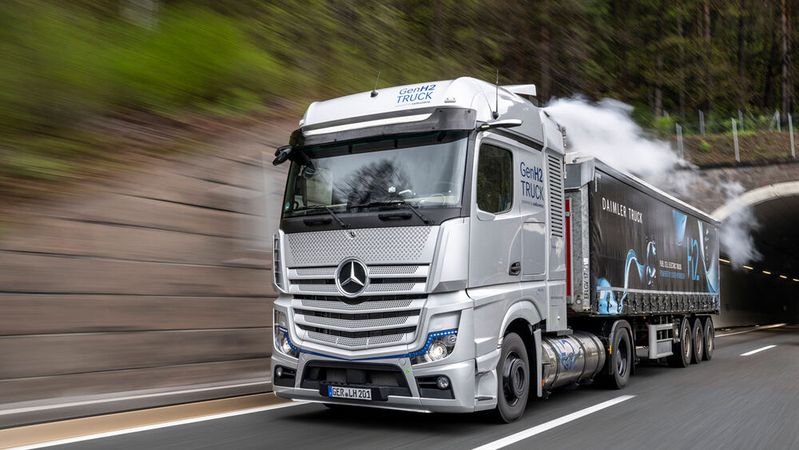
Daimler is testing the "GenH2" truck with hydrogen propulsion at the Brenner Pass.
(Image: Daimler)
Felix Kauffmann is in good spirits but in a bad mood. Because for the umpteenth time this week, the trucker is steering his 40-tonner over the Europabrücke - and once again, he finds himself stuck in traffic on the Brenner North ramp.
No wonder. After all, with around 2.5 million trucks and 40 million tons of freight per year, this is one of the busiest transit routes in Europe. And strictly speaking, Kauffmann is exactly here because of that.
Because he has not loaded time-critical freight and is not worried about arriving punctually somewhere in Italy. Kauffmann is a test driver, and his service vehicle is not only intended to bring a better future to the plagued residents here in Steinach or Gries but also to save the climate.
Ultimate stress test for the "GenH2"
"GenH2" is written on the silver colossus, and instead of a 15.6-liter diesel engine with over 500 hp, the trucker sits above two fuel cells powered by hydrogen, which supply two electric motors each with 450 hp.
While the trucks around him emit thick black smoke in stop-and-go traffic, only clouds of water vapor waft from his exhaust. And instead of a loud rumble, you only hear a soft hum. At least until the huge fans kick in.
Because gradients of more than six percent, a pass height of 1,370 meters, and then also the crawling speed – that is the ultimate stress test for the alternative drive, says the developer as he meticulously studies the curves on his control screens.
Temperatures rise, performance decreases due to thin air, and the electronics struggle to find the right operating strategy between the fuel cell and the relatively small 70 kWh buffer battery. And the traffic jam just doesn't want to end.
"There is a significant need for action to introduce alternative drives in road freight transport."
The fact that Kauffmann is making slow progress almost has a symbolic element. Because, just like his truck at the Brenner Pass, the entire industry is still struggling with the transition to mobility. While the shift seems irreversible for cars, progress is much slower for commercial vehicles, and long-haul transportation, in particular, is still hesitant about the concept of carbon-neutral freight transport.
For good reason, says Steffen Stumpp from the Munich strategy consultancy Berylls. "There are currently simply no market-ready vehicles that could compete with diesel for long-haul trips." Speed is of the essence. "There is a significant need for action to introduce alternative drives in road freight transport," warns the Fraunhofer Institute for Systems and Innovation Research in Karlsruhe.
He accounts for more than a third of the national greenhouse gas emissions in the transport sector – and considering a continuously increasing freight traffic, the tendency is rather increasing. Accordingly, the policy has long tightened the screws on commercial vehicle manufacturers: By 2025, they must reduce their fleet consumption by 15 percent and by 30 percent by 2030, as Brussels decided four years ago.
And now, the traffic light coalition in Germany is taking the next step: Starting next year, they have passed a toll reform for climate protection, imposing an additional 200 euros for every ton of CO2 emissions. In return, emission-free trucks will be exempt from the toll until 2025 and will only have to pay 25 percent of the standard rate thereafter.
Electric trucks are more suitable for distribution traffic.
The outcry in the transport sector is loud because of the limited number of alternatives. For hauliers, this essentially means a doubling of the toll, which cannot be avoided due to a lack of clean vehicles, argues the Federal Association of Goods Transport, Logistics, and Disposal.
And because the industry generates only minimal profits, the additional costs for the CO2 toll could end up with the end consumer through trade. For the time being, this may be true, admits Berylls expert Stumpp. However, in the medium term, the transport sector will also contribute to climate protection and therefore will have to switch from diesel to electric drive.
Date: 08.12.2025
Naturally, we always handle your personal data responsibly. Any personal data we receive from you is processed in accordance with applicable data protection legislation. For detailed information please see our privacy policy.
Consent to the use of data for promotional purposes
I hereby consent to Vogel Communications Group GmbH & Co. KG, Max-Planck-Str. 7-9, 97082 Würzburg including any affiliated companies according to §§ 15 et seq. AktG (hereafter: Vogel Communications Group) using my e-mail address to send editorial newsletters. A list of all affiliated companies can be found here
Newsletter content may include all products and services of any companies mentioned above, including for example specialist journals and books, events and fairs as well as event-related products and services, print and digital media offers and services such as additional (editorial) newsletters, raffles, lead campaigns, market research both online and offline, specialist webportals and e-learning offers. In case my personal telephone number has also been collected, it may be used for offers of aforementioned products, for services of the companies mentioned above, and market research purposes.
Additionally, my consent also includes the processing of my email address and telephone number for data matching for marketing purposes with select advertising partners such as LinkedIn, Google, and Meta. For this, Vogel Communications Group may transmit said data in hashed form to the advertising partners who then use said data to determine whether I am also a member of the mentioned advertising partner portals. Vogel Communications Group uses this feature for the purposes of re-targeting (up-selling, cross-selling, and customer loyalty), generating so-called look-alike audiences for acquisition of new customers, and as basis for exclusion for on-going advertising campaigns. Further information can be found in section “data matching for marketing purposes”.
In case I access protected data on Internet portals of Vogel Communications Group including any affiliated companies according to §§ 15 et seq. AktG, I need to provide further data in order to register for the access to such content. In return for this free access to editorial content, my data may be used in accordance with this consent for the purposes stated here. This does not apply to data matching for marketing purposes.
Right of revocation
I understand that I can revoke my consent at will. My revocation does not change the lawfulness of data processing that was conducted based on my consent leading up to my revocation. One option to declare my revocation is to use the contact form found at https://contact.vogel.de. In case I no longer wish to receive certain newsletters, I have subscribed to, I can also click on the unsubscribe link included at the end of a newsletter. Further information regarding my right of revocation and the implementation of it as well as the consequences of my revocation can be found in the data protection declaration, section editorial newsletter.
Unlike in passenger cars, two alternatives seem to be establishing themselves for electric driving, the expert outlines the market situation: The battery or, as in the modified Actros at the Brenner Pass, the fuel cell. The battery has the advantage of being already available and can at least partially utilize existing infrastructure.
The ranges are still so limited that electric trucks are currently only suitable for distribution traffic, says Daimler strategist Tilman Morlok with regard to the E-Actros, which is now entering the market with a range of 300 or 400 kilometers. Morlok is leading the development of the E-Actros Longhaul, which is set to arrive next year and then achieve 500 kilometers. For this, it will have 600 kWh of battery capacity, which is as much as nine Mercedes EQC vehicles.
"If such vehicles with megawatt technology are charged and can absorb enough energy for the rest of the workday during the driver's mandatory rest periods, and are also traveling on well-planned routes, then they are indeed suitable for long-haul transport."
"Those who really want to drive long distances cannot avoid the fuel cell."
"However, those who really want to drive long distances and do not yet know where their load will go tomorrow cannot avoid the fuel cell," concedes Daimler's Morlok, explaining the dual development approach of the Swabians. Only in this way can they cover the majority of the market and actually achieve ranges of up to 1,000 kilometers."
Daimler is not alone in this endeavor. On the contrary: The fuel cell in the experimental truck, which is expected to go into series production by 2027/28, comes from the joint venture Cellcentric, established by the Swabians in partnership with Volvo, turning their fiercest competitors into partners. Hyundai also believes in the technology, as does the American startup Nikola, which plans to launch hydrogen propulsion in Europe in collaboration with Iveco.



:quality(80)/p7i.vogel.de/wcms/51/1b/511b420dbcc296aec09e3bffb051b8a8/0133581587v1.jpeg "The cables connect numerous machine components—often in confined spaces. (Image:Helu)")
:quality(80)/p7i.vogel.de/wcms/b5/67/b5676f3bfb36251ed31f9a0cccf650b6/0133167827v1.jpeg "Thanks to JumboFlex Generation 2, employees can effortlessly move wheelchairs weighing as much as 40 kilograms. (Image:Lard)")
:quality(80)/p7i.vogel.de/wcms/5e/c6/5ec615b7a51440f668259f2af9158cb9/0132654694v1.jpeg "Strategic Partnerships in Industry: As buyers and restructuring partners, Chinese investors are increasingly helping to preserve jobs in Germany. (Image: ©Anatolii Rymarchuk - stock.adobe.com)")
:quality(80)/p7i.vogel.de/wcms/eb/2b/eb2bd1b8487afe577b37363cd02f16ff/0113143253v1.jpeg "In our China Market Insider, we regularly provide you with relevant information straight from China. (Image:© Eisenhans - stock.adobe.com)")
:quality(80)/p7i.vogel.de/wcms/aa/3e/aa3e2603a812f8e7d33c00ba8ae28c9f/0133507886v1.jpeg "With the Iggy Rob, igus is bringing a humanoid robot into factories for a price of 47,999 euros ($54,718). (Image: igus)")
:quality(80)/p7i.vogel.de/wcms/92/64/92645c64ffbb6980976d39102388d120/0113143253v1.jpeg "In our China Market Insider, we regularly provide you with relevant information straight from China. (Image:© Eisenhans - stock.adobe.com)")
:quality(80)/p7i.vogel.de/wcms/c7/05/c70542511e0824ee491f7b55e21fa429/0133598424v1.jpeg "In logistics, AI is often implemented only on a case-by-case basis; data is stored in separate systems, and inventory levels, status values, and priorities are not defined consistently. (Image: ©m-project - stock.adobe.com)")
:quality(80)/p7i.vogel.de/wcms/3a/9c/3a9c1fd546e1f041b86bb1d03cf39101/0133610524v1.jpeg "The Mason W-01 combines industrial-grade humanoid hardware, Physical AI-based perception, and autonomous task planning. (Image:Nova X Robotics)")
:quality(80)/p7i.vogel.de/wcms/e7/94/e794290f265afbd0ffc7a06c4fe9d425/adobestock-1887113836--hypnotics-14-stock-adobe-com-ki-generiertv1.jpeg "In both autonomous driving and industrial production, there is growing skepticism as to whether full autonomy is always desirable. (Source: © Hypnotics 14 – stock.adobe.com / AI-generated)")
:quality(80)/p7i.vogel.de/wcms/a8/71/a8712e5c6ef536228444ab5275cedfe2/adobestock-340905887--gorodenkoff-stock-adobe-comv1.jpeg "A new position paper outlines the conditions that the business community, academia, and policymakers must jointly establish in order to ensure the long-term viability of industry in Germany and Europe. (Source: © Gorodenkoff – stock.adobe.com)")
:quality(80)/p7i.vogel.de/wcms/7d/eb/7deb25ca674fa4c781a9d1fab083f7cf/parker-entwicklungszentrum-hresv1.jpeg "The centerpiece of the Parker Center for Drive and Control Technology in Offenbach is the exhibition area. (Source: Parker Hannifin)")
:quality(80)/p7i.vogel.de/wcms/3d/ff/3dff5e51c24b30c8dc37c1d024887157/0133602931v1.jpeg "Just a few years ago, SpaceX specialists were working on the world’s largest rocket—the Starship. Now, Elon Musk’s company has reached a milestone during a test flight: Earth’s orbit! But there was also a downside... (Image: SpaceX)")
:quality(80)/p7i.vogel.de/wcms/78/ab/78abbfbab0565fabb19efe637aea30e8/nio-power-swap-station-4-china-guangzhou-2024-1400x933-jpgv1.webp "Nio and Geely are collaborating on battery replacement for electric cars. (Source: Nio)")
:quality(80)/p7i.vogel.de/wcms/2e/58/2e58c664e733dd182666606f850c5da4/0133400664v1.jpeg "The IM6 is sort of the crossover version of the IM5. (Image:MG Motor)")
:quality(80)/p7i.vogel.de/wcms/40/5f/405f41f4075e8798878011f0932a8195/0133509065v1.jpeg "Caruso has integrated Hyundai into its platform. (Image:Hyundai)")
:quality(80)/p7i.vogel.de/wcms/06/98/06989beb3f95b8fb06d71190c86cffde/tabletv1.jpeg "The cockpit view during a test drive in the simulator. (Source: Uccello et al., IEEE OJITS 2026)")
:quality(80)/p7i.vogel.de/wcms/40/34/4034915f85470ad8264659267e4f02d0/0133655653v1.jpeg "Cariad, Volkswagen's software subsidiary, continues to struggle. Now, another round of layoffs has been announced, which will result in the loss of many jobs ... (Image:Cariad)")
:quality(80)/p7i.vogel.de/wcms/e4/2a/e42af12e2a0816bb3d25fac9932903e9/0133646920v1.jpeg "TSMC's U.S. headquarters in Arizona: According to various media reports, the world's largest contract semiconductor manufacturer may be planning to build up to six additional fabs in the state of Texas. (Image:TSMC)")
:quality(80)/p7i.vogel.de/wcms/de/8c/de8c694e560ce8e8d7d43fa5b91917b3/0133668420v1.jpeg "Open-source AI tools: DeepSeek and Huawei are making programming tools for Ascend processors available, with the aim of simplifying development, chip communication, and AI computations on Huawei's hardware—and thereby intensifying competition with Nvidia. (Image:Dall-E / AI-generated)")
:quality(80)/p7i.vogel.de/wcms/86/25/8625a62499a6e70e629a2ddde2f01dcb/0133671173v1.jpeg "\"OpenAI\" has repeatedly experienced problems in which AI models have accessed the internet without authorization in order to carry out their tasks. The company has now fired three people whom it no longer trusts ... (Image:AI-generated)")
:quality(80)/p7i.vogel.de/wcms/21/59/21592b60cc226c533272207ee4b1562c/25dt244-001v1.jpeg "Daimler Truck is showcasing the Actros with several powertrain options at the IAA Transportation; the focus is on battery-electric and hydrogen-powered systems. (Source: Daimler Truck)")
:quality(80)/p7i.vogel.de/wcms/0f/68/0f6882f56904b8e0d0bc84273b48abd7/0127977063v1.jpeg "The testing of the GenH2 Truck enters its second phase. (Image:Daimler Truck)")