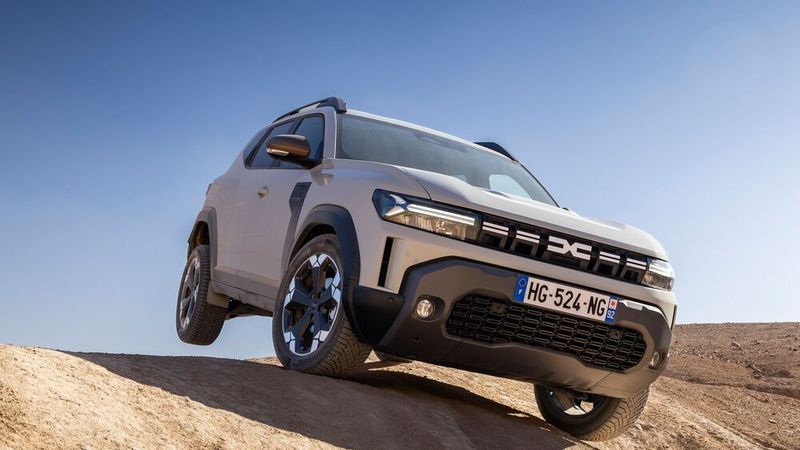
Dacia can only do simple? Not at all. With the Duster Hybrid-G 150 4x4, the Renault subsidiary demonstrates that it can also master very complex systems—such as the new bivalent hybrid all-wheel drive.
Leg up: The new Hybrid-G 150 4x4 drivetrain in the current Dacia Duster is equipped for sand and gravel.
(Image: Dacia)
Stones, gravel, pebbles—and plenty of nasty holes in the washboard track: The tour through the Agafay Desert near Marrakesh is not for the faint-hearted. We are set to tackle nearly 62 largely unpaved miles with the new Duster drivetrain. Steep, bumpy ascents and descents and tilted stretches included. To get straight to the point: the "normal" gravel track and smaller challenges were handled effortlessly by the all-wheel-drive Duster in normal mode. Only in deep gravel and massive uneven terrain combined with steep climbs did the Mud/Sand program need to step in briefly. It immediately succeeded: mission accomplished, as the new drivetrain—which is also available in the larger Bigster—has proven itself.
This is no coincidence. Under the now sleekly designed hood of the Duster and at its rear axle lies a sophisticated drive system that, according to the manufacturer, "does not need to shy away from international comparison." It is also unique worldwide. Specifically, it is an innovative combination of a mild-hybridized LPG and gasoline engine, 48-volt hybrid technology, and all-wheel drive.
Innovative Two-Speed Transmission
This interesting combination not only provides a range of approximately 930 miles, as projected by Dacia, thanks to two 13 gallons tanks (gasoline/LPG), but also delivers remarkable off-road capabilities for this price range—as noted above. A key factor is the innovative two-speed gearbox on the rear electric motor, which transforms the Duster into a true climbing machine at the push of a button. Because the first "electric gear" has a very short ratio, the 23 kW of the electric motor at the rear axle, combined with its immediate high torque, is more than sufficient for demanding climbs. By the way, Dacia classifies the electric unit as the strongest of its kind currently available on a 48-volt basis—worldwide.
But excursions off-road, in this case into the rather rocky than sandy desert near Marrakesh, are just one of many uses for a multipurpose SUV. Far more frequently than in the African outback, such an all-wheel-drive Duster is likely to be found on regular city and country roads as well as highways. And for this, too, the new variant—alongside a version with pure LPG/gasoline drive, a mild hybrid, and a full hybrid, each with front-wheel drive—is well equipped.
Economical Consumption
Five driving modes are available. In "Auto," the Duster automatically switches between 4x2 and 4x4 drive depending on external conditions. In "Eco," fuel is saved, and the rear drive is only engaged when the front and rear wheels do not rotate at the same speed. "Snow" logically stands for all-wheel drive on slippery surfaces, along with "Mud/Sand" and "Lock" for loose and uneven terrain. Additionally, Dacia has equipped the Duster with a hill start assist system called Hill Descent Control.
The result is quite convincing, both on and off-road. The performance of the engine combination, with a system output of 113 kW/154 hp and a maximum system torque of 230 Nm, is entirely sufficient for a vehicle like the Duster. Sure, in a car specs card game, the 10.2 seconds for the standard sprint and the top speed of 112 mph won't get you very far. But in real life, traveling with the Hybrid-G 150 4x4 is quite enjoyable. Those with a strong aversion to gas stations will feel particularly comfortable, as rarely any refueling stops are required if both tanks are emptied and, in city driving, as much as possible is done using the electricity from the small 0.8-kWh battery. The French state a WLTP consumption of 1.6 gallons of gasoline or 1.9 gallons of LPG per 62 miles.
Dacia Impresses With Craftsmanship And Equipment
During our test drives in the Moroccan outback, an average of 2.2 gallons of gasoline was used per 62 miles. Considering the topographical challenges, that's a respectable figure. And yes: the all-wheel-drive Duster can also tow. A maximum towing capacity of 1.7 short tons is permitted, and according to the chief engineer, the compact SUV handles this load without issue, even when starting on steep inclines, thanks to the high electric torque immediately available at the rear wheel. Thanks to a sophisticated strategy ensuring a consistently sufficient charge level for the mini-hybrid battery, the power from the rear can always be relied upon, even on extreme mountain stages. In urban traffic, up to 60 percent of routes can reportedly be driven purely electrically.
Date: 08.12.2025
Naturally, we always handle your personal data responsibly. Any personal data we receive from you is processed in accordance with applicable data protection legislation. For detailed information please see our privacy policy.
Consent to the use of data for promotional purposes
I hereby consent to Vogel Communications Group GmbH & Co. KG, Max-Planck-Str. 7-9, 97082 Würzburg including any affiliated companies according to §§ 15 et seq. AktG (hereafter: Vogel Communications Group) using my e-mail address to send editorial newsletters. A list of all affiliated companies can be found here
Newsletter content may include all products and services of any companies mentioned above, including for example specialist journals and books, events and fairs as well as event-related products and services, print and digital media offers and services such as additional (editorial) newsletters, raffles, lead campaigns, market research both online and offline, specialist webportals and e-learning offers. In case my personal telephone number has also been collected, it may be used for offers of aforementioned products, for services of the companies mentioned above, and market research purposes.
Additionally, my consent also includes the processing of my email address and telephone number for data matching for marketing purposes with select advertising partners such as LinkedIn, Google, and Meta. For this, Vogel Communications Group may transmit said data in hashed form to the advertising partners who then use said data to determine whether I am also a member of the mentioned advertising partner portals. Vogel Communications Group uses this feature for the purposes of re-targeting (up-selling, cross-selling, and customer loyalty), generating so-called look-alike audiences for acquisition of new customers, and as basis for exclusion for on-going advertising campaigns. Further information can be found in section “data matching for marketing purposes”.
In case I access protected data on Internet portals of Vogel Communications Group including any affiliated companies according to §§ 15 et seq. AktG, I need to provide further data in order to register for the access to such content. In return for this free access to editorial content, my data may be used in accordance with this consent for the purposes stated here. This does not apply to data matching for marketing purposes.
Right of revocation
I understand that I can revoke my consent at will. My revocation does not change the lawfulness of data processing that was conducted based on my consent leading up to my revocation. One option to declare my revocation is to use the contact form found at https://contact.vogel.de. In case I no longer wish to receive certain newsletters, I have subscribed to, I can also click on the unsubscribe link included at the end of a newsletter. Further information regarding my right of revocation and the implementation of it as well as the consequences of my revocation can be found in the data protection declaration, section editorial newsletter.
Long stretches are no longer a problem due to the now truly comfortable front seats. We also rate the interior build quality positively; the materials are functional and give a durable impression. The infotainment system with the Duster's Here navigation is quite user-friendly. From the second trim level, Expression, smartphone support can be added—wirelessly.
The base model includes a DAB+ radio, a USB-C port, Bluetooth, hands-free functionality, a smartphone mount, and four speakers. Moving up the Duster hierarchy offers features such as a 10.1-inch touchscreen, over-the-air updates, or an Arkamys sound system. A rearview camera is standard from the second trim level, Expression. Keycard handsfree and automatic climate control are included from the third tier, Journey. Standard safety features include an emergency brake assistant with pedestrian/cyclist detection, a drowsiness warning, a lane-keeping assistant with lane departure warning, a distance warning system, a blind-spot monitor, and traffic sign recognition with a speed alert. Additionally, there are various extras, including a trunk mat, a sleep box, and a tailgate tent.
Conclusion: A Practical Vehicle With Extras
The new drivetrain version of the Dacia Duster, which has been built around 2.8 million times since 2010, is incredibly complex—without overwhelming the person behind the wheel. Intervention is only required in extreme situations; in everyday life, the Auto and Eco modes are always sufficient. The combination of hybrid technology with LPG and gasoline, the additional gearbox for the rear electric motor, plus the six-speed dual-clutch transmission for the combustion engine, results in an absolutely practical vehicle with a certain extra: if needed, the Duster can handle off-road terrain. Prices ranging from $30,000 (Essential) to $32,000 (Extreme) are quite reasonable for this.
It’s clear that the complex drivetrain adds weight (+130 pounds) and takes up some space. The trunk of the 4x4 holds just under 90 to 370 gallons, significantly smaller than that of the front-wheel-drive mild hybrid (140 to 425 gallons). Additionally, LPG propulsion is on the decline in Germany despite its advantages in price and emissions. For this reason, Dacia is already considering a pure gasoline version for the German market—with half the range. This could arrive at Dacia dealerships no earlier than summer 2026. The bi-fuel version is already available for order, with initial deliveries planned for spring.



:quality(80)/p7i.vogel.de/wcms/51/1b/511b420dbcc296aec09e3bffb051b8a8/0133581587v1.jpeg "The cables connect numerous machine components—often in confined spaces. (Image:Helu)")
:quality(80)/p7i.vogel.de/wcms/b5/67/b5676f3bfb36251ed31f9a0cccf650b6/0133167827v1.jpeg "Thanks to JumboFlex Generation 2, employees can effortlessly move wheelchairs weighing as much as 40 kilograms. (Image:Lard)")
:quality(80)/p7i.vogel.de/wcms/5e/c6/5ec615b7a51440f668259f2af9158cb9/0132654694v1.jpeg "Strategic Partnerships in Industry: As buyers and restructuring partners, Chinese investors are increasingly helping to preserve jobs in Germany. (Image: ©Anatolii Rymarchuk - stock.adobe.com)")
:quality(80)/p7i.vogel.de/wcms/eb/2b/eb2bd1b8487afe577b37363cd02f16ff/0113143253v1.jpeg "In our China Market Insider, we regularly provide you with relevant information straight from China. (Image:© Eisenhans - stock.adobe.com)")
:quality(80)/p7i.vogel.de/wcms/aa/3e/aa3e2603a812f8e7d33c00ba8ae28c9f/0133507886v1.jpeg "With the Iggy Rob, igus is bringing a humanoid robot into factories for a price of 47,999 euros ($54,718). (Image: igus)")
:quality(80)/p7i.vogel.de/wcms/92/64/92645c64ffbb6980976d39102388d120/0113143253v1.jpeg "In our China Market Insider, we regularly provide you with relevant information straight from China. (Image:© Eisenhans - stock.adobe.com)")
:quality(80)/p7i.vogel.de/wcms/c7/05/c70542511e0824ee491f7b55e21fa429/0133598424v1.jpeg "In logistics, AI is often implemented only on a case-by-case basis; data is stored in separate systems, and inventory levels, status values, and priorities are not defined consistently. (Image: ©m-project - stock.adobe.com)")
:quality(80)/p7i.vogel.de/wcms/3a/9c/3a9c1fd546e1f041b86bb1d03cf39101/0133610524v1.jpeg "The Mason W-01 combines industrial-grade humanoid hardware, Physical AI-based perception, and autonomous task planning. (Image:Nova X Robotics)")
:quality(80)/p7i.vogel.de/wcms/e7/94/e794290f265afbd0ffc7a06c4fe9d425/adobestock-1887113836--hypnotics-14-stock-adobe-com-ki-generiertv1.jpeg "In both autonomous driving and industrial production, there is growing skepticism as to whether full autonomy is always desirable. (Source: © Hypnotics 14 – stock.adobe.com / AI-generated)")
:quality(80)/p7i.vogel.de/wcms/a8/71/a8712e5c6ef536228444ab5275cedfe2/adobestock-340905887--gorodenkoff-stock-adobe-comv1.jpeg "A new position paper outlines the conditions that the business community, academia, and policymakers must jointly establish in order to ensure the long-term viability of industry in Germany and Europe. (Source: © Gorodenkoff – stock.adobe.com)")
:quality(80)/p7i.vogel.de/wcms/7d/eb/7deb25ca674fa4c781a9d1fab083f7cf/parker-entwicklungszentrum-hresv1.jpeg "The centerpiece of the Parker Center for Drive and Control Technology in Offenbach is the exhibition area. (Source: Parker Hannifin)")
:quality(80)/p7i.vogel.de/wcms/3d/ff/3dff5e51c24b30c8dc37c1d024887157/0133602931v1.jpeg "Just a few years ago, SpaceX specialists were working on the world’s largest rocket—the Starship. Now, Elon Musk’s company has reached a milestone during a test flight: Earth’s orbit! But there was also a downside... (Image: SpaceX)")
:quality(80)/p7i.vogel.de/wcms/78/ab/78abbfbab0565fabb19efe637aea30e8/nio-power-swap-station-4-china-guangzhou-2024-1400x933-jpgv1.webp "Nio and Geely are collaborating on battery replacement for electric cars. (Source: Nio)")
:quality(80)/p7i.vogel.de/wcms/2e/58/2e58c664e733dd182666606f850c5da4/0133400664v1.jpeg "The IM6 is sort of the crossover version of the IM5. (Image:MG Motor)")
:quality(80)/p7i.vogel.de/wcms/40/5f/405f41f4075e8798878011f0932a8195/0133509065v1.jpeg "Caruso has integrated Hyundai into its platform. (Image:Hyundai)")
:quality(80)/p7i.vogel.de/wcms/06/98/06989beb3f95b8fb06d71190c86cffde/tabletv1.jpeg "The cockpit view during a test drive in the simulator. (Source: Uccello et al., IEEE OJITS 2026)")
:quality(80)/p7i.vogel.de/wcms/40/34/4034915f85470ad8264659267e4f02d0/0133655653v1.jpeg "Cariad, Volkswagen's software subsidiary, continues to struggle. Now, another round of layoffs has been announced, which will result in the loss of many jobs ... (Image:Cariad)")
:quality(80)/p7i.vogel.de/wcms/e4/2a/e42af12e2a0816bb3d25fac9932903e9/0133646920v1.jpeg "TSMC's U.S. headquarters in Arizona: According to various media reports, the world's largest contract semiconductor manufacturer may be planning to build up to six additional fabs in the state of Texas. (Image:TSMC)")
:quality(80)/p7i.vogel.de/wcms/de/8c/de8c694e560ce8e8d7d43fa5b91917b3/0133668420v1.jpeg "Open-source AI tools: DeepSeek and Huawei are making programming tools for Ascend processors available, with the aim of simplifying development, chip communication, and AI computations on Huawei's hardware—and thereby intensifying competition with Nvidia. (Image:Dall-E / AI-generated)")
:quality(80)/p7i.vogel.de/wcms/86/25/8625a62499a6e70e629a2ddde2f01dcb/0133671173v1.jpeg "\"OpenAI\" has repeatedly experienced problems in which AI models have accessed the internet without authorization in order to carry out their tasks. The company has now fired three people whom it no longer trusts ... (Image:AI-generated)")
:fill(fff,0)/images.vogel.de/vogelonline/companyimg/76800/76895/65.jpg "FAULHABER_120mm.jpg ()")
:fill(fff,0)/p7i.vogel.de/companies/69/de/69de1b7403b0d/simtos-logo.jpeg "simtos-logo (SIMTOS)")
:quality(80)/p7i.vogel.de/wcms/aa/9c/aa9cebe29e76407479819921d836c7e9/0128582201v1.jpeg "Clear: The operation of the Dacia Duster is comparatively simple compared to many competitors.(Image: Dacia)")
:quality(80)/p7i.vogel.de/wcms/e9/64/e964f1ab5380f01bccb1f92cae40ecd5/0128582190v1.jpeg "Sand in the front, behind the Atlas Mountains: Thanks to power on all fours, the Duster is in its element here.(Image: Dacia)")
:quality(80)/p7i.vogel.de/wcms/7c/ea/7cea76cddecf80540f16a9b29419c8d9/0127169798v1.jpeg "Dacia has unveiled a box-shaped concept car. The Hipster is set to receive an L7e license. (Image:Dacia)")
:quality(80)/p7i.vogel.de/wcms/bb/a0/bba0184262e3119669e93784b3a3f41c/0128369385v1.jpeg "The new Mercedes GLB. (Image:Mercedes-Benz)")
:quality(80)/p7i.vogel.de/wcms/02/64/02644a307170638c7df2897e869e815a/0127827991v1.jpeg "Toyota has renewed the Hilux. (Image:Toyota)")