


:quality(80)/p7i.vogel.de/wcms/7c/06/7c0604c44d4b96508af8c24641ea3c99/0132136237v1.jpeg "Some may already be familiar with friction stir welding. It can even join different metals together. Researchers now have a new approach to this type of joining in mind, which could bring new advantages to the industry ... (Image: IKT)")
:quality(80)/p7i.vogel.de/wcms/18/6d/186db3fe269627eaeace471ea2f56b55/0132123312v1.jpeg "Proven laser cladding processes are now being optimized by Fraunhofer ILT from Aachen and Etxetar from Spain to help meet new requirements in additional industrial sectors. Here, a railway axle is being repaired using LMD. (Image: Etxetar)")
:quality(80)/p7i.vogel.de/wcms/45/2e/452ebe27b324cc535db2760946dfd15d/0131742792v1.jpeg "A major advantage of the new system is, on the one hand, the stability of the holder system and, on the other hand, the internal coolant supply directly to the working area. (Image:Horn/Sauermann)")
:quality(80)/p7i.vogel.de/wcms/d1/6c/d16c902c1311170a225c4e1b7db7bd4b/0132073916v1.jpeg "Now there is finally a saw with an XXL rotating table, so that ton-heavy plastic or fiber composite material panels can be cut gently and quickly. It is called FK-6, and it was built by IMA Schelling Precision. Read here what has been done ... (Image:IMA Schelling Precision)")
:quality(80)/p7i.vogel.de/wcms/f0/d2/f0d2f7a2e8426bd146c7dd1627bce04d/image-20--20schneider-20electric-20joins-20the-20world-20economic-20forum-20lighthouse-20operating-20system-20advisory-20board-20to-20create-20an-20open-source-20manufacturing-20blueprint-20for-20companies-20of-20all-20sizes-jpgv1.jpeg "Schneider Electric expands its industrial AI business with a billion-euro acquisition. (Image:Schneider Electric)")
:quality(80)/p7i.vogel.de/wcms/f6/9e/f69e31ab5afdd0e20e72f1e60bcac86b/datenauswertung-mg-2703v1.jpeg "Production and machine data are to become more easily accessible through generative artificial intelligence. (Source: University of Stuttgart IFF | Fraunhofer IPA | Rainer Bez)")
:quality(80)/p7i.vogel.de/wcms/e9/31/e93160c28d8262bbfb486b9b4568c751/adobestock-1877003493-puhimecv1.jpeg "The electrification of industry is becoming a business necessity. It allows energy to be sourced from a system that can be better controlled, predicted, and optimized than fossil alternatives. (Source: © puhimec – stock.adobe.com)")
:quality(80)/p7i.vogel.de/wcms/f1/a8/f1a8487a3107019f251569661b4f3867/inovance-20x-20vascat-203v1.jpeg "David Bedford Guaus (right), Country Manager at Inovance Technology Spain and Technical Director for Inovance in the Europe and North America regions, says: \"The joint search for a solution to integrate our drives into the system has further enhanced our collaboration with Vascat, and we very much hope to work together again in the future.\" (Image: Inovance)")
:quality(80)/p7i.vogel.de/wcms/23/b7/23b7c94b680b588e6a782720cc06900b/newsimage424308v1.jpeg "Left: Injection-molded test specimen with conventional platelet-shaped metallic effect pigments. Right: Injection-molded test specimen with novel tetrahedral pigment particles. (Image: Fraunhofer IAP)")
:quality(80)/p7i.vogel.de/wcms/40/0d/400df72efc5f3a38cd9ee532027309e5/june12finals-8-bncrop-2048x1170v1.jpeg "An \"electronic nose\" developed by researchers at UC Berkeley can detect gases emitted by spoiled food and food allergens better than the human nose. (Image: Brandon Sánchez-Mejia/UC Berkeley)")
:quality(80)/p7i.vogel.de/wcms/04/eb/04ebee99febeb716da7782b9e42d78b8/0132051842v1.jpeg "The Basic Day Thermal Management is an essential part of the \"Power of Electronics\" conference and originally evolved from the \"Cooling Days.\" (Image: Stefan Bausewein)")
:quality(80)/p7i.vogel.de/wcms/19/27/1927ccde4c7d25ce6f4e274a06bfc06c/cover-20imagev1.jpeg "Additive manufacturing has established itself as a complementary alternative to traditional machining for automotive tools, offering greater speed and flexibility. (Source: Stratasys)")
:quality(80)/p7i.vogel.de/wcms/82/77/8277f2b357418cecb2c9875271c5d1e2/freightliner-20m2-20106-20plus-20utilityv1.jpeg "Daimler Truck North America and Allison Transmission collaborate on the two powertrain solutions for the Freightliner M2 106 Plus. (Source: Clint Davis)")
:quality(80)/p7i.vogel.de/wcms/fa/3e/fa3e28db3a7aacf8fa268271193cd7f2/continental-unternehmenszentrale--2025-2-v1.jpeg "Continental has sold the Contitech division and is now solely a tire manufacturer. (Source: Continental)")
:quality(80)/p7i.vogel.de/wcms/16/a8/16a83b69fc74edb2ea0446cdd52d77a0/26c0162-508v1.jpeg "Vattenfall and Wireless Car aim to offer automated charging processes: without a card or charging app. (Source: Mercedes-Benz)")
:quality(80)/p7i.vogel.de/wcms/16/3c/163c1e300ce18f4afae03345f2ee567c/opening-20benteler-20kenitra-plantv1.png "The new plant in Kenitra is Benteler's first location in Morocco. (Image:Benteler)")
:quality(80)/p7i.vogel.de/wcms/77/15/7715aab3d27cae68e7ff6e2b802668d2/0132070881v1.jpeg "Innodisk's HDR cameras are intended to deliver usable image data for embedded vision and edge AI applications even with significant brightness differences. (Image:Innodisk)")
:quality(80)/p7i.vogel.de/wcms/64/43/6443737124d870de11c81bd7636fa646/0132086586v1.jpeg "Symbolic image: RAM (Image: freely licensed)")
:quality(80)/p7i.vogel.de/wcms/7a/b8/7ab83a5250152fbfd1b6bf7e35a2b50b/0132065385v1.jpeg "Pilot S20: It entered the market in the late 1990s and was the direct evolution of the very first Pilot system from 1995. With this model, Seica achieved an international breakthrough against major players like GenRad or Teradyne. (Image:Seica)")
:quality(80)/p7i.vogel.de/wcms/52/07/52071244e4b5cc28a8834b26ae30eee6/0132094074v1.jpeg "Symbol image: Photonics. (Image: Dall-E / AI-generated)")
:fill(fff,0)/p7i.vogel.de/companies/68/a4/68a47beec75ce/logo-cmyk-de.jpeg "logo-cmyk-de (https://www.datatec.eu/)")

Date: 08.12.2025
Naturally, we always handle your personal data responsibly. Any personal data we receive from you is processed in accordance with applicable data protection legislation. For detailed information please see our privacy policy.
Consent to the use of data for promotional purposes
I hereby consent to Vogel Communications Group GmbH & Co. KG, Max-Planck-Str. 7-9, 97082 Würzburg including any affiliated companies according to §§ 15 et seq. AktG (hereafter: Vogel Communications Group) using my e-mail address to send editorial newsletters. A list of all affiliated companies can be found here
Newsletter content may include all products and services of any companies mentioned above, including for example specialist journals and books, events and fairs as well as event-related products and services, print and digital media offers and services such as additional (editorial) newsletters, raffles, lead campaigns, market research both online and offline, specialist webportals and e-learning offers. In case my personal telephone number has also been collected, it may be used for offers of aforementioned products, for services of the companies mentioned above, and market research purposes.
Additionally, my consent also includes the processing of my email address and telephone number for data matching for marketing purposes with select advertising partners such as LinkedIn, Google, and Meta. For this, Vogel Communications Group may transmit said data in hashed form to the advertising partners who then use said data to determine whether I am also a member of the mentioned advertising partner portals. Vogel Communications Group uses this feature for the purposes of re-targeting (up-selling, cross-selling, and customer loyalty), generating so-called look-alike audiences for acquisition of new customers, and as basis for exclusion for on-going advertising campaigns. Further information can be found in section “data matching for marketing purposes”.
In case I access protected data on Internet portals of Vogel Communications Group including any affiliated companies according to §§ 15 et seq. AktG, I need to provide further data in order to register for the access to such content. In return for this free access to editorial content, my data may be used in accordance with this consent for the purposes stated here. This does not apply to data matching for marketing purposes.
Right of revocation
I understand that I can revoke my consent at will. My revocation does not change the lawfulness of data processing that was conducted based on my consent leading up to my revocation. One option to declare my revocation is to use the contact form found at https://contact.vogel.de. In case I no longer wish to receive certain newsletters, I have subscribed to, I can also click on the unsubscribe link included at the end of a newsletter. Further information regarding my right of revocation and the implementation of it as well as the consequences of my revocation can be found in the data protection declaration, section editorial newsletter.
:quality(80)/p7i.vogel.de/wcms/00/06/0006d38cbd9db4024c37dbfcc744cd0e/0131550253v1.jpeg "Zonal E/E architectures impose new requirements on the internal connection technology of software-defined vehicles (Image: TE Connectivity)")
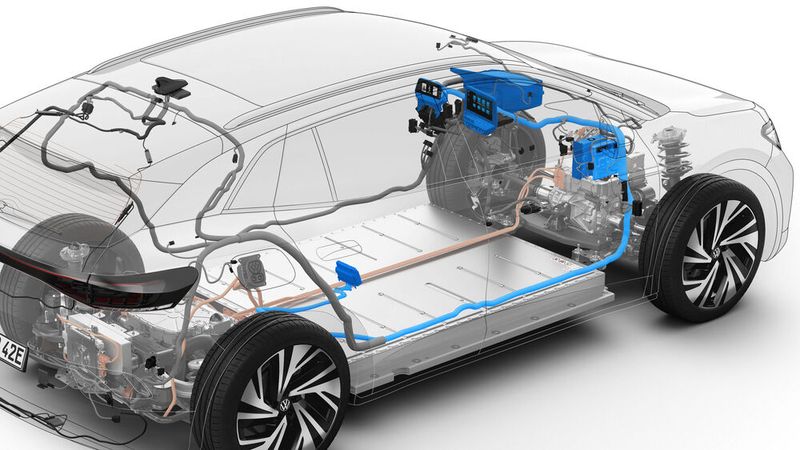
:quality(80)/p7i.vogel.de/wcms/ba/d4/bad4381a8d47b890932f93bc4dfbdfed/0111323802v1.jpeg "Software functions are visible on the displays. However, a comprehensive IT system is needed to coordinate all systems with each other. There are different operating systems for this. (Image:Volkswagen AG)")