The drying of active ingredients through freezing and evaporation is widespread in the pharmaceutical industry. Freeze-drying systems are highly complex, and correspondingly complex are the CAD models. Designers at GEA Lyophil work with Creo and now benefit from significantly accelerated loading times of the models thanks to support from Inneo.
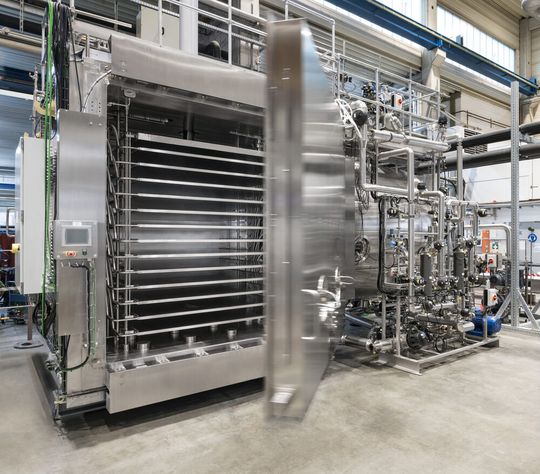
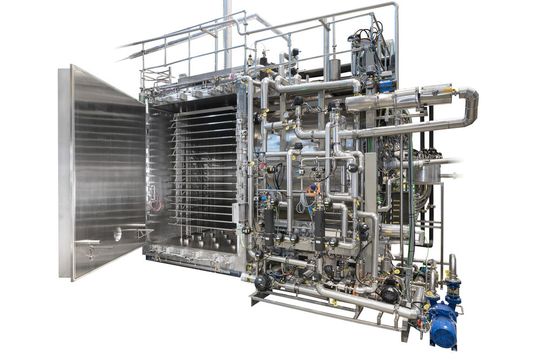
Systems for freeze-drying active ingredients are extremely complex. This results in huge assemblies in the design phase, which can make handling difficult.
(Image: GEA)
Dipl.-Ing. Ralf Steck is a freelance specialist journalist for the areas of CAD/CAM, IT, and mechanical engineering in Friedrichshafen (Germany)
Drying through freezing and evaporation is widespread in the pharmaceutical industry to dry and thus preserve active ingredients. The freeze-drying systems offered by GEA Lyophil in Hürth are highly complex and involve a multitude of individual processes. Accordingly, the CAD models created by GEA in the CAD system Creo are also complex.
GEA Lyophil specializes in freeze drying systems for the pharmaceutical industry. The company name is derived from the process in the systems, where the technical term for freeze drying is "lyophilization," and the term "lyophil" in chemistry means easily soluble or solvent-absorbing. Freeze dryers remove the solvent, usually water, from a liquid by intense cooling and vacuum. The solvent freezes and sublimates very quickly without transitioning into the liquid phase, leaving the dissolved components at the end of the process.
Medicines are mostly composed of large molecules of an active ingredient dissolved in water. Over time, these long-chain molecules decompose, rendering the active ingredient ineffective. Drying prevents decomposition and preserves the active ingredient. If, for example, the medicine were boiled to remove the water, the active ingredient molecules would break down much faster—drying with heat is therefore not an option.
How freeze-drying works
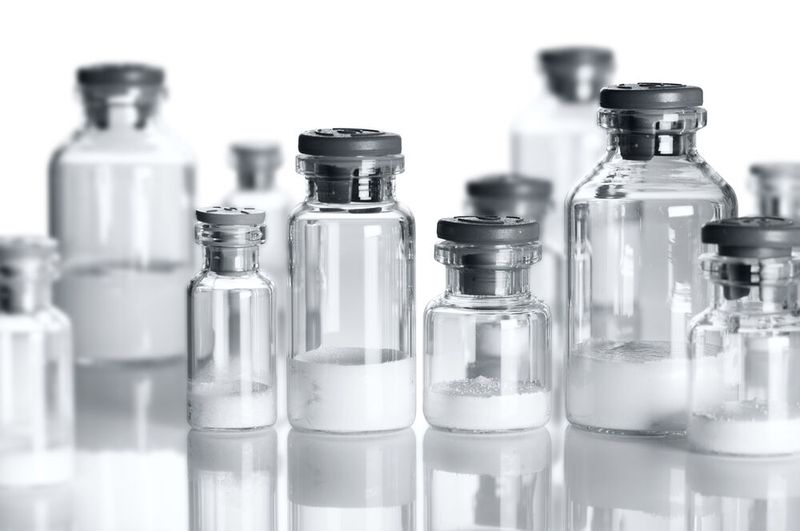
In GEA freeze dryers, thousands of small bottles containing active pharmaceutical ingredients are placed in a chamber. The bottles are already fitted with a lid, but it is not fully closed. They are arranged in multiple layers on trays. These trays are flowed through by silicone oil for temperature regulation, and at the end of the freeze drying process, the tray package is compacted to fully close the lids. This prevents contamination from entering the bottles, which now only contain an active ingredient powder. After removal from the system, the closures are crimped. To use, the user pierces the lid with a needle, injects saline solution into the bottle, and re-dissolves the active ingredient.
Design challenges: temperature fluctuations and plant size
After each freeze drying cycle, which lasts one to two days, the interior of the system is cleaned and sterilized with hot steam at 248°F. Then, the next batch is loaded, and the next drying process is carried out at -112°F. "The temperature fluctuations are enormous," explains designer Alexey Bauer, "and we have to take that into account in the design. A whole series of processes run consecutively or in parallel within the systems, in addition to feeding and sealing the finished products. This affects a wide range of process engineering procedures and makes the systems very complex."
In addition, the systems can be very large, ranging from laboratory units the size of a double-door refrigerator to multi-story systems integrated into larger production lines. Therefore, the work in the design department has a lot to do with buildings—whether it's fitting systems into existing buildings and production facilities or dealing with installation situations and assembly.
Real custom machine engineering—customer-specific systems
Freeze dryers are complex systems that need to be tailored individually to the customer and process.
(Image: GEA)
Each system is tailored to the process and the customer, thus representing true special-purpose machine construction. Only components can be reused, while the majority of parts and assemblies are specific to a system. Due to this complexity, 3D CAD was adopted early on, and Creo was introduced in 2004, then known as Pro/Engineer. The designers initially modeled primarily the chamber and the condenser of the drying systems, while the numerous pipelines were manually constructed according to the P&ID plans (Piping and Instrumentation Diagram).
"In recent years, customer demands on delivery times increased," recalls Bauer. "An analysis showed that the greatest potential for time savings was in manufacturing, particularly in piping."
An analysis revealed that the greatest potential for time savings was in manufacturing, particularly in piping.
Alexey Bauer
In addition, customers increasingly demanded a complete model of the machine, preferably in Navisworks. Navisworks is mainly used for 3D design review in the architecture, engineering, and construction industries to complement 3D design packages, and it allows for the analysis of the installation situation in the building. For this, the most complete 3D data of all machine components is necessary.
Date: 08.12.2025
Naturally, we always handle your personal data responsibly. Any personal data we receive from you is processed in accordance with applicable data protection legislation. For detailed information please see our privacy policy.
Consent to the use of data for promotional purposes
I hereby consent to Vogel Communications Group GmbH & Co. KG, Max-Planck-Str. 7-9, 97082 Würzburg including any affiliated companies according to §§ 15 et seq. AktG (hereafter: Vogel Communications Group) using my e-mail address to send editorial newsletters. A list of all affiliated companies can be found here
Newsletter content may include all products and services of any companies mentioned above, including for example specialist journals and books, events and fairs as well as event-related products and services, print and digital media offers and services such as additional (editorial) newsletters, raffles, lead campaigns, market research both online and offline, specialist webportals and e-learning offers. In case my personal telephone number has also been collected, it may be used for offers of aforementioned products, for services of the companies mentioned above, and market research purposes.
Additionally, my consent also includes the processing of my email address and telephone number for data matching for marketing purposes with select advertising partners such as LinkedIn, Google, and Meta. For this, Vogel Communications Group may transmit said data in hashed form to the advertising partners who then use said data to determine whether I am also a member of the mentioned advertising partner portals. Vogel Communications Group uses this feature for the purposes of re-targeting (up-selling, cross-selling, and customer loyalty), generating so-called look-alike audiences for acquisition of new customers, and as basis for exclusion for on-going advertising campaigns. Further information can be found in section “data matching for marketing purposes”.
In case I access protected data on Internet portals of Vogel Communications Group including any affiliated companies according to §§ 15 et seq. AktG, I need to provide further data in order to register for the access to such content. In return for this free access to editorial content, my data may be used in accordance with this consent for the purposes stated here. This does not apply to data matching for marketing purposes.
Right of revocation
I understand that I can revoke my consent at will. My revocation does not change the lawfulness of data processing that was conducted based on my consent leading up to my revocation. One option to declare my revocation is to use the contact form found at https://contact.vogel.de. In case I no longer wish to receive certain newsletters, I have subscribed to, I can also click on the unsubscribe link included at the end of a newsletter. Further information regarding my right of revocation and the implementation of it as well as the consequences of my revocation can be found in the data protection declaration, section editorial newsletter.
Challenge time: Make large models usable too
The goal was to model the entire system with all the pipelines in Creo. However, the first attempts revealed a new problem: the models became so slow that efficient work was unthinkable. Just opening the model of a large system could take six to seven hours. At the same time, the systems became more detailed as it became clear how beneficial the comprehensive representation of all system parts is, for example, for laying the piping—the designer can see very precisely in a complete CAD model where there is space for a pipe or component.
In their desperation, the GEA officials turned to Inneo, a specialist in Creo, product development, and design methodology. "By the second phone call, we had a real specialist on the line," Bauer recalls. "He simply said that if a model takes more than five minutes to load, something went wrong in the modeling. He quickly analyzed the situation and was able to give us the first tips over the phone on how to configure Creo so that even large models remain usable." When these tips showed noticeable results, a closer collaboration was agreed upon.
"That wasn't easy," Bauer recalls the time about two years ago. "The Inneo specialists scrutinized every single setting and process in the design. It often turned out that the processes suggested by Inneo were not only simpler but also less taxing on the model." The innovations developed together with Inneo were documented by Bauer in detailed work instructions so that they could be implemented by all designers at the now over 30 Creo workstations.
The Inneo specialists scrutinized every single setting and process in the design. It often turned out that the processes suggested by Inneo were not only simpler but also placed less strain on the model.
Alexey Bauer
Advantages also and especially in the later design phases
One of the most important tips was using Creo Piping for modeling the pipelines, valves, and instruments. Bauer recalls, "We had experimented with Creo Piping back in 2005 or 2006 and did not have a good experience. At that time, the system was not advanced enough for us to use it efficiently, so we worked without the piping module for many years. However, this manual pipe construction was one of the main reasons for the exponentially growing processing times."
Instead of 25 minutes, opening the complete assembly now takes only three and a half minutes, thanks to support from Inneo.
(Image: GEA)
In 2023, another attempt with Creo Piping was made, and it quickly became apparent that the software had made significant advancements. Bauer reports, "We started with an initial meeting in early August, after which an Inneo employee spent a week with us to analyze the situation and develop solutions. These were fully implemented within a month, including the introduction of Creo Piping."
In November, the first project began in which the Inneo suggestions were implemented from the start. The results surprised the GEA designers: instead of 25 minutes, opening the complete assembly took only three and a half minutes. It was easily possible to work in the main assembly, which is particularly important in the later stages of design to utilize the available space.
Wanted: More optimization potential
And last but not least, Creo Piping is a great relief, as Bauer lists: "A flange connection no longer has to be modeled with all individual parts but is defined with a single click. Each pipeline can be color-coded differently, greatly simplifying the understanding of the system. Additionally, the models have become significantly more agile and can be processed very efficiently. We are still in the process of using piping correctly, but even now the module is performing more than we expected. We can now use piping in every project and are eager for the first large project that we will realize from the start with the new system."
The designer continues: "We are not even using the full potential of the system because we still use our own libraries for fittings and piping instead of those provided by Inneo. But there's a lot of work in our libraries, and adapting the Inneo libraries to our needs would take a lot of time."
We are not even using the full potential of the system because we still use our own libraries for fittings and piping instead of those provided by Inneo.
Alexey Bauer
Next, an in-depth system analysis is expected to reveal further improvement potential, as Bauer explains: "With today's shortage of skilled workers, we cannot simply absorb growth by hiring more staff; we need to make the existing team more efficient. Better tools mean less unproductive waiting time. For us, CAD is not an end in itself but simply a tool that should work—actually, all our designers are process engineers."
"In a year, GEA Lyophil will move to a larger location," Bauer looks to the future. "Then we want to broadly implement Windchill and use it throughout the entire process. A project for this is currently underway with Inneo. After the consistently positive experiences we've had with Inneo, we are confident that this project will also advance us significantly. We want to further deepen our collaboration and are already looking forward to it."



:quality(80)/p7i.vogel.de/wcms/dd/08/dd086510d9ae7b50181f6070e4463b44/0129363730v1.jpeg "Typical application for ionizing devices: Wrapping films. (Picture: ©Adobe Stock/SMC)")
:quality(80)/p7i.vogel.de/wcms/35/57/3557c819943c53acec41a0ccba87da4f/0130049064v1.jpeg "Researchers at the Fraunhofer IWU in Chemnitz have long known that many typical sheet metal parts can be manufactured more cost-effectively using hollow embossing rollers. Now there is news to report ... (Image:Fraunhofer IWU)")
:quality(80)/p7i.vogel.de/wcms/59/02/590246e3b3f415c65edbee377c14ca77/26-06-pi-fraunhofer-iws-41450-direktplattieren-pic-01-7771x4369v1v1.jpeg "The Fraunhofer IWS has developed the new \"direct laser cladding\" process, which creates a functional layer directly on the base body by applying a strip-shaped metal to rotationally symmetrical components in a spiral and bonding it locally by laser. (Image:Christoph Wilsnack/Fraunhofer IWS)")
:quality(80)/p7i.vogel.de/wcms/73/60/73608418789b1d9c393f5e2fa974eda2/0130209906v1.jpeg "The robots of the X6 generation from b+m enable very high painting quality and are also particularly compact and easy to maintain. (Image:Beckhoff)")
:quality(80)/p7i.vogel.de/wcms/78/e9/78e9188c25a8a94e67c34c9bf8ffe495/visual-agile-20robots-20and-20google-20deepmind-20partner-20to-20bring-20intelligence-20to-20robotics-2500x1406v1v1.jpeg "Together, the partners are developing adaptable, intelligent robots for a wide range of applications (Image:Agile Robots SE)")
:quality(80)/p7i.vogel.de/wcms/e7/66/e7669ecf0260ae8fc54c214e34e4902a/0130316817v1.jpeg "Siemens and Palo Alto Networks offer tested cybersecurity solution for industrial 5G. (Image:Siemens)")
:quality(80)/p7i.vogel.de/wcms/9f/55/9f55324832c4f426958031375124d9de/siemens-20ubtech-20hmnd-1920x1079v1v1.png "Ready for the factory floor: While Ubtech is planning mass production, Siemens is already testing humanoids in real factory applications in Erlangen. (Image:Siemens)")
:quality(80)/p7i.vogel.de/wcms/11/36/113695ed260e29c8c2d9d39dc5f9d869/0130213768v1.jpeg "AI can work cheaply in China and deliver the results rapidly all over the world. (Image:Dall-E / AI-generated)")
:quality(80)/p7i.vogel.de/wcms/62/5f/625f41e87ebfef156a98c8e6393e32fd/0130211654v1.jpeg "Axial flux motors have some advantages over radial flux motor—but their production is currently still expensive. (Image:RWTH Aachen University)")
:quality(80)/p7i.vogel.de/wcms/77/9b/779b0685d010dfe45c9c2cb1cfecd467/0128886425v1.jpeg "The BlueEye is the first \"real\" hyperspectral camera for the UV range and covers the wavelength range from 220 to 380nm. (Image:Inno-spec GmbH)")
:quality(80)/p7i.vogel.de/wcms/e4/51/e451d52ce0182fb0aaa46a5774f832ef/26-04-pi-fraunhofer-iws-21160-bioslide-pic-01-4128x2321v1v1.jpeg "With the BioSlide research project, the Fraunhofer IWS is investigating how sliding systems can be designed to be more sustainable and energy-efficient. New materials can be tested in a particularly application-oriented manner on this plain bearing test stand. (Image:Fraunhofer IWS)")
![Thanks to advanced 3D printing technology, a more efficient use of resources should contribute to lower-emission aviation—this is the goal of ['skai]-lab. (Image:Oleksandr Pashchenko - stock.adobe.com / AI-generated)](https://cdn1.vogel.de/nghHNSbySccfOjG3n1qCA-FVOjQ=/288x162/smart/filters:format(jpg):quality(80)/p7i.vogel.de/wcms/62/64/626424c97a16e69f871bf216c9629c2a/adobestock-1927043193--c2-a9-20oleksandr-20pashchenko-20-e2-80-93-20stock-adobe-com-ki-generiertv1v1.jpeg "Thanks to advanced 3D printing technology, a more efficient use of resources should contribute to lower-emission aviation—this is the goal of ['skai]-lab. (Image:Oleksandr Pashchenko - stock.adobe.com / AI-generated)")
:quality(80)/p7i.vogel.de/wcms/c3/c4/c3c4ce270b083eeac55654148611f064/0130237945v1.jpeg "China is not giving up on hydrogen, but is intensifying its efforts. (Image:freely licensed from Pixabay)")
:quality(80)/p7i.vogel.de/wcms/4e/c0/4ec0bd19390b169edfa23677373dcdf1/0130260089v1.jpeg "Renewable fuels can supply European road traffic, according to a study. (Image:Aral)")
:quality(80)/p7i.vogel.de/wcms/6f/c9/6fc9050301d745cad25585c6780f8f51/0130197341v1.jpeg "Production facilities are a worthwhile target and are therefore at risk. (Image:ABB Robotics)")
:quality(80)/p7i.vogel.de/wcms/b6/62/b662adc2cec8227d8172509bbfb6ee42/25c0207-107-4961x2789v1v1.jpeg "The GLB is the second model based on Mercedes' new MMA platform. Apparently, Geely's platform is better and cheaper, which is why the two companies are negotiating a partnership. (Image:Mercedes-Benz)")
:quality(80)/p7i.vogel.de/wcms/4d/dd/4dddf438e91f394c04a095dbfd109d1c/0130236430v1.jpeg "Measurement modules: The 720301 module in combination with the SL2000 enables RMS and power calculations, among other things. (Image:Yokogawa)")
:quality(80)/p7i.vogel.de/wcms/61/fc/61fcf95f5cca15494ad18343901ae585/0130317237v1.jpeg "With the AGI CPU, Arm says it is taking a \"historic step\": With the processor aimed at AI in data centers, the company is presenting itself for the first time as a provider of its own chips, not just as a pure IP licensor. (Image:Arm)")
:quality(80)/p7i.vogel.de/wcms/82/90/8290dfe3595b6c6b33726ae8b76172c7/0130319587v1.jpeg "The concept image illustrates how the pattern of tiny protrusions and depressions created on the substrate (MgO, bottom) controls the arrangement of atoms in the superconducting material (YBCO, top). At the interface between the two layers, an electronic structure enables superconductivity to occur at higher temperatures than previously possible. (Image:Chalmers University of Technology / Riccardo Arpaia)")
:fill(fff,0)/images.vogel.de/vogelonline/companyimg/76800/76895/65.jpg "FAULHABER_120mm.jpg ()")
:fill(fff,0)/p7i.vogel.de/companies/67/eb/67eba621ef6ea/logo2.png "logo2 (Wuxi InfiMotion)")
:quality(80)/p7i.vogel.de/wcms/3d/3f/3d3f5d065ef66c9ba2b51ff240a7de5d/0126756957v1.jpeg "In hardware development, where physical properties, chemical resistance, and regulatory requirements intersect, an ALM system provides the necessary clarity. (Image: ©Kwangmoozaa – stock.adobe.com)")
:quality(80)/p7i.vogel.de/wcms/3e/5e/3e5e5ee0739d85653a8499cc7c0c4752/0126756957v1.jpeg "In hardware development, where physical properties, chemical resistance, and regulatory requirements intersect, an ALM system provides the necessary clarity. (Image: ©Kwangmoozaa – stock.adobe.com)")