Recalls like the Takata airbag scandal show how far-reaching the consequences can be when requirements are not fully captured or documented. ALM systems reduce the risk.
In hardware development, where physical properties, chemical resistance, and regulatory requirements intersect, an ALM system provides the necessary clarity.
It is one of those stories told in lectures when the material is dry and a bit of life is needed to liven up the theory. A lecturer in plastics engineering tells the story of a small, medium-sized injection molding company specializing in the production of airbag covers for the automotive industry. A solid business, technically demanding but manageable. Until one day, a message from Australia arrives that calls everything into question.
There, at the other end of the world, airbags deploy without any apparent reason. The vehicles are intact, the sensors seem to be functioning—and yet the safety systems activate as if an accident had occurred. Suspicion quickly falls on the covers. The quality of the production is called into question, and a recall is on the horizon. For the small company, this would be a financial disaster.
Far-Reaching Consequences of Flawed Requirements Definition
What follows is an intensive investigation and a surprising discovery: it is not the production that failed, but the environmental conditions. In Australia, where the sun shines relentlessly, people frequently use sunscreen. And it is precisely these creams that contain ingredients that, over time, react with the plastic of the covers. The material becomes soft, loses its strength—and the airbags deploy. But the company can breathe a sigh of relief: resistance to sunscreen was never part of the specifications. There is no liability.
Whether this story is true cannot be determined with certainty. However, real-life recalls, such as the globally known Takata airbag scandal, show us how far-reaching the consequences can be when requirements are not fully captured or documented: millions of vehicles had to be recalled because faulty inflators caused life-threatening situations. Other cases—such as defective braking systems, faulty electronic components, or flying panels as seen with Tesla Cybertrucks—also highlight how crucial complete documentation and traceability of technical requirements are.
The difference between a controlled risk and an existential image-damaging crisis is made by Application Lifecycle Management, or ALM.
ALM System is the Backbone of A Structured Development Process
In the world of technical development, nothing is as dangerous as relying on gut feeling. Products today are created in a complex interplay of requirements, standards, tests, and documentation. An ALM system is far more than a digital storage system—it is the backbone of a structured development process.
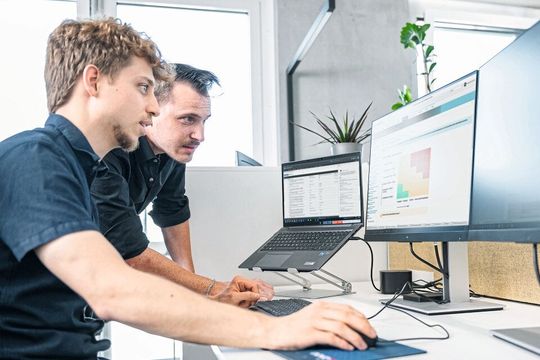
ALM systems like Codebeamer enable seamless documentation and traceability of technical requirements.
(Image: Inneo)
Especially in hardware development, where physical properties, chemical resistance, and regulatory requirements intersect, an ALM system provides the necessary clarity. It accompanies a product from the initial idea through specification and design to validation and maintenance. The work is often guided by the so-called V-model—a process model that links development phases with the corresponding review and test steps.
The V-model can be imagined as a bridge: on the left side, requirements are defined, systems are designed, and components are specified. On the right side, it is verified whether these requirements have been met—through integration tests, system tests, and approvals. The ALM system digitally represents this bridge and ensures that no step is missed, no requirement is forgotten, and every decision remains traceable. Scalable solutions like ReqMan or Codebeamer, available in Inneo's portfolio, offer flexible and powerful tools to efficiently shape these processes.
Why Clean Documentation And A Structured Approach Are Important
Let’s take a real-world example: A company develops a new housing for a control unit to be installed in vehicles. The requirements are clear—the material must withstand extreme temperatures, be UV-resistant, and remain resistant to chemicals such as engine oil or brake fluid. But how can it be ensured that all these requirements are not only considered but also implemented and tested?
This is where the interplay of the V-model and ALM system comes into play:
The requirements are first systematically captured, analyzed, and transferred into technical specifications.
Each of these steps is mirrored by corresponding tests.
The ALM system links the requirements with the test cases, documents changes, and makes the results transparent.
This creates an unbroken chain—from the idea to implementation to validation.
And if a problem arises later, for example, due to a cleaning agent that affects the plastic, the company can prove: This substance was never part of the specification. The responsibility does not lie with the manufacturer but with the client or user. What seems like bureaucratic effort becomes the company's lifeline in an emergency.
Date: 08.12.2025
Naturally, we always handle your personal data responsibly. Any personal data we receive from you is processed in accordance with applicable data protection legislation. For detailed information please see our privacy policy.
Consent to the use of data for promotional purposes
I hereby consent to Vogel Communications Group GmbH & Co. KG, Max-Planck-Str. 7-9, 97082 Würzburg including any affiliated companies according to §§ 15 et seq. AktG (hereafter: Vogel Communications Group) using my e-mail address to send editorial newsletters. A list of all affiliated companies can be found here
Newsletter content may include all products and services of any companies mentioned above, including for example specialist journals and books, events and fairs as well as event-related products and services, print and digital media offers and services such as additional (editorial) newsletters, raffles, lead campaigns, market research both online and offline, specialist webportals and e-learning offers. In case my personal telephone number has also been collected, it may be used for offers of aforementioned products, for services of the companies mentioned above, and market research purposes.
Additionally, my consent also includes the processing of my email address and telephone number for data matching for marketing purposes with select advertising partners such as LinkedIn, Google, and Meta. For this, Vogel Communications Group may transmit said data in hashed form to the advertising partners who then use said data to determine whether I am also a member of the mentioned advertising partner portals. Vogel Communications Group uses this feature for the purposes of re-targeting (up-selling, cross-selling, and customer loyalty), generating so-called look-alike audiences for acquisition of new customers, and as basis for exclusion for on-going advertising campaigns. Further information can be found in section “data matching for marketing purposes”.
In case I access protected data on Internet portals of Vogel Communications Group including any affiliated companies according to §§ 15 et seq. AktG, I need to provide further data in order to register for the access to such content. In return for this free access to editorial content, my data may be used in accordance with this consent for the purposes stated here. This does not apply to data matching for marketing purposes.
Right of revocation
I understand that I can revoke my consent at will. My revocation does not change the lawfulness of data processing that was conducted based on my consent leading up to my revocation. One option to declare my revocation is to use the contact form found at https://contact.vogel.de. In case I no longer wish to receive certain newsletters, I have subscribed to, I can also click on the unsubscribe link included at the end of a newsletter. Further information regarding my right of revocation and the implementation of it as well as the consequences of my revocation can be found in the data protection declaration, section editorial newsletter.
As long as everything works, comprehensive management often seems like unnecessary ballast. But as soon as something goes wrong, the value of clean documentation, clear traceability, and a structured approach becomes evident. The story with the sunscreen is a symbol of this: a seemingly harmless influence can trigger a chain of events that lead to financial ruin—if the requirements are not properly documented.
ALM systems are not bureaucratic monsters. They are tools that help manage complexity, identify risks, and ensure quality.
ALM Systems Create Transparency And Protect Against Blind Flights
ALM systems are not bureaucratic monsters. They are tools that help manage complexity, identify risks, and ensure quality. They create transparency, enable collaboration, and protect companies from flying blind. Ignoring them means relying on luck—and risking that a harmless sunscreen becomes the cause of a disaster.
The advantages of Application Lifecycle Management in hardware development:
Transparency: ALM tools provide a consistent view for all teams involved, enabling precise project planning and real-time decisions.
Efficient requirements management: Specifications and requirements can be systematically captured, adjusted, and documented, which is helpful for certifications and standards in the hardware sector.
Improved collaboration and quality: Unified workflows and centralized documentation enhance collaboration between development, testing, and quality assurance, minimizing errors.
Shorter development cycles: Continuity and automation of many processes, such as approvals and testing, accelerate development.
Continuous optimization: ALM platforms promote continuous improvement through systematic collection and analysis of test results, user feedback, and process data.
Future-Proof Authentication with Universal RFID Readers



:quality(80)/p7i.vogel.de/wcms/dd/92/dd928ba2e2956aa2bfff4888af8b08f8/photo--1v1.jpeg "Catalog product for extreme operating conditions: The new NRTVG guide carriage from Bosch Rexroth withstands extreme environmental conditions. (Source: Bosch Rexroth AG)")
:quality(80)/p7i.vogel.de/wcms/5a/9e/5a9e57e26964ba5c9d8719a9ee520bb3/0133310195v1.jpeg "Germany and the United Arab Emirates have signed an agreement to stand shoulder to shoulder in times of crisis. This will bring Germany many billions, to say the least.
From left: Sheikh Mohammed bin Sajed al-Nahjan and Federal Chancellor Friedrich Merz. (Image:dpa / K. Nietfeld)")
:quality(80)/p7i.vogel.de/wcms/ce/96/ce964ee3cbd875e63a809c3df1d2b01e/0133312918v1.jpeg "Do you also have a branch in China and are looking for a local partner there with whom you can work to strengthen your market position? If so, time is running out, as a survey by the German Chamber of Foreign Trade in Beijing reveals ... (Image: AI-generated)")
:quality(80)/p7i.vogel.de/wcms/a0/94/a09489b453e958dc8ffd85accab2aaf3/0130556732v1.jpeg "Mutares supported two of its portfolio companies to help them strengthen their position. It worked out perfectly. Now both have been sold. Read here to find out exactly what this is all about... (Image:Mutares)")
:quality(80)/p7i.vogel.de/wcms/81/dc/81dc63ed24c562521413023779495e7d/chris-kramerv1.jpeg "Chris Kramar, Director and General Manager of OEM Solutions for Germany, Austria, and Switzerland at Dell Technologies (Source: Dell Technologies)")
:quality(80)/p7i.vogel.de/wcms/bb/f5/bbf5342f532debc1bd7c09c2b9a0bf42/0133176497v1.jpeg "Over the past two years, AI has emerged as the most important growth driver in the industry. (Image: ©Gorodenkoff - stock.adobe.com)")
:quality(80)/p7i.vogel.de/wcms/01/61/01615a0939754c41e9d2c8971bf0b38a/web-image-kuka-kmf-1500p-300-dpi-1v1.jpeg "Thanks to its design, the KMF 1500P-CB is suitable for the stable and flexible handling of closed and open pallets. (Source: Kuka)")
:quality(80)/p7i.vogel.de/wcms/0b/ef/0bef343dfe1c7f83a1be01e7e83cc5ac/delta-fabrikv1.jpeg "Autonomous mobile manipulation robots can perform a wide range of tasks in a modern factory, from loading machines to quality control. (Image:Delta)")
:quality(80)/p7i.vogel.de/wcms/f4/3d/f43d1f4297d9ae0cd1b6d2adfcb5ffe1/0133276470v1.jpeg "Simulation: Electric arcs in the electrical industry, including associated field simulation. (Image:CADFEM)")
:quality(80)/p7i.vogel.de/wcms/1d/fb/1dfbb415cd837102a33ce21ecf052ec3/0133277411v1.jpeg "LED drivers: LED circuit boards connect the light fixture to the electronics. During design, the operating current, forward voltage, and temperature must be taken into account across the entire operating range. (Image: ©Maria - stock.adobe.com)")
:quality(80)/p7i.vogel.de/wcms/80/8a/808a0eccf49a2a4fe560bd1998506ef9/0133308770v1.jpeg "Just like that, the supports are gone! High-speed footage of the automated, ultrasound-based process for removing optimized support structures from additively manufactured metal parts. It will be presented for the first time at Formnext from November 17 to 20. (Image:Fraunhofer IAPT)")
:quality(80)/p7i.vogel.de/wcms/be/4d/be4d7294d3d171468dc0b83efa4f442c/0133268906v1.jpeg "Here, two experts from Lufthansa Technik are applying the “AeroSHARK” coating to an aircraft. Until now, Boeing has been using this coating, which mimics the skin structure of sharks. Now Airbus also wants to use it to make its aircraft more fuel-efficient. (Image:Lufthansa Technik)")
:quality(80)/p7i.vogel.de/wcms/39/86/398641ac031ac48fd402c27ffe4f0e0d/zf-screenshot-2026-09-09-131739v1.png "The decarbonization of commercial vehicles will be a key topic at IAA Transportation next week. ZF is advocating for a more technology-neutral approach. (Image:ZF)")
:quality(80)/p7i.vogel.de/wcms/94/1e/941e22de0ec2d22e9619c469ec79292b/20260731163822591v1.jpeg "The Chinese government wants its automakers to adhere to certain rules of conduct when operating abroad. (Image:Sany Truck)")
:quality(80)/p7i.vogel.de/wcms/33/f6/33f69ba076b4f655d74bd6788cf5c4a0/0133305882v1.jpeg "As they move toward production readiness, the BMW iX5 Hydrogen prototypes are undergoing an extensive testing program. (Image:BMW)")
:quality(80)/p7i.vogel.de/wcms/bb/02/bb02989aac1291557168fb36afc42343/0133288089v1.jpeg "In China, automakers will be held liable in the future if traffic rules are violated while in autonomous driving mode and, for example, an accident occurs. (Image:Created with AI)")
:quality(80)/p7i.vogel.de/wcms/6c/a6/6ca6c6410e051401d5596d5cc6dfa277/0133283570v1.jpeg "From Core to Platform: With MIPS, ARC, and RISC-V, competition is shifting from individual processor IP blocks to integrated compute platforms for specialized applications. (Image:Dall-E / AI-generated)")
:quality(80)/p7i.vogel.de/wcms/73/17/73174a2afe684fa12d7d6a57b29b20e2/0133305506v1.jpeg "AI data centers are a key driver of direct current technologies. (Image:Pixabay / Brian Penny / AI-generated)")
:quality(80)/p7i.vogel.de/wcms/08/b2/08b2ce49b6d6d11d5953064bb0a62f37/0133308791v1.jpeg "If what Anthropics is accusing its Chinese AI competitors of is true, then the industry is in for quite a shakeup! At stake is nothing less than Chinese AI systems—such as Kimi and Deepseek—that were actually trained indirectly using U.S. AI systems. (Image: AI-generated)")
:quality(80)/p7i.vogel.de/wcms/c4/b5/c4b5badd67b0037f23c1d69806a13d16/0133216860v1.jpeg "Fascinating Technology: ASML's NXE3800E EUV machine. (Image:ASML)")
:fill(fff,0)/p7i.vogel.de/companies/69/de/69de1b7403b0d/simtos-logo.jpeg "simtos-logo (SIMTOS)")

:quality(80):fill(efefef,0)/p7i.vogel.de/wcms/67/ae/67ae0b9ac31f8/elatec-wp-universal-reader.png "Elatec WP Universal Reader")
:quality(80)/p7i.vogel.de/wcms/3e/5e/3e5e5ee0739d85653a8499cc7c0c4752/0126756957v1.jpeg "In hardware development, where physical properties, chemical resistance, and regulatory requirements intersect, an ALM system provides the necessary clarity. (Image: ©Kwangmoozaa – stock.adobe.com)")
:quality(80)/p7i.vogel.de/wcms/6b/70/6b70cd2fc515dee01219b578d82eb419/0132755946v1.jpeg "Artificial intelligence can help detect quality issues earlier and turn the 8D report into an efficiency booster. (Image:AI-generated)")