A new permanent magnet machine for mobile off-highway applications provides a significantly more efficient, safer, and low-maintenance alternative to hydraulic motors. With the same power density as a hydraulic motor, the electric machine offers other crucial advantages.
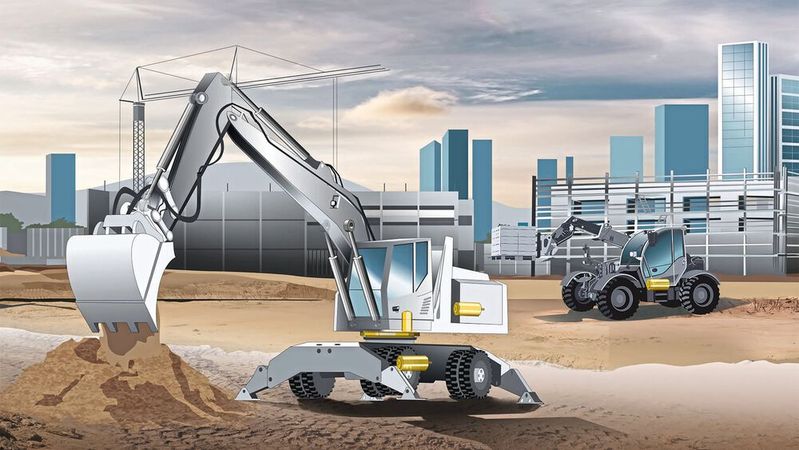
The permanent magnet machines for mobile off-highway applications provide a significantly more efficient, safe, and low-maintenance alternative to hydraulic motors.
(Image: Liebherr-Components)
In mobile work machines, operational safety, robustness, durability, and efficiency have always been important—as well as compact designs. Until now, hydraulic motors have been able to offer a power density that met the high demands of mobile applications such as excavators, wheel loaders, and telehandlers. Now, Liebherr introduces a new design of permanent magnet machines. It comes with the same power density as hydraulic motors, but without the efforts and risks that the extensive piping systems of these motors entail.
In permanent magnet synchronous machines (PMSM), magnets generate a constant magnetic field in the rotor. The rotating magnetic field of the stator pulls the rotor synchronously along, as the magnetic poles strive to align with the stator field. This creates torque in a low-loss manner, as no electrical excitation is required in the rotor. This efficiency and precision make PMSMs the preferred choice in electric vehicles and modern industrial drives.
Increased machine efficiency to 94 to 96 percent
Liebherr has now optimized the design of permanent magnet machines, increasing their efficiency to 94 to 96 percent. The higher power density of the new motor compared to conventional PMSM was achieved through a combination of several measures. First, a systematic analysis of torque generation was conducted to precisely understand the relevant components and their impact on overall performance. Based on this analysis, precise solutions were developed, with the improvement of cooling identified as the most crucial factor for the increased power density.
In addition to cooling, the mechanical structure of the motor was also optimized, further increasing the torque density and improving the overall performance of the system. A particular challenge was integrating all these individual improvements into an economically attractive overall system without exceeding the installation space of a hydrostat. This was achieved through careful coordination of the various components, allowing the motor to achieve the desired high power density while still fitting into the same installation space as a hydrostat.
A sustainable and future-proof alternative
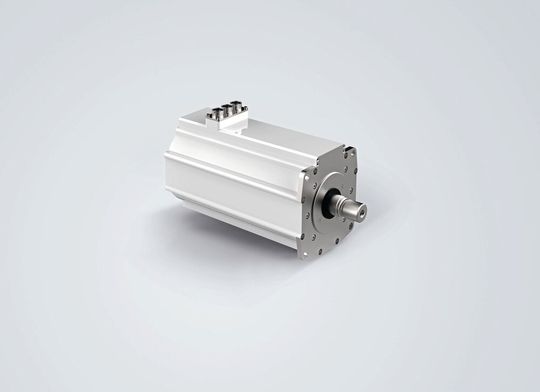
Compact and revolutionary—the innovative design of Liebherr's new electric machines significantly reduces maintenance requirements.
(Image: Liebherr-Components)
The directly oil-cooled electric machine, specifically developed for battery and diesel-electric drive systems, enables quick and easy installation as well as the electrification of existing hydraulic drive concepts. Thanks to moderate pressures in the cooling circuit, the risk of leaks is significantly reduced, enhancing safety. Additionally, there is no further danger from emissions, contamination, or accidents caused by burst pipes.
The design of the motor significantly reduces maintenance requirements. The result is less downtime and lower maintenance costs. Additionally, the high torque relative to speed ensures a longer machine lifespan and increases the MTBF (mean time between failures) in the system by reducing gear stages. Liebherr's permanent magnet machines are suitable for mobile applications where compact space, as well as the reduction of emissions and pollution, are crucial.
The efficiency of electric drive systems can be up to twice as high compared to hydraulic systems because less energy is lost in the form of heat.
Permanent magnet machine far more effective than a hydraulic motor
With an efficiency of 94 to 96 percent, a permanent magnet machine is far more effective than a hydraulic motor (approximately 50 percent) and therefore consumes significantly less energy. Even though the purchase cost of an electric motor is generally higher than that of a hydraulic motor, the new electric machines prove to be more cost-effective over the entire lifespan of the applications when considering the operating costs.
The development aims to enable the integration of electric drives into modern vehicle concepts without extensive structural modifications. Particular attention is paid to maintaining common flange dimensions.
Additional efforts in vehicle control are necessary
Nevertheless, the electric powertrain presents new challenges for vehicle manufacturers. Due to the more direct response of electric drives and the changed requirements in energy management, additional efforts in vehicle control are necessary. Furthermore, the high voltages of such a system require extended qualifications for service personnel. Consequently, existing service networks need to be adapted or expanded. However, through proactive design measures, significant added value can be achieved for the company.
Date: 08.12.2025
Naturally, we always handle your personal data responsibly. Any personal data we receive from you is processed in accordance with applicable data protection legislation. For detailed information please see our privacy policy.
Consent to the use of data for promotional purposes
I hereby consent to Vogel Communications Group GmbH & Co. KG, Max-Planck-Str. 7-9, 97082 Würzburg including any affiliated companies according to §§ 15 et seq. AktG (hereafter: Vogel Communications Group) using my e-mail address to send editorial newsletters. A list of all affiliated companies can be found here
Newsletter content may include all products and services of any companies mentioned above, including for example specialist journals and books, events and fairs as well as event-related products and services, print and digital media offers and services such as additional (editorial) newsletters, raffles, lead campaigns, market research both online and offline, specialist webportals and e-learning offers. In case my personal telephone number has also been collected, it may be used for offers of aforementioned products, for services of the companies mentioned above, and market research purposes.
Additionally, my consent also includes the processing of my email address and telephone number for data matching for marketing purposes with select advertising partners such as LinkedIn, Google, and Meta. For this, Vogel Communications Group may transmit said data in hashed form to the advertising partners who then use said data to determine whether I am also a member of the mentioned advertising partner portals. Vogel Communications Group uses this feature for the purposes of re-targeting (up-selling, cross-selling, and customer loyalty), generating so-called look-alike audiences for acquisition of new customers, and as basis for exclusion for on-going advertising campaigns. Further information can be found in section “data matching for marketing purposes”.
In case I access protected data on Internet portals of Vogel Communications Group including any affiliated companies according to §§ 15 et seq. AktG, I need to provide further data in order to register for the access to such content. In return for this free access to editorial content, my data may be used in accordance with this consent for the purposes stated here. This does not apply to data matching for marketing purposes.
Right of revocation
I understand that I can revoke my consent at will. My revocation does not change the lawfulness of data processing that was conducted based on my consent leading up to my revocation. One option to declare my revocation is to use the contact form found at https://contact.vogel.de. In case I no longer wish to receive certain newsletters, I have subscribed to, I can also click on the unsubscribe link included at the end of a newsletter. Further information regarding my right of revocation and the implementation of it as well as the consequences of my revocation can be found in the data protection declaration, section editorial newsletter.
The type of primary energy supply does not matter in electric drive technology—even with diesel drives, replacing hydraulic systems with electric drives is sensible, as diesel consumption can be significantly reduced depending on the application.
Future-Proof Authentication with Universal RFID Readers



:quality(80)/p7i.vogel.de/wcms/da/58/da58c363e5354da35941bd4b2fe56b5b/0128273113v1.jpeg "The Hirth serration of the TTD drills from Mapal ensures a very stable fit of the drill heads. This enables optimum torque transfer as well as high changeover and concentricity accuracies. (Image:Mapal)")
:quality(80)/p7i.vogel.de/wcms/45/58/4558b829ca844389c7c340a706e80ac5/0129121753v1.jpeg "High-precision milling and grinding with oil on the Kern Micro HD achieves maximum accuracy in the tolerance range of up to 1.5 micrometers in the workpieces. (Image:Kern Mikrotechnik GmbH)")
:quality(80)/p7i.vogel.de/wcms/4b/0f/4b0faa6f14d841b9c739c2e3359eb032/0129335117v1.jpeg "Riccardo Rosa, president of Ucimu, the Italian mechanical engineering association, is not pleased with the overall situation in his country. Here is a status report from the \"boot\" of Europe ... (Image:Ucimu)")
:quality(80)/p7i.vogel.de/wcms/af/1e/af1ec4fca4636f521f780ba0ae009c8e/bild3-werkst-c3-bcck-20und-20werkzeug-5204x2928v1v1.jpeg "The main area of application for the new axial gear cutting machine is the production of rotor shafts for electric vehicles. (Image:Profiroll Technologies)")
:quality(80)/p7i.vogel.de/wcms/cd/fe/cdfe212a3b3206e2ff09dcdf71c11240/0129219561v1.jpeg "Extended S-series: The new Cobot models from Omron lift up to 30 kilograms and are now also protected against dust and water thanks to protection class IP65. (Image:Omron)")
:quality(80)/p7i.vogel.de/wcms/c3/6d/c36d161e7709095fd1de4cb9de27d927/0129133682v1.jpeg "Nanjing is Siemens' largest research and production center for CNC systems, drives and electric motors outside Germany. (Image:Siemens)")
:quality(80)/p7i.vogel.de/wcms/70/dc/70dc2fbc09e6958a72c63bd15e986e14/0129206156v1.jpeg "The global shoe machine manufacturer Desma relies on automation and has been revolutionizing shoe production—together with ABB Robotics for over 40 years. (Image:ABB Robotics)")
:quality(80)/p7i.vogel.de/wcms/60/fd/60fd12ddfe1fb623568736f27d1cfe61/0128606899v1.jpeg "The future of supply chains: AI and dashboards to ensure optimal OTIF values (Picture: ©immimagery - stock.adobe.com)")
:quality(80)/p7i.vogel.de/wcms/8f/ff/8fff835b941e411b6f988a183905309a/0129302533v1.jpeg "The Chair of AI Chip Design at the Technical University of Munich (TUM) has created the EU's first AI chip using modern 7-nanometer technology. In the picture: Chair holder Prof. Hussam Amrouch. (Image:Andreas Heddergott / TU Munich)")
:quality(80)/p7i.vogel.de/wcms/39/38/393873c2ed943bb715a6419d94049b63/geralt-entrepreneur-1340649-1280-1280x720v1v1.jpeg "Visual Components presents its forecast for production simulation in 2026. (Image:Pixabay)")
:quality(80)/p7i.vogel.de/wcms/60/4e/604e2a1ce26f177c5f28c2bff94c2f7d/der-20rotor-20mit-20aktiv-20verwindbaren-20rotorbl-c3-a4ttern-20im-20windkanal-1920x1079v1v1.jpeg "The rotor with actively twistable rotor blades in the wind tunnel: The open measuring section and sound-absorbing wall and model fuselage cladding enable high-quality acoustic measurements. (Image:DLR)")
:quality(80)/p7i.vogel.de/wcms/a8/9a/a89aef1cba3843fa06a1ec1f07cf659b/adobestock-95634179--c2-a9-20crazyforanimeart-20-e2-80-93-20stock-adobe-com-4762x2678v1v1.jpeg "Copied from the octopus: Researchers have developed a film-like thin-film platform that can dynamically change not only its color but also its surface structure. (Image:AdobeStock_95634179_ CrazyForAnimeArt)")
:quality(80)/p7i.vogel.de/wcms/21/8e/218e304ba65372854479aa52b4ccdbe5/0129271089v1.jpeg "Suppliers from Europe are currently facing a variety of challenges. Pictured: The Aumovio headquarters in Frankfurt am Main. (Image:Aumovio)")
:quality(80)/p7i.vogel.de/wcms/d2/40/d240b49c8edba464bf610f0e0b3628f0/p90629460-lowres-2250x1265v1.jpeg "(Source: BMW Group)")
:quality(80)/p7i.vogel.de/wcms/e9/60/e960f8c34a847b11fc576c54d9d46ea6/0129325747v1.jpeg "Robobuses, like WeRide here, are well on the way to becoming an integral part of local public transport. (Image:WeRide)")
:quality(80)/p7i.vogel.de/wcms/e3/8d/e38d7a9b1bcb87f6ef6546654a2ee40f/bild1v1.jpeg "(Source: InfiMotion)")
:quality(80)/p7i.vogel.de/wcms/5b/38/5b385ec75bff6e84b70a02c0c939dd2b/0129331527v1.jpeg "The TSMC site of Japan Advanced Semiconductor Manufacturing in Kumamoto, Japan. While the second fab currently under construction was initially only intended for the production of semiconductors using the N6 process, the contract manufacturer is currently negotiating with the Japanese government to possibly upgrade the site to N3 after all. (Image:JASM)")
:quality(80)/p7i.vogel.de/wcms/02/49/0249ae04d53137282148ff0ef0fbcfa2/0129294209v1.jpeg "Superconductivity can reveal hidden magnetic orders by forcing it to break its own symmetries. (Image:freely licensed)")
:quality(80)/p7i.vogel.de/wcms/82/53/8253c7a38b4891e5822a06405e0124cb/0129319571v1.jpeg "The losses and penetration depth depend on the frequency. (Picture: ©studioworkstock - stock.adobe.com)")
:quality(80)/p7i.vogel.de/wcms/6f/8f/6f8ff5bf9b81829ef22736bc790cecca/0129224894v1.jpeg "View of the quantum optics laboratory at the University of Stuttgart: here, researchers are experimenting with new photon sources for quantum computing and quantum networks. (Image:Barz Group, University of Stuttgart)")
:fill(fff,0)/images.vogel.de/vogelonline/companyimg/76800/76895/65.jpg "FAULHABER_120mm.jpg ()")
:fill(fff,0)/p7i.vogel.de/companies/69/88/69882c428938e/tmts2026-ticec-banner-en-2000px.png "tmts2026-ticec-banner-en-2000px (https://www.tmts.tw/en)")
:fill(fff,0)/p7i.vogel.de/companies/67/eb/67eba621ef6ea/logo2.png "logo2 (Wuxi InfiMotion)")
:quality(80):fill(efefef,0)/p7i.vogel.de/wcms/67/ae/67ae0b9ac31f8/elatec-wp-universal-reader.png "Elatec WP Universal Reader")
:quality(80)/p7i.vogel.de/wcms/6c/3b/6c3b348d3d8b50900dd5df06d55869dd/0128845456v1.jpeg "The combination of magnets without rare earths and synchronous reluctance motors for main and auxiliary drives enables a wide performance range. (Image:Astemo)")
:quality(80)/p7i.vogel.de/wcms/97/6b/976b8b47233ce9ba3ac56dca6ac6b3a9/0127259658v1.jpeg "The technologies in the Ferrari Elettrica. (Image:Ferrari)")