The logistics industry is constantly facing new challenges - driver shortages, falling profit margins, and not least climate change, which is also caused by the industry. However, there is also tremendous potential to address these issues and tackle them through innovations in automation.
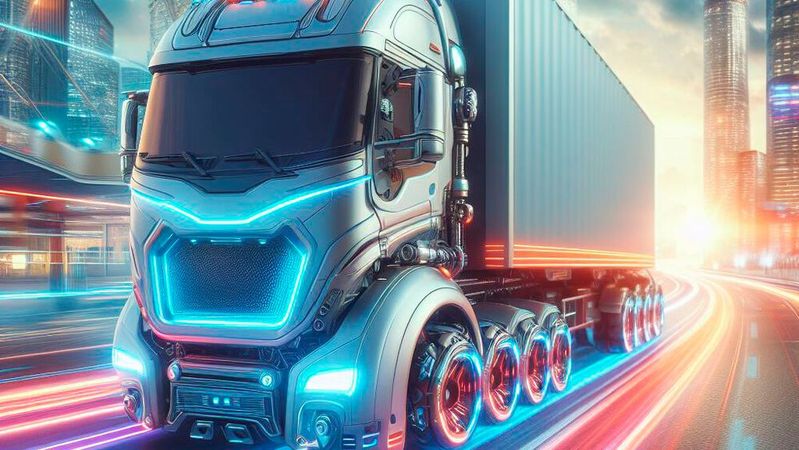
Trucks are currently at the third level of driving automation.
(Image: Aurora Labs)
Alexander Bodensohn is Director of Business Development at Aurora Labs.
Compared to passenger vehicles, commercial vehicles face very specific challenges - whether due to their size, the kilometres to be covered, or the complexity of using autonomy in logistics. A lot of work is being done to future-proof these vehicles. However, these issues are not necessarily a disadvantage in the field of innovation.
In the world of commercial vehicles, there are remarkable advances that lead to impressive new capabilities through new possibilities in sensor technology and data processing.
Driver Assistance Systems
Modern trucks, like passenger cars, are now equipped with advanced driver assistance systems (ADAS). In total, there are six different levels:
Level 0 means that there are no supporting systems installed in the vehicle, i.e., the entire dynamic driving task (DDT) is performed by a human.
At level 1, the autonomous driving system performs an operational design domain (ODD) specific part of the DDT. This means either lateral or longitudinal control, i.e., either steering or accelerating/braking, but not both at the same time.
At level 2, partially automated driving is similar, but with the extension that the autonomous driving system can perform both lateral and longitudinal driving.
Level 3, conditional automation, is a further addition; the autonomous driving system can now perform a larger part of the Dynamic Driving Task (DDT) specific to the Operational Design Domain (ODD) in expectation that the driver is ready to drive when the system requests it. In addition, the autonomous driving system also performs the Object or Event Detection Response (OEDR), i.e., the system recognizes the environment and acts according to the requirements.
At Level 4, high automation, the autonomous driving system now performs the entire DDT within a certain ODD as well as the DDT fallback. This means that the human on the driver's seat is more of a passenger within the specific ODD. However, the human takes over the DDT when the autonomous vehicle leaves the ODD. An example of this is an autonomous vehicle capable of performing the DDT on a highway. But it cannot get on or off the highway itself, but requires a human driver who is capable of performing these tasks.
The final level is level 5, full automation, i.e. the non-ODD-specific execution of the entire DDT by an autonomous driving system the entire DDT and DDT fallback. This means that the autonomous vehicle can be used anywhere a typically trained human driver could drive the vehicle.
Trucks are currently at the third level of automation. Systems, such as the lane-keeping assist and collision reduction, are mainly for the safety of the drivers and other road users. However, due to the size and weight of trucks, additional safety features are needed. Examples of these are the brake hold mode, which relieves drivers during longer standstills, and the automatic stop function, which actively brakes the truck to a safe standstill.
Autonomous driving and platooning
The development of autonomous trucks is progressing rapidly. This is due to the fact that commercial vehicles mainly operate on motorways/highways, where the environment and manoeuvres are less complex. Compared to urban or rural roads, where passenger cars operate, motorway driving is more predictable. Especially in North America or Australia, intercity roads are often very controllable areas of action, in which automation comes into question. Although many tests still include drivers who can intervene if necessary, autonomous trucks are becoming increasingly likely through new hardware innovations that effectively use LiDAR, camera and radar systems, as well as powerful control units that could operate around the clock.
The advantages are obvious. Trucks that do not require a driver are more lucrative for freight companies. But even a relaxation of rest period regulations can lead to efficiency gains.
Despite promising results from truck platooning tests, where a convoy of trucks drive closely behind each other to reduce air resistance and be more efficient, this is more a form of automation than full autonomy. The driver remains necessary, especially when a vehicle separates from the convoy and has to navigate individually to the destination. Some emergency systems, such as the emergency brake assistant, are already mandatory for trucks today and have had to be installed in all new trucks since 2015.
However, the situation is different in enclosed environments. On enclosed premises, where no uninvolved persons are present and thus unpredictable risks are minimized, commercial vehicles can be used fully autonomously. By equipping the environment with sensors, sufficient data can be collected to ensure safe traffic. This area of application is particularly interesting for logistics centers and agriculture. There, large areas are available without external distracting factors, offering the ideal space for fully automated vehicles.
Date: 08.12.2025
Naturally, we always handle your personal data responsibly. Any personal data we receive from you is processed in accordance with applicable data protection legislation. For detailed information please see our privacy policy.
Consent to the use of data for promotional purposes
I hereby consent to Vogel Communications Group GmbH & Co. KG, Max-Planck-Str. 7-9, 97082 Würzburg including any affiliated companies according to §§ 15 et seq. AktG (hereafter: Vogel Communications Group) using my e-mail address to send editorial newsletters. A list of all affiliated companies can be found here
Newsletter content may include all products and services of any companies mentioned above, including for example specialist journals and books, events and fairs as well as event-related products and services, print and digital media offers and services such as additional (editorial) newsletters, raffles, lead campaigns, market research both online and offline, specialist webportals and e-learning offers. In case my personal telephone number has also been collected, it may be used for offers of aforementioned products, for services of the companies mentioned above, and market research purposes.
Additionally, my consent also includes the processing of my email address and telephone number for data matching for marketing purposes with select advertising partners such as LinkedIn, Google, and Meta. For this, Vogel Communications Group may transmit said data in hashed form to the advertising partners who then use said data to determine whether I am also a member of the mentioned advertising partner portals. Vogel Communications Group uses this feature for the purposes of re-targeting (up-selling, cross-selling, and customer loyalty), generating so-called look-alike audiences for acquisition of new customers, and as basis for exclusion for on-going advertising campaigns. Further information can be found in section “data matching for marketing purposes”.
In case I access protected data on Internet portals of Vogel Communications Group including any affiliated companies according to §§ 15 et seq. AktG, I need to provide further data in order to register for the access to such content. In return for this free access to editorial content, my data may be used in accordance with this consent for the purposes stated here. This does not apply to data matching for marketing purposes.
Right of revocation
I understand that I can revoke my consent at will. My revocation does not change the lawfulness of data processing that was conducted based on my consent leading up to my revocation. One option to declare my revocation is to use the contact form found at https://contact.vogel.de. In case I no longer wish to receive certain newsletters, I have subscribed to, I can also click on the unsubscribe link included at the end of a newsletter. Further information regarding my right of revocation and the implementation of it as well as the consequences of my revocation can be found in the data protection declaration, section editorial newsletter.
Predictive Maintenance
With the help of sensors in the vehicle and AI tools, the maintenance needs of a truck can be precisely predicted. This means that technicians no longer need to be sent into the field, but the vehicles can be serviced when they are back at the base. All data, such as weather, route, temperature, and traffic are processed and thus determine the condition of the vehicle.
By predicting a vehicle's maintenance needs, fleet managers can ensure that these routes are covered by other trucks to minimize downtime. Additionally, this type of maintenance also improves safety. For example, tire sensors in combination with predictive maintenance algorithms could help prevent tire blowouts.
Software Innovations
While the hardware is important, it is the software that controls all of these intelligent functions. Almost every control unit/subsystem of a vehicle is significantly controlled by software today. This makes commercial vehicles incredibly complex, necessitating software innovations to ensure that the systems run without problems. After all, downtime is costly in terms of resources.
Intelligent software development tools are therefore necessary to ensure that the system integration is validated throughout the vehicle's life cycle; OTA updates should be carried out without downtime and without interruption of the vehicle's productivity; in addition, continuous monitoring of software behaviour should be carried out, even while driving. This detects system malfunctions before they lead to downtime and thus unnecessary costs.
The use of AI has now become an essential part of this development and maintenance process, helping to identify changes in software code lines, behaviour and relationships within a vehicle. AI provides important insights into the processes of software development, testing, integration, approval, deployment and maintenance. This accelerates development, reduces costs, and at the same time ensures safe, reliable, and robust software systems.



:quality(80)/p7i.vogel.de/wcms/45/e4/45e497fad5299ffbb7278c1636a261ba/0129304667v1.jpeg "Screw head forming with heat: The heads of the blanks are heated to over 1,000 °C in the induction stage. (Image:Aachen mechanical engineering)")
:quality(80)/p7i.vogel.de/wcms/bc/df/bcdfa690253179f44dfa43986e35e3d4/0129302450v1.jpeg "The VSC 400 DDS retrofit machine from EMAG at EWS Weigele with tool shuttle for external tool preparation - the basis for reliable hard machining of gears. (Image:Emag Systems)")
:quality(80)/p7i.vogel.de/wcms/f7/85/f785e961fa2a55ecf4380e1a204c79e3/0129432203v1.jpeg "This is the new Artis 300, which completes the Artis range as the third variant. It stands for TIG DC welding up to 300 amps and is designed as an XT variant for all common voltage levels worldwide. (Image:Fronius)")
:quality(80)/p7i.vogel.de/wcms/28/7c/287ccc5ac565d6e6041bebb1e3e073f0/0113143253v1.jpeg "In our China Market Insider, we regularly provide you with relevant information directly from China. (Image:© Eisenhans - stock.adobe.com)")
:quality(80)/p7i.vogel.de/wcms/99/2e/992e57a54c4ddeaafc113de8e56f2b73/0129501004v1.jpeg "Sereact's AI-based control system can process new and unknown items without prior data collection. (Image:Sereact)")
:quality(80)/p7i.vogel.de/wcms/97/3a/973acc83133c28605f855d750523142e/0129492013v1.jpeg "During the opening, Agile One symbolically pressed the start button. (Image:Deutsche Telekom AG / Cindy Albrecht)")
:quality(80)/p7i.vogel.de/wcms/dd/4e/dd4e6ce73e0e700dcc0f0584813ef47f/0128875162v1.jpeg "Thanks to their high precision, robustness and integration capability, Micro-Epsilon's measurement technology solutions are not only suitable for new systems, but also ideal for retrofit applications. (Image:Micro-Epsilon Messtechnik GmbH & Co. KG)")
:quality(80)/p7i.vogel.de/wcms/17/61/1761a0165c23fe007d0a8e62d2a23121/0129467133v1.jpeg "The partnership between Dassault Systèmes and Nvidia aims to make the industry more effective with the help of AI and digital twins. (Picture: ©DC Studio - stock.adobe.com)")
:quality(80)/p7i.vogel.de/wcms/f8/2d/f82d45c2610205e2c0c188968022890d/more-liftoff-power-first-ariane-6-with-four-boosters-launched-4781x2691v1v1.jpeg "The Ariane 6 can be modularly adapted to any mission—either with two or four boosters and a variable payload fairing length. (Image:ESA-M. Pedoussaut)")
:quality(80)/p7i.vogel.de/wcms/9b/e7/9be7c2ceb897aa2bf1ab4eb2198b8b96/roboter-20hand1-1240x698v1v1.jpeg "What if you could 3D print a soft robot with predictable shape-shifting capabilities already built in? (Image:Picture: Harvard University)")
:quality(80)/p7i.vogel.de/wcms/a7/34/a73475e9638e032c32288f53006abab7/newsimage417867-2665x1500v1v1.jpeg "Combination of a model from a scanning electron microscope image (left) with a section of the underlying crystal structure of a studied MXene with precisely controlled surface terminations. (Image:B. Schröder/HZDR)")
:quality(80)/p7i.vogel.de/wcms/d2/1a/d21a9b3e1333f306ffd6421e84f9e3d0/semiconductor-20image-20courtesy-20of-20gelest-3000x1688v1.jpeg "In a new collaboration, IBM will test the performance of Gelest precursor materials for dry resist EUV lithography, generating results that aim to guide Gelest on materials research and speed innovation toward smaller devices. (Source: Gelest)")
:quality(80)/p7i.vogel.de/wcms/ad/72/ad72626a52c9a9332591f457e5afabca/0129497458v1.jpeg "BMW's new Board Member for Development Joachim Post in the new iX3 model. (Image:BMW)")
:quality(80)/p7i.vogel.de/wcms/12/ce/12ce3b8d4062d9e433419e9ada594c34/adobestock-1669527454-marewa-4096x2304v1v1.jpeg "Symbol image (Image:Marewa - stock.adobe.com)")
:quality(80)/p7i.vogel.de/wcms/e8/1f/e81f2bd61d820a0cf982dd3831f273dd/0129511298v1.jpeg "In China, certain functions in new cars will once again be directly accessible via haptic input—without a screen. (Image:BYD)")
:quality(80)/p7i.vogel.de/wcms/0b/02/0b02abc1524e267ae66ad0609ce08b20/0129482073v1.jpeg "The Haval Jolion Pro competes in the compact SUV segment. (Image:GWM)")
:quality(80)/p7i.vogel.de/wcms/68/ec/68ec268edc51a26c4e6e2de7187e8e4f/0129456364v1.jpeg "The storage facilities are being built at three locations in Lithuania. (Image:Nidec Conversion)")
:quality(80)/p7i.vogel.de/wcms/a0/36/a03679debcdda99158f4eaa0d6fbe43d/0129505643v1.jpeg "Arduino App Lab: The current release 0.4.0 brings a number of helpful new features. (Image:Arduino)")
:quality(80)/p7i.vogel.de/wcms/36/c8/36c8b329076027abf5def92031e3028e/0129508876v1.jpeg "Microsoft German headquarters in Munich: As part of the Munich Security Conference, 15 international companies along the entire electronics value chain have formed a tech alliance for digital sovereignty and common trust standards under the leadership of Microsoft and Ericsson. (Image:Microsoft)")
:quality(80)/p7i.vogel.de/wcms/d5/6e/d56e97cb8afab17e93794c1cca214228/0129419457v1.jpeg "China is investing heavily in its domestic semiconductor ecosystem. If you want to be part of it, you should know in advance where which cluster is located and which technology it is driving forward. (Image:Dall-E / AI-generated)")
:fill(fff,0)/images.vogel.de/vogelonline/companyimg/76800/76895/65.jpg "FAULHABER_120mm.jpg ()")
:fill(fff,0)/p7i.vogel.de/companies/67/eb/67eba621ef6ea/logo2.png "logo2 (Wuxi InfiMotion)")
:quality(80)/p7i.vogel.de/wcms/cd/bc/cdbca4cccf7785615e79346abf9f8a09/aurora-launch-1-7680x4316v1v1.jpeg "Aurora has put the first self-driving truck on the road.
(Image:Aurora)")
:quality(80)/p7i.vogel.de/wcms/bb/6e/bb6e230f8c1580fb1843b0de7d5abcf1/0124522783v1.jpeg "The AI Assurance in Mobility Conference Europe, which took place on April 1st and 2nd, 2025, in Berlin, focused on one question: How can we build trust in AI-based driving systems? (Image:AI Assurance in Mobility)")