The shortage of skilled workers is driving the development of collaborative robots (cobots). They now handle even complex joining processes such as welding. This is why Dast Schweißtechnik GmbH has also decided to use the "Inna" robot cell to produce components in series.
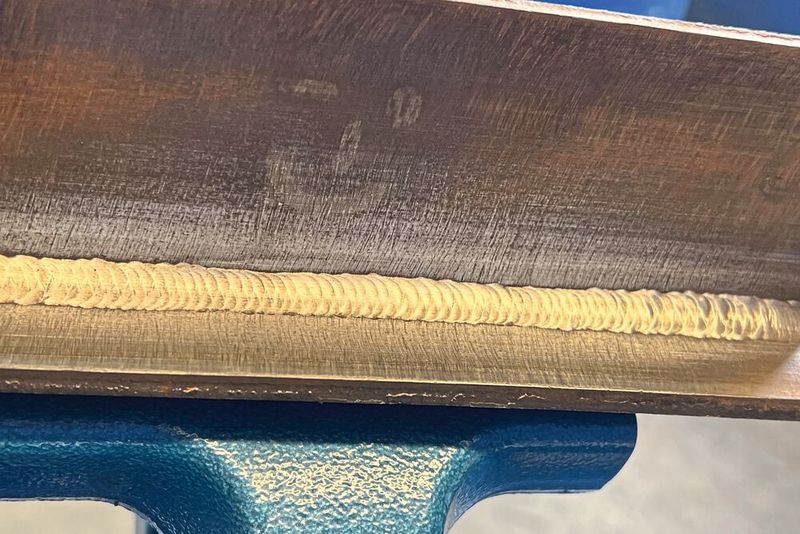
MAG welding is also possible with Inna. Steel material with a thickness of 10 millimeters is welded using a fillet weld.
(Image: Dast Welding Technology / INperfection)
Cobots are trending - not only large companies are now using robotic colleagues in production. Many small and medium-sized enterprises (SMEs) are also considering switching to automated processes. The reason for this is the existing shortage of skilled workers. Particularly in complex manufacturing processes such as welding, experts with experience are required. But they are becoming increasingly difficult to find. Can the robotic colleague step in and solve the problem? The Item Plus partner, Inperfektion GmbH from Wegberg, has dealt with this topic and, together with Niederrhein Automation GmbH and Item Industrietechnik GmbH, has developed the multifunctional robotic cell "Inna".
Robot cell setup
The profile technology from item forms the basic construction for the "Inna". Based on the XMS series, a machine housing was created that is 1.60 meters long, 1.50 meters wide and 2.20 meters high. The entire cell weighs around 500 kilos, making it much lighter than a comparable steel construction. Inside is a Cobot from Doosan Robotics with a movement radius of 2.20 meters. The robot is mounted on a functional adapter plate from Item. As the aim with the welding cell is to achieve the shortest possible setup times, the project participants opted for a rotating table version at the front.
The welding and setup process run almost in parallel, as the rotatable table has two devices for clamping the workpiece. These two devices are separated from each other by a welding protection screen. While the Cobot is welding inside the cell, the next component can be clamped outside the cell. Once the Cobot has finished welding, the table is rotated and the finished component is removed. In the meantime, the robot is already welding the previously clamped workpiece.
High heat as one of many challenges
The final construction was created in close consultation between the three participating partners. Item dealt with the basic construction, Niederrhein Automation provided the suitable Cobot and Inperfektion took over the planning and implementation. There were some requirements to consider in the planning phase. For example, the plastic areas of the robot arm have to be protected against excessive heat transfer. "Many aspects influenced the design of the robot cell," says Dennis Edelmann, project manager at Item. "Due to the heat, we had to maintain certain minimum distances and additionally protect components from welding splatter." The cables should not be installed openly in the cell. It was also necessary to consider the integration of a device for extracting gases and dust, as well as a container for the resulting welding slag.
Machine enclosure as a modular system
The XMS series from Item is ideally suited for robotic integration. This is because the individual components can be used universally and enable free scalability. The components can be easily connected and are all compatible with each other. Existing structures can thus be quickly and easily extended or adapted at any time - a big advantage over welded structures. Since the profiles of the XMS series have internal cable channels, the cables are well protected against welding spatter and heat. With the "inside out" principle, Item allows easy maintenance, as the cables are accessible from the outside. This allows them to be viewed directly and supplemented with additional cables at any time even after installation. The interior remains tidy and unnecessary components are saved. Another plus: the easy-to-clean surface of the smooth profiles.
Advantages due to repeat-accurate execution
If numerous identical components are manually welded one after the other, this quickly leads to employee fatigue. Continuous stress can lead to execution errors. In addition, the welder is exposed to hazardous welding fumes. The robot cell solves these problems and ensures permanent process reliability. Once programmed, the cobot repeats the processes with the highest accuracy and precision. "However, the robot cell is not a substitute for skilled personnel, but serves as support," says Wissam Nehme, sales employee at Imperfection. "For the programming or parameterization, or the so-called teaching of the lightweight robot should always be done by a welder. All further work can then be taken over by colleagues who do not necessarily need this expert knowledge." This relieves the staff and can be used more efficiently. Since the welding process takes place behind glass in the closed cell, employees are protected from dangers such as welding smoke formation. "To teach our robot, no extensive programming knowledge is necessary, as the process is very intuitive," explains Sven Gerards, Managing Director of Niederrhein Automation. "Another advantage: The once entered program is stored in the system and can be retrieved at any time if needed." Last but not least, the Doosan cobot scores with a good price-performance ratio and is therefore particularly suitable for use in SMEs.
Weld 3,500 boilers in 8 days
The significant support that the "Inna" provides is demonstrated by its use in a specific project at Dasat Welding Technology GmbH from Wegberg-Wildenrath. The family business, founded by Dieter Wagels in 1999, employs 16 people. The company offers various training and qualifications in the field of welding technology and, as a contract manufacturer, takes on welding work in single and series production. A customer enquiry involved the production of 3,500 boilers per month. Holders were to be welded parallel to each other on two sides. "For this project, we would have needed elaborate equipment and would have had to use three welders, who would have been fully occupied with it," explains Denise Wagels. Under these conditions, Dast would not have been able to keep the desired cost frame and would have had to reject the project. Therefore Denise Wagels contacted Inperfektion, which is located nearby. "My father was initially very sceptical and could not imagine that the use of a robot is worthwhile for our medium-sized company," says Denise Wagels. "The picture has completely changed, because the results convinced him." Inperfektion programmed the cell together with a specialist from Dast. The setup was completed in a very short time and the project could start. The "Inna" produced 3,500 boilers within just eight days. Welding specialists are significantly relieved by the robot welding cell and now take on other tasks. A trained assistant is responsible for loading the plant. "Monotonous work is now done by the 'Inna', which benefits everyone," explains Denise Wagels. "In addition to repeat accuracy and consistently high quality of components, continuous availability as well as reduction of error rate and setup time are other major advantages of the robot cell. The expertise of the specialists is of course still in demand, so they check the results, for example, but can now be used much more efficiently." Since operating the lightweight robot does not require in-depth programming knowledge, a Dast employee is now responsible for it. "If we have any questions, we can always turn to Inperfektion, who has so far looked after us optimally and always helps quickly and without complications," Denise Wagels emphasizes. "We plan to use the 'Inna' not only for resistance spot welding, but also for friction welding in the future, thus opening up further fields of application."
Date: 08.12.2025
Naturally, we always handle your personal data responsibly. Any personal data we receive from you is processed in accordance with applicable data protection legislation. For detailed information please see our privacy policy.
Consent to the use of data for promotional purposes
I hereby consent to Vogel Communications Group GmbH & Co. KG, Max-Planck-Str. 7-9, 97082 Würzburg including any affiliated companies according to §§ 15 et seq. AktG (hereafter: Vogel Communications Group) using my e-mail address to send editorial newsletters. A list of all affiliated companies can be found here
Newsletter content may include all products and services of any companies mentioned above, including for example specialist journals and books, events and fairs as well as event-related products and services, print and digital media offers and services such as additional (editorial) newsletters, raffles, lead campaigns, market research both online and offline, specialist webportals and e-learning offers. In case my personal telephone number has also been collected, it may be used for offers of aforementioned products, for services of the companies mentioned above, and market research purposes.
Additionally, my consent also includes the processing of my email address and telephone number for data matching for marketing purposes with select advertising partners such as LinkedIn, Google, and Meta. For this, Vogel Communications Group may transmit said data in hashed form to the advertising partners who then use said data to determine whether I am also a member of the mentioned advertising partner portals. Vogel Communications Group uses this feature for the purposes of re-targeting (up-selling, cross-selling, and customer loyalty), generating so-called look-alike audiences for acquisition of new customers, and as basis for exclusion for on-going advertising campaigns. Further information can be found in section “data matching for marketing purposes”.
In case I access protected data on Internet portals of Vogel Communications Group including any affiliated companies according to §§ 15 et seq. AktG, I need to provide further data in order to register for the access to such content. In return for this free access to editorial content, my data may be used in accordance with this consent for the purposes stated here. This does not apply to data matching for marketing purposes.
Right of revocation
I understand that I can revoke my consent at will. My revocation does not change the lawfulness of data processing that was conducted based on my consent leading up to my revocation. One option to declare my revocation is to use the contact form found at https://contact.vogel.de. In case I no longer wish to receive certain newsletters, I have subscribed to, I can also click on the unsubscribe link included at the end of a newsletter. Further information regarding my right of revocation and the implementation of it as well as the consequences of my revocation can be found in the data protection declaration, section editorial newsletter.
An economically attractive robot cell for many tasks
The robot cell "Inna" also enables SMEs to enter into automated manufacturing. The multifunctional robot cell can not only provide support in the area of welding. It offers enormous flexibility, as the welding attachment can be easily replaced with another end effector. This allows other tasks such as painting, engraving, grinding, drilling or brushing to be carried out. The cobot can be quickly retrofitted for each task. Moreover, the design of the cell is very variable. "The user decides how to use our cell," explains Dennis Edelmann. "We use standard components, but they still allow individual applications to be realised." For example, the existing door can be replaced by a double-wing door if the customer wishes. This allows more comfortable access to the interior and can also handle larger components. As a result, not only large lot sizes can be manufactured efficiently with the flexible robot cell "Inna" due to its simple and seamless integration into an existing production, but even small series. Investing in such cobots is also worth it for SMEs, as it relieves their skilled personnel and allows them to be used for value-adding tasks.



:quality(80)/p7i.vogel.de/wcms/a0/47/a04725ef9bd09fb6c9341a1bea1b5d93/0130443083v1.jpeg "Here, a type of plastic pallet is produced by thermoforming (vacuum forming or deep drawing) at the corresponding division of New England Plastics in the USA. This division, which specializes in so-called liners, is now part of Ringmetall ... (Image:New England Plastics)")
:quality(80)/p7i.vogel.de/wcms/23/99/23992bf2dcdc432c9b7209c34a4a7c48/0129733089v1.jpeg "Stork relies on the modular Neoswiss turning system from Iscar to shorten the set-up times for its sliding headstock lathes and work more productively. (Image:Iscar)")
:quality(80)/p7i.vogel.de/wcms/7d/e2/7de2923434b2f1a78ba5482d8d335269/0113143253v1.jpeg "In our China Market Insider we regularly provide you with relevant information directly from China. (Image:© Eisenhans - stock.adobe.com)")
:quality(80)/p7i.vogel.de/wcms/9d/2b/9d2b802f800e5caf17b2831e74228cd3/screenshot-202026-03-03-20103822-609x343v1v1.png "Visual comparison: on the left, a clean, burr-free cut edge; on the right, typical burr formation with oxidation discoloration. This illustrates how strongly parameter control and gas management influence the quality of the result. (CO₂ laser, oxygen cutting gas, sheet thickness approx. 15 mm). (Image:Picture: Rime)")
:quality(80)/p7i.vogel.de/wcms/b7/36/b736dfebc16c42d6901d0d0e1f390493/3d-druck-20factory-20--20ki-20generiert-1920x1079v1.png "(Source: AI-generated)")
:quality(80)/p7i.vogel.de/wcms/79/b2/79b21aad663f4a7bd4472afc1c1afc62/0130433994v1.jpeg "Mission Joyride: The free-flying robot (shown here in the rendering) will relieve the ISS crew of logistics tasks from 2027 with its two mechanical arms. (Image:Icarus Robotics)")
:quality(80)/p7i.vogel.de/wcms/6b/45/6b4546fa6ebf305c3660326909363f32/0130437089v1.jpeg "Industrial AI in action: Rockwell Automation presents practical solutions for self-controlling production systems at the Hannover Messe. (Image:Rainer Jensen, Deutsche Messe)")
:quality(80)/p7i.vogel.de/wcms/78/e9/78e9188c25a8a94e67c34c9bf8ffe495/visual-agile-20robots-20and-20google-20deepmind-20partner-20to-20bring-20intelligence-20to-20robotics-2500x1406v1v1.jpeg "Together, the partners are developing adaptable, intelligent robots for a wide range of applications (Image:Agile Robots SE)")
:quality(80)/p7i.vogel.de/wcms/59/a2/59a2b11f0aa1b700eff02addd5de8703/adobestock-1788280853--c2-a9-20satria-20-e2-80-93-20stock-adobe-com-5081x2860v1v1.jpeg "Quantum computers require extreme cooling to temperatures close to absolute zero in order to keep qubits stable. (Image:satria - stock.adobe.com)")
:quality(80)/p7i.vogel.de/wcms/49/38/493876a248943456b7e4a6db6edfc454/0130230765v1.jpeg "Safe and reliable in aircraft construction: light-curing adhesive bond combined with universal fastening elements. (Source: Delo)")
:quality(80)/p7i.vogel.de/wcms/b5/c7/b5c749d16c8a2e789c1469c2c8c1c387/0130452780v1.jpeg "Volvo Trucks completes road tests with its new hydrogen-powered trucks. (Image:Volvo Trucks)")
:quality(80)/p7i.vogel.de/wcms/ba/69/ba6975f417a85147084f38dc2cd209e2/0130451386v1.jpeg "Together with Nvidia, Hyundai wants to develop an architecture that will be used for level 4 robotaxis (image) as well as for level 2 customer vehicles. (Image:Hyundai)")
:quality(80)/p7i.vogel.de/wcms/93/4d/934de334b47abaa526c78cba1417d7af/0130343495v1.jpeg "The new SU7 is available in three price categories, \"Standard\", \"Pro\" and \"Max\" (Image:Xiaomi)")
:quality(80)/p7i.vogel.de/wcms/df/a0/dfa048434bb94f1b7d030e346b25b3ae/0130373541v1.jpeg "From August, BMW will be producing the i3 at its main plant in Munich - which the car manufacturer has extensively rebuilt for this purpose. (Image:Rainer Haeckl)")
:quality(80)/p7i.vogel.de/wcms/ee/09/ee09acbd6dc896df25affaa9e871e6e5/0130440053v1.jpeg "IMS chip module for simple system integration into an ion mobility spectrometer. (Image:Fraunhofer IPMS)")
:quality(80)/p7i.vogel.de/wcms/10/6c/106cd22de5f68a0f74639d654827228c/0130345302v1.jpeg "Made in India: According to the India Electronics and Semiconductor Association (IESA), the country should be able to produce between 75 and 80 million chips by the beginning of 2027, once the plants currently under construction become operational. (Image:Pixabay (Montage: Sebastian Gerstl))")
:quality(80)/p7i.vogel.de/wcms/a5/ed/a5ed6fda029d362732a293d6b19d74c4/0130444216v1.jpeg "Thirteen executives from the Chinese chip industry have drawn up a plan to achieve an 80% self-sufficiency rate for semiconductors by 2030. (Image:Maxim_Kazmin - stock.adobe.com)")
:quality(80)/p7i.vogel.de/wcms/31/a6/31a646018b34d8e0a44bfc8bf17837f6/0130361632v1.jpeg "For many companies, PFAS are considered indispensable in electronics production. (Image:freely licensed)")
:fill(fff,0)/images.vogel.de/vogelonline/companyimg/76800/76895/65.jpg "FAULHABER_120mm.jpg ()")
:quality(80)/p7i.vogel.de/wcms/5e/52/5e522ff6c5d6c6f03241351a9d1338af/87211198.jpeg "Die Online-Software ist leicht zu bedienen und quasi von jedem nutzbar – ob Konstrukteur, Mitarbeiter im Einkauf oder Geschäftsführer. (Bild: Item)")
:quality(80)/p7i.vogel.de/wcms/3b/fe/3bfee993f42ffcac787be8082e1fea9c/jpg-20version-202-03-2025-we-casestory-ferk-20metallbau-2037-1500x843v1v1.jpeg "Four robots of the UR10e type help Ferk streamline processes, be faster and more precise, and above all, remain flexible. One of the cobots is permanently installed in an application for welding. (Image:Universal Robots)")
:quality(80)/p7i.vogel.de/wcms/b6/ca/b6cadb68a36d4250032126430ddd34e4/0126599764v1.jpeg "The market offers a wide variety of cobots: the range includes single- or multi-axis cobots with payloads of up to 20 kg, reach up to 1,500 mm, and varying speeds, as well as mobile solutions. (Image:Beckhoff)")