Welding remains a central joining process in the metal processing industry, requiring in-depth expertise and skill. Despite good pay, fewer and fewer young people are choosing this profession, as it is often considered unattractive, unhealthy, and dirty. Cobots can provide a remedy here. They make welding not only more interesting and safer but also more economical, even for small batch sizes.
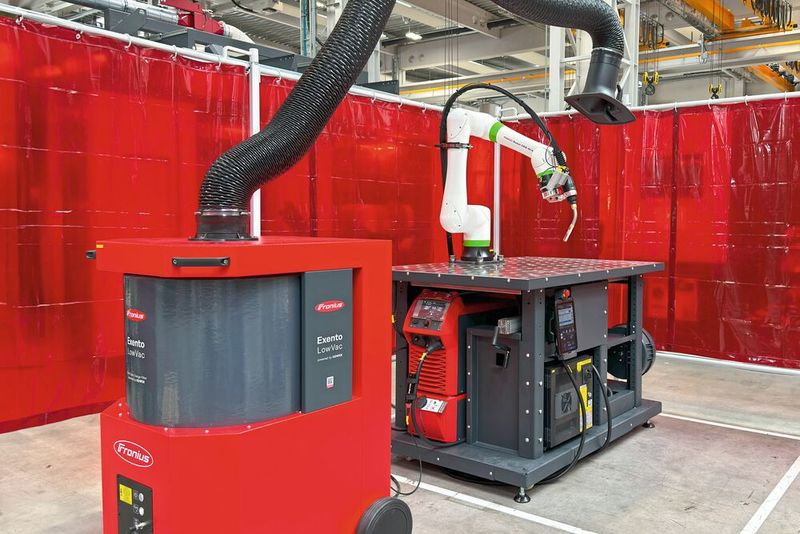
Cobot welding system CWC-mobile with extraction and movable enclosure for welding small and large components. Equipped with retractable transport wheels, the system can be transported to the component.
(Image: Fronius)
Nowadays, there are collaborative welding robots in various designs: as mobile single workstations or fully enclosed one or two-station solutions. The range of technical equipment is diverse and includes robotic tracks, turn-tilt positioners, automatic exhaust systems, and protective doors. High-tech welding equipment and processes as well as software solutions for offline programming are now often part of the standard equipment.
Unlike in the past, welding is increasingly becoming a high-tech profession. Welding automation is intended not only to increase productivity in commercial and industrial enterprises but also to counteract the growing shortage of skilled workers and make the profession cleaner, safer, and more attractive. The career ladder for welders is now high and ranges from welding specialist to International Welding Engineer (IWE).
Even the best welding professionals cannot produce weld seams of consistent quality around the clock. Cobots, on the other hand, effortlessly master this task: with them, 100 percent reproducible, identical weld seams are guaranteed. Equipped with modern welding equipment from Fronius, such as the TPS 400i CMT or the multi-process version iWave 400i AC/DC CMT, a wide variety of metals can be welded, including steel, stainless steel, aluminum, copper, and titanium. Innovative welding packages like Low Spatter Control (LSC), Pulse Multi Control (PMC), or the world-renowned Cold Metal Transfer (CMT) can also be used.
The LSC function generates a modified, low-spatter short arc with increased melting performance. PMC offers an optimized pulsed arc, where penetration and arc length stabilizers ensure the best welding quality and high welding speeds. CMT combines a new type of droplet detachment with a reversing wire movement, resulting in lower heat input than conventional short arcs. This makes the process particularly suitable for thin sheet welding.
"A major advantage of cobot welding systems, especially the Fronius systems, is the simple and intuitive programming of the welding processes, which significantly facilitates the entry into automated welding," emphasizes Ing. Christian Neuhofer IWS, Product Manager at Fronius International.
In three steps to the welding program
Programming industrial robots requires not only welding experience but also profound programming knowledge. With cobots, however, this is completely different. With Fronius systems, you simply grab the torch, guide it to the starting point, select the appropriate torch position, and press the memory button on the control handle. Then set contour points along the welding path to the endpoint. These points are stored at the push of a button and form the welding path. Once this is created, programming the welding process follows using the graphical user interface of the teach pendant—intuitively via drag & drop.
"In comparison to programming industrial robots, cobot teaching requires little training effort for most users. Especially welding professionals who are accustomed to touchscreens and have some computer knowledge can start welding the first components after just a few hours," explains Neuhofer.
Valid welding parameters from the smartphone
With the practical WeldConnect app, welding professionals always have their personal parameter manager at hand. The innovative online welding assistant offers professional support in selecting the appropriate welding parameters. These can be saved as a job and transferred to the cobot system's welding machine via NFC signal, allowing you to start welding immediately.
The Weld-Connect app allows for storing numerous jobs that can be accessed at any time. Especially young welding specialists, who are accustomed to using smartphones, appreciate the app as it provides reliable welding parameters for various tasks. Together with the Weld-Connect app, cobots help alleviate the shortage of skilled workers and make the welding profession more attractive again.
Mobile and flexibly deployable
The mobile cobot system offers an intelligent combination of mobility, advanced welding technology, and excellent value for money. It particularly facilitates smaller workshops in entering automated welding technology. Thanks to retractable transport rollers, the system is not only suitable for welding small components. "Those who have to weld larger objects such as excavator buckets can easily push the CWC-mobile to the ready-to-weld component," emphasizes Neuhofer, highlighting the system's exceptional versatility.
Date: 08.12.2025
Naturally, we always handle your personal data responsibly. Any personal data we receive from you is processed in accordance with applicable data protection legislation. For detailed information please see our privacy policy.
Consent to the use of data for promotional purposes
I hereby consent to Vogel Communications Group GmbH & Co. KG, Max-Planck-Str. 7-9, 97082 Würzburg including any affiliated companies according to §§ 15 et seq. AktG (hereafter: Vogel Communications Group) using my e-mail address to send editorial newsletters. A list of all affiliated companies can be found here
Newsletter content may include all products and services of any companies mentioned above, including for example specialist journals and books, events and fairs as well as event-related products and services, print and digital media offers and services such as additional (editorial) newsletters, raffles, lead campaigns, market research both online and offline, specialist webportals and e-learning offers. In case my personal telephone number has also been collected, it may be used for offers of aforementioned products, for services of the companies mentioned above, and market research purposes.
Additionally, my consent also includes the processing of my email address and telephone number for data matching for marketing purposes with select advertising partners such as LinkedIn, Google, and Meta. For this, Vogel Communications Group may transmit said data in hashed form to the advertising partners who then use said data to determine whether I am also a member of the mentioned advertising partner portals. Vogel Communications Group uses this feature for the purposes of re-targeting (up-selling, cross-selling, and customer loyalty), generating so-called look-alike audiences for acquisition of new customers, and as basis for exclusion for on-going advertising campaigns. Further information can be found in section “data matching for marketing purposes”.
In case I access protected data on Internet portals of Vogel Communications Group including any affiliated companies according to §§ 15 et seq. AktG, I need to provide further data in order to register for the access to such content. In return for this free access to editorial content, my data may be used in accordance with this consent for the purposes stated here. This does not apply to data matching for marketing purposes.
Right of revocation
I understand that I can revoke my consent at will. My revocation does not change the lawfulness of data processing that was conducted based on my consent leading up to my revocation. One option to declare my revocation is to use the contact form found at https://contact.vogel.de. In case I no longer wish to receive certain newsletters, I have subscribed to, I can also click on the unsubscribe link included at the end of a newsletter. Further information regarding my right of revocation and the implementation of it as well as the consequences of my revocation can be found in the data protection declaration, section editorial newsletter.
In addition to its flexibility in welding, the CE-certified cobot system offers uncompromising safety: the joint arm's force and torque limitation, a mobile welding fume extraction, a movable glare protection, and standard-compliant personal protective equipment (PPE)—consisting of puncture-resistant gloves, welding helmet, and protective clothing—protect against illnesses and injuries. This ensures that the CWC-mobile fully complies with the European Machinery Directive requirements, which are prerequisites for CE certification.
Single and dual systems—component dimensions and requirements decide
Fronius offers two fully enclosed cobot welding cells, the CWC-S and the CWC-D, for single and dual-station operations. Both systems, like the CWC-mobile, feature the latest welding technology. For welding components up to 3 meters in length (approx. 10 ft), the dual-station solution CWC-D is ideal. By removing the middle partition wall screwed to the welding table, an extended working area of 3,000 x 1,000 x 600 millimeters (approx. 118 x 39 x 24 inches) is created for single-station operations.
"In dual-station operation, the system enables setup-parallel welding and is ideal for small series production of components with a maximum side length of 1.5 meters (approx. 4,9 ft). While welding is carried out on one side, the other side can be prepared to increase productivity. Both stations can weld components weighing up to 2 tons," explains Neuhofer.
The smaller, compact CWC-S was specifically developed for components that are no wider than 1.5 meters. Both the single system CWC-S and the dual system CWC-D are available with rotating and turn-tilt positioners for circular seam welding of cylindrical components. The rotating positioner is optionally available with a tailstock on the longitudinal axis. With the software option Coordinated Motion, which is available for all positioners, the welding torch and positioner can be moved in sync. The torch cleaning station Robacta Reamer V is available as an accessory.
Cobots and welding robots merge
The fully enclosed Fronius cobot welding systems CWC-S and CWC-D allow a seamless transition from cobot mode to robot mode. In this mode, the force/torque monitoring and the speed limit of 250 mm/s (approx. 0,82 ft/s) are disabled, allowing speeds of up to 2 m/s (approx. 6,56 ft/s). When programming with the iPendant robot controller, not only high joint arm speeds but also more complex movements and the control of devices are achievable in robot mode. This makes it possible to fully exploit the systems' potential and significantly increase productivity.
Cobots offer an ideal entry into the world of automation. They allow understanding the operation of robots through manual teaching and learning the R-kinematics without a high risk of injury. Welding professionals benefit from a better understanding of kinematic processes, which is particularly advantageous when transitioning to robotic welding later on.
Increase productivity through offline programming
With the offline programming software Fronius Pathfinder, welding operations can be programmed independently of the cobot welding system, without interrupting ongoing production with stops. Unlike manual teaching, the software allows for copying and mirroring of weld seams, creating search paths, and simulating complex movements. This minimizes downtime and increases productivity by up to 80 percent, especially with complex component geometries. Once a program is completed, it is transferred to the welding cell and manually adjusted if necessary. Another advantage of Fronius is that both the software and the welding system come from a single source and are perfectly matched.
Fronius, in collaboration with an external safety examiner, conducted a series of intensive safety tests that delivered convincing results. Among other things, these tests attempted to pierce gloves with a wire—without success! The impact force of the gas nozzle and the edges of the torch holder were also measured and safely remained within the defined limits. It is particularly noteworthy that the water-cooled torches are hand-warm within seconds, effectively minimizing the risk of burns. All these results confirm that Fronius products meet the highest safety standards, ensuring maximum safety.
The path to automation
Fronius accompanies its customers from the very beginning, offering tailored automation solutions, ranging from simple systems to complex applications. "As a general provider, we assist in selecting optimal solutions, whether they are cobots, welding robots, or mechanized systems such as welding carriages, circumferential and longitudinal seam welding systems, clamping benches, or orbital systems. Our support doesn't end with the purchase: we also assist our customers during commissioning and offer a global service network that provides quick and reliable help with problems. In this way, our customers benefit from high efficiency and safety in their welding processes," concludes Neuhofer.



:quality(80)/p7i.vogel.de/wcms/1d/85/1d856c359855885a633f48d9f77fe69c/0130227630v1.jpeg "Two \"HBZ AeroCell 160\" in the Moyola factory. The machines mark a significant milestone in Moyola's ongoing commitment to performance, innovation and global competitiveness. (Image:Moyola)")
:quality(80)/p7i.vogel.de/wcms/78/e3/78e3db1b32fb30c9a9195e36864db885/0129830906v1.jpeg "Siemens and Caphenia sign the partnership agreement. From left to right: Nicky Ahnert, Jürgen Giegerich, Frank Knauf (all Siemens), Dr. Mark Misselhorn, Dr. Andreas Waibel (both Caphenia). (Image:Siemens)")
:quality(80)/p7i.vogel.de/wcms/5a/d7/5ad72fd14971344dbfed431e07ae6423/0130200276v1.jpeg "A new machining job needs to be processed! Open the drawer—but the right tool is missing! That's what happens when you work with old data. But EVO Informationssysteme has an AI tool that means the problem will never slow down production again. (Image:EVO Information Systems)")
:quality(80)/p7i.vogel.de/wcms/53/f7/53f7dadbe4d656a3fd4f4077445f29f6/0129828707v1.jpeg "Thanks to its compact design and drilling/unscrewing function, the Fire Birdie is suitable for applications with limited installation space and frequent tool changes. (Image:Marcel Kraibühler)")
:quality(80)/p7i.vogel.de/wcms/21/3b/213b5e5454b0c4344ba0eaa700857607/0129635774v1.jpeg "The QRV flow control valves from Lee are available in sizes from 5.5 to 18 mm and cover a flow rate of 0.2 to 20 l/min. Depending on the version, the pressure range is either between 0.1 and 2.75 bar (1.5 - 40 psi) or between 0.17 and 2 bar (2.5 - 30 psi). (Image:Lee)")
:quality(80)/p7i.vogel.de/wcms/63/e9/63e9db3259a656cca88c5f7158af3fcb/0129385769v1.jpeg "The Agibot A2 at a Fortune China event in December 2025. (Image:Agibot)")
:quality(80)/p7i.vogel.de/wcms/df/a1/dfa1786a3b05f5ff2e51d0f633695c57/0130137877v1.jpeg "Openclaw inspires AI communities. (Image:Openclaw.ai)")
:quality(80)/p7i.vogel.de/wcms/16/9c/169ce3040d09673a91a403598d15dbf1/0130162776v1.jpeg "From networked cameras to vacuum robots, industrial robots, drones and humanoids, AI is moving ever closer to sensors and actuators as it develops from \"basic intelligence\" to \"multi-purpose intelligence\", while software-defined architectures make long-term systems flexibly upgradeable for new functions and AI models. (Image:Globalfoundries)")
:quality(80)/p7i.vogel.de/wcms/78/28/7828775af76773458b4d1409ceb1cf0c/368945-20dam-20imagery-digital-transformation-pc-1920x1079v1v1.jpeg "Complex development projects with high regulatory requirements, such as in the aerospace industry, benefit in particular from the Intelligent Product Lifecycle. (Image:PTC)")
:quality(80)/p7i.vogel.de/wcms/e7/82/e7822e208621ba2ae892d609e60481e8/texas-20uni-850x478v1v1.jpeg "Superfoam is a composite that is capable of absorbing 10 times more energy than a conventional foam. (Image:Abbey Toronjo/Texas A&M University Division of Marketing & Communications)")
:quality(80)/p7i.vogel.de/wcms/da/4d/da4da8d34671dc6bce80e496212de877/0129850788v1.jpeg "Mate-XT Go supports the arms and shoulders during overhead work and repetitive tasks and is designed to significantly reduce muscle strain in everyday working life. (Image:Comau)")
:quality(80)/p7i.vogel.de/wcms/3f/cc/3fccb748b0fe16f1f61249d94c72f126/0130149439v1.jpeg "Requirements for integrated power supply systems: Precise AC and DC power supply systems that not only provide energy, but also reliably combine measurement, analysis and system integration. (Image:Schulz Electronic)")
:quality(80)/p7i.vogel.de/wcms/2b/0b/2b0b5ff55299be32174cb0ed76718253/0130177406v1.jpeg "Rolls-Royce has received funding of 70 million US dollars from the EU public-private partnership \"Joint Undertakings for Clean Aviation\". (Image:Rolls-Royce)")
:quality(80)/p7i.vogel.de/wcms/95/7e/957ed49b185794b3e76b9e610a8a389f/0130217926v1.jpeg "Bosch wants to offer components for e-vehicles in India together with Tata. (Image:Bosch)")
:quality(80)/p7i.vogel.de/wcms/d8/11/d8118b193939ca897a4962aeb1bbc5ae/0130224537v1.jpeg "Opel plans to participate in the Formula Ene racing series from fall 2026 with the fully electric Gen4 racing cars. (Image:Opel)")
:quality(80)/p7i.vogel.de/wcms/92/f1/92f12f22e5045c6af002ab48a59841d0/0130171646v1.jpeg "The US electric vehicle manufacturer Rivian is to supply self-driving vehicles to Uber. (Image:Rivian)")
:quality(80)/p7i.vogel.de/wcms/3a/50/3a50d3f269f38f14d7a25a93c6f2b2f8/0130147601v1.jpeg "The compact modulator enables fast and energy-efficient data transmission and can be manufactured cost-effectively. (Image:Hugo Larocque, EPFL)")
:quality(80)/p7i.vogel.de/wcms/54/d3/54d34bf24912ac87780c1fbfa745dad7/0130174841v1.jpeg "Simulation can help to optimize material flows in production. (Image:freely licensed)")
:quality(80)/p7i.vogel.de/wcms/1f/8e/1f8e294ac0af3a801575c7e1400cc830/0130164847v1.jpeg "While micro-injection molding takes 10 to 12 weeks for critical components, 3D printing offers faster manufacturing and greater flexibility for design iterations, Collins said. (Image:Boston Micro Fabrication)")
:quality(80)/p7i.vogel.de/wcms/ae/8f/ae8f87001d67841b6a6f9e3efb5a2f1a/0130176499v1.jpeg "Almost 160 exhibitors and 2,400 participants came to Munich for LOPEC 2026 to find out about printed electronics. (Image:Messe München GmbH)")
:fill(fff,0)/images.vogel.de/vogelonline/companyimg/76800/76895/65.jpg "FAULHABER_120mm.jpg ()")
:fill(fff,0)/p7i.vogel.de/companies/67/eb/67eba621ef6ea/logo2.png "logo2 (Wuxi InfiMotion)")
:quality(80)/p7i.vogel.de/wcms/4b/a3/4ba36eaeccd9606b031f1e3d8a762f3e/0122031501v1.jpeg "Cobot welding system CWC-mobile with extraction and movable enclosure for welding small and large components. Equipped with retractable transport wheels, the system can be transported to the component.(Image: Fronius)")
:quality(80)/p7i.vogel.de/wcms/82/be/82bec547ed9f710a8be9668ce3061113/0122031604v1.jpeg "\"A major advantage of cobot welding systems, especially the Fronius systems, is the simple and intuitive programming of the welding processes, which significantly facilitates the entry into automated welding,\" emphasizes Ing. Christian Neuhofer IWS, Product Manager at Fronius International.(Image: Fronius)")
:quality(80)/p7i.vogel.de/wcms/45/b3/45b3fffbce05a9bda1de85943a4af4bf/0122031485v1.jpeg "Fronius CWC-D cobot welding system, schematic for the two-station solution.(Image: Fronius)")
:quality(80)/p7i.vogel.de/wcms/44/69/44693620d68db530f16b4f357d8a52fd/0122031492v1.jpeg "CWC-mobile welding an excavator bucket (Fronius product rendering).(Image: Fronius)")
:quality(80)/p7i.vogel.de/wcms/50/85/5085e082d538804ebcd71a2ca8611b2d/0120975718v1.jpeg "Always stay on top of your welding wire! This is ensured by a range of smart assistance systems for robotic welding developed by Fronius. Learn about the benefits of turning the welding wire into a sensor, as done here... (Image:Fronius)")
:quality(80)/p7i.vogel.de/wcms/3f/3a/3f3a2203d092373a1ed25e91383fc9c7/0125666672v1.jpeg "Bending machines from Trumpf Maschinen Austria (pictured) are enjoying increasing popularity. This demand grew so rapidly that capacity had to be expanded to meet it. Assistance also comes from a laser hybrid welding system by Fronius ... (Image:Trumpf)")
:quality(80)/p7i.vogel.de/wcms/6b/ae/6bae4acda96a3188a08ffd58efcaa0ed/0124041282v1.jpeg "Creating a perfect weld seam is by no means trivial but depends on numerous factors such as welding consumables, current, and wire feed. (Image:EWM)")