GF Casting Solutios manufactures heavy structural parts from cast iron. By reversing the machining logic with a nesting arrangement of their existing cast part machining centers and using form nest-specific program variants, machine builder Fill has created a system that allows even smaller cast iron parts to be automatically fettled.
In the Grind Performer, cast iron parts are introduced via a rotary table without specific fixtures, automatically freed from feeders and burrs, and finally discharged, processed so that no rework is required.
(Image: Fill)
When the word "cast iron" is mentioned, many think of grilling in the backyard or architectural design elements from earlier times, such as street lamps, manhole covers, hydrants, or bridge railings. Although cast iron has now largely been replaced by other materials in these areas, the material is far from obsolete.
Because cast iron is very suitable for casting due to its lower melting point, it is the material of choice for highly stressed components for engines or the drivetrain of commercial vehicles and mobile work machines.
The globally active Swiss industrial company Georg Fischer (GF) offers products and solutions for the safe transport of liquids and gases, as well as lightweight cast components and high-precision manufacturing technologies. Its subsidiary GF Casting Solutions GmbH from Leipzig (Germany) manufactures structural parts from iron casting for agricultural and forestry machinery and construction machines, as well as systems for renewable energy. "Casting technology is the best choice for a high degree of functional integration in complex components," explains production manager Andriy Malaschkin. "We support our customers in the development and production of highly complex iron casting solutions up to a box format of 2,500 mm × 1,600 mm × 500 mm (approx. 98 inches × 62 inches × 19 inches)." The company covers the entire process chain with a certified environmental management system, from mold and core production through melting and casting, to coating, CNC machining, and assembly.
Important Process Step: Deburring
After the casting process, the components still exhibit excess material at the mold parting lines and gating channels in the form of runners, burrs, and risers. These need to be removed before further processing. For this task, GF Casting Solutions has been using several automated cleaning stations for years. In them, an industrial robot fully automatically performs the various machining steps.
This works very well for most workpieces, but for some parts, the frequent tool changes and nesting-related variations in dimensional accuracy affect the cycle time. Among other reasons, because the existing systems were fully utilized, the cleaning of these parts was mostly done by hand until recently or was partially outsourced to external service providers. "Finding personnel for this physically demanding, loud, dirty, and monotonous work is becoming increasingly difficult," reports Malaschkin. "Outsourcing is also not a long-term solution, as transportation involves delays, costs, and other uncertainties."
Automation Gaps Closed
Therefore, the production manager set out to find a solution for automating the deburring and removal of feeders from parts up to 250 kilograms. This had to enable the machining of numerous different components based on the target contours from their CAD data with short cycle times and thereby close the aforementioned automation gap.
Since smaller components often come from a mold in multiples, the process should also be able to account for differences in residual material occurrence with components from different form nests. According to Andriy Malaschkin, these nesting-related differences were the main reason why this process had previously resisted automation.
Of the invited mechanical engineering companies, Fill, based in Gurten (Upper Austria), presented the most convincing concept. The mechanical engineering experts of the globally operating premium manufacturer have been developing and producing systems and machines for foundry technology for almost 30 years.
Machining Logic Reversed
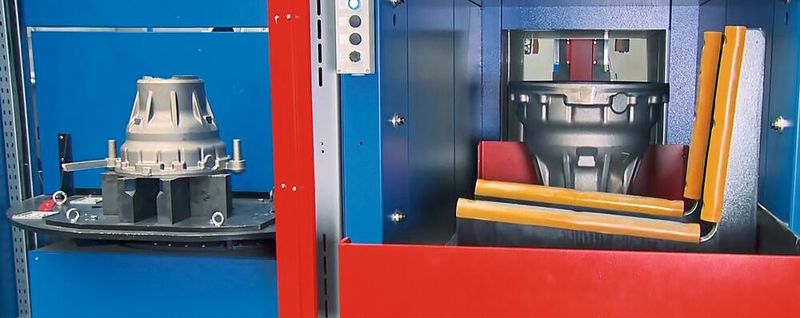
Fill developed a completely new cleaning and grinding cell according to the specifications of GF Casting Solutions Leipzig, with a robot as the central element. However, that's where the similarities with the existing systems end. "To achieve the required cycle times, we reversed the machining logic," explains Thomas Rathner, head of the competence center for foundry technology at Fill. "With the Grind Performer, the robot moves the component to the various fixed-position tools instead of moving the tool to the stationary component." This eliminates the delays caused by the otherwise necessary tool change.
The loading of the components into the grinding and deburring cell is also time-saving via a rotary table. The workpiece is not clamped but placed flat. A camera system detects the part, its position, and orientation, so the robot can approach and pick it up correctly.
Consistently High Quality Ensured
Another camera system identifies the mold nest identification applied in plain text on the component. This information enables the retrieval of a mold nest-specific variant of the machining program that was created during the run-in of a new component. "When manually cleaning, the worker can spontaneously react to the different defect patterns," says Andriy Malaschkin. "Although the machine can't do that, it achieves an extremely consistent result with the nesting-specific programming, and that with consistently high quality."
Date: 08.12.2025
Naturally, we always handle your personal data responsibly. Any personal data we receive from you is processed in accordance with applicable data protection legislation. For detailed information please see our privacy policy.
Consent to the use of data for promotional purposes
I hereby consent to Vogel Communications Group GmbH & Co. KG, Max-Planck-Str. 7-9, 97082 Würzburg including any affiliated companies according to §§ 15 et seq. AktG (hereafter: Vogel Communications Group) using my e-mail address to send editorial newsletters. A list of all affiliated companies can be found here
Newsletter content may include all products and services of any companies mentioned above, including for example specialist journals and books, events and fairs as well as event-related products and services, print and digital media offers and services such as additional (editorial) newsletters, raffles, lead campaigns, market research both online and offline, specialist webportals and e-learning offers. In case my personal telephone number has also been collected, it may be used for offers of aforementioned products, for services of the companies mentioned above, and market research purposes.
Additionally, my consent also includes the processing of my email address and telephone number for data matching for marketing purposes with select advertising partners such as LinkedIn, Google, and Meta. For this, Vogel Communications Group may transmit said data in hashed form to the advertising partners who then use said data to determine whether I am also a member of the mentioned advertising partner portals. Vogel Communications Group uses this feature for the purposes of re-targeting (up-selling, cross-selling, and customer loyalty), generating so-called look-alike audiences for acquisition of new customers, and as basis for exclusion for on-going advertising campaigns. Further information can be found in section “data matching for marketing purposes”.
In case I access protected data on Internet portals of Vogel Communications Group including any affiliated companies according to §§ 15 et seq. AktG, I need to provide further data in order to register for the access to such content. In return for this free access to editorial content, my data may be used in accordance with this consent for the purposes stated here. This does not apply to data matching for marketing purposes.
Right of revocation
I understand that I can revoke my consent at will. My revocation does not change the lawfulness of data processing that was conducted based on my consent leading up to my revocation. One option to declare my revocation is to use the contact form found at https://contact.vogel.de. In case I no longer wish to receive certain newsletters, I have subscribed to, I can also click on the unsubscribe link included at the end of a newsletter. Further information regarding my right of revocation and the implementation of it as well as the consequences of my revocation can be found in the data protection declaration, section editorial newsletter.
After knocking off the riser with a hydraulic hammer, the robot moves the workpiece to several grinding, cutting, and milling tools. In the process, all burrs and other excess material are removed. "A certain challenge was not just bending fine burrs, but actually removing them completely," reports Thomas Rathner. "To achieve the desired 100 percent result here, we had to conduct several test series with different grinding and machining tools."
Easy Operation, Safe Operation
No experiments are required for the programming and operation of the robot cleaning cell. The Grind Performer is operated via Cybernetics Studio, a software tool developed by Fill itself, which enables simple programming. To create a new component, employees do not need programming knowledge. They define the required machining steps and process parameters through visual settings on its 3D CAD model. In doing so, they inform the machine program where burrs or similar are expected, based on the mold parting lines known from the CAD data of the casting mold.
The execution of the programs created in this way always takes place in the computer simulation on the digital twin of the system. This ensures that collisions in the workspace can be reliably avoided. Since the simulation also runs concurrently during main time, it helps to detect unplanned states or deviations from the target early and to respond to them appropriately. Later changes or optimizations to the programs can also be easily implemented through parameterization.
Rapid Going-Live and Reliable Results
Even before the final system decision was made, trials were conducted with all manufacturers on the shortlist, including at the test center at Fill's main location in Gurten. Subsequently, the machine builder received the order for this unique system. About a year later, it was delivered and commissioned. "As is to be expected with a system manufactured for the first time, some optimizations were still necessary afterward," confirms Andreas Sallaberger, sales and project engineering for foundry technology at Fill. "In particular, the reliability of the plain text recognition for nest identification had to be increased to the required level due to inconsistent writing styles."
In addition to improving working conditions for personnel by eliminating manual cleaning, the Grind Performer brings high process stability and reproducibility of machining steps. Not least, the nesting-specific program versions ensure consistently high quality of the reworked components. "The automated cleaning of the new iron cast parts in the Grind Performer is another important step towards the automation of our process chain and provides an important contribution to securing the location," confirms Matthias Heinrich, Managing Director of GF Casting Solutions Leipzig. "Unlike the existing machines, almost no rework is required with this system."
*Peter Kemptner is a freelance technical journalist
Future-Proof Authentication with Universal RFID Readers



:quality(80)/p7i.vogel.de/wcms/dd/08/dd086510d9ae7b50181f6070e4463b44/0129363730v1.jpeg "Typical application for ionizing devices: Wrapping films. (Picture: ©Adobe Stock/SMC)")
:quality(80)/p7i.vogel.de/wcms/35/57/3557c819943c53acec41a0ccba87da4f/0130049064v1.jpeg "Researchers at the Fraunhofer IWU in Chemnitz have long known that many typical sheet metal parts can be manufactured more cost-effectively using hollow embossing rollers. Now there is news to report ... (Image:Fraunhofer IWU)")
:quality(80)/p7i.vogel.de/wcms/59/02/590246e3b3f415c65edbee377c14ca77/26-06-pi-fraunhofer-iws-41450-direktplattieren-pic-01-7771x4369v1v1.jpeg "The Fraunhofer IWS has developed the new \"direct laser cladding\" process, which creates a functional layer directly on the base body by applying a strip-shaped metal to rotationally symmetrical components in a spiral and bonding it locally by laser. (Image:Christoph Wilsnack/Fraunhofer IWS)")
:quality(80)/p7i.vogel.de/wcms/73/60/73608418789b1d9c393f5e2fa974eda2/0130209906v1.jpeg "The robots of the X6 generation from b+m enable very high painting quality and are also particularly compact and easy to maintain. (Image:Beckhoff)")
:quality(80)/p7i.vogel.de/wcms/78/e9/78e9188c25a8a94e67c34c9bf8ffe495/visual-agile-20robots-20and-20google-20deepmind-20partner-20to-20bring-20intelligence-20to-20robotics-2500x1406v1v1.jpeg "Together, the partners are developing adaptable, intelligent robots for a wide range of applications (Image:Agile Robots SE)")
:quality(80)/p7i.vogel.de/wcms/e7/66/e7669ecf0260ae8fc54c214e34e4902a/0130316817v1.jpeg "Siemens and Palo Alto Networks offer tested cybersecurity solution for industrial 5G. (Image:Siemens)")
:quality(80)/p7i.vogel.de/wcms/9f/55/9f55324832c4f426958031375124d9de/siemens-20ubtech-20hmnd-1920x1079v1v1.png "Ready for the factory floor: While Ubtech is planning mass production, Siemens is already testing humanoids in real factory applications in Erlangen. (Image:Siemens)")
:quality(80)/p7i.vogel.de/wcms/11/36/113695ed260e29c8c2d9d39dc5f9d869/0130213768v1.jpeg "AI can work cheaply in China and deliver the results rapidly all over the world. (Image:Dall-E / AI-generated)")
:quality(80)/p7i.vogel.de/wcms/62/5f/625f41e87ebfef156a98c8e6393e32fd/0130211654v1.jpeg "Axial flux motors have some advantages over radial flux motor—but their production is currently still expensive. (Image:RWTH Aachen University)")
:quality(80)/p7i.vogel.de/wcms/77/9b/779b0685d010dfe45c9c2cb1cfecd467/0128886425v1.jpeg "The BlueEye is the first \"real\" hyperspectral camera for the UV range and covers the wavelength range from 220 to 380nm. (Image:Inno-spec GmbH)")
:quality(80)/p7i.vogel.de/wcms/e4/51/e451d52ce0182fb0aaa46a5774f832ef/26-04-pi-fraunhofer-iws-21160-bioslide-pic-01-4128x2321v1v1.jpeg "With the BioSlide research project, the Fraunhofer IWS is investigating how sliding systems can be designed to be more sustainable and energy-efficient. New materials can be tested in a particularly application-oriented manner on this plain bearing test stand. (Image:Fraunhofer IWS)")
![Thanks to advanced 3D printing technology, a more efficient use of resources should contribute to lower-emission aviation—this is the goal of ['skai]-lab. (Image:Oleksandr Pashchenko - stock.adobe.com / AI-generated)](https://cdn1.vogel.de/nghHNSbySccfOjG3n1qCA-FVOjQ=/288x162/smart/filters:format(jpg):quality(80)/p7i.vogel.de/wcms/62/64/626424c97a16e69f871bf216c9629c2a/adobestock-1927043193--c2-a9-20oleksandr-20pashchenko-20-e2-80-93-20stock-adobe-com-ki-generiertv1v1.jpeg "Thanks to advanced 3D printing technology, a more efficient use of resources should contribute to lower-emission aviation—this is the goal of ['skai]-lab. (Image:Oleksandr Pashchenko - stock.adobe.com / AI-generated)")
:quality(80)/p7i.vogel.de/wcms/c3/c4/c3c4ce270b083eeac55654148611f064/0130237945v1.jpeg "China is not giving up on hydrogen, but is intensifying its efforts. (Image:freely licensed from Pixabay)")
:quality(80)/p7i.vogel.de/wcms/4e/c0/4ec0bd19390b169edfa23677373dcdf1/0130260089v1.jpeg "Renewable fuels can supply European road traffic, according to a study. (Image:Aral)")
:quality(80)/p7i.vogel.de/wcms/6f/c9/6fc9050301d745cad25585c6780f8f51/0130197341v1.jpeg "Production facilities are a worthwhile target and are therefore at risk. (Image:ABB Robotics)")
:quality(80)/p7i.vogel.de/wcms/b6/62/b662adc2cec8227d8172509bbfb6ee42/25c0207-107-4961x2789v1v1.jpeg "The GLB is the second model based on Mercedes' new MMA platform. Apparently, Geely's platform is better and cheaper, which is why the two companies are negotiating a partnership. (Image:Mercedes-Benz)")
:quality(80)/p7i.vogel.de/wcms/4d/dd/4dddf438e91f394c04a095dbfd109d1c/0130236430v1.jpeg "Measurement modules: The 720301 module in combination with the SL2000 enables RMS and power calculations, among other things. (Image:Yokogawa)")
:quality(80)/p7i.vogel.de/wcms/61/fc/61fcf95f5cca15494ad18343901ae585/0130317237v1.jpeg "With the AGI CPU, Arm says it is taking a \"historic step\": With the processor aimed at AI in data centers, the company is presenting itself for the first time as a provider of its own chips, not just as a pure IP licensor. (Image:Arm)")
:quality(80)/p7i.vogel.de/wcms/82/90/8290dfe3595b6c6b33726ae8b76172c7/0130319587v1.jpeg "The concept image illustrates how the pattern of tiny protrusions and depressions created on the substrate (MgO, bottom) controls the arrangement of atoms in the superconducting material (YBCO, top). At the interface between the two layers, an electronic structure enables superconductivity to occur at higher temperatures than previously possible. (Image:Chalmers University of Technology / Riccardo Arpaia)")
:fill(fff,0)/images.vogel.de/vogelonline/companyimg/76800/76895/65.jpg "FAULHABER_120mm.jpg ()")
:fill(fff,0)/p7i.vogel.de/companies/69/88/69882c428938e/tmts2026-ticec-banner-en-2000px.png "tmts2026-ticec-banner-en-2000px (https://www.tmts.tw/en)")
:fill(fff,0)/p7i.vogel.de/companies/67/eb/67eba621ef6ea/logo2.png "logo2 (Wuxi InfiMotion)")
:quality(80)/p7i.vogel.de/wcms/8e/9e/8e9e790d33068808d724c30c4e7a4c4d/0124708098v1.jpeg "The extremely short cycle time is possible because the robot does not bring the tools to the workpiece, but vice versa.(Image: Fill)")
:quality(80)/p7i.vogel.de/wcms/f6/40/f6409319e416125ba0e68cb56a4de970/0124295129v1.jpeg "The first machining step is usually the breaking off of the central feeder using a hydraulic hammer.(Image: Fill)")
:quality(80)/p7i.vogel.de/wcms/f5/07/f50747dd2581d4cd48cc59192d5ed837/0124708291v1.jpeg "The position determination by camera saves time and clamping devices for part provisioning.(Image: Fill)")
:quality(80)/p7i.vogel.de/wcms/2c/f3/2cf37603e28d145bafb55abb008e541b/0124707753v1.jpeg "The operation of the fully enclosed Grind Performer via Cybernetics Studio enables easy programming without programming knowledge. The simulation, which can run parallel to main operations, helps to detect unplanned states or deviations from the target early on.(Image: Peter Kemptner)")
:quality(80):fill(efefef,0)/p7i.vogel.de/wcms/67/ae/67ae0b9ac31f8/elatec-wp-universal-reader.png "Elatec WP Universal Reader")
:quality(80)/p7i.vogel.de/wcms/a9/98/a9987eaef49991498219863dc831ebf1/0124731784v1.jpeg "Impressions from the info days at Arku. (Image:VCG/Finus)")
:quality(80)/p7i.vogel.de/wcms/4d/74/4d740870522ccda3ca36efbbfd6f2b47/0127899702v1.jpeg "Comparison of tools before and after vibratory finishing. (Image:Anca)")