Could the lack of mobile radio frequencies soon be a thing of the past? A novel architecture for Collaborative Intelligent Radio Networks (CIRNs) uses AI-capable, self-learning radio systems that support various networks in collaborating by sharing location information, interference data, and frequency settings.
Mobile Communications: Could the lack of mobile radio frequencies soon be a thing of the past?
(Image: fernando zhiminaicela on Pixabay / Pixabay)
Since the beginning of wireless communication, fixed frequency plans have granted radio technologies exclusive access to specific frequency ranges in the respective geographical region.
This has allowed operators to retain more control over their networks and ensure strict quality standards (QoS). However, it has also created a significant imbalance. While many frequency bands are underutilized, others are overloaded—particularly those that enable the communication services society relies on. This poses a challenge for the introduction of next-generation mobile technologies (such as 5G New Radio) that must operate in the same frequency ranges already overloaded today.
In this context, the shared use of frequencies plays a key role as it allows different technologies and user groups to use the same spectrum.
Successful strategies for shared use of the frequency spectrum are subject to two key requirements. Firstly, they must enable cellular operators to use frequency bands already assigned to other users. Secondly, the established infrastructure must be protected from interference and disruption.
Shared use of frequencies—the limitations
However, the current practice of frequency sharing has significant limitations. For one, it does not scale well, as the mechanisms for coordination and granting access are extremely complicated. The need to protect established operators further increases the complexity.
In response to these challenges, researchers at the IDLab—a imec research group collaborating with Ghent University and the University of Antwerp in Belgium—have developed a novel approach for collaborative intelligent radio networks (CIRNs). A key part of their concept resides in using AI-capable self-learning radio systems, which support different networks in their collaboration by sharing location information, interference data and frequency settings.
Experiments show that the new design enables an efficient shared use of the frequency spectrum, without the need for personnel, while at the same time ensuring the protection of established users and technologies. In a variety of scenarios, the system was able to identify and predict established transmissions almost in real time and with an accuracy of over 95%—thus laying the foundation for a more efficient shared use of frequencies.
Managing the radio spectrum: from chaos to a coordinated overall concept
Wireless applications such as radar-based monitoring and navigation, radio and television broadcasts, and 4G mobile communication use electromagnetic waves in the frequency range of 30 Hz to 300 GHz (commonly referred to as radio waves) to transmit information from one point to another.
In the early days of radio communication, the lack of a coordinated broadcast and the increase in distant and high-frequency radio led to chaos and disruptions. As a result, strict regulations were imposed. They determined how the radio spectrum should be used and assigned to various users. This marked the beginning of the management of radio frequencies.
Over the years, various methods have been used to assign radio frequencies for certain technologies and use cases. In the USA, the Federal Communications Commission (FCC) initially held comparative hearings to determine optimal frequency use. From 1982, the FCC moved to lotteries, and from 1994, auctions were introduced as a more effective means of selling portions of the electromagnetic spectrum to the highest bidder.
This strategy, later adopted by regulatory authorities around the world, has proven to be highly effective. It allows operators to plan network construction carefully and comply with strict quality guarantees for services.
Due to the limited nature of frequency resources—limited by the laws of physics - the continuous allocation of specific frequencies for certain services or radio technologies has become an unsustainable practice. The result is a significant underutilization of most radio bands, while the part of the spectrum used for mobile telecommunications services is heavily congested. This observation does not bode well for the introduction of the next generations of mobile technologies such as 5G-New Radio, as these will have to use the same already congested frequency ranges to enable better, more comprehensive, and stable wireless connectivity.
Date: 08.12.2025
Naturally, we always handle your personal data responsibly. Any personal data we receive from you is processed in accordance with applicable data protection legislation. For detailed information please see our privacy policy.
Consent to the use of data for promotional purposes
I hereby consent to Vogel Communications Group GmbH & Co. KG, Max-Planck-Str. 7-9, 97082 Würzburg including any affiliated companies according to §§ 15 et seq. AktG (hereafter: Vogel Communications Group) using my e-mail address to send editorial newsletters. A list of all affiliated companies can be found here
Newsletter content may include all products and services of any companies mentioned above, including for example specialist journals and books, events and fairs as well as event-related products and services, print and digital media offers and services such as additional (editorial) newsletters, raffles, lead campaigns, market research both online and offline, specialist webportals and e-learning offers. In case my personal telephone number has also been collected, it may be used for offers of aforementioned products, for services of the companies mentioned above, and market research purposes.
Additionally, my consent also includes the processing of my email address and telephone number for data matching for marketing purposes with select advertising partners such as LinkedIn, Google, and Meta. For this, Vogel Communications Group may transmit said data in hashed form to the advertising partners who then use said data to determine whether I am also a member of the mentioned advertising partner portals. Vogel Communications Group uses this feature for the purposes of re-targeting (up-selling, cross-selling, and customer loyalty), generating so-called look-alike audiences for acquisition of new customers, and as basis for exclusion for on-going advertising campaigns. Further information can be found in section “data matching for marketing purposes”.
In case I access protected data on Internet portals of Vogel Communications Group including any affiliated companies according to §§ 15 et seq. AktG, I need to provide further data in order to register for the access to such content. In return for this free access to editorial content, my data may be used in accordance with this consent for the purposes stated here. This does not apply to data matching for marketing purposes.
Right of revocation
I understand that I can revoke my consent at will. My revocation does not change the lawfulness of data processing that was conducted based on my consent leading up to my revocation. One option to declare my revocation is to use the contact form found at https://contact.vogel.de. In case I no longer wish to receive certain newsletters, I have subscribed to, I can also click on the unsubscribe link included at the end of a newsletter. Further information regarding my right of revocation and the implementation of it as well as the consequences of my revocation can be found in the data protection declaration, section editorial newsletter.
Potential bandwidth shortage: Are mobile operators really in trouble?
Does this mean that operators are in acute danger of running out of the bandwidth they need? Not necessarily, because the most demanding mobile services are primarily used at home over the home Wi-Fi. And although there can be signal delays and hiccups when using high-bitrate services on the move (e.g. video streaming on the train), users usually tolerate these minor annoyances. For the time being, anyway.
With the introduction of 5G technology and a new range of applications, service providers could soon come under pressure. Think of AR/VR apps, which have relentless bandwidth and latency requirements. Or consider the scenario of a smart stadium, where thousands of spectators want to access a high-resolution camera network to follow the action on the field live.
This last example is particularly interesting. The additional complexity is that today, any operator wanting to provide network coverage inside and outside the stadium must set up (and invest in) their own network infrastructure; a network that must be capable of handling peak loads of thousands of simultaneous users, even if the stadium is only occupied sporadically.
In conjunction with the issue of frequency scarcity, this type of investment poses a significant challenge to the operators' 5G business case. It not only forces them to explore the use of new frequencies, but also to accept the idea of much stronger collaboration and consider the dynamic use of shared resources.
Two regulatory solutions: reassignment and shared use of frequencies
Regulators have two options to solve the issue of frequency scarcity. The first is to reassign portions of the spectrum. In Belgium for example, during the most recent frequency auctions, the 3400-3800 MHz band originally intended for television broadcasting was allocated to mobile operators. As traditional television has been mostly replaced by cable TV, IP TV, and satellite TV services, the local regulatory authority saw itself capable of reallocating these frequencies for the more urgent case of 5G communication.
The second approach, shared frequency use, makes things even more complex. Although this concept has existed for several decades, it has only recently been put into practice. The idea behind it is that an existing service in a frequency band can coexist with new market participants, as long as the former is protected from interference.
Examples of this approach are the Citizens Broadband Radio Service (CBRS) system in the US and the Licensed Spectrum Access (LSA) model in Europe. They rely on smart radio devices that can scan the spectrum, identify primary users, and determine whether transmission leads to crosstalk and interference. CBRS, for example, provides a three-tier access system that ensures lower priority users vacate the spectrum when a higher priority user is transmitting.
A drawback is that CBRS systems heavily rely on a central administration and rigid, predetermined rules. Each device intending to operate in the CBRS band must first be manually registered and can even be shut down if it poses an interference risk. In other words, this approach lacks flexibility and does not scale well, making it suitable only for smaller, non-business-critical deployments.
In order to achieve more efficient shared use of the frequency spectrum on a broader basis, automated coordination is essential. This is where Collaborative Intelligent Radio Networks (CIRNs) come into play, which are equipped with radio systems that can recognize the spectrum and make intelligent, autonomous decisions. Combined with advanced algorithms that can learn and predict an established operator's transmission patterns, CIRNs truly set a new standard for frequency sharing.
Shared frequencies, shared success
Although the concept of sharing frequencies may seem counterintuitive for service providers looking to optimize their operations, it offers clear benefits.
Imagine a busy shopping center with three mobile operators. Throughout the day, each operator may experience different network loads. Instead of oversizing their networks independently of each other to handle peak loads and compete for frequencies, they could work together to use the available resources more effectively. This way, they could collectively improve service quality and ensure stable bandwidth without needing special operator frequencies. This is where Collaborative Intelligent Radio Networks play a crucial role.
Why can't we use even higher frequencies?
On the one hand, these higher frequencies (think of 30GHz, 60GHz, 70GHz and beyond) are already allocated—for example, to support radar-based traffic monitoring in vehicles. Moreover, operating at higher frequencies presents a number of challenges. The higher the frequency, the more susceptible the signals are to absorption by the environment - so susceptible that even a drop of water can cause signal distortions.
The international research community is dealing with these and other challenges as part of their efforts to develop joint communication and radar sensor systems (JCRS). Although these systems have traditionally been developed separately, interest in their coexistence, cooperation, and shared use of the radio spectrum has grown in recent years. Still, several challenges need to be overcome to reduce the size of the devices, reduce power consumption, and increase performance.
We will probably first see JCRS solutions in controlled environments, such as in meeting rooms in office buildings, where the risk of interference (e.g., with the technology's beam steering mechanisms) is lower.
A CIRN called 'SCATTER'
Researchers at IDLab have developed and experimentally validated a novel CIRN architecture. Named SCATTER, it consists of radio systems equipped with an advanced two-tier AI engine, allowing the radio systems to exchange location information, interference measurements, and frequency operating parameters. This facilitates network collaboration. Unique to SCATTER is its ability to detect established transmissions almost in real-time and with high accuracy, learning from it and proactively predicting to prevent crosstalk – and completely avoiding radio shutdowns.
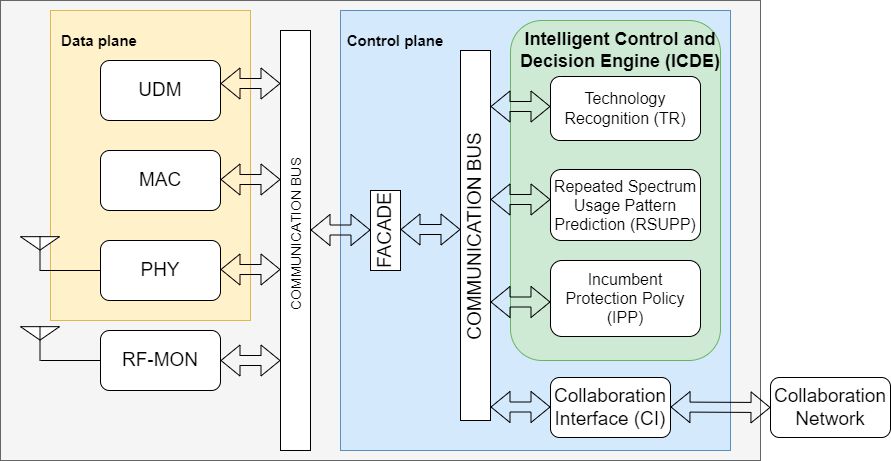
Image 1: A simplified representation of the SCATTER architecture and the sub-modules of the Intelligent Control and Decision Engine (ICDE), which contains the components for SCATTER's established protection system.
(Image:imec)
Image 1 shows a simplified view of the SCATTER architecture with six of its key components:
The physical layer (PHY) is implemented as a software-defined radio (SDR) and has functions such as OFDM waveform (Orthogonal Frequency Division Multiplexing), burst transmission, two simultaneous physical layers, FPGA-based filtered transmission, out-of-band full-duplex operations, and layer configuration based on timed commands.
The MAC layer (Medium Access Control) is based on an extended MF-TDMA scheme (Multi-Frequency Time-Division Multiple Access) that divides the band capacity both in time and frequency.
The User Data Management (UDM) layer checks and reports information about incoming traffic from the user/application area during runtime.
The Radio Frequency Monitor (RF-MON) is an FPGA-based module for spectrum monitoring.
The Collaborative Interface (CI) enables communication between the SCATTER CIRN, the protected established operators, and other CIRNs via a precisely defined cooperation protocol or corresponding language. It serves to send and receive data about the location, the actual and predicted frequency usage, performance metrics, reports on the established operator's performance measurement, etc.
The Intelligent Control and Decision Engine (ICDE) controls and optimizes the performance of the radio network through a combination of rule-based and AI-based algorithms. It uses information such as the spectrum patterns of the RF-MON, the status of the slot assignment and link statistics of the MAC layer, traffic flow information from the UDM and reports generated by the AI. After combining and processing the data from these sources, the ICDE module intelligently and dynamically adjusts the radio parameters at various levels to improve performance, increase spectrum efficiency, and work with other networks to optimize the shared use of the spectrum.
AI system for detecting and predicting established transmission systems
To detect and identify radio technologies and make informed decisions optimising the use of the spectrum, SCATTER radio systems utilise a unique, self-learning AI engine that builds on two sub-modules within the ICDE.
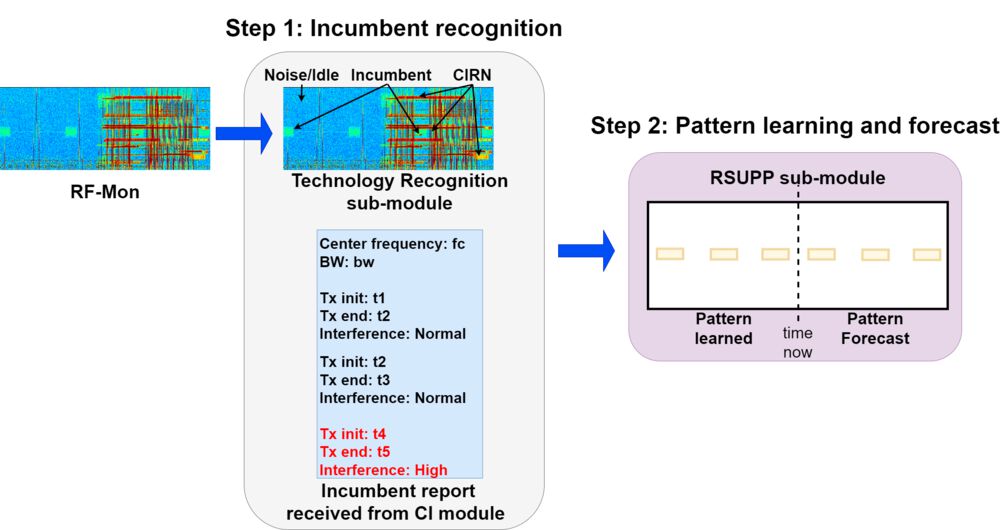
The first submodule, known as technology recognition (TR), detects and distinguishes between the spectral signatures of different radio technologies and idle noise. It takes a continuous stream of spectral data captured by the SCATTER RF-MON module and outputs whether a technology is present in a specific spectral voxel (i.e., a geometric depiction of the spectrum - considering elements such as time, frequency, location, and power).
The second sub-module, Repeated Spectrum Usage Pattern Prediction (RSUPP), uses an algorithm to learn and predict the patterns of established transmissions in real time.
Image 2: SCATTER's two-stage algorithmic approach to protect established companies.
(Image:Imec)
Image 2 shows how these two submodules interact to form SCATTER's unique, two-stage algorithmic approach. In the first step, the spectrum data – originating from the RF-MON module – is processed by the TR module to identify the established transmissions in its surroundings. This information is then used to create a binary 2D grid where the spectrum voxels are marked in which the established transmitter was recognized. This grid is then forwarded to the RSUPP submodule for the second step, in which the RSUPP algorithm learns all the periodic patterns of the established provider and uses them to predict (and protect) future transmissions.
Specially designed CNN for short training times and fast predictions
In order for CIRNs to unleash their magic (i.e., identify established transmissions, understand their patterns, and quickly respond to dynamic changes), time is a crucial factor.
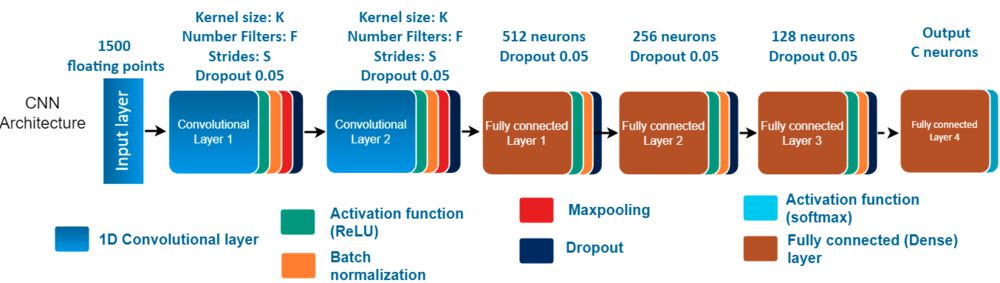
Image 3: The CNN behind SCATTER's technology detection module. It consists of three convolution layers and three dense layers and requires significantly fewer parameters to do its job. This means shorter training times and quick predictions in real-time.
(Image:imec)
Earlier research work on developing technology detection modules had already shown that existing convolutional neural network (CNN) architectures cannot classify radio signals in near-real-time (i.e., in less than a second). Therefore, the SCATTER team developed a CNN architecture that is characterized by lower complexity, improved generalization and accelerated training.
Experiments have shown that SCATTER's system – equipped with its own proprietary two-stage AI engine—successfully uses spectrum data and information from the established operator to recognize, learn, and predict its transmission patterns in near-real-time (i.e., in less than 300 ms) with an accuracy of over 95%. The latter means that in an average of 95% of cases, the established operator's traffic is correctly identified, with no interference or service interruptions.
What the Future Holds: Digital Twins, Orchestrated Intelligence, and the PPDR Opportunity
Looking to the future, the imec researchers have identified several areas of focus to advance their SCATTER research.
A branch of research is exploring the use of digital twin technology, building on imec's established expertise in this area. Digital twins provide an important platform for operators and researchers to safely test the CIRN concept before deploying it in commercial networks. In this area, for example, imec's researchers are contributing to the recently launched European project 6G-TWIN.
The management and orchestration of network intelligence is another focus area. Instead of simply distributing intelligence across the RAN and the transport network, seamless communication (and awareness) between all levels of intelligence maximizes their value. The recently completed H2020 DAEMON project focused on this issue and will continue to be researched in the context of the 6G-TWIN project.
Finally, the researchers at imec are investigating the potential of intelligent radio networks to support public protection and disaster relief services (PPDR). Given the vulnerability of today's public 4G/5G networks in emergencies, these services are heavily reliant on reliable, but limited, TETRA networks. Here too, intelligent radio networks could play a role by seamlessly integrating various network technologies, dynamically prioritizing traffic, and creating self-optimizing networks that distribute resources efficiently and can access additional spectrum when needed.
The role of 3GPP and the O-RAN ALLIANCE
So how will SCATTER and other AI-based CIRNs evolve in the future? The O-RAN ALLIANCE is well on its way to being a driving force in this area—with the support of research institutions, operators (such as AT&T, BT, Deutsche Telekom, and Orange) and telecommunications providers (including Ericsson, Nokia, and Siemens). The goal of the alliance is to improve mobile networks by making them smarter, more open, virtualized, scalable, and fully interoperable. It builds on the foundation of the 3GPP mobile standardization body, but emphasizes the need for new features and open, interoperable interfaces.
In particular, the RAN Intelligent Controller (RIC) is a key component that will support the automation and optimization of the radio network proposed by the alliance. It improves the RAN by introducing intelligence, flexibility, and programmability. These capabilities, for example, enable the development and deployment of third-party software applications that monitor user traffic and make intelligent, informed decisions on different time scales (real-time, near real-time, and non real-time) using an open framework that prevents binding to a specific provider.
The O-RAN ALLIANCE states that the RIC will help service providers have more control over their RANs and the spectrum being used, by deploying tailored AI algorithms. This should, in turn, translate into a better quality of experience.
In other words, thanks to initiatives like O-RAN, the recent advancements in intelligent radio research, such as SCATTER, can now be leveraged. In fact, we see today that 3GPP has already begun incorporating intelligent RAN components/functions into its upcoming releases. This development should not come as a surprise, as the transition to an intelligent radio architecture based on AI-driven CIRNs is ultimately in the best interest of mobile network operators. (kr)
*Miguel Camelo researches at IDLab, an imec research group, in cooperation with Ghent University and the University of Antwerp (Belgium). He was part of the SCATTER team that participated in the DARPA SC2 competition.



:quality(80)/p7i.vogel.de/wcms/40/c5/40c5051cebdb10fdee9a283303434d9d/0129881741v1.jpeg "3D-printed tools and other components contribute to energy-saving, precise processes. (Image:Gerhard Schubert GmbH)")
:quality(80)/p7i.vogel.de/wcms/e5/fa/e5fa9fa2e3b44ee1894fdf95bbe828fe/0129904146v1.jpeg "Airports and other critical infrastructure in Europe are to be better protected against drones. (Picture: ©assetseller - stock.adobe.com)")
:quality(80)/p7i.vogel.de/wcms/ae/bd/aebda515c684825e97579175874ea6bd/0129920231v1.jpeg "Hensoldt, a sensor specialist for critical defense applications among other things, now has a strategic milestone ahead of it. The company is planning to acquire Nedinsco, an optronics company from Venlo in the Netherlands. Here's what's to come ... (Image:Hensoldt)")
:quality(80)/p7i.vogel.de/wcms/c3/6f/c36f031df46d22615d941d077d32313c/0129800025v1.jpeg "The laser-assisted process is intended to make wafer cutting significantly more productive. (Image:Trumpf)")
:quality(80)/p7i.vogel.de/wcms/e8/dc/e8dc27a8d9fba8fbd081987400bf6848/0127426198v1.jpeg "3D FEM models are detailed, large and computationally intensive. Thanks to ROM and the support of Cadfem, Wago has succeeded in setting up an e-shop for thermal simulation. (Image:WAGO)")
:quality(80)/p7i.vogel.de/wcms/9c/ac/9cac6246660e746c5a3989399ac4d250/0128561645v1.jpeg "Artificial intelligence can drive efficiency in smart factories through centralized data management and predictive maintenance. (Picture: ©Fardived - stock.adobe.com)")
:quality(80)/p7i.vogel.de/wcms/6b/e2/6be235b5ad8a442ccd9d164b0b300d8b/0129763992v1.jpeg "As early as 2020, the Zimmer Group announced that it would convert its production to be sustainably CO2-neutral. (Image:Zimmer Group)")
:quality(80)/p7i.vogel.de/wcms/d4/ba/d4bab9481e66f8570f40eb8ef2a90198/0129795613v1.jpeg "A camera inspection during removal ensures that the components are placed correctly in the KLTs. (Image:Yaskawa Europe)")
:quality(80)/p7i.vogel.de/wcms/76/81/7681b6450512b2cce1e453cd3d732543/0129479309v1.jpeg "Symbolic image: Model-based design combines virtual system models with real machines and systems in order to simulate, validate and coordinate functions, control and software early on in the development process. (Image:Dall-E / AI-generated)")
:quality(80)/p7i.vogel.de/wcms/5c/0f/5c0fee074c4b6c8e8c0993f3217c2f5a/0129773718v1.jpeg "The General Fusion demonstration reactor. (Image:General Fusion)")
:quality(80)/p7i.vogel.de/wcms/b5/5e/b55ed9355e0395ec0caf111d6af6b494/adobestock-495980372--c2-a9-20natali-mis-20-e2-80-93-20stock-adobe-com-6720x3778v1v1.jpeg "Which engineering skills will be in vogue in 2026? (Image:natali_mis - stock.adobe.com)")
:quality(80)/p7i.vogel.de/wcms/bf/a5/bfa5d882e93f159ce93e933742272b00/nord-vibn-cmyk-2196x1235v1v1.jpeg "With digital twins for virtual commissioning, Nord supports customers in ensuring that systems are available more quickly, even with complex drive systems. (Image:Nord Drivesystems)")
:quality(80)/p7i.vogel.de/wcms/e4/01/e40186c9a7d04cbecb20fab20ff79094/0129886097v1.jpeg "Skoda has inaugurated a new battery plant in Mlada Boleslav to meet rising demand, but also to reduce battery costs by 30 percent. (Image:Skoda)")
:quality(80)/p7i.vogel.de/wcms/74/7b/747b6bc4d758c5dd4b5c24a763ae493d/0129897614v1.jpeg "Huawei Intelligent Automotive Solutions has presented a lidar with a resolution of 896 lines. (Image:HIMA via ChinaEVHome)")
:quality(80)/p7i.vogel.de/wcms/ba/b7/bab7bfd052f35da3c39388508faa350e/0129851977v1.jpeg "The third generation of the Mazda CX-5 scores above all with its inner values. (Image:Mauritz - VCG)")
:quality(80)/p7i.vogel.de/wcms/81/24/8124e33f53ec73fa99374f407cc11b61/0129727992-541x304v1v1.jpeg "The development of control elements and HMI systems for commercial vehicles can lead to interactions. (Image:Preh / AI-generated)")
:quality(80)/p7i.vogel.de/wcms/8b/46/8b46730ba87a86f16d696f043cf0e3d1/0129887022v1.jpeg "Linyi Yunchuan's S2000 platform has risen to a height of two kilometers and fed the energy generated into the grid. (Image:Linyi Yunchuan)")
:quality(80)/p7i.vogel.de/wcms/92/f8/92f8bf81914500bcda78f63dab8da720/0129926751v1.jpeg "Only recently, the US government allowed high-end chips for AI such as Nvidia's H200 series (pictured) to be exported to China under certain conditions. But now the tax is being pulled back all the harder: An eDraft envisages tighter controls on the export of hardware for AI technologies worldwide. Even allies would be affected. (Image:Nvidia)")
:quality(80)/p7i.vogel.de/wcms/84/cc/84cc506003388ecffaab464677c7afa6/0129843694v1.jpeg "Launched last year, ASML's TWINSCAN XT:260 is an i-line scanner with a throughput of 270 wafers per hour. With a focus on the increased demands of AI chips, ASML wants to shift its focus away from pure front-end tools for chip production in the next ten to fifteen years with packaging and bonding technologies. (Image:ASML)")
:quality(80)/p7i.vogel.de/wcms/8f/48/8f48b0ed0d6c5c4f299b1310a7b577e9/0129830738v1.jpeg "Data centers in orbit are indeed dreams of the future, while data centers under water are already being tested. (Image:Dall-E / AI-generated)")

:quality(80)/p7i.vogel.de/wcms/c0/07/c0075ae9e67a44213268e57263b0f5f8/0124407908v1.jpeg "High frequency technology: New filter system for radio signals (Image:Nagoya Institute of Technology)")
:quality(80)/p7i.vogel.de/wcms/33/3b/333ba42d70724fd60e6c2c5d28207d7c/0127301607v1.jpeg "The communication of IoT devices via standard mobile communication protocols by satellite is possible. (Image:Sateliot)")