China's Automakers "Do it Themselves"Chip War in the Cockpit: China Builds its Own, Xiaomi is Now on Board
From
Henrik Bork
| Translated by AI
5 min Reading Time
China's car manufacturers say they have "no other choice". They have to build their own car chips. Lei Jun, the founder of the electronics manufacturer Xiaomi, which is now also building electric cars, recently put it exactly this way.
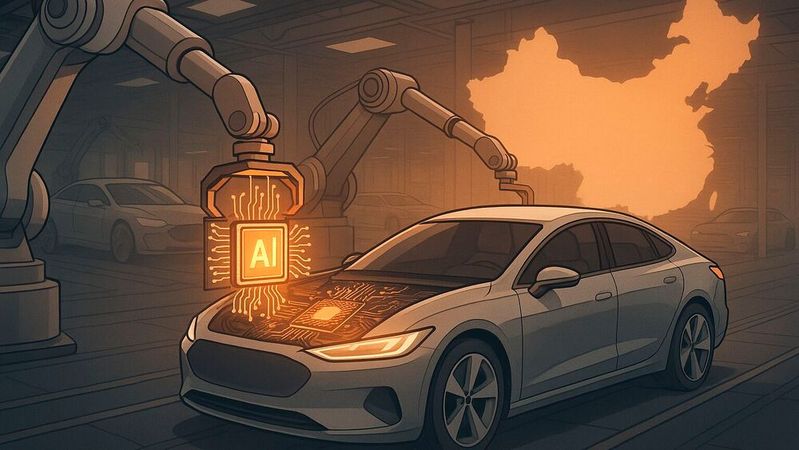
In China, more and more car manufacturers are developing their own chips to circumvent US embargoes and supply chain uncertainties.
(Image: Dall-E / AI-generated)
"As for the battle over chips, we have no other choice," Lei wrote last May in a post for his millions of followers on China's social media. At the same time, he announced that Xiaomi's first self-developed car chip would be unveiled "soon." He did not yet provide details on the architecture or its purpose—whether for autonomous driving or infotainment. However, this places Xiaomi among a growing group of automakers breaking away from Western chip manufacturers.
Nio, Xpeng, and Li Auto have been working for years on developing their own automotive semiconductors. "Go solo" is definitely the answer for some Chinese automakers, writes the Chinese specialist portal 36kr. That this trend is now accelerating further has two main reasons. In-house development is, on the one hand, the Chinese companies' response to the U.S. chip export controls.
In Washington, elected representatives have been busy for several years denying China access to high-end semiconductors, primarily those that are AI-capable. Nvidia is already prohibited from delivering many of its best chips to China, losing more and more market share there. And just at the beginning of this month, the latest tightening in a long list of export controls from the U.S. towards China came into effect. New restrictions on the delivery of EDA software for chip design to China have come into force, reports the Financial Times.
Here Again: Embargoes Do Not Ignite Properly
What the increasingly intense American attempt to cut China off from modern chip and AI technology has been causing for several years now is becoming very clear in the automotive industry. Jensen Huang, the CEO of American chip manufacturer Nvidia, has recently put it very vividly.
Washington's export controls have failed, Huang said during a visit to Taiwan in May. They have given Chinese companies "the spirit, energy, and government support" they need "to accelerate their own development," according to the Nvidia CEO. It is a misconception to think that Chinese industries can be kept away from modern chips. "If they don't have enough Nvidia, they will use their own," the New York Times quotes Huang from Taipei.
On the other hand, and this is the second reason why China's automakers believe they have "no other choice," delivery difficulties from Nvidia have also contributed to the Chinese do-it-yourself efforts. Technical difficulties had repeatedly delayed the delivery of Nvidia's Thor chip. "Thor is now so delayed that competitors' chips are already available," writes 36Kr. Nio and Xpeng have since removed Thor from their strategies; the risk is too great that planned models will falter due to chip supply issues.
The China Association of Automobile Manufacturers also recommended in a public statement "caution when purchasing American chips," reports the Chinese automotive portal Gasgoo.
Supply Chain Security for Market Dominance
The last thing Chinese automakers can afford in the face of very tough competition in the domestic and international car markets is uncertainties in supply chains, whether caused by political activism or manufacturers' delivery bottlenecks. China is therefore reluctantly relying on costly, yet promising a certain degree of autonomy over the product pipeline, self-development of car chips.
Nio has now installed its Shenji NX9031, based on a five-nanometer process, in several models such as the ET9, ES6, or EC6. The chip replaces the function "of four conventional smart-driving chips," said William Li, chairman and CEO of Nio, to CNEVPOST. This not only saves costs but also achieves significantly better integration into its own operating system, SkyOS. For the Nvidia founder, it must be painful to remember that Nio originally wanted to use Nvidia chips.
Date: 08.12.2025
Naturally, we always handle your personal data responsibly. Any personal data we receive from you is processed in accordance with applicable data protection legislation. For detailed information please see our privacy policy.
Consent to the use of data for promotional purposes
I hereby consent to Vogel Communications Group GmbH & Co. KG, Max-Planck-Str. 7-9, 97082 Würzburg including any affiliated companies according to §§ 15 et seq. AktG (hereafter: Vogel Communications Group) using my e-mail address to send editorial newsletters. A list of all affiliated companies can be found here
Newsletter content may include all products and services of any companies mentioned above, including for example specialist journals and books, events and fairs as well as event-related products and services, print and digital media offers and services such as additional (editorial) newsletters, raffles, lead campaigns, market research both online and offline, specialist webportals and e-learning offers. In case my personal telephone number has also been collected, it may be used for offers of aforementioned products, for services of the companies mentioned above, and market research purposes.
Additionally, my consent also includes the processing of my email address and telephone number for data matching for marketing purposes with select advertising partners such as LinkedIn, Google, and Meta. For this, Vogel Communications Group may transmit said data in hashed form to the advertising partners who then use said data to determine whether I am also a member of the mentioned advertising partner portals. Vogel Communications Group uses this feature for the purposes of re-targeting (up-selling, cross-selling, and customer loyalty), generating so-called look-alike audiences for acquisition of new customers, and as basis for exclusion for on-going advertising campaigns. Further information can be found in section “data matching for marketing purposes”.
In case I access protected data on Internet portals of Vogel Communications Group including any affiliated companies according to §§ 15 et seq. AktG, I need to provide further data in order to register for the access to such content. In return for this free access to editorial content, my data may be used in accordance with this consent for the purposes stated here. This does not apply to data matching for marketing purposes.
Right of revocation
I understand that I can revoke my consent at will. My revocation does not change the lawfulness of data processing that was conducted based on my consent leading up to my revocation. One option to declare my revocation is to use the contact form found at https://contact.vogel.de. In case I no longer wish to receive certain newsletters, I have subscribed to, I can also click on the unsubscribe link included at the end of a newsletter. Further information regarding my right of revocation and the implementation of it as well as the consequences of my revocation can be found in the data protection declaration, section editorial newsletter.
The same was true for Xpeng. The Chinese electric car startup had hoped for Nvidia, but then designed its own Turing chip, equipped with two specially developed neural cores. According to the company's own statements, the chip achieves a computing power of about 700 TOPS—comparable to the latest generation of Nvidia's Thor chips, which, after multiple delays, could finally be delivered in a slimmed-down version.
At the same time, Chinese automakers are practicing innovations regarding their car chips. They are striving to circumvent the limitations of edge computing and bring the power of LLM into the car. This aims to translate human-like "common sense" decisions into concrete driving instructions, such as a lane change or the use of brakes. "If we rely solely on vehicle computing, we reach limits," said Xpeng's autonomy chief Li Liyun at a technical briefing in April, reports 36Kr.
Distilled AI Models for the Car
Xpeng is now trying a hybrid strategy: large AI models with up to 72 billion parameters are trained in the cloud and then distilled down to smaller models for vehicle deployment. The Turing chip then processes these locally in the vehicle. Initial tests with this system architecture are said to have been "surprisingly powerful," according to the company.
Meanwhile, the newly joined "do-it-yourself" chip manufacturer in the Chinese automotive industry, Xiaomi, which has also just introduced its new smartphone chip "Xring O1", relies on the Taiwanese contract manufacturer TSMC for chip production. This follows the same path as Apple and Nvidia. However, according to a report by TrendForce, Xiaomi uses U.S. EDA software for its internal design processes, which now fall under export controls. Access to these tools is uncertain in the future, which could also affect Xiaomi's car chip plans, according to the specialist publication.
Nevertheless, Lei Jun is showing a fighting spirit. Xiaomi plans to invest at least 50 billion yuan (around 6.5 billion US dollars) in chip development over the next ten years, he announced. This year alone, it will be over six billion yuan, about 790 million US dollars. Xiaomi has a R&D team with 2,500 employees.
The Government Supports the Ambitions
The Chinese government supports these efforts. The state broadcaster CCTV referred to Xiaomi's announcement of its latest smartphone chip as a "breakthrough," showing that private companies in China are also able to achieve technological sovereignty. Of course, by using their own chips, Chinese automakers not only increase their response speed but also their margin. Nio, for example, was able to replace the use of four Nvidia Orin-X chips with two of its own, as its founder claims, aiming to achieve cost reduction noticeable in the price competition on the domestic market.
The shift towards Chinese chip autonomy in the automotive industry is happening rapidly. "Decoupling begins: Xpeng introduces Turing AI chip in the second quarter and reduces dependence on Nvidia" was the headline recently on the CarNewsChina portal. Tesla demonstrated to Chinese automakers with its "Full Self Driving" architecture how far vertical integration can go. Now, out of necessity, the Chinese are following suit with their own operating systems, data platforms, and AI models. One consequence is that they will need to order less from the Western abroad in the future. (sb)
Future-Proof Authentication with Universal RFID Readers



:quality(80)/p7i.vogel.de/wcms/21/b6/21b61c2ac1df28254fb0dad1574fb2d7/0132853015v1.jpeg "The rose-gold, TiAlSiN-based coating material InoxaCon contributes significantly to the stability and service life of HPTec's new RQR-350 milling tool. It enables safe and efficient automated processes in the manufacturing of surgical instruments. (Image:Cemecon)")
:quality(80)/p7i.vogel.de/wcms/d2/73/d273374d6347651e4e6200cf6061ea4e/0132860560v1.jpeg "Even in July, the flag of the Chinese economy did not flutter particularly briskly in the air. Read here what’s happening and why production in China is apparently declining ... (Image:AI-generated)")
:quality(80)/p7i.vogel.de/wcms/18/47/1847f131e3afda201d1dbb98ad0ecb04/0132826776v1.jpeg "Image 1: Difender armored steels from Dillinger stand out with top scores in ballistic testing and cold bending. Defense companies therefore readily choose them. They can be found, for example, in the armored vehicles Fuchs and GTK Boxer of the German Armed Forces. (Image: Dillinger)")
:quality(80)/p7i.vogel.de/wcms/1e/7d/1e7d651782e0e97b3efc25abf2b52350/img-3485v1.jpeg "The Siemens Energy employees attach balancing weights at the precisely calculated and adjusted angular position to achieve the best possible result. (Source: Schenck Rotec)")
:quality(80)/p7i.vogel.de/wcms/a7/38/a73840cb81da9dc3c503f4c04bf66b96/0132892768v1.jpeg "Unitree's IPO symbolizes the high expectations for humanoid robots and embodied AI. (Image:Dall-E / AI-generated)")
:quality(80)/p7i.vogel.de/wcms/1c/a5/1ca5e3ef5d834c3a42de8909c872e3c6/0132876444v1.jpeg "The autonomous transport system Active Shuttle marketed by Bosch Rexroth has been sold to Neura Robotics. (Image:Bosch Rexroth)")
:quality(80)/p7i.vogel.de/wcms/30/1a/301a1aa59e093d848b69e9ff7006b83e/image1v1.jpeg "Wireless switching devices offer advantages in numerous industrial applications – wherever wired communication reaches its limits (Image: Steute) (Image:)")
:quality(80)/p7i.vogel.de/wcms/a2/85/a285b12508af812e28b17be3482a736c/0132488872v1.jpeg "NIS2 is no longer an abstract requirement in the distant future for many industrial companies. (Image:AI-generated)")
:quality(80)/p7i.vogel.de/wcms/41/fc/41fc456ff1ff8f30807924663e8df127/img-0942v1.jpeg "In industrial additive manufacturing, the production strategy must influence the design from the very beginning. (Source: Materialise)")
:quality(80)/p7i.vogel.de/wcms/44/fe/44fe86a16c26c09bb363b3671bf0b930/0132847771v1.jpeg "CoreTechnologie (CT) points out that the 3D printing software 4D_Additive has been equipped with additional application possibilities. Here you can learn more about what the new version 1.8 can do – such as generating complex lattice structures or optimizing faulty data ... (Image:CT)")
:quality(80)/p7i.vogel.de/wcms/b4/f2/b4f2c272247f79c5e87334a6839f20cb/0132549860v1.jpeg "Morefire analysis: Many mechanical engineering websites focus on technical specs instead of customer benefits. Translating features into clear benefits increases visibility, inquiries, and competitiveness. (Image: ©peopleimages.com - stock.adobe.com)")
:quality(80)/p7i.vogel.de/wcms/b4/9a/b49aaad0500e06e253f7d75ecb77338a/adobestock-4840668--dani-kreienb-hl-stock-adobe-comv1.jpeg "Metal processing in 2026 will be more digital, automated, and data-driven – but not automatically easier. (Image:© Dani Kreienbühl - stock.adobe.com)")
:quality(80)/p7i.vogel.de/wcms/5b/88/5b88d94e6a43f2b857462cd1921f7386/0132281427v1.jpeg "The eTurbo solves a well-known turbocharger problem: by combining an exhaust gas turbocharger and a permanently excited synchronous motor into a highly integrated core assembly, the compressor achieves sufficient speed even when the exhaust energy is actually not yet sufficient. (Image: BorgWarner)")
:quality(80)/p7i.vogel.de/wcms/75/fe/75feffb63bc6275786606d78a8d797c4/0132901853v1.jpeg "Steyr Motors reports similar business results as last year. Here you can learn more about the details of the Austrian company's situation ... (Image:E-Steyr)")
:quality(80)/p7i.vogel.de/wcms/57/d2/57d2b75d884c18866b46e776126fb46b/org-blobs-user-response-file-output-dac07b02-0e97-4452-9a3a-26528da583b3-file-1787126178766-jpgv1.jpeg "The memory manufacturer CXMT has had an extremely successful IPO. Among the investors are several car manufacturers. (Image:KI-generiert)")
:quality(80)/p7i.vogel.de/wcms/d0/68/d0681c9d26012538a22ff5c103429612/0132875205v1.jpeg "Electric vehicles: Structure of the zone architecture in a modern vehicle. (Image:TI)")
:quality(80)/p7i.vogel.de/wcms/22/82/22826566c11220ed61efac5982fb94a2/0132896083v1.jpeg "Electrodes made from paper and copper paste deliver comparable signal quality to the established gold standard. They perform significantly better in all environmental impact analyses. (Image:Screentec)")
:quality(80)/p7i.vogel.de/wcms/c4/9f/c49f5b8173f678f7ef071355b1fbbd7c/yamu-jay-ai-generated-9088888v1.jpeg "As part of a strategic partnership, Siemens and Reinhausen are advancing the future of energy supply solutions for AI data centers. (Symbol image) (Source: pixabay / AI-generated)")
:quality(80)/p7i.vogel.de/wcms/28/20/28204a4592a69a8682bfbf9a8f7e1dc2/0132846993v1.jpeg "The health status of a lithium-ion battery changes with increasing aging. AI models can utilize characteristic changes in the charge and voltage curves to estimate the state of health. (Image:freely licensed)")
:quality(80)/p7i.vogel.de/wcms/90/dc/90dc332e30a3e4bd3ff77646ed0633b7/0132833369v1.jpeg "Through a compromised repository of the widely used open-source tool LiteLLM, attackers were able to capture several terabytes of data and login credentials. Security company CloudSEK concludes, after analyzing the data, that the attack conducted in March of this year affected more than 2,000 companies, including major players like Microsoft, Nvidia, AWS, and Deutsche Bahn. (Image:freely licensed)")
:quality(80):fill(efefef,0)/p7i.vogel.de/wcms/67/ae/67ae0b9ac31f8/elatec-wp-universal-reader.png "Elatec WP Universal Reader")
:quality(80)/p7i.vogel.de/wcms/93/4d/934de334b47abaa526c78cba1417d7af/0130343495v1.jpeg "The new SU7 is available in three price categories, \"Standard\", \"Pro\" and \"Max\" (Image:Xiaomi)")
:quality(80)/p7i.vogel.de/wcms/ea/f1/eaf1aacb9e64448e7539f15d7fbd33ee/screenshot-202025-11-20-20carizon-2112x1188v1v1.png "In the gray casing is a complete computer system. VW intends to develop such a system-on-chip internally (screenshot from the website). (Image:Carizon)")